Author Archive
-
The Battle at Ebix
Eddy Elfenbein, May 7th, 2013 at 3:56 pmThere’s an interesting battle going on at the company Ebix ($EBIX). Goldman Sachs recently offered to buy the company for $20 per share and the board said yes. Some shareholders are fighting back claiming the price is far too low. I have to agree. The price is too low.
Even putting the valuation argument aside, there should be far greater pushback from investors on these types of mergers. I don’t believe the majority of acquisitions are to the benefit of shareholders (for either party). The Sprint-Dish merger seems to be an obvious mistake. With Ebix, they have to wait 45 days for a counter-offer. I doubt one will come. Who wants to piss off Goldman?
The Ebix story gets more interesting because the company is being investigated the SEC due to “accounting issues.” Yeah, that’s not good.
Interestingly, the first event that took down shares of Ebix was a posting at Seeking Alpha two years ago under the name Copperfield Research. Since then, it’s been one long headache for Ebix. There have been accusations and denials, and I can’t keep it straight.
Sorry to sound conspiratorial, but this sounds like a good time for a board to sell out at any price. If Ebix is private, then who cares about their accounting, right? My assumption is that Goldman is a lot less dumb than they are evil.
-
Note to Some Intrepid Journalist
Eddy Elfenbein, May 7th, 2013 at 2:58 pmIt’s not exactly a secret that Janet Yellen will most likely become the next chairman (chairperson?) of the Federal Reserve. Yellen has a long and distinguished career which includes stints at the Fed, the Council of Economic Advisors and many years in academia, first at Harvard and later at Berkeley. She’s also married to George Akerlof, a Nobel Prize-winning economist.
Here’s a listing of her articles and academic papers going back nearly forty years. It’s an impressive body of work. She was addressing the topic of long-term unemployment long before that became a topic of conservation among policy elites.
There is, however, one paper that Yellen wrote that seems quite different from much of her other work. In 1996, she and Akerlof wrote, “An Analysis of Out-of-Wedlock Childbearing in the United States.” I believe that’s the only time she has addressed that subject in depth.
Abstract:
This paper relates the erosion of the custom of shotgun marriage to the legalization of abortion and the increased availability of contraception to unmarried women in the United States. The decline in shotgun marriage accounts for a significant fraction of the increase in out-of-wedlock first births. Several models illustrate the analogy between women who do not adopt either birth control or abortion and the hand-loom weavers, both victims of changing technology. Mechanisms causing female immiseration are modeled and historically described. This technology-shock hypothesis is an alternative to welfare and job-shortage theories of the feminization of poverty.
At the time the paper was written, that was a hot topic. There was a lot of talk about the root causes of poverty and what to do about welfare. That year, Bill Clinton signed the Welfare Reform Act. Well, 1996 was a long time ago and now we know a lot more about effects of out-of-wedlock births.
I haven’t read the paper, but I’m curious…were they right?
-
DirecTV Crushes Earnings
Eddy Elfenbein, May 7th, 2013 at 9:58 amExcellent news today for DirecTV ($DTV). The company absolutely demolished its earnings report. For Q1, DTV earned $1.43 per share which was 33 cents better than Wall Street’s forecast. The earnings were higher than all 18 forecasts made by analysts on Wall Street. Revenues rose 7.6% to $7.58 billion which was $50 million better than estimates.
Once again, Latin America was the key to DTV’s success. Subscriber count grew by 583,000 in that region and there are now 16 million subscribers in Latin America. They’re not doing so badly in North America either. DTV added 21,000 subscribers in the U.S.
I’ve often highlighted DTV as a company that does share repurchases right. Last quarter, they bought back $1.38 billion worth of their shares. The stock closed yesterday at $57.96. It’s been as high as $61.50 this morning, which is a 6.1% gain. Right now, it’s hanging in at $60.36, which is a 4.1% gain.
-
Morning News: May 7, 2013
Eddy Elfenbein, May 7th, 2013 at 6:44 amIMF’s Lagarde Urges All Euro Members To Push For Banking Union
China Names Yuan Convertibility Plan as Goal This Year
Senate Passes Online Sales Tax 69-27 But You Can Avoid It For Now
King Coal Losing Crown as U.S. Gains Energy Independence
HSBC Says Quarterly Profit Almost Doubles on Cost-Cutting
Munich Re First-Quarter Profit Jumps Led by Reinsurance Revenue
Facebook Still Worth Probably No More Than $25 A Share: Barron’s
Commerzbank Posts Second Quarterly Loss on Staff Reductions
Baidu Buys PPS Online Video Business to Contend With Youku Tudou
YouTube Is Said to Plan a Subscription Option
Facing Black Market, Pfizer Sells Viagra on Web
DirecTV Spurns Dish’s View That Wireless Is Satellite-TV Savior
Jeweler Agrees To Plead Guilty In KPMG Insider-Trading Case
Edward Harrison: How Bond Market Vigilantes Force Rates Higher
Cullen Roche: What’s Unique About Monetary Realism?
Be sure to follow me on Twitter.
-
The Strength of Consumer Stocks
Eddy Elfenbein, May 6th, 2013 at 11:24 pmHere’s an interesting chart. This is the Morgan Stanley Consumer Index ($CMR) divided by the S&P 500.
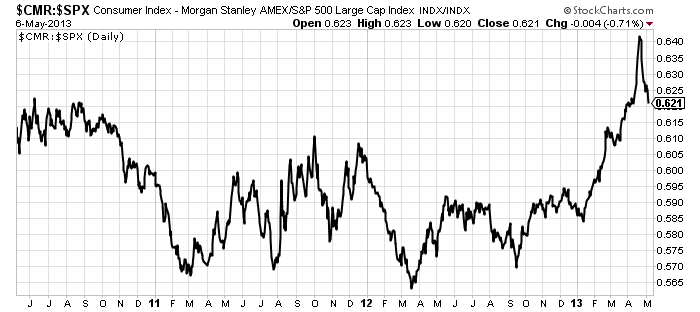
The CMR is heavily defensive although it’s not an exact match for a defensive index. The consumer names have performed very well this year, although since April 19th, their relative performance has suffered a dramatic turn back. It’s unusual, but not unheard of, for defensive stocks to lead a rally. The post-election rally seems to have continued in stride with a quick change in leadership. The change occurred just after the big plunge in gold.
-
Rewarding CEOs for Share Buybacks
Eddy Elfenbein, May 6th, 2013 at 2:45 pmFelix Salmon writes that CEOs should be rewarded for share buybacks. Leaving aside the issue of compensation, I’m not a fan of companies buying back their own shares, although I do admire a few that truly lower their outstanding shares.
I have a few issues here. One is that too many firms use share repurchases to mask their options grants. From what I see, the buybacks routinely go to executives anyway.
Felix writes, “stock buybacks are a very efficient way of returning money to shareholders,” I disagree. In theory, yes, that money goes to shareholders. But the problem is that the volatility of your average stock easily swallows up any gain an investor would see. The daily standard deviation of the Dow, which are blue chip stocks, is 45 times its daily average gain. A generous share repurchase of, say, 4% over the course of a year is a teeny blip in that kind of market action.
Felix writes:
Safeway is faced with a choice right now: it can burn billions of dollars in what would probably be a fruitless attempt to compete with Walmart, or it can return those billions to shareholders, to be reinvested in more promising areas. Safeway’s CEO should choose between those options dispassionately, rather than simply assuming that more investment is always better — and his board should compensate him in such a way that he’s incentivized to make the best decision, rather than always going for growth.
I would say that choice is for the board, with the CEO’s input, and once the strategic decision has been made, the CEO should be in charge of implementation with, of course, a fair degree of latitude.
Felix presents Safeway as having two options. As an investor (though not in Safeway), I have a third: Write me a darn dividend check! After all, who the heck is a board anyway? They work for investors. That profit is mine. Gimme gimme gimme.
Don’t worry about me, I’ll find a use for my own money. I’m pretty good at that, and if I want to buy more stock, that’s my decision, and the same for my fellow shareholders. I only wish our tax system was better aligned to help these investor-friendly decisions.
How absurd is it that Apple, a company with $145 billion in the bank, is borrowing money? It’s a crazy move but math says, do it.
A back-of-the-envelope calculation shows that Apple’s net cost of capital will be roughly just over 1.5 percent per year — pretty cheap long-term money if you can get it. But you can’t. This is a privilege reserved for the largest Silicon Valley powers only.
Apple will have a total outlay of $19.5 billion vs. the $22.95 billion it would have cost the company to bring in the $17 billion from its overseas stash, saving the company more than $3.4 billion.
-
Berkshire Hathaway Breaks $166,000
Eddy Elfenbein, May 6th, 2013 at 10:04 amIt’s a quiet morning so far for our Buy List and the broader market. The S&P 500 is currently up just one point.
Warren Buffett was in the news a lot this weekend as Berkshire Hathaway ($BRKA) held its annual conference. I see that BRKA is currently the top-performer today in the S&P 100. The shares got over $166,000. In 1990, the stock was worth a mere $5,500. When the tech bubble peaked in March 2000, BRKA was worth 30 times the S&P 500. Now it’s up to 103 times the index.
BMC Software ($BMC) has agreed to be sold for $6.6 billion. I’m surprised that the premium is so small. The stock closed Friday at $45.42 and the deal price is $46.25. I think the buyout group, led by Bain Capital and Golden Gate Capital, is getting a decent value. I would have expected this move to have some impact on Oracle ($ORCL) and CA Technology ($CA) but the market doesn’t seem terribly impressed.
Alex Sherman at Bloomberg has an interesting article on the different strategies of Dish Network ($DISH) and DirecTV ($DTV). Dish is moving in the direction of wireless content with their giant purchase of Sprint Nextel, while DTV is sticking with satellite-TV. I’m not a fan of Sprint and I think Dish made its purchase from a position of weakness, not strength.
-
Some Notes on Friday’s Market
Eddy Elfenbein, May 6th, 2013 at 9:30 amI didn’t comment on Friday’s market since the weather was so nice here in D.C. and there are better things to do than watch stock tickers go up and down.
But I want to add a few notes about Friday’s big move. Thanks to the good jobs report, the market closed at yet another all-time high. The Dow broke 15,000 and the S&P broke 1,600. The rally since November has been very impressive.
Cognizant Technologies ($CTSH) was our big winner on Friday. The stock gained 3.5% and has made back much of what it lost. Earnings are due out this week.
Shares of Ford Motor ($F) got up to $13.83 which is the highest since January. Both Microsoft ($MSFT) and AFLAC ($AFL) hit fresh 52-week highs. Nicholas Financial ($NICK) spiked up to $15.13 in the morning before pulling back. Earnings are also due out soon. The only weak spot was Bed Bath & Beyond ($BBBY). The stock was downgraded by Oppenheimer.
-
Morning News: May 6, 2013
Eddy Elfenbein, May 6th, 2013 at 7:45 amFrance Declares Austerity Over as Germany Offers Wiggle Room
E.U. Rules Against Patent Play by Google’s Motorola Unit
Slovenia Falls From Economic Grace, Struggling to Avert a Bailout
Indonesia GDP Growth at Slowest in Over Two Years on Exports
Housing Crash Fades as Defaults Decline to 2007 Levels
Will Verizon Borrow Billions to Become the Biggest?
Bain, Golden Gate near $6.5B deal for BMC
Intel to Buy Finland’s Stonesoft for $389 Million in Cash
GM China April Sales Accelerate as Toyota Extends Decline
Apple Misses IPhone Customers as Global Carriers Balk
Credit Suisse Accuses Goldman Sachs Hire of Secrets Theft
JPMorgan Shareholders Urged to Reject 3 Directors
Occidental’s Chazen Free for Breakup Swan Song as Chairman Out
Joshua Brown: Leon Black is Selling Everything Not Nailed Down
Jeff Miller: Weighing The Week Ahead: New Leadership For Stocks?
Be sure to follow me on Twitter.
-
Dow 15,000
Eddy Elfenbein, May 3rd, 2013 at 10:25 amIt just happened.
The Dow first closed above 150 on October 20, 1925, and above 1,500 on December 11, 1985.
-
Archives
- June 2026
- May 2026
- April 2026
- March 2026
- February 2026
- January 2026
- December 2025
- November 2025
- October 2025
- September 2025
- August 2025
- July 2025
- June 2025
- May 2025
- April 2025
- March 2025
- February 2025
- January 2025
- December 2024
- November 2024
- October 2024
- September 2024
- August 2024
- July 2024
- June 2024
- May 2024
- April 2024
- March 2024
- February 2024
- January 2024
- December 2023
- November 2023
- October 2023
- September 2023
- August 2023
- July 2023
- June 2023
- May 2023
- April 2023
- March 2023
- February 2023
- January 2023
- December 2022
- November 2022
- October 2022
- September 2022
- August 2022
- July 2022
- June 2022
- May 2022
- April 2022
- March 2022
- February 2022
- January 2022
- December 2021
- November 2021
- October 2021
- September 2021
- August 2021
- July 2021
- June 2021
- May 2021
- April 2021
- March 2021
- February 2021
- January 2021
- December 2020
- November 2020
- October 2020
- September 2020
- August 2020
- July 2020
- June 2020
- May 2020
- April 2020
- March 2020
- February 2020
- January 2020
- December 2019
- November 2019
- October 2019
- September 2019
- August 2019
- July 2019
- June 2019
- May 2019
- April 2019
- March 2019
- February 2019
- January 2019
- December 2018
- November 2018
- October 2018
- September 2018
- August 2018
- July 2018
- June 2018
- May 2018
- April 2018
- March 2018
- February 2018
- January 2018
- December 2017
- November 2017
- October 2017
- September 2017
- August 2017
- July 2017
- June 2017
- May 2017
- April 2017
- March 2017
- February 2017
- January 2017
- December 2016
- November 2016
- October 2016
- September 2016
- August 2016
- July 2016
- June 2016
- May 2016
- April 2016
- March 2016
- February 2016
- January 2016
- December 2015
- November 2015
- October 2015
- September 2015
- August 2015
- July 2015
- June 2015
- May 2015
- April 2015
- March 2015
- February 2015
- January 2015
- December 2014
- November 2014
- October 2014
- September 2014
- August 2014
- July 2014
- June 2014
- May 2014
- April 2014
- March 2014
- February 2014
- January 2014
- December 2013
- November 2013
- October 2013
- September 2013
- August 2013
- July 2013
- June 2013
- May 2013
- April 2013
- March 2013
- February 2013
- January 2013
- December 2012
- November 2012
- October 2012
- September 2012
- August 2012
- July 2012
- June 2012
- May 2012
- April 2012
- March 2012
- February 2012
- January 2012
- December 2011
- November 2011
- October 2011
- September 2011
- August 2011
- July 2011
- June 2011
- May 2011
- April 2011
- March 2011
- February 2011
- January 2011
- December 2010
- November 2010
- October 2010
- September 2010
- August 2010
- July 2010
- June 2010
- May 2010
- April 2010
- March 2010
- February 2010
- January 2010
- December 2009
- November 2009
- October 2009
- September 2009
- August 2009
- July 2009
- June 2009
- May 2009
- April 2009
- March 2009
- February 2009
- January 2009
- December 2008
- November 2008
- October 2008
- September 2008
- August 2008
- July 2008
- June 2008
- May 2008
- April 2008
- March 2008
- February 2008
- January 2008
- December 2007
- November 2007
- October 2007
- September 2007
- August 2007
- July 2007
- June 2007
- May 2007
- April 2007
- March 2007
- February 2007
- January 2007
- December 2006
- November 2006
- October 2006
- September 2006
- August 2006
- July 2006
- June 2006
- May 2006
- April 2006
- March 2006
- February 2006
- January 2006
- December 2005
- November 2005
- October 2005
- September 2005
- August 2005
- July 2005
 Eddy Elfenbein is a Washington, DC-based speaker, portfolio manager and editor of the blog Crossing Wall Street. His