Author Archive
-
Intel Is Back Where It Was in 1997
Eddy Elfenbein, November 14th, 2012 at 1:10 pmYesterday, I highlighted Microsoft ($MSFT) and its relatively cheap valuation. Today I want to look at a stock that’s often paired with Microsoft: Intel ($INTC). The stock has been doing terribly lately. Shares of Intel are at a fresh 52-week low today. In May, Intel was over $29 and today the stock nearly broke below $20 per share. The stock first broke above $20 in early 1997. That was the same year that Intel’s CEO, Andy Grove, was named Time’s “Man of the Year.”
Intel’s last earnings report wasn’t terribly good, but Wall Street’s expectations were even worse. For Q3, the company earned 58 cents per share which was eight cents better than estimates. Earnings were down 11% from the same period one year before. Sales were down by 5%.
After exceeding analysts’ expectations following the 2007-2008 financial crisis, the company’s sales in recent months have slowed as demand for its microchips has weakened. Fearing the trend could continue, several analysts last week cut their estimates of the chipmaker’s financial prospects, sending its stock price to its lowest level in a year.
While the sluggish worldwide economy has contributed to Intel’s troubles, a more fundamental worry is its dependence upon personal computers. Its brainy microprocessors power about 80 percent of PCs, whose sales have dwindled as consumers have turned to smartphones and tablets. As a result, Intel is trying to get its chips into those mobile devices.
The company is beginning to have some luck in that regard. But its chips face intense competition from those using an alternative design from British firm ARM Holdings. Traditionally consuming less energy and, thus, providing longer battery life, the ARM camp dominates the mobile device market.
Even if Intel has success with its push into smartphones, the company is likely to remain so dependent on the stagnant PC market that its finances probably won’t improve much over the next 18 months, according to a note Bernstein Research sent their clients last week.
Now let’s look at some numbers. Intel currently pays a quarterly dividend of 22.5 cents per share. This was raised from 21 cents per share earlier this year. At 90 cents for the year, a $20 share price works out to a big fat yield of 4.5%.
Intel’s earnings estimates for next year have been dropping like a stone. Three months ago, the Street had been expecting 2013 earnings of $2.55 per share. Today the consensus is for $1.97 per share. By my simple valuation method, Intel has a fair value of $27.41.
-
Sysco Raises Dividend
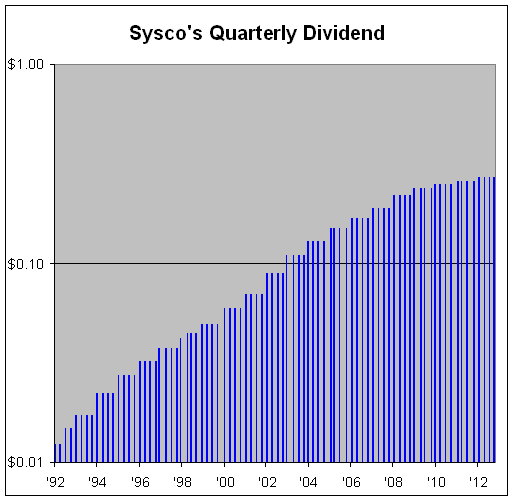
Eddy Elfenbein, November 14th, 2012 at 10:18 amSysco ($SYY) announced today that it’s raising its quarterly dividend by one penny per share. The payout rises from 27 cents to 28 cents per share. This is exactly what I predicted in the CWS Market Review from November 2nd. Sysco has now raised its dividend for 43 years in a row. Based on yesterday’s close and the new dividend, Sysco yields 3.74%.
-
Morning News: November 14, 2012
Eddy Elfenbein, November 14th, 2012 at 7:15 amEuropean Workers Stage Austerity Protests
U.K. Inflation Seen Eluding BOE Goal as Cost Increase
Italy’s Borrowing Costs Drop to Two-Year Low at Bond Auction
Brazil Retail Sales Rise For 4th-Straight Month In September
U.S. to Be World’s Top Oil Producer in Five Years, Report Says
Energy Independence in the United States? Don’t Pop the Cork Yet
Small Business Optimism Index in U.S. Rises to a Five-Month High
Buffett’s New CEO Calls Housing Gain ‘Start of Something Good’
Goldman Using Technology to Become Wal-Mart of Wall Street
Facebook Braces For Biggest Lockup Wave
Cisco Systems Is Not ‘Dead Money’
Best Buy Sets Long-Term Targets, Aims For Stable Sales
Trial to Open in $68 Million Insider Trading Case
Jeff Carter: 25% Angel Tax Credits
Credit Writedowns: Corporatism, Over-Regulation And Fully Reserved Banking
Be sure to follow me on Twitter.
-
Deep Truths about the Markets and Investing
Eddy Elfenbein, November 13th, 2012 at 11:53 amI’ve had a lot of new visitors to the site recently so I thought I’d re-run one of my favorite posts. This is a list of Deep Truths about the Markets and Investing.
In his 1988 Baseball Abstract, Bill James listed a number of lessons had had learned so far through his study of baseball statistics. In that vein, I’ll list some observations that I’ve learned over the years:
The Federal Reserve isn’t nearly as powerful as is commonly believed.
There isn’t a person or group of people in charge of the market.
There’s no such thing as a “healthy correction.”
Good stocks can go down for no reason.
Bad stocks can go up for no reason.
A trend can last much longer than you thought possible.
Stocks don’t know you own them.
The market doesn’t care about politics.
The most important variable to the stock market, by far, is the direction of long-term interest rates.
Mega-mergers rarely work.
Investment bubbles aren’t due to the moral failings of the market participants.
Ignore anyone who tells you that the Federal Reserve is a private bank.
Commodities are almost always terrible investments.
The stock market hates inflation. The only thing it hates more is deflation.
The best environment for stocks is a low stable inflation rate.
As an investment tool, P/E Ratios work much better for individual stocks than for the market as a whole.
The best three fundamental metrics are (in order) ROE, Debt Ratios and Cash Flow.
Wherever possible, seek out stocks with expanding margins.
Dividends are underrated by investors, especially companies that consistently raise them.
Portfolio diversity is overrated.
As a general rule, IPOs are a bad deal.
Boring but profitable always beats exciting and unprofitable.
CAPM and MPT are nonsense.
No one can consistently time the market. No one.
The Equity Risk Premium (over long-term debt) is probably much smaller than commonly believed.
The data showing a return premium for small-cap stocks is probably wrong.
The media never questions the bond market. Only stock investors are “greedy.”
Perma-bears are never held to account for being wrong so if you want to sound smart, be very bearish and very vague.
The market really does “climb a wall of worry.”
Follow unfollowed stocks.
The market is self-aware. Scary but true.
It’s far easier to rationalize selling than buying.
The market isn’t efficient—it can be beaten.
But it’s very, very, very, very hard.
Most technical analysis is complete garbage.
A high P/E Ratio is much better sign of a stock to sell than a low P/E Ratio is a sign to buy.
It’s pointless to measure the stock market relative to gold or in euros or pork bellies or whatever else people can come up with.
Ignore any chart that has seemingly similar lines trying to show how this market is “just like’ the one in 1831.
Except at very low levels, volatility is neutral.
Many gold bugs are quite simply fanatics.
Whatever the issue, your typical finance professor will blame the investing public and urge more self-denial as the solution. Bank on it.
Never base an investment decision of demographics.
The worst investor in the world is the guy holding on to a small loss waiting for the rally because “they don’t want to take the loss.” Again, the stock doesn’t know you own it.
Very, very few serious companies are traded on the pink sheets.
Never stress out about what a stock does after you sell it.
-
Microsoft Looks Inexpensive Here
Eddy Elfenbein, November 13th, 2012 at 11:10 amA year ago, I asked if Microsoft ($MSFT) was a value stock, and I think the answer was yes. This, of course, would have been a big shock to any investor 15 years ago. But times have changed. Unfortunately, the company has made many mistakes over the years and younger rivals are doing to them what they once did to IBM ($IBM).
One such example would be…IBM.
But as shrewd investors, we need to look past some blemishes to find true value. Oftentimes, good stocks to buy come with dents on them. The questions are, how serious are they and at what price?
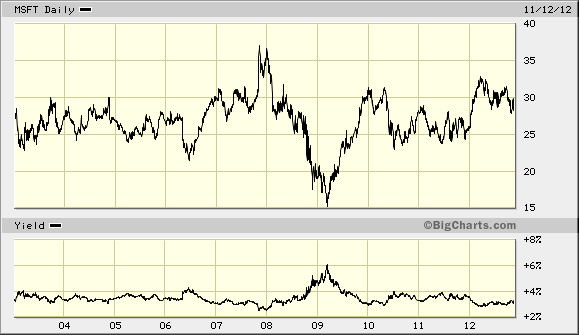
Shares of MSFT are taking a small hit today on the news that the head of Windows is out. Microsoft also had a poor earnings report a few weeks ago. The stock is currently at $27.09.
Let’s look at some numbers. Microsoft is expected to earn $3.21 per share for next year’s calendar year. Microsoft’s fiscal year ends in June, but I’m using the calendar year for easier comparisons. This means that Microsoft is going for just 8.4 times earnings while the S&P 500 is going for 12.2 times next year’s earnings. That’s a steep discount.
Meanwhile, Microsoft continues to generate strong cash flow. I really like that they bumped up their quarterly dividend by 15% (from 20 to 23 cents per share) a few weeks ago. That brings the yield up to 3.4%. Going by my simple valuation formula, Microsoft has a fair value of $40.
I can’t say that Microsoft will hit its fair value. That’s just a rough guess. The stock, of course, can keep going down. But if investors collect a diversified portfolio of several stocks going for good prices, over time, they should do well.
-
Morning News: November 13, 2012
Eddy Elfenbein, November 13th, 2012 at 7:08 amEurope Gives Greece 2 More Years to Reach Deficit Targets
Comments From EU Finance Ministers And Officials
Japan’s Economy Threatens Return To Recession
U.K. Inflation Quickens More Than Forecast on Tuition Fees
German Investor Confidence Unexpectedly Fell in November
Treasuries See U.S. Falling Over Cliff as Yields Converge
Black Thursday? Stores To Open Even Earlier On Thanksgiving.
Home Depot Profit Rises 1.4% as Customer Traffic Gains
Vodafone Falls Into Red On South Europe Writedowns
With Jefferies Deal, ‘Baby Berkshire’ Deviates From Buffett
A Dose of Realism for the Chief of J.C. Penney
D.R. Horton Tops Target And Rises, Beazer Slips
Hostess Closes Plants as Workers Strike
Joshua Brown: How the Fiscal Cliff Could Affect Families, By State
Be sure to follow me on Twitter.
-
Reynolds American’s Investors Day
Eddy Elfenbein, November 12th, 2012 at 1:32 pmReynolds American ($RAI) is holding its Investors Day today. Here’s some coverage:
Reynolds American President and CEO Daan Delen said during Investors Day presentations Monday morning that the company is focusing over the long-term on emerging smoke-free products such as snus and its new electronic cigarette Vuse that offer larger margins and greater potential for growth.
“Everything we’re working on from an innovation standpoint has a higher margin than cigarettes,” Delen said. “I think we’re very well positioned in an evolving market.”
Officials with the Winston-Salem-based tobacco company said volumes have risen this year in smoke-free categories such as moist snuff and snus, particularly among younger demographics, while cigarette volumes continue to decline.
But Delen emphasized that cigarettes are still the core focus and business for the tobacco company. He offered an internal mantra of “80/90/90,” which reflects that 80 percent of the company’s resources are still in the combustible tobacco space, 90 percent of its organizational resources focus on that area, and 90 percent of its research and development budget is centered on combustibles.
“That is the category that is still going to deliver a lot of growth in the future,” Delen said, noting that the U.S. tobacco market continues to offer about a $14 billion “profit pool,” about 85 percent of which comes from cigarettes.
But Reynolds American’s strategy on “transforming tobacco” is obvious, as Delen spent substantial time talking about other categories besides cigarettes in promoting the company’s efforts toward innovation.
The shares are down to $40.85 right now. RAI may hit lowest close since June. The dividend now yields 5.8%.
-
Gilead Continues to Soar
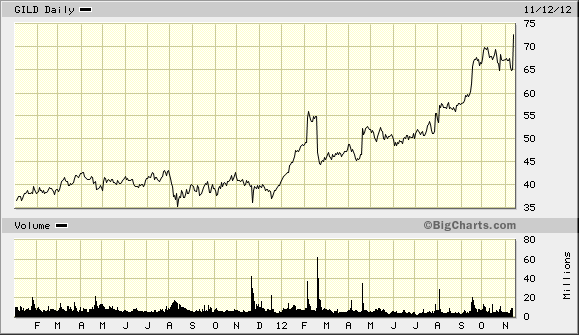
Eddy Elfenbein, November 12th, 2012 at 10:49 amI made a big mistake last year in taking Gilead Sciences ($GILD) off the Buy List. The shares are up more than 72% YTD, and are up big again today.
Shares of Gilead Sciences (GILD) popped more than 11% early Monday after the biotech reported over the weekend that its hepatitis C regimen produced a 100% cure rate in a late-stage trial.
At the annual Liver Meeting in Boston, Gilead reported that all 25 patients in the study showed a sustained virological response after a 12-week course of treatment with standard oral treatment ribavirin along with Gilead’s two drug candidates, GS-5885 and sofosbuvir (formerly known as GS-7977). The group included only patients with genotype 1 of the virus, which accounts for about 70% of all U.S. hepatitis C cases, who had never been treated before. Patients with genotypes 2 and 3 had response rates in the 60s, while genotype 1 patients who’d failed previous treatment responded only at a 10% rate.
The stock gave us nothing but grief last year, but has been a rock star in 2012. Peter Lynch once said that the best stock to buy is often one you already own. I’m kicking myself for letting Gilead go. The lesson is that when you buy out-of-favor stocks, the turnaround often takes longer than you think.
-
Leucadia National Buys Jefferies
Eddy Elfenbein, November 12th, 2012 at 10:33 amWhile the stock market is open today, the bond market is closed in honor of Veteran’s Day. The stock market still seems unnerved by recent events although I think it’s unfair to blame President Obama’s reelection for the entire downturn. There are still concerns about the fiscal cliff and more unresolved problems in Europe.
Regarding the fiscal cliff, I think leaders of both parties realize that the American public is weary of more partisanship, and it’s in their best interest to reach some sort of deal. If nothing is done before the end of the year, automatic across-the-board tax increases will go into effect. I imagine that some tax increase on the wealthy will be passed in exchange for some measures on entitlements (like higher retirement age). I won’t guess as to the specifics but it’s not in anyone’s interest to have a bloody, drawn-out affair.
There’s actually some good news out of Greece for a change. The country’s parliament passed its austerity budget by a vote of 167 to 128. Once the bigwigs in the EU give the thumbs up, this will clear the way for Greece to get another $40 billion in aid. The problem for Europe right now is that the southern part is weak and that’s starting to pull Germany down.
One of our former Buy List stocks is in the news as Leucadia National ($LUK) is buying Jefferies ($JEF) for $3.7 billion. LUK already owns a big chunk of JEF. In fact, they even increased their stake last year during the sovereign debt crisis. Now LUK will buy the whole thing.
-
Morning News: November 12, 2012
Eddy Elfenbein, November 12th, 2012 at 7:20 amGreece’s ‘Monster’ Debt Problem Haunts Europe
Rajoy Aims to Stem Evictions as Suicide Darkens Crisis
Slower October Loans Will Not Derail China Recovery
Japan’s Economy Shrinks As Firms Cut Spending, Recession Looms
Japan Likely to Embrace Free Trade Pact
U.S. Oil Output to Overtake Saudi Arabia’s by 2020, IEA Says
Americans Say Europe Lesson Means Act Now as Austerity Will Fail
Republicans Say Deal Can Be Done On U.S. “Fiscal Cliff”
Apple Settles HTC Patent Suits Shifting From Jobs’ War
Groupon Fights For Its Life As Daily Deals Fade
India’s United Spirits Jumps 35 Percent As Diageo Deal Seen Positive
Emirates Group First-Half Profit Climbs 68% on Passengers
Singular Success: China’s Billion-Dollar Hallmark Holiday
Cullen Roche: About Those “Invisible Bond Vigilantes”
Jeff Miller: Weighing the Week Ahead: Will US Leaders Become Cliff Divers?
Be sure to follow me on Twitter.
-
Archives
- June 2026
- May 2026
- April 2026
- March 2026
- February 2026
- January 2026
- December 2025
- November 2025
- October 2025
- September 2025
- August 2025
- July 2025
- June 2025
- May 2025
- April 2025
- March 2025
- February 2025
- January 2025
- December 2024
- November 2024
- October 2024
- September 2024
- August 2024
- July 2024
- June 2024
- May 2024
- April 2024
- March 2024
- February 2024
- January 2024
- December 2023
- November 2023
- October 2023
- September 2023
- August 2023
- July 2023
- June 2023
- May 2023
- April 2023
- March 2023
- February 2023
- January 2023
- December 2022
- November 2022
- October 2022
- September 2022
- August 2022
- July 2022
- June 2022
- May 2022
- April 2022
- March 2022
- February 2022
- January 2022
- December 2021
- November 2021
- October 2021
- September 2021
- August 2021
- July 2021
- June 2021
- May 2021
- April 2021
- March 2021
- February 2021
- January 2021
- December 2020
- November 2020
- October 2020
- September 2020
- August 2020
- July 2020
- June 2020
- May 2020
- April 2020
- March 2020
- February 2020
- January 2020
- December 2019
- November 2019
- October 2019
- September 2019
- August 2019
- July 2019
- June 2019
- May 2019
- April 2019
- March 2019
- February 2019
- January 2019
- December 2018
- November 2018
- October 2018
- September 2018
- August 2018
- July 2018
- June 2018
- May 2018
- April 2018
- March 2018
- February 2018
- January 2018
- December 2017
- November 2017
- October 2017
- September 2017
- August 2017
- July 2017
- June 2017
- May 2017
- April 2017
- March 2017
- February 2017
- January 2017
- December 2016
- November 2016
- October 2016
- September 2016
- August 2016
- July 2016
- June 2016
- May 2016
- April 2016
- March 2016
- February 2016
- January 2016
- December 2015
- November 2015
- October 2015
- September 2015
- August 2015
- July 2015
- June 2015
- May 2015
- April 2015
- March 2015
- February 2015
- January 2015
- December 2014
- November 2014
- October 2014
- September 2014
- August 2014
- July 2014
- June 2014
- May 2014
- April 2014
- March 2014
- February 2014
- January 2014
- December 2013
- November 2013
- October 2013
- September 2013
- August 2013
- July 2013
- June 2013
- May 2013
- April 2013
- March 2013
- February 2013
- January 2013
- December 2012
- November 2012
- October 2012
- September 2012
- August 2012
- July 2012
- June 2012
- May 2012
- April 2012
- March 2012
- February 2012
- January 2012
- December 2011
- November 2011
- October 2011
- September 2011
- August 2011
- July 2011
- June 2011
- May 2011
- April 2011
- March 2011
- February 2011
- January 2011
- December 2010
- November 2010
- October 2010
- September 2010
- August 2010
- July 2010
- June 2010
- May 2010
- April 2010
- March 2010
- February 2010
- January 2010
- December 2009
- November 2009
- October 2009
- September 2009
- August 2009
- July 2009
- June 2009
- May 2009
- April 2009
- March 2009
- February 2009
- January 2009
- December 2008
- November 2008
- October 2008
- September 2008
- August 2008
- July 2008
- June 2008
- May 2008
- April 2008
- March 2008
- February 2008
- January 2008
- December 2007
- November 2007
- October 2007
- September 2007
- August 2007
- July 2007
- June 2007
- May 2007
- April 2007
- March 2007
- February 2007
- January 2007
- December 2006
- November 2006
- October 2006
- September 2006
- August 2006
- July 2006
- June 2006
- May 2006
- April 2006
- March 2006
- February 2006
- January 2006
- December 2005
- November 2005
- October 2005
- September 2005
- August 2005
- July 2005
 Eddy Elfenbein is a Washington, DC-based speaker, portfolio manager and editor of the blog Crossing Wall Street. His