Author Archive
-
Home Depot Closes in on All-Time High
Eddy Elfenbein, November 6th, 2012 at 12:04 pmOne month ago, Home Depot ($HD) closed at a twelve-and-a-half year high. That’s an eighth of a century. The stock is back up and looks to take out the October high any day now. If so, Home Depot will be the latest in a string of mega-cap blue chip stocks to break very long-term highs.
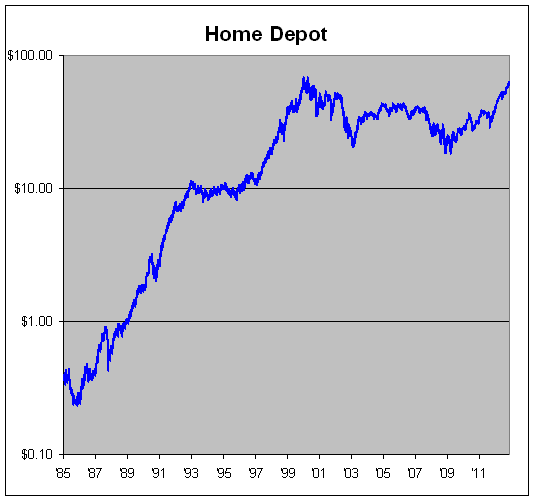
HD set its all-time high close on the final day of the 20th century, December 31, 1999. Home Depot finished that day at $68.75. The stock is currently around $62.70, so it’s not too far away.
Share of HD are riding the recovery of the housing market. The shares are up 119% in the last 15 months. The stock has actually been outperforming the S&P 500 for close to five years. The stock had such a rotten time from 2000 to 2007, I don’t think people realize how cheap it had become.
I think Home Depot has become a bit too pricy here. But it goes to show you that if you wait long enough, every stock can have its day.
Since 1978, shares of Home Depot are up 180,000%. That’s a gain of 1,801-fold which works out to 23.8% per year. Over the same time, the S&P 500 has gained 1,170%.
-
DirecTV Misses By Four Cents Per Share
Eddy Elfenbein, November 6th, 2012 at 10:38 amElection Day is finally here. I’m not in the business of trying to predict who will win, but I think the market will be very pleased to have the uncertainty behind us. The S&P 500 is back over 1,420 this morning but I don’t expect much price action this week.
The weak spot on the Buy List today is DirecTV ($DTV). The satellite TV company missed earnings by four cents per share. For their Q3, DirecTV earned 90 cents per share compared with Wall Street’s consensus of 94 cents per share. The good news is that revenue rose 8.4% to $7.42 billion which was $110 million better than consensus.
DirecTV added 543,000 net subscribers in Latin America, fewer than the 585,000 estimate from nine analysts surveyed by Bloomberg. The disappointing results may indicate a deterioration in the region’s economies, especially Venezuela, said Chris Marangi, a portfolio manager at Gamco Investors Inc. whose funds own 7.4 million DirecTV shares.
Latin American customer additions fell from 645,000 in the quarter ended in June. Last year, DirecTV reported 574,000 new Latin American users in the third quarter, an increase from the prior three-month period.
DirecTV added 67,000 net U.S. customers, less than the 99,000 average analyst estimate. The company has tried to entice subscribers with National Football League Sunday Ticket promotions, which give new customers access to all Sunday football games for free for a year. DirecTV also lowered the price for Sunday Ticket for current customers.
I also forgot to mention the good earnings report last Friday from Moog ($MOG-A). The company reported earnings 91 cents per share which was two cents better than estimates. Moog earned 83 cents per share for the same quarter one year ago.
This was for their fiscal fourth quarter. For the entire year, Moog earned $3.33 per share which was a nice increase over the $2.95 per share they earned in the year before that. Moog reiterated its earnings forecast of $3.50 to $3.70 per share for the coming year. That’s a very good number.
“Over the last three years, sales have increased 34% and earnings per share are up 68%,” said John Scannell, CEO. “We have delivered this improvement despite the reduced military spending and the tepid industrial recovery. We believe our diversity across markets and geographies, as well as our excellent position on the most important military and commercial programs has been the key to this strong performance and we’re confident these factors will continue to benefit us in 2013.”
I think Moog is one of the cheaper stocks on our Buy List.
-
Morning News: November 6, 2012
Eddy Elfenbein, November 6th, 2012 at 6:54 amGreek Strike Shuts Down Country Ahead Of Cliffhanger Austerity Vote
A Year On And Draghi Remains ECB’s ‘Super Mario’
Hollande to Raise French Sales Tax, Cut Spending From 2014
China Row Drags On Nissan, Cuts FY Forecasts
South Africa Banknotes Launched With Mandela Image
Unprecedented Forties Loading Delays Inflate Brent Oil Price
Inergy to Buy Bakken Hub Owner Rangeland for $425 Million
BMW Profit Beats Estimates as China Growth Offsets Europe
Zillow Tumbles as Quarterly Forecast Trails Estimates
Stifel’s Savvy Purchase of KBW
Tesla Advances as Revenue Beats Estimates
Express Scripts Falls Hard; Estimates Appear ‘Overly Aggressive’
The Election Won’t Solve All Puzzles
Epicurean Dealmaker: Get Up Offa That Thing
Be sure to follow me on Twitter.
-
Tupperware Brands (TUP)
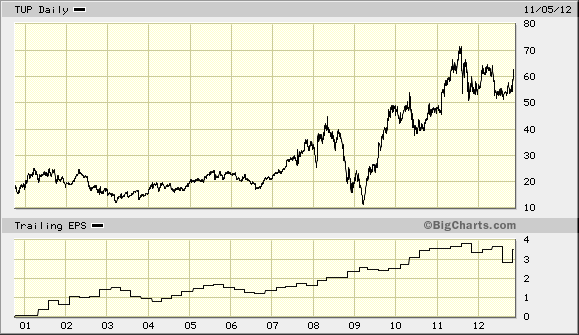
Eddy Elfenbein, November 5th, 2012 at 2:53 pmI’ve been eyeing Tupperware Brands ($TUP) recently. It looks to be a good mid-cap stock with steadily rising earnings.
Here’s how Hoover’s describes them:
Tupperware Brands Corporation (TBC) knows that there’s more than one way to party. The company makes and sells household products and beauty items. Tupperware parties became synonymous with American suburban life in the 1950s, when independent salespeople organized gatherings to sell their plasticware. TBC deploys a sales force of about 2.7 million people in about 100 countries. The company also sells its products online. Brands include Armand Dupree, Avroy Shlain, BeautiControl, Fuller, NaturCare, Nutrimetics, Nuvo, Swissgarde, and, of course, Tupperware. Its BeautiControl unit sells beauty and skin care products and fragrances in North America, Latin America, and the Asia/Pacific region.
TUP should probably earn close $5 per share this year, and $5.50 or more next year. Unfortunately, when I was first looking into TUP, the shares were at $54. The good earnings report sparked a rally to $62. The stock still looks good; it’s just not the outstanding bargain it had been.
The World Simplest Stock Valuation model give TUP a fair value of $77.
-
The Dow’s Four-Year Cycle
Eddy Elfenbein, November 5th, 2012 at 11:39 amWith voting tomorrow, I thought I’d post this chart again. This is the Dow’s average four-year cycle since 1896.

I ran the entire numbers set from May 1896 to September 2011. Except for the 12 months preceding a mid-term election, the Dow generally does well. There’s another slow period for the nine months preceding Memorial Day of the election year.
-
The 200-DMA Is Within Sight
Eddy Elfenbein, November 5th, 2012 at 10:18 amThe stock market’s stall of the last few weeks has brought it closer to its 200-day moving average. Right now, it’s around 1,380 and we’re hovering about 2% above that.
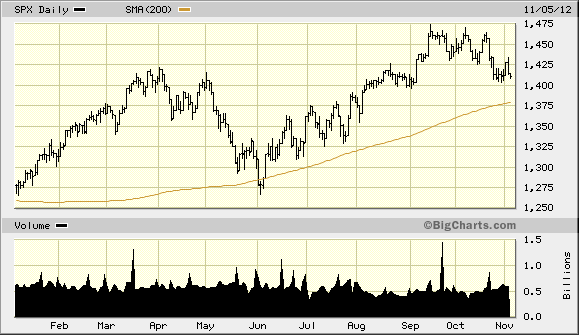
The 200-DMA is an example of a dumb rule that has a surprisingly decent track record. Academics hate things like moving averages, and I agree that we shouldn’t place too much weight on their judgements, but they are worth watching.
What investors need to understand is that financial markets are biases towards trends. When something is going in motion, either up or down, it has a decent chance of continuing to go in that direction. Capturing the turning points is the tricky part and is best left alone. The 200-DMA is simple but it’s able to capture the stock market’s momentum.
Three years ago, I ran the numbers and this is what I found:
So does the 200DMA work? The evidence suggests that it’s a pretty good indicator of future price performance. When the S&P 500 has been below the 200DMA, it’s dropped a total of about 20% over the equivalent of 27 years. In other words, the S&P 500 has been below its 200DMA about one-third of the time.
Historically, the best time to invest has been when the S&P is less than 1.7% below the 200DMA.
When the index is above the 200DMA, well, then everything looks much brighter. All of the market’s gain and then some have happen when we’re above the 200DMA which occurs about two-thirds of the time.
The market seems to like nearly every point of being above the 200DMA. Danger only clicks in when the S&P 500 is over 17.5% above the 200DMA which is a very high reading.
-
Sysco Earns 49 Cents Per Share
Eddy Elfenbein, November 5th, 2012 at 10:09 amThe stock market is down a few points this morning. Obviously, traders are waiting for tomorrow’s election so this is causing some anxiety. Leaving aside any partisan issues, I think investors are nervous that the outcome may be undecided for a few days. That’s probably what concerns people most. I don’t think anyone wants to go through what we had in 2000 again.
Shares of Nicholas Financial ($NICK) took a beating on Friday. Don’t let that scare you. At Friday’s closing price, the stock yields almost exactly 4%. The company will have no trouble covering its dividend. As I said before, the earnings report was slightly disappointing. Note word slightly. All would have been fine if it was, say, four cents more, so how can a four-cent miss turn into a $1 per share loss? I’m not sure. That’s 25 times missing earnings for a stock going around seven times earnings. Such is the mindset of short-term trading.
This morning, Sysco ($SYY), the food services outfit, reported fiscal first-quarter earnings of 49 cents per share which was one penny below expectations. Sales rose 4.7% to $10.6 billion which was an all-time record for Sysco. The shares have pulled back some this morning, but I’m not too concerned. Sysco had a one penny share charge for some severance issues. Like NICK, Sysco pays a generous yield and the stock has had a good run since the market’s swoon in May.
-
Morning News: November 5, 2012
Eddy Elfenbein, November 5th, 2012 at 5:52 amEuropean Stocks, Euro Drop With Copper on Greece, U.S. Elections
Euro Area Resolve for Single Currency Faces Greek Test
US Fiscal Cliff, Europe’s Debt Woes Worry G20
HSBC Sets Aside Extra $800 Million for U.S. Money Laundering Case
Despite China Hit, Toyota Trebles Q2 Profit, Raises FY Forecast
Oil Trades Near Four-Month Low on Greece Concern, U.S. Elections
Berkshire’s Cash Nears Record as Buffett Extends Elephant Hunt
Apple Paid Only 2% Corporation Tax Outside US
Sharp Is Seen Seeking Bailout After Record Loss Forecast
Ryanair Raises Full-Year Forecast
Jim Beam Didn’t Get Putin Memo as Whiskey Eyes Russians
Fight Builds Over Online Royalties
Foxconn International Surges 35 Percent As Citi Report Lifts Iphone Hopes
Howard Lindzon: Patents are the New Biotechs…Shame!
Jeff Miller: Weighing the Week Ahead: Approaching Dangerous Curves?
Be sure to follow me on Twitter.
-
Our Highly Unscientific Poll
Eddy Elfenbein, November 3rd, 2012 at 5:29 pm
-
October Unemployment = 7.9%
Eddy Elfenbein, November 2nd, 2012 at 3:52 pmThis morning was the important jobs report for October. This will be the last major economic report before the election next week.
The government said that the U.S. economy created 171,000 net jobs last month. The gain for August was revised upward from 142,000 to 192,000. The gain for September was also revised higher, to 148,000 from 114,000. The economy has now gained back slightly more than half of the 8.78 million jobs lost between January 2008 and February 2010.
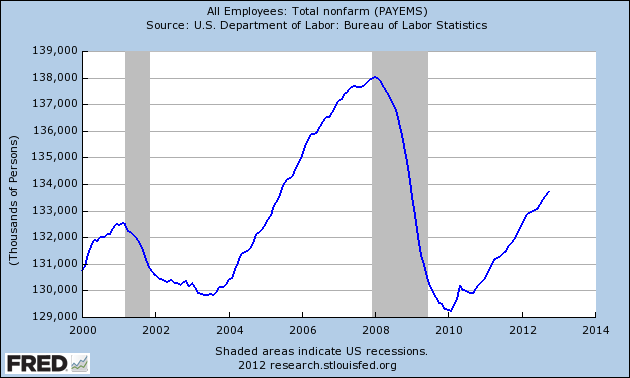
The unemployment rate ticked up from 7.8% to 7.9%. Oddly, part of the reason the unemployment rate rose is that more people rejoined the workforce looking for jobs. The official unemployment had been held down because so many people had simply stopped looking for work altogether.
For the U.S. economy to have the same jobs-to-population ratio as we had 12 years ago, we would need either 13.3 million more jobs, or 20.8 million fewer people.
Here’s a look at the unemployment for the final month before a presidential election. The current one ranks highest of the last 17.
 Eddy Elfenbein is a Washington, DC-based speaker, portfolio manager and editor of the blog Crossing Wall Street. His