Author Archive
-
Morning News: September 18, 2012
Eddy Elfenbein, September 18th, 2012 at 6:19 amEurope Banks Fail to Cut as Draghi Loans Defer Deleverage
ECB’s Coene Says Widening Spreads May Force Spain to Ask for Aid
In Greece, Restlessness Amid a Push for Cuts
Oil Falls To $113, Extends Slide
Defining Bernanke’s New Fed Target
Morgan Stanley Infrastructure Fund Hit By Volcker Rule
Apple Reaches $700 as IPhone 5 Shatters Sales Record
Groupon Falls as Expenses Mount Amid Daily-Deal Fatigue
Lowe’s Pulls $1.8 Billion Bid for Rona
Lenovo Makes First Software Buy to Expand in Cloud Computing
US HOT STOCKS: Office Depot, Tesla, Cliffs Natural Resources, AMN Healthcare
Dole Food Sells Two Businesses To Itochu For $1.7 Billion
Success of Crowdfunding Puts Pressure on Entrepreneurs
Edward Harrison: More On Government Tax Coercion Versus Fiat Money Liberty
Jeff Miller: Weighing the Week Ahead: Higher Hopes for Housing?
Be sure to follow me on Twitter.
-
The Missing Risk Premium
Eddy Elfenbein, September 17th, 2012 at 11:17 amImagine if there was a well-established scientific principle that was taught in schools, had won Nobel Prizes and was accepted across-the-board by experts, yet it was completely and totally wrong.
While this may sound far-fetched, this is the basis of Eric Falkenstein’s new book, “The Missing Risk Premium,” and he makes a convincing case.
Instead of science, Falkenstein looks at economics and argues that the “risk premium,” the reward for investors who shoulder risk, does not exist. This isn’t small potatoes he’s taking on. The risk premium stands front and center in the world of financial economics, and Falkenstein shows us that there’s very little empirical evidence it even exists.
We’ve long known that stocks have beaten bonds over the long run. So academics attempted a model to explain this fact. Their model says that the reason why stocks have beaten bonds is due to risk. Of course, they’re just slapping the name “risk” on to something better described as “that which we do not know.” It’s like calling a black hole “Cleveland.”
The model further states that risk can be quantified and the more of it you take, the better you’ll do. So one would expect that stocks with higher risk should do better than stocks with lower risk. But that’s not the case at all. In fact, stocks with the highest risk do the worst, and stocks with the lowest do the best (Falkenstein is a proponent of minimum volatility investing.)
Just because the measurement of risk explains the gap between stocks and bonds, when applied to individual stocks, it says nothing. Falkenstein goes beyond the world of stocks and looks at several areas where there’s no payoff in taking more risk, or the payoff is actually negative.
I think the example of horse racing probably explains this best. Researchers have found that betting on the long-shot has had the worst payoff. My guess is that in any given race, the long-shot will draw interest from bettors who simply want to bet on the long-shot, no matter how good the horse really is. Betting and winning on the favorite may offer a higher payout (losing money somewhat slower), but it’s not as much fun at hitting the rare long shot. This is what probably draws many investors to obviously overpriced risky stocks. They simply want to be in the game, and they’re willing to ignore the numbers. The lottery is the same way.
What caught my attention is that one of the few areas where a risk premium does appear to exist is at the short end of the yield curve. My guess is that what’s happening is that the characteristic of the asset takes on an over-sized image in the mind of investors. As a result, they’ll over pay for a long shot simply because it’s the long shot. Or they’ll overpay for a risk-free asset simply because it’s risk free. This only works at the extreme and going half way won’t get you half the results.
Some of these concepts Falkenstein covered in his first book, Finding Alpha. This book, however, is much shorter and less technical. Regular readers of his blog (Falkenblog) will also surely recognize many of these arguments.
One of the most eye-raising aspects of the book is where Falkenstein discusses the many small losses that individual investors suffer between the stock gains they see reported on CNBC, and the returns they get. Investors are constantly dinged by things like bad timing, transactional costs, bid-ask spreads and taxes. Once you throw in variables like survivorship bias, Falkenstein says that the historical databases we have return bare little resemblance to what made its way towards investors’ pockets. This topic alone could serve as a useful book.
Falkenstein does say, and I’m inclined to agree, that a risk premium exists between stocks and bonds exists but only for the highly-efficient investor. My guess is that the equity risk premium is probably between 1% and 2% which is far less than what’s accepted by many economists.
Falkstein’s meta-thesis is that investors aren’t greedy; they’re envious. In other words, they don’t simply want the most they can get. They want more than their neighbors. Once you adopt this frame of reference, it undermines the idea that greater wealth can be purchased with greater risk.
My only criticism of The Missing Risk Premium is that this is a self-published book, and the editing is somewhat sloppy. Also, some language explaining difficult concepts is unnecessarily convoluted. Still, the argument presented is strong and clear and will hopefully convince the world that better returns aren’t paid for with pain.
-
The Stock Market Opens With Week With a Sluggish Start
Eddy Elfenbein, September 17th, 2012 at 9:37 amThe stock market looks to open flat to lower this morning. Stocks, of course, have had a good run since Ben Bernanke’s move last week. Over the last four trading sessions, the Dow has added 339 points.
The bond market is, once again, not pleased with Spain. After some squabbling among finance ministers, yields on the 10-year Spanish bond rose to its highest level in four months.
Bloomberg picks up this cutting quote from Joachim Fels, the chief economist at Morgan Stanley in London: “Experience suggests that just as day gives way to night, improvement gives way to policy complacency, which is then followed by renewed crisis.” That pretty much sums it up.
The major economic report this morning showed that the Empire State Manufacturing Index fell to its lowest point in three-and-a-half years. As the name suggests, this covers economic activity in the State of New York. The one bright spot in the report is that the outlook for the future improved greatly since August.
For reasons not immediately clear, Occupy Wall Street has pledged to disrupt the morning commute for many Wall Streeters. Today is the movement’s one year anniversary.
-
Morning News: September 17, 2012
Eddy Elfenbein, September 17th, 2012 at 6:19 amEuropean Squabbling on Euro Crisis Solution May Test Rally
Draghi Euro Humbles Thought Leaders Seeing End of Union
Indian Rates Held Steady Despite “Big Bang” Reforms
German Banks’ Funding Boost Drives Global Loan Rebound
Istanbul Aims to Outshine Dubai With $2.6 Billion Bank Center
U.S. to File W.T.O. Case Against China Over Cars
The Crude World of Middle East Oil
Stocks, More Than Housing, Seen As Initial QE3 Winners
Probe Focuses On JPMorgan’s Monitoring Of Suspect Transactions
Buffett Style Fashions Berkshire’s Foreign Deals
Hennes & Mauritz Sales Miss Estimates After August Heatwave
Billionaire Arnault’s LVMH Amasses EU4 Billion in Belgium
1 Year On, Occupy Is In Disarray; Spirit Lives On
Howard Lindzon: What does a Market TOP Look Like…Not [Friday]!
Phil Pearlman: Shrinkologicals: Who Is Really Panicking?
Be sure to follow me on Twitter.
-
The Market’s P/E Ratio Is Lower Now Than It Was Most of the Time from 1991 to 2010
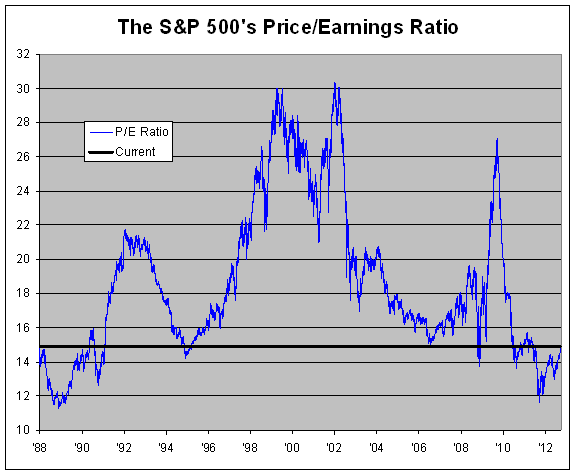
Eddy Elfenbein, September 16th, 2012 at 8:17 amOne of the paradoxes of this market is that stocks have climbed higher even as earnings estimates have come down. Consider that the S&P 500’s earnings multiple is up nearly 30% since the market’s low nearly one year ago.
I think part of the reason for the increased valuation is that the economic uncertainty has started to fade. The Federal Reserve’s move last week probably helped clear up some of that uncertainty.
What’s interesting is that despite the higher valuations, the S&P 500’s Price/Earnings Ratio is still lower now that it was at any point from March 1995 to October 2008. And except for some brief periods, the market’s P/E Ratio is currently lower than it was during the vast majority of the time from 1991 to 2010.
-
Fed Admits Up Until Now U.S. Has Just Been Coasting Off Money From ‘Avatar’
Eddy Elfenbein, September 15th, 2012 at 12:13 pm‘We Spent It All’ Reveals Bernanke
From The Onion:
WASHINGTON—Addressing the nation’s finances at a major economic conference Friday, Federal Reserve chairman Ben Bernanke acknowledged that for the past three years the United States has been scraping by on the revenue generated by the 2009 sci-fi blockbuster Avatar. “By circulating $2.8 billion through the economy in gross box-office receipts alone, the cash from Avatar has been the only thing keeping America’s head above water,” said a solemn-faced Bernanke, adding that when money from the theatrical release ran dry, DVD sales had been able to pick up just enough slack to keep the United States solvent for another year. “We had hoped the Avatar money would see us through the end of 2012, but at this point we’ve blown through all the revenue from toys, clothing, video games, and book tie-ins, and it appears we are now headed over the fiscal cliff.” With a sequel not expected until 2015, Bernanke called for an emergency rerelease of the film “in IMAX 3-D with bonus scenes” in order to prevent the United States from defaulting on overseas loans.
-
Seagull Steals Camera
Eddy Elfenbein, September 15th, 2012 at 6:34 am -
UnitedHealth to Go in the Dow
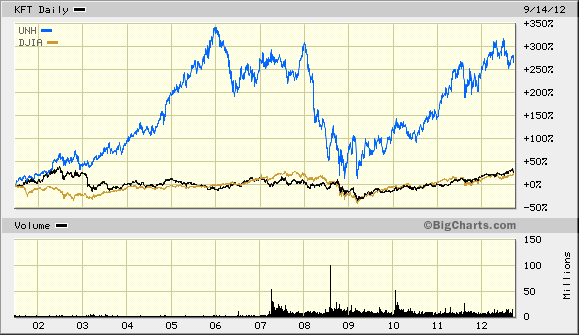
Eddy Elfenbein, September 14th, 2012 at 12:05 pmThe keepers of the Dow just announced that UnitedHealth Group ($UNH) will take the place of Kraft Foods ($KFT) in the Dow Jones Industrial Average. These changes aren’t made very often.
What’s interesting to note is that Kraft has mostly been a market performer but UNH has not. The Dow is going in a different direction and this will increase the volatility of the index.
-
CWS Market Review – September 14, 2012
Eddy Elfenbein, September 14th, 2012 at 8:23 amLast week, it was thank you, Mario. This week, it’s thank you, Ben!
The stock market surged to its highest close in four years on Thursday when it was reported that that the Federal Reserve is embarking on another round of quantitative easing. The last time the S&P 500 was this high was on the final day of trading in 2007. The market had a great day on Thursday, and several of our Buy List stocks like Medtronic ($MDT), DirecTV ($DTV), Hudson City ($HCBK) and Harris Corp. ($HCBK) all broke out to new 52-week highs.
I’m also pleased to announce that—after many of you requested it—I’ve added a “Buy Below” column to our Buy List page. I think you’ll like it a lot. Now you’ll be able to know exactly what I think is a good entry point for all the stocks on our Buy List. It’s important for investors to stay disciplined and never chase after stocks. My Buy Below prices will help you do exactly that.
In this week’s CWS Market Review, I’ll explain what the Fed news means, and I’ll try to keep it jargon free. I’ll also discuss what this policy means for the economy and our portfolios. I’ll also highlight upcoming Buy List earnings reports from Oracle ($ORCL) and Bed Bath & Beyond ($BBBY). But first, let’s look at why stocks are so happy with the Bearded One.
The Federal Reserve Embarks on QE-Infinity
I have to confess some embarrassment with the Fed’s news, because I had long been a doubter that the central bank would pursue more quantitative easing. I even said last week that this week’s policy meeting would be a snoozer. In fact, I was afraid the market was setting itself up to be disappointed. Instead, the market celebrated the news.
Now let’s look at what exactly the Federal Reserve did. The central bank said it will buy $40 billion per month of agency mortgage-backed securities (MBS). What will happen is the Fed will swap assets with a bank. The Fed will get a risky MBS while the bank will get low-risk reserves, which, I should add, are held at the Federal Reserve.
Here’s the problem: Since interest rates are already near 0%, the Fed can’t cut them any further. But the hope is that by buying MBS, the Fed can push down mortgage rates, which will boost the housing market, which in turn will boost the overall economy. At least, that’s the plan. Remember that the housing sector is a key driver of new jobs, and I noted on Thursday that the stocks of many homebuilders gapped up on the news.
The Fed Changes Course
The problem with the two earlier rounds of bond purchases is that while they certainly helped the financial markets, their impact on the economy was probably pretty slight. Some critics said that the Fed simply wasn’t being bold enough. What’s interesting is that this round of bond buying is smaller than the previous rounds.
But here’s the key: The Fed said something very different this time.
To support continued progress toward maximum employment and price stability, the Committee expects that a highly accommodative stance of monetary policy will remain appropriate for a considerable time after the economic recovery strengthens.
In other words, this time the Fed’s plan is unlimited. Implicit in the above sentence is the Fed’s admission that its previous policy just wasn’t working. With the earlier bond buying, the Fed just said that they’re going to buy X dollar amount of bonds, and that’s that. There was no goal.
An idea gaining popularity among economists is that the Fed should buy bonds until some metric like the unemployment rate or nominal GDP hits a specific target. With today’s news, the Fed has clearly moved towards that position without expressly saying so. The Fed said that the bond buying would continue until the labor market improved “substantially” and “for a considerable time after the economic recovery strengthens.” The $40-billion-per-month figure is almost irrelevant in context of an open-ended policy. All told, the Fed will be pumping $85 billion into the economy each month.
What This All Means
I may sound overly cynical, but I suspect the Fed will buy bonds until the bond market shuts them off. (Remember when I talked last week about how the Spanish bond market scared the bejesus out of the European Central Bank?)
The Fed also said that it will keep interest rates near 0% through at least 2015. That’s very good news for a company like Nicholas Financial ($NICK). Another buried angle on today’s news is that the Fed is, in my opinion, giving up on the fiction that it has a dual mandate (low inflation and full employment). When it truly matters, the Fed only cares about employment.
Will this QE-Infinity work? I honestly can’t say. One fear is that mortgage rates are already low, and that hasn’t done much to boost the economy. Looking at the track of previous quantitative easings doesn’t make me overly optimistic that a third version will do the trick.
Let’s look at the probable outcomes for the market. I suspect that in the near term, cyclical stocks and financial stocks will get a nice boost. That’s what happened after the first two rounds of bond buying and Operation Twist. JPMorgan Chase ($JPM), for example, soared to $41.40 on Thursday, which effectively erased its entire loss since the London Whale trading loss was announced in May.
Since the Fed is willing to turn a blind eye toward inflation for the time being, I suspect that hard assets (like gold) and commodity-based stocks will do well. I also think that higher-risk assets will gradually gain favor. For example, spreads between junk bonds and Treasuries will continue to narrow. This will also give a lift to many small-cap stocks, especially small-cap growth stocks. In the long run, I’m not convinced the Fed’s decision this week will have a major impact on the economy. Perhaps the best outcome is that a Fed-induced burst of enthusiasm will give the economy and labor market more time to right themselves. Until then, I urge all investors to own a diversified portfolio of high-quality stocks such as our Buy List.
Earnings from Oracle and BBBY
Next week, we have two earnings reports due. Bed Bath & Beyond ($BBBY) reports on Tuesday, September 18, and Oracle ($ORCL) reports the next day. This will be an interesting report for BBBY because three months ago, traders gave the stock a super-atomic wedgie after the company warned Wall Street that their fiscal Q2 would be below expectations. Wall Street had been expecting $1.08 per share, but BBBY said that earnings would range between 97 cents and $1.03 per share. Traders totally freaked and sent shares of BBBY from $74 all the way down to $58.
For fiscal Q1 (which ended in May), I predicted that BBBY could earn as much as 88 cents per share, which was four cents above Wall Street’s consensus. In fact, the company reported earnings of 89 cents per share. Nevertheless, the weak earnings guidance was too much to overcome.
In the CWS Market Review from June 22, I said that the selling was “way, way WAY overdone.” Fortunately, I was right. Since bottoming out in late-June, shares of BBBY have steadily rallied. On Thursday, the stock closed above $70 for the first time in three months. BBBY is still a good stock, and business is going well, but let’s be smart here and not chase it. I’m keeping my Buy Below price at $70.
Oracle has been one of our best stocks this year. The company beat expectations in March and June, although the stock had a terrible month in May. This earnings report will be for their fiscal Q1. The company said that earnings should range between 51 and 55 cents per share, which is almost certainly too low. They earned 48 cents per share for last year’s Q1. Look for an earnings surprise. I’m raising my Buy Below price on Oracle to $35 per share.
That’s all for now. Don’t forget to check out the new “Buy Below” column on the Buy List page. I’ll have more market analysis for you in the next issue of CWS Market Review!
– Eddy
-
Morning News: September 14, 2012
Eddy Elfenbein, September 14th, 2012 at 6:35 amBernanke’s Battle for Jobs Eclipses Inflation Concerns
Asian Shares Rally On Fed Stimulus Measures
European Stocks Seen Sharply Higher on Fed Boost
Spain’s Aid Dilemma Takes Center Stage at Euro Crisis Meeting
Prices Surged for Producers in August
Gold At Six-Month High As Fed Fans Inflation Risk
Oil Climbs to Four-Month High on Fed Stimulus Plan
Fossil Fuel Industry Ads Dominate TV Campaign
Huawei: Australia Law Could Exclude China Firms
Home Depot to Shut Seven China Stores, Take $160 Million Charge
Facebook Outperforming Google in Ad Revenue From Browsing
Berkshire Posts 25% Intel Gain by Shunning Buy-and-Hold
Cullen Roche: A Disturbing Look Inside the Mind of Ben Bernanke
Be sure to follow me on Twitter.
-
Archives
- June 2026
- May 2026
- April 2026
- March 2026
- February 2026
- January 2026
- December 2025
- November 2025
- October 2025
- September 2025
- August 2025
- July 2025
- June 2025
- May 2025
- April 2025
- March 2025
- February 2025
- January 2025
- December 2024
- November 2024
- October 2024
- September 2024
- August 2024
- July 2024
- June 2024
- May 2024
- April 2024
- March 2024
- February 2024
- January 2024
- December 2023
- November 2023
- October 2023
- September 2023
- August 2023
- July 2023
- June 2023
- May 2023
- April 2023
- March 2023
- February 2023
- January 2023
- December 2022
- November 2022
- October 2022
- September 2022
- August 2022
- July 2022
- June 2022
- May 2022
- April 2022
- March 2022
- February 2022
- January 2022
- December 2021
- November 2021
- October 2021
- September 2021
- August 2021
- July 2021
- June 2021
- May 2021
- April 2021
- March 2021
- February 2021
- January 2021
- December 2020
- November 2020
- October 2020
- September 2020
- August 2020
- July 2020
- June 2020
- May 2020
- April 2020
- March 2020
- February 2020
- January 2020
- December 2019
- November 2019
- October 2019
- September 2019
- August 2019
- July 2019
- June 2019
- May 2019
- April 2019
- March 2019
- February 2019
- January 2019
- December 2018
- November 2018
- October 2018
- September 2018
- August 2018
- July 2018
- June 2018
- May 2018
- April 2018
- March 2018
- February 2018
- January 2018
- December 2017
- November 2017
- October 2017
- September 2017
- August 2017
- July 2017
- June 2017
- May 2017
- April 2017
- March 2017
- February 2017
- January 2017
- December 2016
- November 2016
- October 2016
- September 2016
- August 2016
- July 2016
- June 2016
- May 2016
- April 2016
- March 2016
- February 2016
- January 2016
- December 2015
- November 2015
- October 2015
- September 2015
- August 2015
- July 2015
- June 2015
- May 2015
- April 2015
- March 2015
- February 2015
- January 2015
- December 2014
- November 2014
- October 2014
- September 2014
- August 2014
- July 2014
- June 2014
- May 2014
- April 2014
- March 2014
- February 2014
- January 2014
- December 2013
- November 2013
- October 2013
- September 2013
- August 2013
- July 2013
- June 2013
- May 2013
- April 2013
- March 2013
- February 2013
- January 2013
- December 2012
- November 2012
- October 2012
- September 2012
- August 2012
- July 2012
- June 2012
- May 2012
- April 2012
- March 2012
- February 2012
- January 2012
- December 2011
- November 2011
- October 2011
- September 2011
- August 2011
- July 2011
- June 2011
- May 2011
- April 2011
- March 2011
- February 2011
- January 2011
- December 2010
- November 2010
- October 2010
- September 2010
- August 2010
- July 2010
- June 2010
- May 2010
- April 2010
- March 2010
- February 2010
- January 2010
- December 2009
- November 2009
- October 2009
- September 2009
- August 2009
- July 2009
- June 2009
- May 2009
- April 2009
- March 2009
- February 2009
- January 2009
- December 2008
- November 2008
- October 2008
- September 2008
- August 2008
- July 2008
- June 2008
- May 2008
- April 2008
- March 2008
- February 2008
- January 2008
- December 2007
- November 2007
- October 2007
- September 2007
- August 2007
- July 2007
- June 2007
- May 2007
- April 2007
- March 2007
- February 2007
- January 2007
- December 2006
- November 2006
- October 2006
- September 2006
- August 2006
- July 2006
- June 2006
- May 2006
- April 2006
- March 2006
- February 2006
- January 2006
- December 2005
- November 2005
- October 2005
- September 2005
- August 2005
- July 2005
 Eddy Elfenbein is a Washington, DC-based speaker, portfolio manager and editor of the blog Crossing Wall Street. His