Author Archive
-
CWS Market Review – September 7, 2012
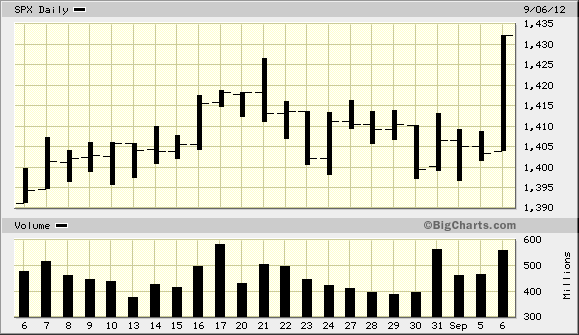
Eddy Elfenbein, September 7th, 2012 at 6:38 amThe Great Summer Snoozefest came to an abrupt end on Thursday as the S&P 500 vaulted more than 2% to close at 1,432.12, which is its highest close since January 3, 2008. The Nasdaq Composite did even better; it hasn’t been this high since Bill Clinton was president.
Let me warn you, don’t get too comfy. Unfortunately, I think the easy money has already been made. In this week’s CWS Market Review, I’ll talk about the market’s newly found self-confidence. I also show you some of the best ways to position your portfolio over the next few weeks which I still think will be bumpier than most folks expect. But first, let’s look at what drove stocks to multi-year highs.
Super Mario Comes to the Rescue
Frankly, it’s about time the market broke out of its summer slumber. This was getting seriously dull. In the 21 trading sessions prior to Thursday, the S&P 500 had been locked in a tight trading range of less than 1.4%. It was like watching paint dry. Daily volatility was down more than 80% from last year.
The driver of Thursday’s rally was the news that the European Central Bank is going to crack open its piggy bank and start buying bonds in a massive way. I’ll skip the boring econo-babble and boil it down for you—the Europeans ain’t messing around anymore. The partial fixes that everyone’s been trying (and trying and trying) are now history.
Four weeks ago, I highlighted Mario Draghi’s statement that the ECB was “ready to do whatever it takes to preserve the euro. And believe me, it will be enough.” As I explained, that was big. Central bankers simply aren’t in the habit of talking like that so we knew something big was up.
In plain English, the benefit of not being in a currency union is that you can print as much money as you want. Of course, if you go overboard, the market will start laughing at your money. History is full of these stories. But if you’re inside a currency union, then you can’t crank up the printing press—you’re trapped. To get more cash, the only thing you can do is borrow money. That’s what some eurozone countries were forced to do. The problem is that the bond market started to shut out Spanish and Italian debt.
When the yield on Spanish bonds hit 7%, the adults finally realized that this wasn’t going to work. You can’t expect someone to pay back money at 7% when their economy is going down the tubes. You’re just borrowing money to pay off your older debt. On Thursday, Mr. Draghi said he planned to buy an “unlimited” amount of bonds in order to push borrowing costs down. The Germans, as you might guess, weren’t pleased. Will it work? Honestly, I don’t know but Spanish bonds soared in response. The Spanish 10-year bond now yields 6.02%.
In my opinion, the key here is that the “unlimited” pledge finally breaks the trap of being in a currency union. This solution has the benefit of realizing what the problem has been all along. This really is a game-changer. In short, what Draghi wants to do is to take the huge risk premium of borrowing money off the table. The key part of this plan is that it doesn’t need to be perfect. It only needs to give countries like Italy and Spain a little more time to get back on their feet. The market clearly liked what it saw.
With Less Uncertainty, Our Buy List Soars
The fear of a meltdown in Europe had been hanging over the U.S. market for several months. What’s interesting is that the stock market has been cautiously rallying even though Wall Street’s earnings forecasts have been slowly coming down. Let me explain this apparent contradiction.
What’s happened is that valuations have increased, and that’s probably due to less uncertainty. There are few things Wall Street hates more than uncertainty. If the S&P 500 can earn $100 this year, which is quite reasonable, and we attach a P/E Ratio of 15 on to that (again, very reasonable), then today’s market valuation should hardly be surprising. Yet less than a year ago, the S&P 500 dipped below 1,100! Fear was in charge, and there wasn’t much we could do about it.
Thankfully, the mood has changed. The immediate benefit of the news out of Europe is that our financial stocks like JPMorgan Chase ($JPM) and AFLAC ($AFL) improved very nicely. Also, Nicholas Financial ($NICK) just topped $14 per share. Just three months ago, AFLAC was below $39 and on Thursday, it broke through $47. No matter how much AFLAC tells the market that it has cut its exposure to Europe, the stock market insists on treating the insurance company as if Europe is most of their business. That’s simply not the case. By the way, Barron’s recently made the case for AFLAC going to $60. I rate AFL a good buy anytime it’s below $50 per share.
I apologize if I take a moment to brag about the performance of our Buy List, but those of us who lived through the hurricane of this past May will understand. Good stocks were dropping simply on fear. I felt like I was doing more damage control than analysis.
For example, Bed Bath & Beyond ($BBBY) plunged from $74 to $58 on earnings that were disappointing but c’mon, they weren’t that bad. I told investors to relax and the shares are now back over $69. Look for a good earnings report later this month. BBBY is a good buy below $70.
Wright Express ($WXS) got hammered after its lower guidance a few weeks ago. The stock dropped from $64 to $60. Again, I told investors not to panic. Wright is now over $72 per share. The stock jumped 9.1% on Thursday after announcing its purchase of Fleet One. I’m raising my buy price on Wright from $65 to $75.
Last month, DirecTV ($DTV) missed earnings by four cents per share and stock dropped. Once again, I told investors to keep calm and once again, DTV just closed at a new 52-week high.
Fiserv ($FISV) also dropped after their earnings report even though the company raised the low-end of their full-year guidance. But traders got scared and sold. Now, just a few weeks later, the stock closed at a fresh 52-week high.
I often joke that our set-and-forget strategy for our Buy List is due to laziness. But honestly, passive investing is far superior to frequent trading. I almost feel sorry for day-traders who are gripped by every little price change. Our Buy List now has three stocks that are up more than 30% this year, plus another three that are up more than 20%. The lesson is that good stocks will come through; it just takes time.
Some Buy-List Bargains
I want investors to prepare themselves for a rough period over the next few weeks. There are still some trouble spots like the election, earnings guidance, a weak jobs market and an unsure consumer. Also, Europe isn’t out of the woods just yet.
Some stocks on the Buy List that look particularly attractive include Ford ($F) which is getting very close to $10. I also like Johnson & Johnson ($JNJ) at this price. The shares currently yield 3.6%. Sysco ($SYY) also offers a generous yield of 3.5%. High-yield stocks are always good to have in your portfolio during tough markets.
That’s all for now. There’s another Fed meeting next week but I don’t expect much will happen. I may be wrong but the election is just too close to make any major policy decisions. Be sure to keep checking the blog for daily updates. I’ll have more market analysis for you in the next issue of CWS Market Review!
– Eddy
-
The Market Rallies to a Post-Crash High
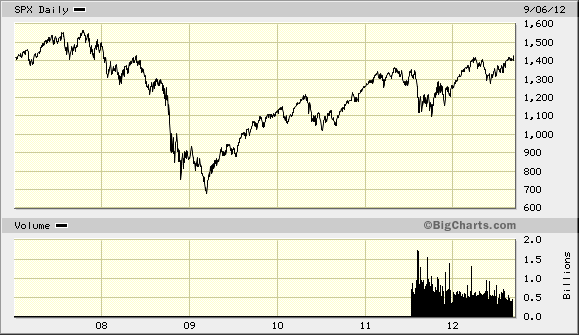
Eddy Elfenbein, September 6th, 2012 at 1:25 pmThe S&P 500 is up 1,430 today. If this holds up, the index will close at its level since January 3, 2008.
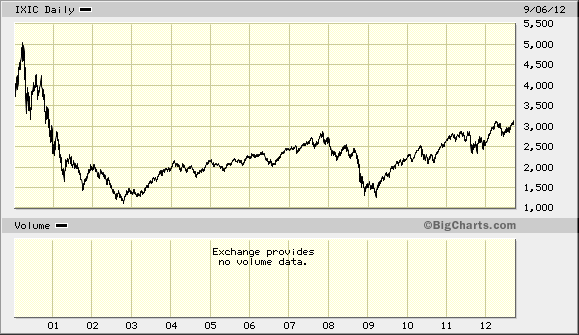
The Nasdaq Composite is on its way to highest close since November 15, 2000.
-
Wright Express Soars on Acquisition
Eddy Elfenbein, September 6th, 2012 at 9:54 amShares of Wright Express ($WXS) are up strongly today on the news that the company is buying fuel card provider Fleet One for $369 million. The stock was also upgraded to a Buy from Neutral at Janney Capital Markets.
Payment processor Wright Express Corp agreed to buy fuel card provider Fleet One from private equity firms LLR Partners and FTV Capital for $369 million in cash.
The deal is expected to immediately add to the company’s adjusted net income and will likely generate about $100 million in present value of tax benefits for Wright Express.
Wright Express said it will finance the deal through its existing credit facility.
The stock is up about 7.5% today.
-
1400 to 1420 Trading Range
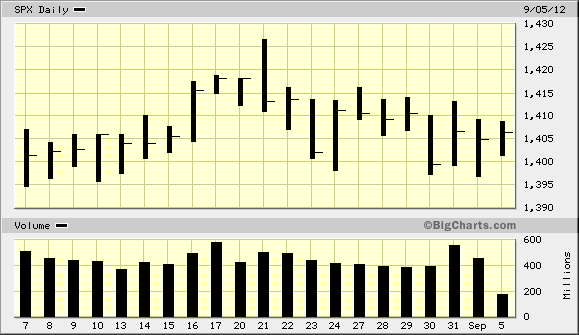
Eddy Elfenbein, September 5th, 2012 at 12:27 pmCheck out this chart to see the S&P 500’s tight trading range over the past month. Don’t let the vertical axis fool you, the market has stayed almost entirely within a 1.5% wide band since early August.
-
Why Return-On-Equity Is So Important
Eddy Elfenbein, September 5th, 2012 at 10:58 amHere’s a post for new investors or a helpful reminder for more experienced investors.
When you’re looking at a company, the single-most important number is return-on-equity. Forget head-and-shoulders, forget bear traps and double bottoms, forget volume, forget stochastics. Return-on-equity tells you more than anything else about how well a company is performing. It’s the best measure of efficiency, bar none. In short, ROE tells us how much we get for how much we got.
ROE can be deconstucted down into three parts (warning, math ahead). Profits margins, asset turnover and leverage. Think of it this way:
Profit margin is profits divided by sales.
Asset turnover is sales divided by assets.
Leverage is assets (stuff you have) divided by equity (stuff you own).
If we multiply them it will look like this:
(Profits) (Sales) (Assets)
——– X ——– X ——– = ROE
(Sales) (Assets) (Equity)I pass the graphics savings on to you.
The mathematically inclined will see that the two “sales” and two “assets” cancel each other out. And we’re left with profits divided by equity, or return-on-equity.
(Profits) (
Sales) (Assets)
——– X ——– X ——– = ROE
(Sales) (Assets) (Equity)See, easy.
The beauty of ROE is that it works for every company. You can compare General Electric to a lemonade stand. A company like Wal-Mart may have a teeny profit margin (around 3.5% last year), but incredible asset turnover. Wal-Mart is really just one big inventory control machine. A financial company like JPMorgan has 12 times more assets than equity, but it generates less than a penny of revenue for each dollar of assets.
Everything here balances out. If you want to borrow more to increase your leverage, your interest costs will hurt your profit margin. Or, you can increase your asset turnover by lowering your margins. There’s no way to shortcut except by doing better business.
For ease of explanation, I’m simplifying this but there are two other ways to bump up your ROE. One is by lowering your taxes and the other is by lowering your borrowing costs. Typically, however, companies aren’t in control of these variables.
-
Q2 Productivity = 2.2%
Eddy Elfenbein, September 5th, 2012 at 10:01 amMore decent news for the economy. The government reported that worker productivity rose by 2.2% last quarter. Economists were expecting an increase of 1.8%.
The biggest gains in productivity during the current expansion have probably already occurred as companies find they need to boost staff to further increase output and as investment in new equipment cools. At the same time, a weakening global economy is already hurting earnings, indicating businesses will continue to look for ways to operate more efficiently.
“Companies did a good job on productivity during the crisis, and they will continue to try to increase productivity to boost profits, but it’s not so easy to do that from here,” said Harm Bandholz, chief economist at UniCredit Group in New York. “Investment spending in the U.S. has been lackluster, and it’s certainly not getting better. The potential for increasing profits by cutting costs has come down quite a bit.”
-
Would You Buy this Stock?
Eddy Elfenbein, September 4th, 2012 at 12:21 pmWhat do you think?
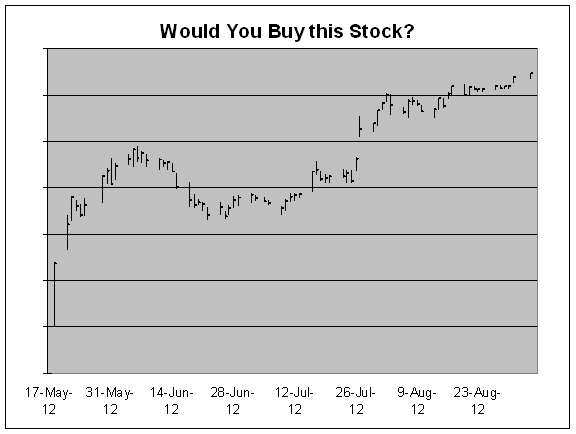
It’s Facebook ($FB) upside down.
-
Ford U.S. Sales Rose 13%
Eddy Elfenbein, September 4th, 2012 at 11:58 amGood news for Ford Motor ($F):
Ford said it sold 197,249 vehicles in August in the U.S., a 13% improvement from both last year’s 175,220 and July’s total of 173,966.
The Ford brand, the company’s largest, saw a 13% sales improvement, while Lincoln brand sales grew 1.7%.
Company-wide, August car sales rose 7.1% as truck sales improved 6.1%. Utility-vehicle sales jumped 28%.
Ford Fusion sales grew 21% last month, while sales of its best-selling vehicle, the Ford F-Series, were up 19%. Fiesta sales dropped 28%.
August had 27 sales days, while the year-ago month had 26 sales days.
Strong sales of the Ford brand have helped the auto maker’s results in recent months. But Ford reported in July its second-quarter earnings fell 57% as its overseas operations and a higher tax rate held back strong results from North America. The auto maker also lowered its full-year profit forecast as well as its budget for capital spending.
-
August ISM = 49.6
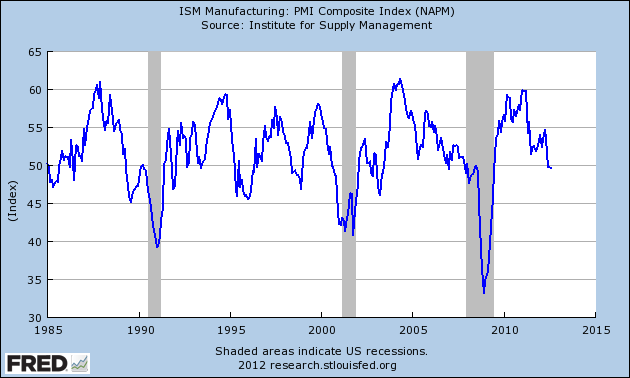
Eddy Elfenbein, September 4th, 2012 at 10:05 amThe August ISM Index just came out and it was 49.6. Wall Street was expecting 50. Remember that a reading greater than 50 means that the manufacturing sector is expanding while less than 50 indicates contraction. In July, it was 49.8. This is the third straight reading that’s been slightly below 50. Historically, recessions occur when the ISM is below 44 or 45.
-
It’s Easier for Stock-Pickers
Eddy Elfenbein, September 4th, 2012 at 9:56 amThis story from Bloomberg confirms a lot of what I’ve been saying:
Companies in the S&P 500 rose or fell an average of 4.4 percent the day after releasing results since July, according to data compiled by Bloomberg. The last time they moved more was in the second quarter of 2009. Daily swings in the benchmark gauge narrowed to 0.4 percent last month from 2.2 percent a year ago, as economic and policy changes battered investors. More than 475 S&P 500 stocks moved in the same direction in six of the first nine days of August 2011, with all 500 down on Aug. 8.
Bulls say lockstep moves are diminishing because investors are changing their behavior, making choices based on corporate results at a time when analysts estimate profits (SPX) for companies in the S&P 500 will rise almost 10 percent a year through 2014. Bears say the focus on earnings won’t bring back individuals who have drained more than $420 billion from U.S. equity mutual funds over the past four years even as stocks rallied 108 percent since March 2009 and net income was unchanged in the second quarter.
“I’m not saying it’s an easy job to be a stock picker in this environment, but it’s certainly easier,” Sandy Lincoln, the Chicago-based chief market strategist with BMO Global Asset Management, which oversees about $100 billion, said in an Aug. 28 interview. “Stock selection does have the opportunity here to finally show a face with a smile.”
-
Archives
- June 2026
- May 2026
- April 2026
- March 2026
- February 2026
- January 2026
- December 2025
- November 2025
- October 2025
- September 2025
- August 2025
- July 2025
- June 2025
- May 2025
- April 2025
- March 2025
- February 2025
- January 2025
- December 2024
- November 2024
- October 2024
- September 2024
- August 2024
- July 2024
- June 2024
- May 2024
- April 2024
- March 2024
- February 2024
- January 2024
- December 2023
- November 2023
- October 2023
- September 2023
- August 2023
- July 2023
- June 2023
- May 2023
- April 2023
- March 2023
- February 2023
- January 2023
- December 2022
- November 2022
- October 2022
- September 2022
- August 2022
- July 2022
- June 2022
- May 2022
- April 2022
- March 2022
- February 2022
- January 2022
- December 2021
- November 2021
- October 2021
- September 2021
- August 2021
- July 2021
- June 2021
- May 2021
- April 2021
- March 2021
- February 2021
- January 2021
- December 2020
- November 2020
- October 2020
- September 2020
- August 2020
- July 2020
- June 2020
- May 2020
- April 2020
- March 2020
- February 2020
- January 2020
- December 2019
- November 2019
- October 2019
- September 2019
- August 2019
- July 2019
- June 2019
- May 2019
- April 2019
- March 2019
- February 2019
- January 2019
- December 2018
- November 2018
- October 2018
- September 2018
- August 2018
- July 2018
- June 2018
- May 2018
- April 2018
- March 2018
- February 2018
- January 2018
- December 2017
- November 2017
- October 2017
- September 2017
- August 2017
- July 2017
- June 2017
- May 2017
- April 2017
- March 2017
- February 2017
- January 2017
- December 2016
- November 2016
- October 2016
- September 2016
- August 2016
- July 2016
- June 2016
- May 2016
- April 2016
- March 2016
- February 2016
- January 2016
- December 2015
- November 2015
- October 2015
- September 2015
- August 2015
- July 2015
- June 2015
- May 2015
- April 2015
- March 2015
- February 2015
- January 2015
- December 2014
- November 2014
- October 2014
- September 2014
- August 2014
- July 2014
- June 2014
- May 2014
- April 2014
- March 2014
- February 2014
- January 2014
- December 2013
- November 2013
- October 2013
- September 2013
- August 2013
- July 2013
- June 2013
- May 2013
- April 2013
- March 2013
- February 2013
- January 2013
- December 2012
- November 2012
- October 2012
- September 2012
- August 2012
- July 2012
- June 2012
- May 2012
- April 2012
- March 2012
- February 2012
- January 2012
- December 2011
- November 2011
- October 2011
- September 2011
- August 2011
- July 2011
- June 2011
- May 2011
- April 2011
- March 2011
- February 2011
- January 2011
- December 2010
- November 2010
- October 2010
- September 2010
- August 2010
- July 2010
- June 2010
- May 2010
- April 2010
- March 2010
- February 2010
- January 2010
- December 2009
- November 2009
- October 2009
- September 2009
- August 2009
- July 2009
- June 2009
- May 2009
- April 2009
- March 2009
- February 2009
- January 2009
- December 2008
- November 2008
- October 2008
- September 2008
- August 2008
- July 2008
- June 2008
- May 2008
- April 2008
- March 2008
- February 2008
- January 2008
- December 2007
- November 2007
- October 2007
- September 2007
- August 2007
- July 2007
- June 2007
- May 2007
- April 2007
- March 2007
- February 2007
- January 2007
- December 2006
- November 2006
- October 2006
- September 2006
- August 2006
- July 2006
- June 2006
- May 2006
- April 2006
- March 2006
- February 2006
- January 2006
- December 2005
- November 2005
- October 2005
- September 2005
- August 2005
- July 2005
 Eddy Elfenbein is a Washington, DC-based speaker, portfolio manager and editor of the blog Crossing Wall Street. His