Author Archive
-
“American Investors Lack Basic Financial Literacy”
Eddy Elfenbein, August 30th, 2012 at 7:23 pmI recently wrote about the comics and games put out by the Federal Reserve. I concluded that unfortunately, many Americans need these types of materials because they know nothing about managing their money.
One provision of the Dodd-Frank Act was to look at American financial literacy. The report came out today…and we got a big fat F. Here’s a depressing quote:
According to the Library of Congress report, studies consistently show that American investors lack basic financial literacy. For example, studies have found that investors do not understand the most elementary financial concepts, such as compound interest and inflation. Moreover, many investors do not understand other key financial concepts, such as diversification or the differences between stocks and bonds, and are not fully aware of investment costs and their impact on investment returns. According to the Library of Congress report, studies show that investors lack critical knowledge that would help them protect themselves from investment fraud. In particular, surveys demonstrate that certain subgroups, including women, African-Americans, Hispanics, the oldest segment of the elderly population, and those who are poorly educated, have an even greater lock of investment knowledge than the average general population. The Library of Congress Report concludes that “low levels of investor literacy have serious implications for the ability of broad segments of the population to retire comfortably, particularly in an age dominated by defined-contribution retirement plans.” Furthermore, it states that “intensifying efforts to educate investors is essential,” and that investor education programs should be tailored to specific subgroups “to maximize their effectiveness.”
What’s left unsaid is that it’s in Wall Street’s best interest to keep folks in the dark.
-
The Fed Gathers in Jackson Hole
Eddy Elfenbein, August 30th, 2012 at 2:10 pmThis week, the Federal Reserve gathers at its annual Labor Day weekend retreat in Jackson Hole, Wyoming. Investors all over the world are ready to hear news that could, just maybe, just possibly, be important.
But probably not.
Gary Alexander explains why Jackson Hole has become important:
During Bernanke’s speech at Jackson Hole on August 27, 2010, hefirst acknowledged that the pace of economic growth had been “less vigorous” than the Fed was expecting and that the pace of the U.S. job growth had been “painfully” slow. Bernanke also acknowledged that the Fed was surprised by the “sharp deterioration” in the U.S. trade balance. His solution was to revive 2008’s “quantitative easing” as “QE-2.” The market loved QE-2: The S&P 500 rose from 1040 on the day of Bernanke’s 2010 Jackson Hole talk to 1363 the following April – up 30% in eight months.
At Jackson Hole in 2011, Chairman Bernanke laid the groundwork for another monetary strategy called “Operation Twist.” Over the next few weeks, various Fed governors hit the road to explain and defend their $400 billion operation to artificially flatten the yield curve. The stock market also liked Operation Twist. The S&P 500 rose from 1099 to 1419 in the six months from October 3, 2011 to April 2, 2012. (A clear improvement in various economic indicators also helped!)
So if it made headlines the last two years, it most certainly will again this year? Well, I doubt it.
Under Bernanke, the Fed has become slightly more transparent. The central bank is still very opaque, but some rays of light have been allowed through.
The Fed has been surprisingly forthright about its intentions, and this time around, they seem pretty clear that more action will not be needed. In fact, most economic news aides the case for inaction. And let’s not forget that a general election is only weeks away so the Fed will try to avoid any signs of partisanship.
I’m not expecting much news out of Jackson Hole.
-
Amazon Touches $250
Eddy Elfenbein, August 30th, 2012 at 11:31 amEarlier today, shares of Amazon.com ($AMZN) finally touched $250. That’s an astounding run since the comapny’s IPO more than 15 years ago. What’s interesting is even if bought Amazon at its 1999 peak of $113 per share and held on, you would have more than doubled your money 13 years later. The S&P 500, by contrast, is still down.
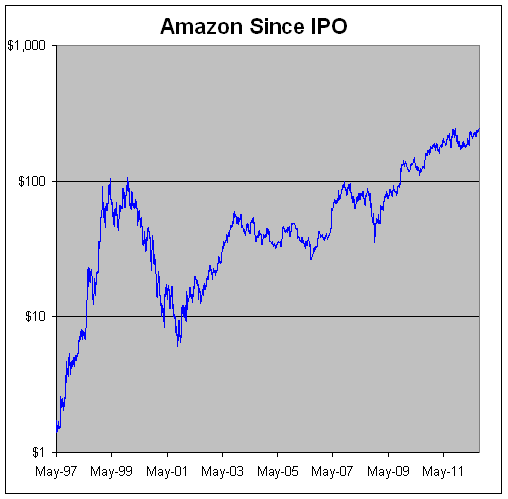
The problem, of course, is the “and hold on” part. Would you have been able to watch your initial investment at $113 plunge all the way down to $5.51 as Amazon did after 9/11? I doubt I could.
Wall Street currently expects Amazon to earn $2.38 per share next year. That means the stock is going for 105 times earnings. I don’t think this will end well.
-
Morning News: August 30, 2012
Eddy Elfenbein, August 30th, 2012 at 8:10 amEuro-Area Confidence Drops, German Jobless Increases
ECB Action Prospects Underpin Italian Bond Auction
ICBC Profit Growth Slips to 11% as China Slowdown Hits Loans
China to Continue Investing in Europe
Gold Holds Steady Ahead of Jackson Hole Symposium
U.S. Q2 Growth Revised Up, Fed Still Seen in Play
Mortgage Settlement With Banks Starts To Ease Foreclosure Crisis
Hedge Fund Proposal Would Allow Secretive Enclave to Open Up
Costco, Limited Exceed August Sales Estimates
GSV Capital, Placing Bets on Start-Ups, Falters
Citigroup Agrees To Pay $590 Million In Shareholder Suit
Sears Holdings Exiting S&P 500
Joshua Brown: An Asset Allocator’s Prayer
Howard Lindzon: The Web and Google are Winning…Facebook and Twitter are only #Winning
Be sure to follow me on Twitter.
-
JoS A Bank Soars on Strong Earnings
Eddy Elfenbein, August 29th, 2012 at 3:35 pmFor the second time this week, one of our Buy List stocks is soaring. And for the second time, it was one of the stocks I had been down on.
This morning, JoS. A. Bank Clothiers ($JOSB) reported quarterly earnings of 83 cents per share for its fiscal second quarter. That was 10 cents per share more than Wall Street had been expecting. The metric is that same-store sales were up 6.1%. The company did especially well with its online sales.
JoS A Bank, which competes with Men’s Wearhouse Inc, has set up Amazon.com Inc and eBay Inc stores, aiming for a bigger slice of shoppers’ wallets by catering to different consumers than the ones who come to their own websites and physical stores.
Sales at its direct marketing segment, which comprises the Internet and catalog call centers, rose 39.3 percent for the second quarter. The segment recorded higher sales in August compared to last year, the company said.
Direct marketing, driven primarily by Internet sales, accounted for about 10 percent of total sales last year.
Several retailers are looking to grow into the online market place by setting up storefronts on Amazon and eBay.
JoS A Bank also signed up for PayPal’s in-store service in May that allows shoppers to pay through their mobile phones, making purchases at brick-and-mortar stores easier.
Comparable store sales increased 6.1 percent for three months ended July 28. Total sales rose 12.9 percent to $260.3 million.
In last week’s CWS Market Review, I expressed my frustration with JoS. A. Bank. I even said that adding it to this year’s Buy List was a mistake. This is why I don’t try to time the market. Though in my defense I did say that the stock wasn’t unreasonably priced at $41.
At one point today, the stock was up 18.76%, and that doesn’t include the stock’s 3.51% rally yesterday. JOSB has settled down some and it’s currently up just over 14%. Of course, much of today’s gain is merely walking back losses from earlier in the year. As of now, JOSB is down just over 2% for the year.
-
Q2 GDP Growth = 1.7%
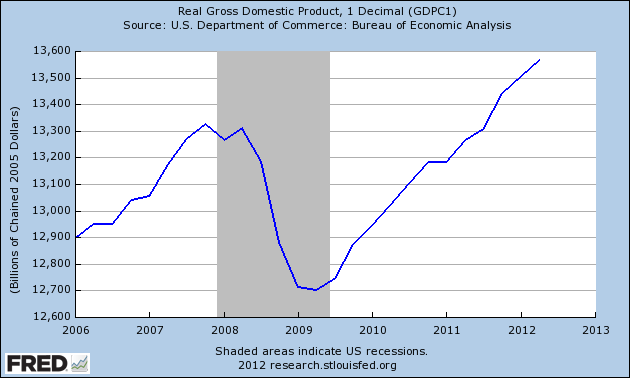
Eddy Elfenbein, August 29th, 2012 at 11:15 amThe economy had some good news, and it’s slightly more evidence in favor of our the-economy-is-stronger-than-people-realize thesis. The government revised higher its estimate for second quarter GDP growth.
The initial estimate one month ago said the economy grew by 1.5% during the second quarter. Now they’re saying it was 1.7%. Sure, that’s not a major revision but at least it’s in the right direction.
A second straight quarter of slowing growth shows the world’s largest economy is having difficulty making headway as consumers stay frugal and looming tax changes prompt companies to limit investment and hiring. Chairman Ben S. Bernanke this week may reaffirm the view of many Federal Reserve policy makers that more stimulus will be needed unless the expansion shows signs of strengthening.
“We are very much struck in a slow-growth mode,” said Mark Vitner, a senior economist at Wells Fargo Securities LLC in Charlotte, North Carolina, who correctly forecast the revision. “We still don’t see the economy breaking free of this 1.5 percent to 2 percent growth rate. A 1.7 percent pace is the personification of the Fed’s frustration.”
The economy grew by 2% in the first quarter. Before today’s data came out, we were able to say that economic growth was “decelerating,” meaning rate of growth was slowing. That’s still technically true, but it’s probably more accurate to say that growth has leveled off during the first half of this year.
-
Morning News: August 29, 2012
Eddy Elfenbein, August 29th, 2012 at 7:34 amDraghi Hits Back at German Criticism of ECB Bond Plan
Spain, Italy Yields Hit 2-Week Highs on New Issue, Catalonia
AgBank Sees Stern Challenges Ahead
Hungary Tests Investors With Rate Cut as Recession Deepens
What Downturn? Bank Profits Hit $34.5 Billion
Home Prices Jump In 20 Major U.S. Cities
Consumer Confidence in U.S. Declines by Most Since October
Occupy Sets Wall Street Tie-Up as Protesters Face Burnout
Daikin Buys Goodman For $3.8 Billion, Gains Access To North America
U.S. Sets Higher Fuel Efficiency Standards
Ford Breaks Ground On New Plant In Eastern China
GM To Invest $1 Billion In Russia Within 5 Years
Lexmark’s Inkjet Exit Symptomatic Of Industry
Stone Street: Book Review: “Bailout” by Neil Barofsky, or: Why I’ll Never Work in Washington D.C.
Be sure to follow me on Twitter.
-
Morning News: August 28, 2012
Eddy Elfenbein, August 28th, 2012 at 7:54 amSpain Says Recession Deepening, GDP Shrinks 0.4%
German at European Central Bank at Odds With Country’s Policy Makers
ECB Said to Urge Weaker Basel Liquidity Rule on Crisis Risks
A Youthful Populace Helps Make the Philippines an Economic Bright Spot in Asia
Occupy Hong Kong Holdouts Defy Order to Leave Despite Effort by HSBC
Greece Plans “Special Economic Zones” To Boost Growth
Isaac Seen Making Release of U.S. Strategic Oil Likely
Apple Seeks Ban on Sales of Eight Samsung Phones in U.S.
IBM Taps Into Talent With Kenexa Buy
Struggling AOL Defies Gravity Again
Ford’s European Legacy Losing to Hyundai’s Newcomer Edge
Ford Readies Lincoln Launch In China By 2014
New York Bank Merger May Be Too Good To Be True
Credit Writedowns: Profit Incentives, Disruptive Technology, and Reducing Health Care Costs
Cullen Roche: John Bogle’s 10 Rules of Investing
Be sure to follow me on Twitter.
-
Harris Raises Dividend
Eddy Elfenbein, August 27th, 2012 at 10:52 amMore good news for our Buy List this morning. Harris ($HRS) just announced a 12% dividend increase. The quarterly dividend is rising from 33 to 37 cents per share. Going by Friday’s close, the stock yields 3.18%.
-
Hudson City to Merge With M&T Bank
Eddy Elfenbein, August 27th, 2012 at 8:37 amOne of our Buy List stocks is getting married! Hudson City ($HCBK) has decided to merge with M&T Bank ($MTB). Investors can get cash or stock worth 0.08403 of an MTB share. Based on Friday’s close, that comes to $7.2156 per share. Hudson City closed Friday at $6.44 per share.
My advice is to take the MTB shares, and that’s how I’ll adjust the Buy List.
Here’s the press release:
Hudson City Bancorp, Inc. (HCBK) (“Hudson City”) and M&T Bank Corporation (MTB) (“M&T”) announced today that they have entered into a definitive agreement under which Hudson City will merge into a subsidiary of M&T, expanding the premier community banking franchise in the eastern United States.
Under terms of the agreement, each Hudson City share will receive consideration valued at 0.08403 of an M&T share in the form of either M&T stock or cash, based upon the election of each Hudson City shareholder, subject to proration as specified in the merger agreement (which provides for an aggregate split of total consideration of 60% common stock of M&T and 40% cash). Based on the closing price of M&T stock on August 24, 2012, the transaction is valued at approximately $3.7 billion. The transaction is expected to be immediately accretive to the combined company’s capital ratios, capital generation and tangible book value per share, as well as its GAAP and operating earnings per share.
“This merger creates tremendous opportunities to build on the successes that each company has achieved individually in its own markets,” said Hudson City Chairman and CEO, Ronald E. Hermance, Jr. “Hudson City recently embarked on a diversification of our product lines and our balance sheet. This transaction accelerates that transformation. As we combine Hudson City’s attractive retail network with M&T’s full service commercial banking suite, our stakeholders will participate in the growth of one of the nation’s strongest and most successful banking franchises.”
“M&T, which was established in 1856, and Hudson City, founded in 1868, have been serving their customers and communities for generations, and we look forward to building on that long history and tradition together in the future,” said Robert G. Wilmers, M&T Chairman and CEO.
M&T will acquire Hudson City’s network of 135 branch offices, which are located in New Jersey (97 branches), downstate New York (29 branches) and Fairfield County, Connecticut (9 branches). M&T’s existing branch network is adjacent to Hudson City’s franchise, with very little overlap. The combined network of 870 branches will stretch from Connecticut to Virginia.
M&T expects to gain approximately $25 billion in deposits and $28 billion in loans from the merger (before acquisition accounting adjustments), giving M&T the fourth largest deposit share in New Jersey.
“To the customers and communities now served by Hudson City, M&T brings a wider array of banking products and services,” continued Wilmers. “As a thrift, Hudson City focused primarily on deposits and mortgages. M&T will build on Hudson City’s loyal customer base to create a comprehensive community banking franchise that provides a full range of checking and savings accounts, debit and credit cards, home equity loans and other lending options, plus small business and commercial banking services and our premier wealth management and corporate trust solutions through Wilmington Trust.”
Headquartered in Buffalo, N.Y., M&T has $80.8 billion in assets. Hudson City, based in Paramus, N.J., currently has $43.6 billion in assets. After the merger is completed, M&T expects to repay approximately $13 billion of Hudson City’s long-term borrowings by liquidating its comparably sized investment portfolio. M&T’s pro forma balance sheet will have then increased by approximately $28 billion.
The merger has been approved by the boards of directors of each company, and is subject to certain conditions, including regulatory approvals and approval by M&T’s and Hudson City’s common shareholders. After the transaction is completed, Mr. Hermance will be appointed to the boards of directors of M&T and its principal banking subsidiary, M&T Bank.
J.P. Morgan acted as financial adviser to Hudson City and rendered a fairness opinion in connection with the transaction, and Sullivan & Cromwell LLP acted as its legal adviser. Evercore Partners rendered a fairness opinion to M&T in connection with the transaction, and Wachtell, Lipton, Rosen & Katz acted as its legal adviser.
M&T is a financial holding company headquartered in Buffalo, New York. M&T’s principal banking subsidiary, M&T Bank, operates banking offices in New York, Pennsylvania, Maryland, Virginia, West Virginia, Delaware and the District of Columbia. Trust-related services are provided by M&T’s Wilmington Trust-affiliated companies and by M&T Bank.
Hudson City Bancorp, Inc. maintains its corporate offices in Paramus, New Jersey. Hudson City Savings Bank, a well-established community financial institution serving its customers since 1868, is the largest thrift institution headquartered in New Jersey. Hudson City Savings Bank currently operates a total of 135 branch offices in the New York metropolitan and surrounding areas.
-
Archives
- June 2026
- May 2026
- April 2026
- March 2026
- February 2026
- January 2026
- December 2025
- November 2025
- October 2025
- September 2025
- August 2025
- July 2025
- June 2025
- May 2025
- April 2025
- March 2025
- February 2025
- January 2025
- December 2024
- November 2024
- October 2024
- September 2024
- August 2024
- July 2024
- June 2024
- May 2024
- April 2024
- March 2024
- February 2024
- January 2024
- December 2023
- November 2023
- October 2023
- September 2023
- August 2023
- July 2023
- June 2023
- May 2023
- April 2023
- March 2023
- February 2023
- January 2023
- December 2022
- November 2022
- October 2022
- September 2022
- August 2022
- July 2022
- June 2022
- May 2022
- April 2022
- March 2022
- February 2022
- January 2022
- December 2021
- November 2021
- October 2021
- September 2021
- August 2021
- July 2021
- June 2021
- May 2021
- April 2021
- March 2021
- February 2021
- January 2021
- December 2020
- November 2020
- October 2020
- September 2020
- August 2020
- July 2020
- June 2020
- May 2020
- April 2020
- March 2020
- February 2020
- January 2020
- December 2019
- November 2019
- October 2019
- September 2019
- August 2019
- July 2019
- June 2019
- May 2019
- April 2019
- March 2019
- February 2019
- January 2019
- December 2018
- November 2018
- October 2018
- September 2018
- August 2018
- July 2018
- June 2018
- May 2018
- April 2018
- March 2018
- February 2018
- January 2018
- December 2017
- November 2017
- October 2017
- September 2017
- August 2017
- July 2017
- June 2017
- May 2017
- April 2017
- March 2017
- February 2017
- January 2017
- December 2016
- November 2016
- October 2016
- September 2016
- August 2016
- July 2016
- June 2016
- May 2016
- April 2016
- March 2016
- February 2016
- January 2016
- December 2015
- November 2015
- October 2015
- September 2015
- August 2015
- July 2015
- June 2015
- May 2015
- April 2015
- March 2015
- February 2015
- January 2015
- December 2014
- November 2014
- October 2014
- September 2014
- August 2014
- July 2014
- June 2014
- May 2014
- April 2014
- March 2014
- February 2014
- January 2014
- December 2013
- November 2013
- October 2013
- September 2013
- August 2013
- July 2013
- June 2013
- May 2013
- April 2013
- March 2013
- February 2013
- January 2013
- December 2012
- November 2012
- October 2012
- September 2012
- August 2012
- July 2012
- June 2012
- May 2012
- April 2012
- March 2012
- February 2012
- January 2012
- December 2011
- November 2011
- October 2011
- September 2011
- August 2011
- July 2011
- June 2011
- May 2011
- April 2011
- March 2011
- February 2011
- January 2011
- December 2010
- November 2010
- October 2010
- September 2010
- August 2010
- July 2010
- June 2010
- May 2010
- April 2010
- March 2010
- February 2010
- January 2010
- December 2009
- November 2009
- October 2009
- September 2009
- August 2009
- July 2009
- June 2009
- May 2009
- April 2009
- March 2009
- February 2009
- January 2009
- December 2008
- November 2008
- October 2008
- September 2008
- August 2008
- July 2008
- June 2008
- May 2008
- April 2008
- March 2008
- February 2008
- January 2008
- December 2007
- November 2007
- October 2007
- September 2007
- August 2007
- July 2007
- June 2007
- May 2007
- April 2007
- March 2007
- February 2007
- January 2007
- December 2006
- November 2006
- October 2006
- September 2006
- August 2006
- July 2006
- June 2006
- May 2006
- April 2006
- March 2006
- February 2006
- January 2006
- December 2005
- November 2005
- October 2005
- September 2005
- August 2005
- July 2005
 Eddy Elfenbein is a Washington, DC-based speaker, portfolio manager and editor of the blog Crossing Wall Street. His