Author Archive
-
Fiserv Earns $1.28 Per Share
Eddy Elfenbein, July 30th, 2012 at 4:11 pmFiserv‘s ($FISV) Q2 earnings are out and the company made $1.28 per share for the second three months of the year. This was two cents more than Wall Street’s forecast. All across the board, these were solid results:
GAAP revenue in the second quarter was $1.10 billion compared with $1.07 billion in the second quarter of 2011. Adjusted revenue was $1.03 billion in the second quarter compared with $1.00 billion in 2011, an increase of 3 percent. For the first six months of 2012, GAAP revenue was $2.21 billion compared with $2.11 billion in 2011, and adjusted revenue was $2.06 billion compared with $1.99 billion in 2011, an increase of 4 percent.
GAAP earnings per share from continuing operations for the second quarter was $1.18 compared with $0.67 in 2011, which included a loss from early debt extinguishment of $0.26 per share. GAAP earnings per share from continuing operations for the first six months of 2012 was $2.13 compared with $1.45 in 2011, which included a loss from early debt extinguishment of $0.26 per share.
Adjusted earnings per share from continuing operations in the second quarter increased 13 percent to $1.28 compared with $1.13 in 2011. Adjusted earnings per share from continuing operations for the first six months of 2012 was up 15 percent to $2.48 compared with $2.15 in 2011.
“We achieved strong earnings and sales performance in the quarter consistent with our full year expectations,” said Jeffery Yabuki, President and Chief Executive Officer of Fiserv. “The continuing strength in the sales of our leading channel, payment and account processing solutions is providing strong forward momentum.”
As I suspected this morning, Fiserv raised the lower-end of its full-year forecast by four cents per share. The new range is $5.08 to $5.20 per share. At $72, this is a good deal.
-
Moog Earns 85 Cents Per Share
Eddy Elfenbein, July 30th, 2012 at 1:09 pmI neglected to mention Moog’s ($MOG-A) earnings report from Friday. Moog isn’t a well-known company but it ought to be; they make flight control systems for commercial and military aircraft. Even though defense budgets have come under the knife in the U.S. and Europe, Moog is still doing well.
The company earned 85 cents per share for its fiscal third quarter which was a penny ahead of estimates. Moog had earned 73 cents per share in the same quarter one year ago. On the bad side, the company cut its 2012 revenue estimate just slightly from $2.47 billion to $2.45 billion. For 2013, they see full-year earnings ranging between $3.50 and $3.70.
If they hit $3.70 per share, that would be a very strong number. That means the stock is going for just under 10 times forward earnings. The stock is up about 2.5% today.
-
Looking Ahead to the Fed’s Meeting
Eddy Elfenbein, July 30th, 2012 at 11:09 amThere’s a lot going on this week. For one, Europe seems to have Mario Draghi’s back in his attempt to save the euro. This won’t be easy and honestly, they don’t have much time left. Draghi is meeting with Tim Geithner today in Germany. I’m not sure how much that will help him.
Wall Street is also waiting the big jobs report, which comes this Friday. This will be a biggie and I don’t expect much good news. Wall Street expects a gain of 85,000 for NFP. There could, however, be a surge due to pent up demand from earlier this year.
Before the jobs report, the Fed holds a two-day meeting on Tuesday and Wednesday of this week. Any new policy will be announced on Wednesday afternoon. The latest talk is that the Fed may cut the interest rate it pays banks on their reserves. Since they only pay 0.25%, I’m not sure how much of an impact this would have. Interestingly, Draghi did this same move in Europe a few weeks ago. The idea is that by stopping rewarding them to park their money at the Fed, banks will have to lend their money out to consumers and businesses who, in turn, will get the economy up off its back.
Another idea being kicked around is that the Fed will extend its forecast for low interest rates. Previously, the central bank said its rates would be staying low through 2014. They could slap another year on that and make it through 2015.
-
Up 4% in Three Days
Eddy Elfenbein, July 30th, 2012 at 10:25 amThe stock market is slightly higher this morning. This is a continuation of the strong rally from Friday which led the S&P 500 to its highest close since May 3rd. The S&P 500 is up 4% over the last three trading sessions. From our Buy List, Fiserv ($FISV) is scheduled to report its earnings after the close. Shares of FISV are down a bit today but they’re very close to their 52-week high. Wall Street expects Q2 earnings of $1.26 per share.
Previously, Fiserv had told us to expect full-year earnings to range between $5.04 and $5.20 per share. That’s a high bar but I think the company has a very good chance of hitting that. In fact, I wouldn’t be surprised to see FISV raise the lower end of its guidance.
Even though the stock is near a 52-week high, it’s only going for about 14 times this year’s earnings estimate. That’s still a good deal.

-
Morning News: July 30, 2012
Eddy Elfenbein, July 30th, 2012 at 6:36 amEuro-Area Economic Confidence Drops More Than Forecast
After Pledge of Help for Euro, Pressure Is On for Bank Chief
Spanish Economy Contracts More Sharply
More Signs of Aid to Spain From Euro Partners
Japan Industrial Output Falls as Korea Confidence Sinks
SEC Freezes Trader Assets in Probe of Cnooc’s Nexen Bid
West Bank’s Emerging Silicon Valley Evades Issues of Borders
Fed Weighs Cutting Interest on Banks’ Reserves After ECB Move
HSBC Sets Aside $2 Billion For US Investigation, Mis-Selling
TNT Express Profit Beats Estimates as Cost-Savings Kick In
Peet’s Seen Tempting Starbucks to Top Richest Java Bid
Dubai Developer Nakheel’s H1 Net Profit Up 36.5%
Time Inc.’s New Chief Rethinks Magazines for a Digital Audience
Cullen Roche: Stagnating Corporate Profits…
Joshua Brown: How to Fix TheStreet.com
Be sure to follow me on Twitter.
-
Lightnin’ Hopkins – Baby Please Dont Go
Eddy Elfenbein, July 27th, 2012 at 3:57 pm -
Earnings Outlook Worst Since 2001
Eddy Elfenbein, July 27th, 2012 at 2:21 pmU.S. companies are more negative in their earnings outlooks than they have been in 11 years, due to mounting worries about Europe and slower overseas demand.
With pre-announcements in so far from 54 Standard & Poor’s 500 companies, the negative-to-positive ratio for the third quarter stands at 5 to 1, the most negative since the second quarter of 2001, according to Thomson Reuters data.
That’s a big increase from the second quarter’s ratio of 3.3 to 1, which included guidance from 143 S&P 500 companies.
“With all of the uncertainty around the global economy, Europe being at the top of the page, China being in the middle of the page and then the U.S. slowdown, it is completely understandable companies are issuing cautious remarks about future earnings,” said Leo Grohowski, who oversees more than $170 billion in client assets as chief investment officer at BNY Mellon Wealth Management in New York.
The third-quarter pre-announcement ratio is the latest bit of data to point to a deteriorating picture for U.S. earnings.
While the majority of companies who have reported results so far for the second quarter have beaten earnings expectations, just 40 percent have beaten revenue estimates, the lowest amount since the first quarter of 2009, Thomson Reuters data shows.
The technology sector has led in negative earnings guidance.
“Eighteen of the (40) negative ones were in tech, so almost half” came from that sector, said Greg Harrison, corporate earnings research analyst for Thomson Reuters. “But tech usually gives more guidance than other sectors.”
Among the most notable was Apple’s negative guidance for the third quarter. Apple also surprised investors by missing analysts’ estimates on earnings and revenue on second-quarter results.
-
Q2 GDP = 1.5%
Eddy Elfenbein, July 27th, 2012 at 9:56 amThe government released its first estimate of second-quarter GDP growth today and it was a better-than-expected 1.5%. The government also revised all the GDP data going back to 2009. It turns out that the recession wasn’t as bad as we thought, but the recovery wasn’t as strong.

-
CWS Market Review – July 27, 2012
Eddy Elfenbein, July 27th, 2012 at 6:34 amNow that the second-quarter earnings season is half over, we can say that the results aren’t so bad. Going into earnings season, we had many reasons to believe that it could have been far worse. Three such reasons were Europe, Europe and Europe. So far, 72% of the 255 companies in the S&P 500 that have reported earnings have topped estimates. But that’s against expectations. On a comparative basis, earnings are down 1.6% from a year ago. This the first quarterly earnings decline in three years.
In this issue of CWS Market Review, we’ll take a look at the flurry of Buy List earnings reports we had this week. Some were good and some were not so good. I’ll sort through the noise for you and highlight the best bargains.
I also want to discuss the market’s turn towards a defensive posture. This is a key point all investors need to understand. When the Street gets worried about the economy, sectors like Staples and Healthcare lead the way while Industrials and Energy stocks get left behind. Too many individual investors get blindsided by sector rotation. But first let’s look at why we already may be in the midst of an earnings recession.
How to Survive an Earnings Recession
The stock market has recovered quite well since early June, but there are a few ominous clouds on the horizon. For example, while nearly three-fourths of earnings reports have come in above expectations, only 43% have beaten their sales expectations. This suggests that companies are still relying on wider margins to grow their bottom lines. The problem with this strategy is that it can’t go on indefinitely.
The other trouble spot is that analysts are now ratcheting back their earnings forecasts for Q3. At the start of the third quarter, Wall Street expected Q3 earnings to grow by 3.1%. Now they see earnings dropping by 0.1%. While the economy is still growing at a very low but positive rate, the corporate world is probably in an earnings recession.
Wall Street is very sensitive to this shift and we’ve already seen a major sector rotation. Since February 3rd, the Morgan Stanley Cyclical Index (^CYC) is down by 12.2% while the S&P 500 is up by 1.1%. That’s a major divergence. The relative strength of the CYC just hit a three-year low. Key defensive sectors like Consumer Staples, Healthcare and Consumer Discretionaries have recently made all-time highs. The move away from cyclical stocks has held back some Buy List stocks like Ford ($F) and Moog ($MOG-A).
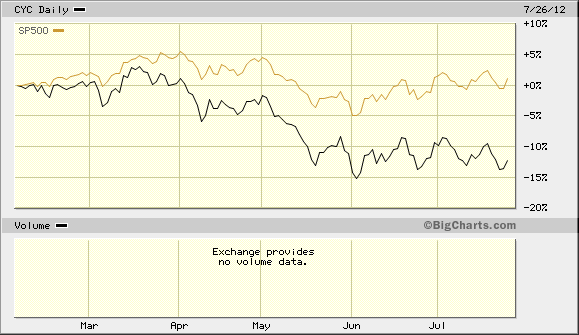
This defensive turn is matched by the tremendous surge in the bond market. The yields for long-term U.S. Treasuries are at all-time lows. It has never been cheaper for Uncle Sam to borrow money—and he’s been borrowing a lot.
Investors should stay far away from the ultra-low rates in the bond market. The 10-year Treasury gets you less than 1.5%, and the 20-year TIPs actually has a negative yield. There are plenty of stocks on our Buy List that yield more than that, and they have potential for growth.
This is also a good time for investors to get rid of overpriced stocks in their portfolio. A few weeks ago, I put together a list of stocks to avoid. I also caution investors to not be tempted by the dollar’s surge against the euro. The best part of that currency move has already happened. Investors should continue to focus on high-quality stocks, particularly some of the beaten down financials like JPMorgan Chase ($JPM) and Nicholas Financial ($NICK).
Dissecting Earnings from Ford, AFLAC and Others
I’m going to touch on the six Buy List earnings reports we had this week. Before I do, let me stress that with our style of investing, we don’t have to worry so much about a company earning precisely this or that. The earnings guessing game just ain’t worth playing. All of our Buy List stocks are high-quality companies. Just to make it here, they gotta be very, very good. With our earnings reports, we just want to see if business is going well. Missing by a penny or two…well, that doesn’t bother me at all.
Last Friday, Reynolds American ($RAI) reported earnings of 79 cents per share which was three cents more than estimates. I don’t care about that at all. The important news is that Reynolds reiterated its full-year forecast of $2.91 to $3.01 per share. They’re clearly on track to hit that. RAI yields 5.2%.
On Wednesday, Ford Motor ($F) reported earnings that were frankly rather blah. The automaker made 30 cents per share which was two cents better than Wall Street’s estimate. I’m not wild about these results but I’m comforted that Ford’s problems were due to weakness in Europe. Business in North America is still going very well. On Thursday, the stock closed at $8.96 which is a very low price. This is a good example of a cyclical company that’s been punished by an unforgiving sector rotation. Ford may be the cheapest major stock on Wall Street.
On Tuesday, AFLAC ($AFL) reported earnings of $1.61 per share which matched Wall Street’s estimate. Frankly, this earnings report was also disappointing, but just slightly. AFLAC has done a very good job of paring back on problematic investments in its portfolio. This seems to have caused Wall Street undue worry but I’m pleased with how the company has addressed the issue.
AFLAC said that it expects third-quarter earnings to range between $1.64 and $1.69 per share. The Street had been expecting $1.63 per share. AFLAC also narrowed its full-year guidance from $6.46 – $6.65 per share to $6.45 – $6.52 per share (assuming an average exchange yen/dollar rate of 80).
AFLAC is standing by its forecast that earnings growth will accelerate next year. That probably means that earnings will range somewhere between $6.80 and $7.00 per share. In other words, AFLAC is going for roughly six times next year’s profit. The shares pulled back this week, but my outlook hasn’t changed at all. AFLAC is a very good buy anytime the shares are below $50.
On Thursday, CA Technologies ($CA), our #1 performer on the year, reported quarterly earnings of 63 cents per share which was two cents above Wall Street’s consensus. This was a good quarter for CA in a difficult environment. The company shaved three cents off the top-end of their full year forecast (the June quarter is their fiscal Q1). That’s not a big deal. Once again, currency was a drag. CA is one of the most stable stocks on our Buy List. The stock currently yields 3.8% and is a strong buy up to $30 per share.
After the closing bell on Wednesday, CR Bard ($BCR) reported second-quarter earnings of $1.62 per share. The market wasn’t pleased as the stock dropped 4.7% on Thursday, but I think it’s a decent number. The company had given a range of $1.61 to $1.65 per share and Wall Street was expecting $1.64 per share, so Bard was in the ballpark. As with other companies this earnings season, Bard is running its business well. The problem is the economy in other parts of the world, especially Europe.
On the earnings call, Bard says it sees Q3 earnings ranging between $1.60 and $1.64 per share. Wall Street had been expecting $1.68 and I thought it could have been as high as $1.70 per share. Bard had previously said that it sees earnings growing by 3% to 4% for this year, and they reiterated that forecast. That works out to a range of $6.59 to $6.66 per share for this year. CR Bard remains a solid buy whenever the stock is below $112 per share.
Hold Hudson City
One of the Buy List stocks that I’m really having reservations about is Hudson City Bancorp ($HCBK). The other is JoS. A. Bank ($JOSB). Make no mistake, Hudson City is a fundamentally good stock, but I didn’t appreciate how much the business got squeezed by the low-rate environment. The stock ran out to a big gain for us early in the year, but HCBK has since given all of it back. This week’s earnings report was decent (15 cents per share, one penny more than estimates).
The best news is that Hudson City will keep its dividend at eight cents per share. If that payout holds for the following year, the shares will yield 5.4%. There’s no reason to sell HCBK, but I’m lowering it to a hold. I doubt Hudson City will be on next year’s Buy List.
This coming week, we’ll have earnings from Fiserv ($FISV), Harris ($HRS), Wright Express ($WXS), DirecTV ($DTV) and Nicholas Financial ($NICK). You can see an earnings calendar here.
Let me add a quick word about Wright Express. The stock got knocked down in May after the company guided lower for Q2. Yet Wright kept their full-year forecast the same. This shows you how short-sighted Wall Street can be. Less than a month after the earnings report, shares of Wright began a furious rally. Since early June, the stock is up more than 20% and it’s close to making a fresh 52-week high. Rational? No. But it’s not uncommon on Planet Wall Street.
That’s all for now. More earnings reports are coming next week. Then on Friday, all eyes will be on the July jobs report. Be sure to keep checking the blog for daily updates. I’ll have more market analysis for you in the next issue of CWS Market Review!
– Eddy
-
Morning News: July 27, 2012
Eddy Elfenbein, July 27th, 2012 at 5:47 amEurope’s Brutal Game of Dominoes
Bundesbank Maintains Opposition to ECB Bond Buying
Spanish Unemployment Hits Fresh All-Time High
Geithner Faces Senate on Rate-Rigging Scandal
Wary Consumers To Weigh On Growth In Second Quarter
For Food, It’s the Bad and the Ugly
For Big Drug Companies, a Headache Looms
Facebook Revenue Growth Skids, Shares Plunge
Google Move Buoys Chicago Tech Hub
Starbucks Loses a Bit of Steam
Samsung Shares Surge on Buoyant Phone, TV Sales Forecasts
Porsche Profit Jumps on 911 Demand as Volkswagen Purchase Nears
Renault Profit Declines 37% in First Half
Jeff Miller: Four Common Mistakes About the Fed
Jeff Carter: Did The Tech Bubble Burst Again?
Be sure to follow me on Twitter.
-
Archives
- June 2026
- May 2026
- April 2026
- March 2026
- February 2026
- January 2026
- December 2025
- November 2025
- October 2025
- September 2025
- August 2025
- July 2025
- June 2025
- May 2025
- April 2025
- March 2025
- February 2025
- January 2025
- December 2024
- November 2024
- October 2024
- September 2024
- August 2024
- July 2024
- June 2024
- May 2024
- April 2024
- March 2024
- February 2024
- January 2024
- December 2023
- November 2023
- October 2023
- September 2023
- August 2023
- July 2023
- June 2023
- May 2023
- April 2023
- March 2023
- February 2023
- January 2023
- December 2022
- November 2022
- October 2022
- September 2022
- August 2022
- July 2022
- June 2022
- May 2022
- April 2022
- March 2022
- February 2022
- January 2022
- December 2021
- November 2021
- October 2021
- September 2021
- August 2021
- July 2021
- June 2021
- May 2021
- April 2021
- March 2021
- February 2021
- January 2021
- December 2020
- November 2020
- October 2020
- September 2020
- August 2020
- July 2020
- June 2020
- May 2020
- April 2020
- March 2020
- February 2020
- January 2020
- December 2019
- November 2019
- October 2019
- September 2019
- August 2019
- July 2019
- June 2019
- May 2019
- April 2019
- March 2019
- February 2019
- January 2019
- December 2018
- November 2018
- October 2018
- September 2018
- August 2018
- July 2018
- June 2018
- May 2018
- April 2018
- March 2018
- February 2018
- January 2018
- December 2017
- November 2017
- October 2017
- September 2017
- August 2017
- July 2017
- June 2017
- May 2017
- April 2017
- March 2017
- February 2017
- January 2017
- December 2016
- November 2016
- October 2016
- September 2016
- August 2016
- July 2016
- June 2016
- May 2016
- April 2016
- March 2016
- February 2016
- January 2016
- December 2015
- November 2015
- October 2015
- September 2015
- August 2015
- July 2015
- June 2015
- May 2015
- April 2015
- March 2015
- February 2015
- January 2015
- December 2014
- November 2014
- October 2014
- September 2014
- August 2014
- July 2014
- June 2014
- May 2014
- April 2014
- March 2014
- February 2014
- January 2014
- December 2013
- November 2013
- October 2013
- September 2013
- August 2013
- July 2013
- June 2013
- May 2013
- April 2013
- March 2013
- February 2013
- January 2013
- December 2012
- November 2012
- October 2012
- September 2012
- August 2012
- July 2012
- June 2012
- May 2012
- April 2012
- March 2012
- February 2012
- January 2012
- December 2011
- November 2011
- October 2011
- September 2011
- August 2011
- July 2011
- June 2011
- May 2011
- April 2011
- March 2011
- February 2011
- January 2011
- December 2010
- November 2010
- October 2010
- September 2010
- August 2010
- July 2010
- June 2010
- May 2010
- April 2010
- March 2010
- February 2010
- January 2010
- December 2009
- November 2009
- October 2009
- September 2009
- August 2009
- July 2009
- June 2009
- May 2009
- April 2009
- March 2009
- February 2009
- January 2009
- December 2008
- November 2008
- October 2008
- September 2008
- August 2008
- July 2008
- June 2008
- May 2008
- April 2008
- March 2008
- February 2008
- January 2008
- December 2007
- November 2007
- October 2007
- September 2007
- August 2007
- July 2007
- June 2007
- May 2007
- April 2007
- March 2007
- February 2007
- January 2007
- December 2006
- November 2006
- October 2006
- September 2006
- August 2006
- July 2006
- June 2006
- May 2006
- April 2006
- March 2006
- February 2006
- January 2006
- December 2005
- November 2005
- October 2005
- September 2005
- August 2005
- July 2005
 Eddy Elfenbein is a Washington, DC-based speaker, portfolio manager and editor of the blog Crossing Wall Street. His