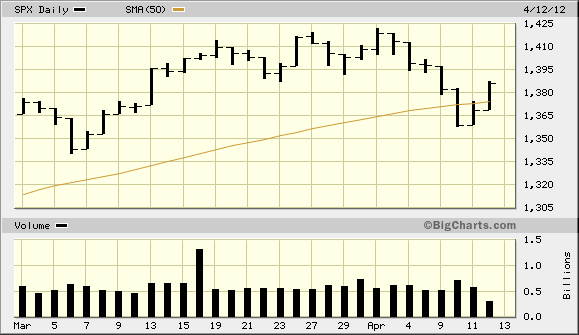
There’s an old Wall Street saying that investors should “sell in May and go away.” Recent years have been excellent examples. Last year, the stock market peaked on April 29th and in 2010, it peaked on April 23rd. This year, the S&P 500 is down since April 2nd.
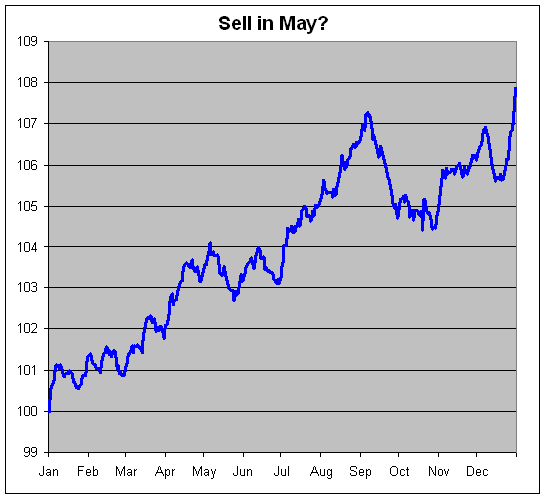
I recently crunched all the Dow’s daily closing figures going back to 1896 and found that there is, indeed, a seasonal effect. The chart below shows what the Dow has done, on average, throughout the year. Historically, the Dow hits a peak on May 6th and pulls back an average of 1.33% by May 25th. The chart shows that even by October 27th, the Dow has advanced just 0.34% from May 6th. This means that the market is nearly flat for slightly more than one-third of the year. Excluding that period, that has gained an average of 7.5% for the rest of the year.
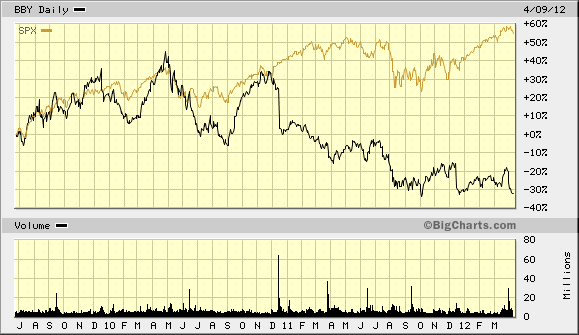
Brian Dunn is out at Best Buy ($BBY). Since he became CEO, the stock had dropped from $33 to $22 while the S&P 500 rallied from 900 to 1,400.
Investor’s Business Daily referenced this post in one of their editorials.
Numbers tell the story. Since Obama entered office promising a jobs boom from his “stimulus,” the economy has lost 1.6 million jobs. Since the employment peak in early 2008, 5.2 million jobs have disappeared.
Labor participation rates have plunged in recent years, in part due to retirements, but mostly due to people just dropping out — they can’t find jobs at all.
Today, a record 100.5 million Americans older than 16 don’t have jobs, up 34% since 2000. As Eddy Elfenbein, editor of the Crossing Wall Street blog, notes, “If we were to have the same jobs-to-population ratio as 12 years ago, there would have to be 14.6 million more jobs, or 22.6 million fewer people.”
That’s the scale of the damage done to our economy.
Bloomberg has an interesting article today on one of our Buy List favorites, DirecTV ($DTV). The article highlights two importact facts about DTV.
One is how well the company is doing in Latin America (“It’s not hard to envision a day when Latin America is perceived to be the core of DirecTV, and where the U.S. is an afterthought”).
The other is the enormous cash flow the company generates. They’re buying back $100 million of their shares per week.
Today was an ugly day on Wall Street. The market is still reeling from Friday’s jobs report. The cylicals were hit especially hard as were many financials.
There are a few things to remember: The market has climbed almost continuously for six-straight months, so some give back is to be expected. Also, the jobs report is hardly evidence that the new recession is on the way. It merely signals that jobs growth isn’t quite as robust as we thought. These numbers will be revised and the other evidence continues to show a modestly improving jobs environment.
One outlier in today’s selloff was Nicholas Financial ($NICK). The shares closed at $12.42 which is a 5.48% fall from Thursday’s close. The stock got as low at $12.14 in today’s trading. I wouldn’t worry about this at all.
There’s absolutely no news to indicate that NICK is in any trouble. This is purely a market-driven event. If anything, the belief that the Fed will hold down rates for a while longer is actually good news for NICK. Going by today’s close, the stock yields 3.22%.
 Eddy Elfenbein is a Washington, DC-based speaker, portfolio manager and editor of the blog Crossing Wall Street. His