Author Archive
-
Booming North Dakota
Eddy Elfenbein, November 8th, 2011 at 10:03 amEver heard of the Bakken formation? You soon will. Thanks to oil, western North Dakota’s economy is growing so fast that communities are struggling to keep up. Strippers make $2,000 a night. Here’s a look at how fast production is growing.
-
Morning News: November 8, 2011
Eddy Elfenbein, November 8th, 2011 at 5:32 amEU Eyes December Start for Rescue Fund
In Turmoil, Greece and Italy Deepen Euro Crisis
Interest Rates on Italian Bonds Pushed to New Levels
Businesses Feel the Pinch as China Tightens Lending
Oil Trades Near a Three-Month High on U.S. Supply, European Crisis Outlook
Promises Made, and Remade, by Firms in S.E.C. Fraud Cases
MF Global’s Europe Clients Fume, U.S. Breathes Easier
Its Leader on Sidelines, Regulator Faces Biggest Test in MF Global
Toyota Q2 Falls 32%, Withdraws Full-year Forecast
Olympus Hid Losses With Acquisition Fees
Societe Generale Q3 Profit Declines 31% on Greece
Vodafone Raises Full-Year Forecast
Global Reinsuring Giant Munich Re’s Quarterly Net Decline Exceeds Analysts’ Forecast
Facebook Wins Battle of Europe Clones
High Bank Fees Give Wal-Mart a Money Aisle
Edward Harrison: Italy’s Debt Woes and Germany’s Intransigence Lead to Depression
Paul Kedrosky: Germany, Not China, Must Bail Europe
Be sure to follow me on Twitter.
-
Buffett Is Buying
Eddy Elfenbein, November 7th, 2011 at 10:36 amFrom Bloomberg:
Warren Buffett’s Berkshire Hathaway Inc. (BRK/A) invested $23.9 billion in the third-quarter, the most in at least 15 years, as he accelerated stock purchases and broadened the portfolio beyond consumer and financial-company holdings.
Berkshire bought almost $7 billion of equity securities in the three months ended Sept. 30, compared with $3.62 billion in the second quarter and $834 million in the first, the Omaha, Nebraska-based company said Nov. 4 in a filing. Stockholdings labeled “commercial, industrial and other” soared 62 percent in the three months to $17.4 billion on a cost basis, surpassing equity investments in financial and consumer-product firms.
“He sees something, and it’s big,” said Thomas Russo, a partner at Berkshire investor Gardner Russo & Gardner.
Buffett, 81, drew down Berkshire’s cash as Europe’s debt crisis and Standard & Poor’s downgrade of the U.S. pushed stocks to their worst quarterly performance since 2008. The investments disclosed Nov. 4 include $6.9 billion of equities, $5 billion for preferred shares and warrants in Bank of America Corp. and the acquisition of Lubrizol Corp. for about $9 billion.
Buffett is expanding a portfolio that for more than 20 years has included equity stakes in Coca-Cola Co. (KO), the world’s largest soft-drink maker, and Wells Fargo & Co. (WFC), now the No. 1 U.S. home lender. The chairman and chief executive officer acquired a power company in 2000 and railroad Burlington Northern Santa Fe last year.
“Historically he has preferred consumer products and banking to industrial companies,” said James Armstrong, president of Berkshire shareholder Henry H. Armstrong Associates. “But the market changes, so the names he comes up with changes.”(Via: The Reformed Broker)
-
Sysco Earns 55 Cents Per Share
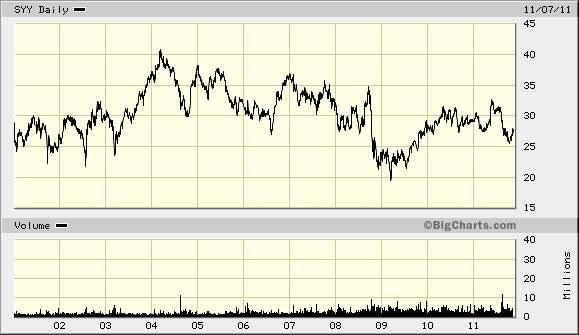
Eddy Elfenbein, November 7th, 2011 at 9:58 amSysco ($SYY) just reported earnings for its fiscal first quarter of 55 cents per share which was three cents better than estimates. Quarterly revenue rose 8.6% to $10.59 billion which was $140 million over consensus.
First Quarter Fiscal 2012 Highlights
* Sales were $10.6 billion, an increase of 8.6% from $9.8 billion in the first quarter of fiscal 2011.
* Operating income was $509 million, an increase of 0.6%, compared to $506 million in last year’s first quarter, and Sysco’s highest first quarter on record.
* Adjusted1 operating income increased 6.1%, excluding gross business transformation expenses and the impact of corporate-owned life insurance (COLI).
* Diluted earnings per share (EPS) were $0.51, which included a $0.04 negative impact from gross business transformation expenses. Last year’s first quarter EPS was also $0.51, but included a $0.02 benefit from COLI and a $0.02 negative impact from gross business transformation expenses.
* Adjusted diluted EPS was $0.55, an increase of 7.8%, excluding gross business transformation expenses and the impact of COLI.
“I am encouraged by our underlying business performance during the quarter as softening consumer sentiment contributed to ongoing challenges for the foodservice industry,” said Bill DeLaney, Sysco’s president and chief executive officer. “Our associates remain committed to supporting our customers by meeting and exceeding their expectations each and every day.”
First Quarter Fiscal 2012 Summary
Sales for the first quarter were $10.6 billion, an increase of 8.6% compared to sales in the same period last year. Food cost inflation, as measured by the estimated change in Sysco’s product costs, was 7.3%. Inflation continued to be broad-based, but was impacted most significantly by increased prices for dairy, meat and canned/dry products. This compares to inflation of 3.3% in the prior year period, and 5.9% in the fourth quarter of fiscal 2011. In addition, sales from acquisitions (within the last 12 months) increased sales by 0.7%, and the impact of changes in foreign exchange rates for the first quarter increased sales by 0.7%. Case volume for the company’s Broadline and SYGMA operations combined grew nearly 2% during the quarter including acquisitions, and more than 1% excluding acquisitions.
Gross profit for the first quarter was $1.9 billion, an increase of 5.5%, compared to the prior year. Operating expenses in the first quarter increased $98 million, or 7.3%, compared to operating expenses in the prior year period. This was due mainly to a $40 million increase in payroll expense, a $16 million increase in gross business transformation expenses, a $14 million increase in fuel expense and a $13 million lower benefit from COLI, partially offset by a $7 million decline in expenses for the corporate-sponsored pension plan. Excluding gross business transformation expenses and the impact of COLI, adjusted operating expenses increased 5.3%. Management believes that excluding these items better represents the company’s underlying business performance.
Operating income was $509 million in the first quarter, increasing $3 million, or 0.6% compared to operating income in the prior year. Excluding gross business transformation expenses and the impact of COLI, adjusted operating income increased 6.1%.
Net earnings for the first quarter were $303 million, an increase of $4 million, or 1.2%, compared to net earnings in the prior year. Diluted EPS in the first quarter of fiscal 2012 was $0.51, which included a $0.04 negative impact from gross business transformation expenses. Last year’s first quarter EPS was also $0.51, but included a $0.02 benefit from COLI and a $0.02 negative impact from gross business transformation expenses.Excluding gross business transformation expenses and the impact of COLI, first quarter fiscal 2012 adjusted EPS was $0.55, an increase of 7.8% compared to the prior year.
Cash Flow and Capital Spending
Cash flow from operations was $255 million for the first quarter of fiscal 2012. Capital expenditures totaled $227 million for the first quarter, including $45 million related to the company’s business transformation project. The primary areas for investment included facility replacements and expansions, replacements to Sysco’s fleet, and technology.
-
Morning News: November 7, 2011
Eddy Elfenbein, November 7th, 2011 at 5:02 amPapandreou to Step Down in Accord on Unity Government
World Economy Dodges Slump With China-U.S. Buoy
Stocks Decline, Euro Weakens on Italian Vote Concern; Swiss Franc Slides
Danish Firms Pleading With Banks for Credit
China Swaps Drop Most Since ‘08
Thailand Flooding Cripples Hard-Drive Suppliers
Futures Signal Weaker Start for Equities
CME, ICE Cut Margin Needs to Limit MF Global Fallout
Carphone Sells U.S. Stake to Best Buy
Ryanair Boosts Profit Forecast 10% on Fares
Buffett Broadens Portfolio by Spending $23.9 Billion
Cnooc Purchase of BP’s $7.1 Billion Argentine Unit Scrapped
Vodacom Earnings Miss Estimates on Network Spending, Prices
Disney and YouTube Make a Video Deal
Stone Street: How I Learned to Stop Worrying and Love Italy’s Finances
Epicurean Dealmaker: Known Unknowns
Howard Lindzon: Investing and Trading….Just Words.
Be sure to follow me on Twitter.
-
The New York Times on Place-Kicking
Eddy Elfenbein, November 6th, 2011 at 3:33 pmThe New York Times has a fascinating article on the rise in kicking accuracy in the NFL.
Gee, it’s almost as if I read that somewhere before!
Here’s the NYT:
The only pure kicker in the Pro Football Hall of Fame, Jan Stenerud, made only 17 of 64 field-goals attempts of 50 yards or more in his 19-year career. He made the most — converting 3 of 4 — in 1984.
This season, the most successful long-distance kickers, Oakland’s Sebastian Janikowski and Jacksonville’s Josh Scobee, have already made five each. Stenerud’s career field goal percentage was 66.8. Were he kicking this season, that would place Stenerud next to last in success rate, one-tenth of a point ahead of Jay Feely, the Arizona kicker who is having an unusually bad season at 66.7 (his career average is 81.8). Overall field goal percentage this season is 85.9, up from 82.3 last season.
This high-octane accuracy is completely new to football. In 1974, the first year when the uprights were placed at the back of the end zone, kickers made just four of 30 field goals from 50 or more yards. Jan Stenerud, the only pure placekicker in the Hall of Fame, made 66.8% of his career field goal attempts. Today that’s good enough for 105th place in career accuracy. Nearly every player in the top 30 for career accuracy is currently active.
Two entries on the same topic, using the same stats and even using the same obscure reference points — mine being posted a few days before. This could be a highly unusual coincidence, however, I’m very suspicious.
Update: The writer from the Times contacted me and claims she was unaware of my post. I’ve edited some of the language of this post to be less accusatory. You can read both and determine for yourself. I remain very suspicious.
-
Income Tax Poll Results
Eddy Elfenbein, November 5th, 2011 at 3:31 pmI want to thank everyone who participated in my recent (and highly unscientific) poll on the proper tax rate on $10 million. We had a total of 624 votes.
The answers were widely distributed but I calculated an estimated median tax rate of 33.53%.
Tax Rate Votes Percentage 0% 21 3.27% 1% to 5% 4 0.62% 5% to 10% 9 1.40% 10% to 15% 18 2.80% 15% to 20% 47 7.32% 20% to 25% 77 11.99% 25% to 30% 78 12.15% 30% to 35% 95 14.80% 35% to 40% 102 15.89% 40% to 45% 65 10.12% 45% to 50% 47 7.32% 50% to 55% 34 5.30% 55% to 60% 5 0.78% 60% to 65% 11 1.71% 65% to 70% 4 0.62% 70% or more 25 3.89% I’ve previously done similar polls for $25,000, $40,000, $100,000, $250,000 and $1 million.
Here are the results by estimated median vote:
$25,000: 2.66%
$40,000: 8.31%
$100,000: 16.33%
$250,000: 22.69%
$1,000,000: 28.23%
$10,000,000: 33.53%Breaking out a little math, we can make a three-bracket tax code that links the data above. It looks like this:
The first $21,245 is tax-free.
$21,245 to $74,275 is taxed at 17.73%.
$74,275 to $671,715 is taxed at 26.93%.
Over $671,715 is taxed at 34.12%.There are lots of ways to connect the data. We could add one more bracket at 10% and create a little more realistic code:
The first $18,350 is tax-free.
$18,350 to $28,410 is taxed at 10%.
$28,410 to $85,628 is taxed at 20%.
$85,628 to $85,628 is taxed at 27%.
Over $676,779 is taxed at 34.1%.Triumph Visits Occupy Wall Street
Eddy Elfenbein, November 4th, 2011 at 2:18 pmThe October Jobs Report
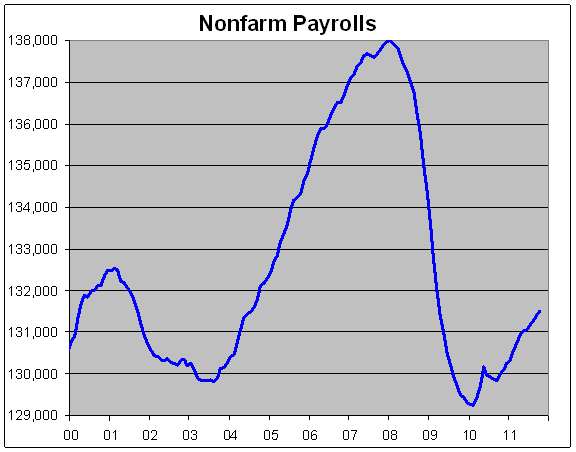
Eddy Elfenbein, November 4th, 2011 at 8:32 amThe economy created 80,000 jobs last month compared with Wall Street’s estimate of 100,000. Private sector jobs increased by 104,000.
The revision for September was plus 102,000.
The unemployment rate dropped 0.1% to 9%. The long-term unemployment number fell by 366,000 to 5.9 million.
Since the recession officially ended 28 months ago, the unemployment rate has dropped from 9.5% to 9%.
Moog Earns 83 Cents Per Share
Eddy Elfenbein, November 4th, 2011 at 7:01 amMoog ($MOG-A) just reported earnings for its fiscal fourth quarter of 83 cents per share, ten cents more than Wall Street’s forecast.
For all of 2011, Moog earned $2.95 per share. For 2012, the company sees sales increasing by 8% to $2.52 billion and EPS rising 12% to $3.31. Wall Street had been expecting $3.25 per share.
Moog Inc. announced today fiscal year 2011 sales of $2.33 billion, up 10%. Net earnings were $136 million and earnings per share of $2.95 were up 26% and 25%, respectively compared to last year.
For the fourth quarter, sales of $619 million were up 8% from last year. Net earnings were $38 million, up 18%, and earnings per share of $.83 were 17% higher than last year.
Aircraft sales for the year were $851 million, up 12% from the year previous, driven by very strong military and commercial aftermarket sales. Military sales were $498 million with sales on the F-35 Joint Strike Fighter, V-22 tilt rotor and the Blackhawk helicopter mostly unchanged. Military aftermarket sales were $204 million, a Company record. Commercial aircraft sales for the year of $314 million were 20% higher on stronger sales to Boeing and Airbus. Sales to business jet manufacturers were $33 million, a 24% improvement. Commercial aftermarket revenues of $100 million were 21% higher than a year ago. The Company’s navigation aids product line had sales of $38 million.
In the fourth quarter, Aircraft sales of $228 million were up 13% from the same quarter last year. Military aircraft sales were up 13%, once again the result of higher sales in the aftermarket. Commercial aircraft revenues in the quarter of $81 million were 10% higher. Boeing Commercial revenues were flat while revenues for products sold to business jet manufacturers were slightly higher. Sales to Airbus increased 36% as production increased on existing Airbus programs.
The Space and Defense segment had another strong year. Sales of $356 million were up 9%. Sales of controls on tactical missiles, at $66 million, were up 39% and offset lower sales on satellites. Deliveries for the Driver’s Vision Enhancer (DVE) system were about equal to last year. Security and surveillance product sales were up $21 million, helped by the 2010 Pieper acquisition. Sales to NASA on the Space Launch System and Crew Launch Vehicle development programs were up $10 million to a total of $28 million.
Space and Defense fourth quarter sales were up only slightly from a year ago at $93 million. The growth was mainly driven by NASA programs and security and surveillance products.
Sales for the year in the Industrial Systems segment were $629 million, a 15% increase. Capital equipment market sales were higher, reflecting strong demand for plastics machine controls, metal forming press controls and specialized test equipment. Sales of simulator motion systems were $69 million, up 43%. Wind energy sales, at $132 million, were lower than last year reflecting reduced demand from turbine manufacturers in China.
Industrial sales in the fourth quarter of $173 million were up 8%. Capital equipment sales were up 28% to $52 million and wind energy sales were $39 million.
Components Group sales for the year of $353 million, and for the fourth quarter of $89 million, were slightly lower than last year. Growth in marine, medical and industrial markets offset the weaker military aircraft and space and defense markets. Animatics, a third quarter 2011 acquisition, added $5 million in sales to the year.
The Medical Devices segment generated sales of $142 million, up 12% from last year. The segment showed significantly improved sales in the second half of the year. For the quarter, sales in Medical Devices of $37 million were up 18% from a year ago.
Year-end backlog of $1.3 billion was up $144 million, or 12%, from a year ago.
The Company updated its guidance for fiscal 2012. The current forecast has sales increasing 8% to $2.52 billion, net earnings of $152 million and earnings per share of $3.31, a 12% increase over fiscal 2011.
“Fiscal 2011 was another great year for our company,” said R.T. Brady, Chairman and CEO. “Strong sales growth produced even stronger earnings growth. Many good things are happening. Airplanes that we’ve worked on for years are moving into production. NASA now has a plan. The recovery in our industrial markets continues and our medical business is back on track. We look forward to an even stronger 2012.”
-
Archives
- June 2026
- May 2026
- April 2026
- March 2026
- February 2026
- January 2026
- December 2025
- November 2025
- October 2025
- September 2025
- August 2025
- July 2025
- June 2025
- May 2025
- April 2025
- March 2025
- February 2025
- January 2025
- December 2024
- November 2024
- October 2024
- September 2024
- August 2024
- July 2024
- June 2024
- May 2024
- April 2024
- March 2024
- February 2024
- January 2024
- December 2023
- November 2023
- October 2023
- September 2023
- August 2023
- July 2023
- June 2023
- May 2023
- April 2023
- March 2023
- February 2023
- January 2023
- December 2022
- November 2022
- October 2022
- September 2022
- August 2022
- July 2022
- June 2022
- May 2022
- April 2022
- March 2022
- February 2022
- January 2022
- December 2021
- November 2021
- October 2021
- September 2021
- August 2021
- July 2021
- June 2021
- May 2021
- April 2021
- March 2021
- February 2021
- January 2021
- December 2020
- November 2020
- October 2020
- September 2020
- August 2020
- July 2020
- June 2020
- May 2020
- April 2020
- March 2020
- February 2020
- January 2020
- December 2019
- November 2019
- October 2019
- September 2019
- August 2019
- July 2019
- June 2019
- May 2019
- April 2019
- March 2019
- February 2019
- January 2019
- December 2018
- November 2018
- October 2018
- September 2018
- August 2018
- July 2018
- June 2018
- May 2018
- April 2018
- March 2018
- February 2018
- January 2018
- December 2017
- November 2017
- October 2017
- September 2017
- August 2017
- July 2017
- June 2017
- May 2017
- April 2017
- March 2017
- February 2017
- January 2017
- December 2016
- November 2016
- October 2016
- September 2016
- August 2016
- July 2016
- June 2016
- May 2016
- April 2016
- March 2016
- February 2016
- January 2016
- December 2015
- November 2015
- October 2015
- September 2015
- August 2015
- July 2015
- June 2015
- May 2015
- April 2015
- March 2015
- February 2015
- January 2015
- December 2014
- November 2014
- October 2014
- September 2014
- August 2014
- July 2014
- June 2014
- May 2014
- April 2014
- March 2014
- February 2014
- January 2014
- December 2013
- November 2013
- October 2013
- September 2013
- August 2013
- July 2013
- June 2013
- May 2013
- April 2013
- March 2013
- February 2013
- January 2013
- December 2012
- November 2012
- October 2012
- September 2012
- August 2012
- July 2012
- June 2012
- May 2012
- April 2012
- March 2012
- February 2012
- January 2012
- December 2011
- November 2011
- October 2011
- September 2011
- August 2011
- July 2011
- June 2011
- May 2011
- April 2011
- March 2011
- February 2011
- January 2011
- December 2010
- November 2010
- October 2010
- September 2010
- August 2010
- July 2010
- June 2010
- May 2010
- April 2010
- March 2010
- February 2010
- January 2010
- December 2009
- November 2009
- October 2009
- September 2009
- August 2009
- July 2009
- June 2009
- May 2009
- April 2009
- March 2009
- February 2009
- January 2009
- December 2008
- November 2008
- October 2008
- September 2008
- August 2008
- July 2008
- June 2008
- May 2008
- April 2008
- March 2008
- February 2008
- January 2008
- December 2007
- November 2007
- October 2007
- September 2007
- August 2007
- July 2007
- June 2007
- May 2007
- April 2007
- March 2007
- February 2007
- January 2007
- December 2006
- November 2006
- October 2006
- September 2006
- August 2006
- July 2006
- June 2006
- May 2006
- April 2006
- March 2006
- February 2006
- January 2006
- December 2005
- November 2005
- October 2005
- September 2005
- August 2005
- July 2005
 Eddy Elfenbein is a Washington, DC-based speaker, portfolio manager and editor of the blog Crossing Wall Street. His