Author Archive
-
NFP +103,000
Eddy Elfenbein, October 7th, 2011 at 9:41 amThe economy created 103,000 jobs in September. The unemployment rate remains at 9.1%.
The good news is that the economy added 137,000 private sector jobs. Also, the number (private and non-private) for August was revised higher from zero to 57,000 jobs. The July number was revised higher from 85,000 to 127,000.
-
CWS Market Review – October 7, 2011
Eddy Elfenbein, October 7th, 2011 at 9:27 amOn Monday, the S&P 500 finally broke out of its 100-point trading range. For 41 sessions in a row, the index had closed between 1,119 and 1,219. But on Monday, the S&P 500 dropped down to close at 1,099.23. That was our first close below 1,100 in over a year.
Since then, the market has raced higher. On Thursday, the S&P 500 closed at 1,167.97 which is a 5.98% surge in just three days. Naturally, we shouldn’t get too excited by this recent uptick. For the last several weeks, the stock market has bounced up and down in high-volatility spikes, but ultimately, we haven’t moved very far. However, with earnings season upon us, this time could be different.
As usual, the hurdle has been Europe, and more specifically, Greece. For a few months now, investors have been jerked around as we wait to hear something (anything!) promising from the Old World. Unfortunately, European officials seem firmly committed to doing a series of half-steps—and after each one, they seem puzzled that things aren’t getting any better. The good news is that it appears as if some folks in Europe are starting to understand what needs to be done.
In this issue of CWS Market Review, I want to give you a preview of the third-quarter earnings season. While the overall market continues to spin its wheels, I think several of our Buy List stocks are poised to surge higher. In fact a few of our stocks, like Deluxe ($DLX) and Ford ($F), have already started to turn the corner.
I’m writing you in the wee hours of Friday morning. Later today, we’ll get the crucial jobs report for September. Wall Street has been dreading this report for several days now, and it’s easy to understand why. Frankly, nearly every jobs report for the last few years has been dismal. I’m afraid I’m not expecting much better for September’s report. Wall Street is expecting a gain of 60,000 nonfarm payroll jobs, and as low as that estimate is, it might be too high.
If the news is better than expected, it may take some of the pressure off the Federal Reserve to get the economy going again. But bear in mind that the economy needs to create, on average, 200,000 net new jobs every month for a few years to get back to anywhere near normal. Truthfully, I think many of our economic problems are beyond the scope of the Fed’s repair kit, but I’ll save that for another time. If Friday’s jobs report is worse than expected, well…we’re already down so much that it may not hurt equities (although the political fallout could be dramatic).
The truth is that the U.S. economy isn’t doing nearly as badly as is generally perceived. Of course, I’m not saying that the economy is humming along. I’m just saying that its performance is far better than the febrile commentary I see every day. Consider that earlier this week Bespoke Investment Group noted that 17 of the last 21 economic reports have come in better than expected. Just this week, the ISM Manufacturing index topped expectations. The ADP jobs report beat consensus and the construction spending report was surprisingly strong. On October 27th, the government will release its first estimate of Q3 GDP growth and I think it’s possible that growth will come in over 2%. That’s not great, but it’s a far cry from a Double Dip.
Another promising note is that bond yields are finally beginning to creep higher. This is an early signal that investors may be willing to take on more risk. What’s interesting is how orderly the increase in risk is turning out to be. Yields for the one-, two- and three-year Treasuries all bottomed out on September 19th. Three days later, the yields for the five-, seven-, ten-, twenty- and thirty-year Treasuries hit their lows. Since then, the yield on the ten-year note has jumped 29 basis points. The five-year yield just closed above 1% for the first time in six weeks. The takeaway is that this orderly exodus out of low-risk investments may provide fuel for a sustained stock rally. Capital always goes where it’s treated best. If Friday’s jobs report comes in strong, Treasuries will continue to fall.
I’m pleased to see that many of our Buy List stocks continue to do well. In the last two weeks, the Buy List has gained 2.11% while the S&P 500 is down by 0.15%. On Thursday, shares of AFLAC ($AFL) got as high as $38.40. That’s the highest price since mid-August and it’s a 22% bounce off the low from two weeks ago. I’ve been flabbergasted by AFLAC’s recent plunge. The company is clearly doing well. I expect to see another strong earnings report on October 26th. I also wouldn’t be surprised to see another upward revision to next year’s earnings guidance. Still, investors seem convinced that AFLAC is taking a bath on its European investments. They’re not. AFLAC is well protected. The stock is a very good buy up to $40 per share.
Another big gainer recently has been JPMorgan Chase ($JPM). Over the last three days, the shares have gapped up by 14%. Next Thursday, JPM is due to report its third-quarter earnings. This will be the first of our stocks to report this season. Due to the problems in Europe and in our economy, Wall Street has been ratcheting down estimates for JPM. The Street currently expects JPM to report 98 cents per share which is 23 cents less than what they were expecting just one month ago.
I have to admit that I don’t have a good feel for what JPM should report next week. In previous quarters, I had a pretty good idea but there are too many unknowns to give you a precise forecast. However, I wouldn’t be surprised to see JPM miss estimates this time around; but I’ll be far more interested to hear what they have to say about their business. JPM continues to be the healthiest of the major banks. Thanks to the lower share price, the stock currently yields 3.2%. I also expect that the bank will bump up that dividend early next year. In fact, they could easily raise the dividend by 30% to 50%. If next week’s earnings report is positive, JPM would be a good buy up to $34 per share.
I’ve been very frustrated by the performance of Ford ($F) but I have to admit that the stock is well below a reasonable valuation for the company. Ford has turned itself around very impressively. I don’t like many cyclical stocks but Ford looks very good here. Sales continue to do well. The shares are currently going for about one-third of its sales. If you’re able to get shares of Ford below $11, you’ve gotten a very good deal.
There are a few other stocks I want to highlight. Over the last three sessions, shares of Deluxe ($DLX) are up nearly 18%. Even after that rally, the shares still yield 4.7%. Jos. A Bank Clothiers ($JOSB) is up over 10% since Monday and Wright Express ($WXS) has tacked on 13%. Last week, I highlighted Moog ($MOG-A), one of our quieter buys, and the stock has rallied nicely since then.
That’s all for now. Be sure to keep checking the blog for daily updates. I’ll have more market analysis for you in the next issue of CWS Market Review!
– Eddy
-
Morning News: October 7, 2011
Eddy Elfenbein, October 7th, 2011 at 5:25 amMerkel-Sarkozy Divided on Default Threat to Banks
German Minister Signs MOU To Help Greece Restructure Its Economy
Bank of Japan Keeps Policy Unchanged as It Watches Yen Moves, Europe
Australia Has Scope to Cut Rates If Needed, IMF Staff Say
Bank of England Loses Faith in Europe, Announces Stimulus
U.S. Senate Nears Approval of Measure to Punish China Over Currency Manipulation
Brent Crude Stays Firm Above $105 on EU’s Move
Some Unemployed Find Fault in Extension of Jobless Benefits
F.C.C. Plans to Overhaul Telecom Fund to Focus on Expanding Broadband
Retailers’ Discounts Lure Shoppers
Moody’s Cuts RBS and Lloyds Ratings
S&P Cuts Core Dexia Banks By One Notch, On Watch
Oracle Settles U.S. Agency Overbilling Case for $199.5 Million
Jeffrey Carter: Steve Jobs and the Entrepreneurial Ecosystem
Credit Writedowns: Europe’s Bank Problem
Be sure to follow me on Twitter.
-
Strategists See Big Q4 Rally
Eddy Elfenbein, October 6th, 2011 at 10:48 amFrom Bloomberg:
Wall Street strategists say the Standard & Poor’s 500 Index, after falling within 1 percent of a bear market this week, will post the biggest fourth-quarter rally in 13 years even after they cut forecasts at a rate exceeded only during the credit crisis.
The benchmark index for U.S. stocks will climb 14 percent from yesterday to end 2011 at 1,300, according to the average estimate of 12 strategists surveyed by Bloomberg. The last time they were this bullish in October was 2008, when the group predicted a 27 percent gain and the index lost 18 percent.
Analysts from Oppenheimer & Co. to UBS AG and Barclays Plc say equities will rebound from a decline of 19 percent since April as policy makers prevent a default by Greece and profit in the S&P 500 climb to $95.85 a share in 2011. Europe’s worsening debt crisis and the U.S. government’s loss of its AAA credit rating led strategists to cut their S&P 500 forecast in the past two months from an average level of 1,401.
“Investors are way too bearish and are being swayed by macro variables,” Brian Belski, the New York-based chief investment strategist at Oppenheimer, wrote in an e-mail on Oct. 4. “Fundamentals drive stocks,” he said. “U.S. portfolios are not positioned for a positive third-quarter earnings season.”
-
Morning News: October 6, 2011
Eddy Elfenbein, October 6th, 2011 at 5:35 amEurope’s Rescue Fund Is Only Last Resort: Merkel
Euro Rises Versus Dollar as European Stocks Rally; Aussie Gains
M&G Welcomes Volatility as Bank of England Mulls Asset Purchases
Hong Kong Shares Jump 5.7%, Best Day Since April 2009
Swiss National Bank Foreign Currency Reserves Climb to Record
HSBC Lowers Forecasts for Most Asian Economies
Unions Lend Muscle, Resources to Wall St. Protests
Labor Reports Indicate No End to Jobs Worries
Democrats Seek Tax on ‘Richest,’ Aiming Gauntlet at G.O.P.
Volcker Rule Draft Gives Banks Ability to Hedge
A Look Back at Steve Jobs of Apple
Tim Cook Aims to Carry On Steve Jobs’s Vision
Belgium’s Dexia Lifts In Early Trading As Key Decisions Loom
Costco to Raise Membership Fee
Roger Nusbaum: What to Make of Occupy Wall Street
Paul Kedrosky: Refuting Dan Yergin
Be sure to follow me on Twitter.
-
1984: Steve Jobs introduces the Macintosh
Eddy Elfenbein, October 5th, 2011 at 10:21 pm -
Apple’s Share Price History 1980 to Present
Eddy Elfenbein, October 5th, 2011 at 9:29 pmApple‘s ($AAPL) stock has averaged a 1% gain each week for eight-and-a-half years.

-
Stanford Commencement 2005
Eddy Elfenbein, October 5th, 2011 at 8:25 pm -
RIP: Steve Jobs
Eddy Elfenbein, October 5th, 2011 at 8:13 pmFrom the NYT:
SAN FRANCISCO — Steven P. Jobs, the visionary co-founder and former chief executive of Apple, has died at 56.
Apple said in a press release that it was “deeply saddened” to announce that Mr. Jobs had passed away on Wednesday.
“Steve’s brilliance, passion and energy were the source of countless innovations that enrich and improve all of our lives,” the company said. “The world is immeasurably better because of Steve.
Mr. Jobs stepped down from the chief executive role in late August, saying he could no longer fulfill his duties, and became chairman. He underwent surgery for pancreatic cancer in 2004, and received a liver transplant in 2009.
Rarely has a major company and industry been so dominated by a single individual, and so successful. His influence went far beyond the iconic personal computers that were Apple’s principal product for its first 20 years. In the last decade, Apple has redefined the music business through the iPod, the cellphone business through the iPhone and the entertainment and media world through the iPad. Again and again, Mr. Jobs gambled that he knew what the customer would want, and again and again he was right.
The early years of Apple long ago passed into legend: the two young hippie-ish founders, Mr. Jobs and Steve Wozniak; the introduction of the first Macintosh computer in 1984, which stretched the boundaries of what these devices could do; Mr. Jobs’s abrupt exit the next year in a power struggle. But it was his return to Apple in 1996 that started a winning streak that raised the company from the near dead to its current position of strength.
Bill Gates, the former chief executive of Microsoft, said in a statement that he was “truly saddened to learn of Steve Jobs’s death.” He added: “The world rarely sees someone who has had the profound impact Steve has had, the effects of which will be felt for many generations to come. For those of us lucky enough to get to work with him, it’s been an insanely great honor. I will miss Steve immensely.”
Mr. Jobs’s decision to step down in August inspired loving tributes to him on the Web and even prompted some fans to head to Apple stores to share their sentiments with others. Some compared him to legendary innovators like Thomas Edison.
-
Tuesdays Continue to Rule
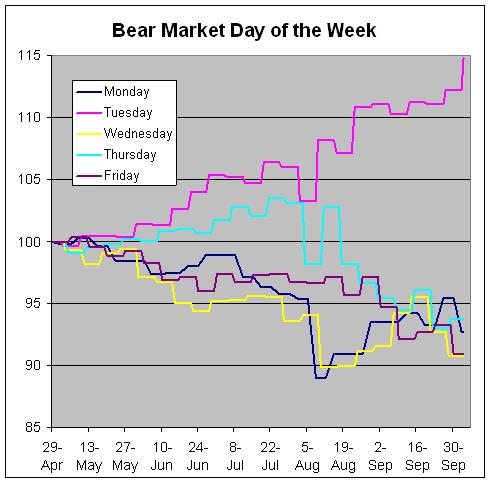
Eddy Elfenbein, October 5th, 2011 at 1:10 pmThanks to yesterday’s late-day rally, the Tuesday Effect continues to rule the market. While the market has done poorly since April 29th, Tuesdays, on average, have been very good.
Here are the returns by day of the week since the market topped on April 29th.
 Eddy Elfenbein is a Washington, DC-based speaker, portfolio manager and editor of the blog Crossing Wall Street. His