-
July Jobs Report
Posted by Eddy Elfenbein on August 5th, 2011 at 8:31 amNFP: +117,000
Private Sector: +154,000
Healthcare +31,000
Retail +26,000
Manufacturing +24,000
May Revision: From +18,000 to +46,000
June Revision: From +25,000 to +53,000
Unemployment Rate: 9.1% down from 9.2% last month
-
CWS Market Review – August 5, 2011
Posted by Eddy Elfenbein on August 5th, 2011 at 7:09 amUgh! There’s not much else to say about Thursday’s stock market except that it was a total disaster. It was the Rocky V of trading days. But unlike Rocky V, we can’t pretend that Thursday never happened. In this issue of CWS Market Review, I’ll review the damage. More importantly, I’ll tell you what’s really going on and what you need to do to protect yourself during a frenetic market like this.
As we all know, Wall Street can be a serious drama queen. When the bears go on a rampage, well…they’re pretty hard to stop. There’s an old saying on Wall Street: “If you can’t sell what you want, sell what you can.” That’s exactly what happened. I mean, AFLAC ($AFL) at $42?? Dear Lord! And Reynolds American ($RAI) yielding 6.3%?? Heavens to Murgatroyd; that’s the equivalent of 718 Dow points!
I can’t predict when all this madness will end but I can say that we’re already well-protected. On Thursday, our Buy List out-performed the S&P 500 by 27 basis points. Of course, that simply means we got shellacked somewhat less than the other guy, but the important point is that investors didn’t massively abandon the high-quality stocks I favor like they did everything else. This is key and I’ll dissect it more in a bit.
Now let’s look at some of the numbers. I’ll warn you: If you have a weak stomach, feel free to skip this section. On Thursday, the S&P 500 plunged 60.27 effing points for a drop of 4.76%. Yuck! That’s the index’s worst loss in 18 months. Plus, this sell-off comes on the heels of an eight-day losing streak which culminated in Tuesday’s 2.56% wipeout. All told, we’ve lost 10.78% in the last nine trading sessions.
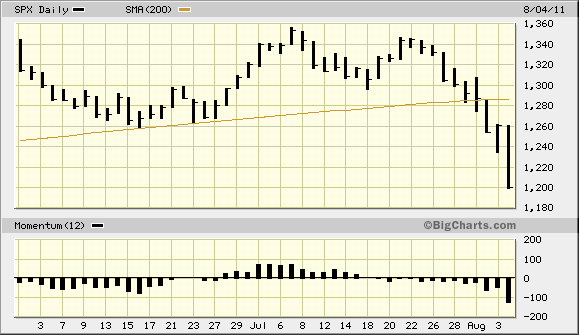
Want to see how much the sellers are in control? On Thursday, the Nasdaq’s up volume swamped its down volume by a ratio of 85-to-1. Think about that. Even the Smurfs were no help. Since they rang the opening bell last week, the Dow has dropped 760 points. Short blue bastards.
What’s especially frustrating is that I saw a lot of the larger trends coming but I was wrong in anticipating just how hard they would hit. For example, I’ve repeatedly warned investors to stay away from cyclical stocks, but I didn’t think the Morgan Stanley Cyclical Index (^CYC) would perform quite so poorly. Consider this: The cyclicals have trailed the overall market for 17 of the last 20 trading sessions. That comes to a loss of 18.32% which includes a staggering 6.68% drop on Thursday.
Similarly, I told investors to keep an eye on the S&P’s 200-day moving average. I even cautioned folks that there are often three tests of this key support level. That’s exactly what happened. The S&P 500 bounced off the 200-DMA twice in June but never closed below it. Then on Tuesday of this week, the S&P 500 finally breached the 200-DMA. That gave the bears a huge confidence lift because by the closing bell on Thursday, the S&P 500 stood nearly 7% below its 200-DMA. Once again, I wasn’t surprised by the retest but I didn’t anticipate that rout that followed.
For some background, the 200-day moving average is one of these silly rules that has a surprisingly good track record. The evidence is clear: The S&P 500 has performed much better when it’s above its 200-DMA than when it’s below it. In the short-term, momentum is a key driver of the market and for some reason the 200-day moving average captures this well. If history is our guide, the stock market will likely spin its wheels until we surge above the 200-day moving average.
So is it time to sell? Absolutely not. In fact, this would be a terrible time to sell. The stock market may indeed head lower in the short term, but the best opportunities are in stocks. As I’ve said many times, the earnings outlook for our Buy List stocks continues to be bright. Just this week, both Becton Dickinson ($BDX) and Wright Express ($WXS) not only beat Wall Street’s earnings estimates but also raised guidance. For Wright, it was the second guidance increase this year. If some hedgie needs to raise cash by dumping WXS, that’s his problem, not ours.
I urge investors to be patient. Wall Street likes to shoot first and ask questions later. Remember, we had a 16% sell-off last year due to another “Double Dip” that failed to come. Do not give into the market’s panic.
Here’s what’s happening: Investors are quickly moving out of areas that are seen as risky and into areas that are seen as safe. What we’re witnessing is the unwinding of the QE2 trade. Last November there was an especially brilliant and prescient article at TheStreet.com which explained how the Fed’s QE2 policy would cause a shift in favor of riskier instruments. Now that trade is falling apart in a major way. All across the board, investors are dumping risk and hoarding security. Fear is giving greed a major beat-down.
Just look at the two-year Treasury yield which dropped to an all-time low of 0.26%. That means that an investment of $1 million yields you a whopping profit of $7 per day. I honestly think you could find more loose change on a DC metro car. The yield on the one-month Treasury actually become negative for a brief period which means you had to pay the government to borrow your money. The long-end of the curve has been even more popular. The price for the 10-year T-bond jumped by more than 2% on Thursday and the price of the 30-year rallied by 4.66%. Gold just hit a new all-time high this week of $1,681.72 per ounce. Safety is trumping everything. Everything.
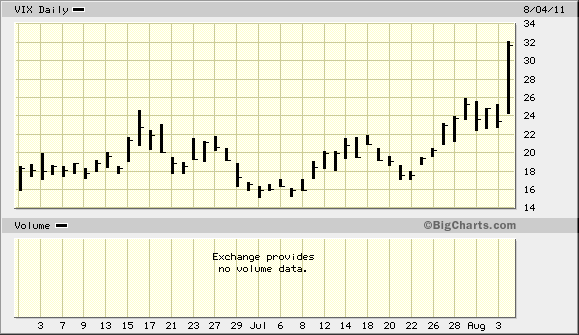
In last week’s issue, I discussed the alarming rise of the Volatility Index ($VIX). I noted that the VIX had spiked up from less than 16 to 23.74 in just three weeks. Please; that was nothing. On Thursday, the VIX jumped more than 35% to reach 31.66. That was the biggest jump in more than four years. To give you an idea of what the VIX means, a reading of 30 means the market expects the S&P 500 to swing by an average of 8.66% over the next month. Note that it doesn’t indicate which direction it will move, just that it will move a lot.
The Federal Reserve meets again next week and there’s growing speculation that the Fed will launch another round of quantitative easing, QE3. For now, call me a doubter. So far, the Fed hasn’t given us any indication that it’s looking to buy more bonds. The last time around, the Fed made its intentions very clear to Wall Street. Part of the reason I missed the strength of this sell-off is that earnings for the overall market have been quite good. Of course, earnings results are backwards-looking. What’s troubled the market so much recently has been growing evidence that the economy will soon take a turn for the worse.
Every day we’ve gotten bad news on the economy. Starting last Friday, the second-quarter GDP report came in very soft and the first-quarter report was revised downward. The government revised the GDP numbers for several quarters and it showed that the recession was worse than we original thought and that the recovery was weaker than we thought. In real terms, the economy grew by less than 1% for the first half of this year.
Then on Monday, the ISM Manufacturing Index dropped to 50.9 for July which is the lowest level in two years. Any number above 50 means the economy is expanding, while any number below 50 means the economy is receding. Also, the Commerce Department said that factory orders dropped by 0.9% in June. That’s the first drop for that metric since the recession ended.
On Tuesday, the Commerce Department reported that consumer spending dropped by 0.2% in June. That’s the biggest fall-off since September 2009. This is very important because consumer spending represents 70% of the U.S. economy.
On Wednesday, the ISM Service Index came in at 52.7, its weakest level in 17 months. Since February, the index has dropped by seven points. Also, ADP ($ADP) released its jobs report which showed that the economy created 114,000 jobs last month which is far from a strong number. The government will release its report on Friday morning. (I’m writing this in the wee hours of Friday morning.) Wall Street expects a meager gain of 85,000 jobs.
These negative reports are causing analysts to pare back their growth forecasts. JPMorgan Chase ($JPM) cut its estimate for third-quarter growth (which we’re nearly halfway through) to just 1.5%. As bad as this is, there’s still no hard evidence that we’re in a recession. That may come, and the odds are higher than they were one month ago, but it’s still not here yet. For now, I suspect that the economy is due for a period of slow and disappointing growth but not a full-blown recession. I’m not writing off the possibility of a recession, but I don’t think it’s probable.
The best part of a fearful and panicked market is that you can find good values and that’s what prudent investing is all about. I want to highlight some Buy List stocks that look especially attractive right now. If you can get shares of Nicholas Financial ($NICK) for less than $11.50, you’re getting an amazing deal. As I mentioned before, AFLAC ($AFL) and Reynolds American ($RAI) are both very cheap. How about Oracle ($ORCL) at $28? I strongly doubt that will last. Abbott Labs ($ABT) is a solid buy that now yields 3.9%. I also think JPMorgan Chase ($JPM) is worth a look now that it’s below $38 per share. The yield alone will get you 2.6%.
That’s all for now. The Fed’s meeting and QE3 speculation will dominate headlines next week. Be sure to keep visiting the blog for daily updates. I’ll have more market analysis for you in the next issue of CWS Market Review!
Eddy
P.S. This Sunday, I’ll be on Kevin Whalen’s radio show on WRKO at 7:30 p.m. to discuss (what’s left of) the market and the economy. I also want to thank everyone who submitted a question for my Q&A. I hope to have that up soon.
-
Morning News: August 5, 2011
Posted by Eddy Elfenbein on August 5th, 2011 at 6:48 amEU Struggles to Tame Crisis Amid Contagion
Germans Lead Resistance to ECB Bond Buying
Japan Dusts Off Mr. Yen’s Policy Toolkit as Recovery Risked by Haven Flows
German Industrial Output Unexpectedly Fell
Time to Say It: Double Dip Recession May Be Happening
Markets Fall as Global Worries Multiply
Payrolls Awaited as Markets Fear Recession
Volatility Index Forewarned Market Turmoil: The Ticker
LinkedIn Ekes Out a Profit, as Sales Surge
Profit Hurt at Southwest on Higher Fuel Costs
P&G Results Top Views, But Outlook Falls Short
Viacom Profit Climbs 37% on Higher U.S. Sales
Allianz Profit Falls 8.2%, Missing Estimates
Kraft CEO Spent Billions Preparing to Dismantle
Paul Kedrosky: QotD: Barton Biggs — I Want to Go Home
Howard Lindzon: Global Markets – I Want My Mommy!!!! and Always Respect Risk
Be sure to follow me on Twitter.
-
Wright Express CEO on Business Outlook
Posted by Eddy Elfenbein on August 4th, 2011 at 10:25 amVia TheStreet.com:
-
The High-End and Low-End Thrive
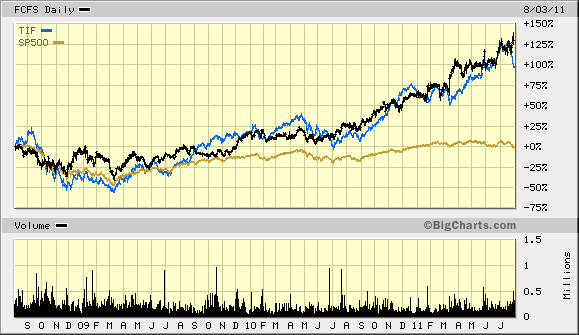
Posted by Eddy Elfenbein on August 4th, 2011 at 10:12 amThis chart tells you a lot about the current economy. Two stocks that are doing well cater to the very high end and the very low end.
The blue line is Tiffany ($TIF), the jewelry store, and the black line is First Cash Financial ($FCFS), which is a publicly-traded pawn shop.
-
Stocks Plunge — Again
Posted by Eddy Elfenbein on August 4th, 2011 at 10:03 amThe market plunged at the open. Once again, the yield on the one-month T-bill has gone negative.
A few weeks ago, I remarked on Carl Icahn’s bid for Clorox ($CLX). First he bid $76.50 per share then increased it to $80. The stock bounced as high as $75.44 but the board had no interest and neither did anyone else. I told investors to get out as soon as possible. The stock is now below $68 per share.
-
S&P 500 Vs. 10-Year TIPs Spread
Posted by Eddy Elfenbein on August 4th, 2011 at 8:21 amHere’s a fascinating chart. The increase in the 10-year TIPs spread (in red) closely matches the rebound in the stock market (in blue). The TIPs spread is the difference between the 10-year Treasury yield and the yield on the inflation-protected yield. In other words, it’s the market’s view of expected inflation.
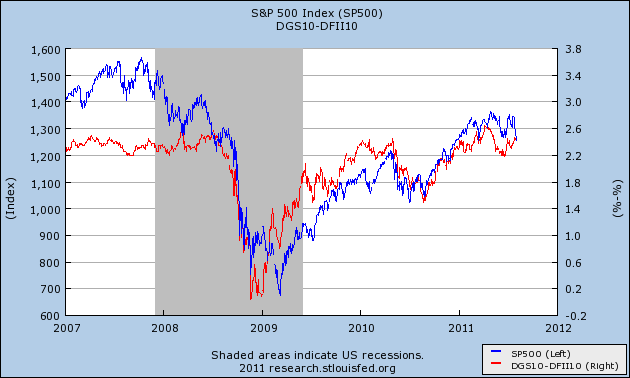
Of course, there’s a causation/correlation angle here. Did inflation expectations increase because investor optimism increased? Or did higher share prices lead to a concern about higher prices?
Either way, the Fed’s efforts to increase inflation expectations starting last year worked, and stocks climbed as well. The problem is that the TIPs spread peaked in early April and the peak in stocks came shortly afterward.
If there is good news in this, it’s that the rally in bonds has been matched by a stronger rally in TIPS. That translates to a slightly wider TIPs spread.
-
Morning News: August 4, 2011
Posted by Eddy Elfenbein on August 4th, 2011 at 8:00 amBOE Keeps Rate on Hold Amid Fading U.K. Recovery
Italy, Spain Yields Fall on ECB Support Speculation
UniCredit Bank Austria First-Half Profit Rises on Eastern Europe
Turkish Lira Weakens After Central Bank’s Surprise Rate Cut
Gold May Climb Toward Record as Global Slowdown Increases Demand for Haven
Currency Intervention Revived as Odds Escalate Fed to Ease
Even Marked Up, Luxury Goods Fly Off Shelves
Announced U.S. Job Cuts Jumped 59% in July
Kraft to Split Snacks and Grocery Businesses
CenturyLink 2Q Profit Down 57% On Acquisition Charges
Deutsche Telekom Profit Down As Europe Weighs
CVS Caremark Profit Tops Expectations
ING Insurance Improving Ahead Of IPOs; Will Markets Follow?
Stone Street: Shared Sacrifice
Phil Pearlman: Fear Sells at the Times
Be sure to follow me on Twitter.
-
Stockmageddon
Posted by Eddy Elfenbein on August 3rd, 2011 at 5:40 pmWhat a crazy day on Wall Street. Even after yesterday’s plunge, the market started off on a bad foot this morning. By 10:40 am, the S&P had lost 1.55%.
Then we suddenly rallied and closed at 1,260.34 which is a gain on the day of 0.50%. Our Buy List did even better as it gained 0.68%.
The S&P 500 finally snapped its streak of seven-straight down days. The Dow had fallen for eight straight days in a row (and the S&P 500 was only up a measly 0.09% on the day before its streak began). Johnson & Johnson ($JNJ) has fallen for eight straight days. In the last two weeks, the stock market has lost a total of $1.07 trillion in market value.
Every day we’ve been getting hit with bad economic news. On Friday, it was the GDP. On Monday, it was the ISM manufacturing index. Yesterday, it was consumer spending. The bad economic news today was that the ISM service index hit its lowest level since February 2010.
There’s no big economic report due tomorrow (the initial jobless claims figure isn’t that important). But the big report will be the jobs number on Friday morning. I hope I’m not ruining your suspense when I say that it won’t be good. Wall Street is expecting a gain of 115,000 jobs. This morning, ADP said in its jobs estimate that the economy created 114,000 new jobs last month. Wall Street is getting the message. JPMorgan Chase ($JPM) cut its estimate for third-quarter growth to 1.5%.
This morning, I posted on Wright Express’ ($WXS) good earnings report and higher guidance. At least I thought it was a good report. At one point, shares of Wright were down 6.75%. Then, much like the overall market, WXS started to surge. The stock closed the day at $47.21. That’s 1.48% higher than yesterday’s close and 8.83% above today’s low. I have no idea how that makes sense, but that’s daily market activity for you.
-
The Onion: “Drunken Ben Bernanke Tells Everyone At Neighborhood Bar How Screwed U.S. Economy Really Is”
Posted by Eddy Elfenbein on August 3rd, 2011 at 12:49 pmThe Onion is on the scene:
SEWARD, NE—Claiming he wasn’t afraid to let everyone in attendance know about “the real mess we’re in,” Federal Reserve chairman Ben Bernanke reportedly got drunk Tuesday and told everyone at Elwood’s Corner Tavern about how absolutely fucked the U.S. economy actually is.
Bernanke, who sources confirmed was “totally sloshed,” arrived at the drinking establishment at approximately 5:30 p.m., ensconced himself upon a bar stool, and consumed several bottles of Miller High Life and a half-dozen shots of whiskey while loudly proclaiming to any patron who would listen that the economic outlook was “pretty goddamned awful if you want the God’s honest truth.”
“Look, they don’t want anyone except for the Washington, D.C. bigwigs to know how bad shit really is,” said Bernanke, slurring his words as he spoke. “Mounting debt exacerbated—and not relieved—by unchecked consumption, spiraling interest rates, and the grim realities of an inevitable worldwide energy crisis are projected to leave our entire economy in the shitter for, like, a generation, man, I’m telling you.”
“And hell, as long as we’re being honest, I might as well tell you that a truer estimate of the U.S. unemployment rate is actually up around 16 percent, with a 0.7 percent annual rate of economic growth if we’re lucky—if we’re lucky,” continued Bernanke, nearly knocking a full beer over while gesturing with his hands. “Of course, if everybody knew that, it would likely cripple financial markets across the entire fucking globe, even in various emerging economies with self- sustaining growth.”
After launching into an extended 45-minute diatribe about shortsighted moves by “those bastards in Congress” that could potentially exacerbate the nation’s already deeply troublesome budget imbalance, the Federal Reserve chairman reportedly bought a round of tequila shots for two customers he had just met who were seated on either side of him, announcing, “I love these guys.”
Numerous bar patrons slowly nodded in agreement as Bernanke went on to suggest the United States could pass three or four more stimulus packages and “it wouldn’t even matter.”
“You think that’s going to create long-term economic growth, let alone promote job creation?” Bernanke said. “We’re way beyond that, my friend. There are no jobs, okay? There’s nothing. I think that calls for another drink, don’t you?”
While using beer bottles and pretzel sticks in an attempt to explain to the bartender the importance of infusing $650 billion into the bond market, the inebriated Fed chairman nearly fell off his stool and had to be held up by the patron sitting next to him.
Another bargoer confirmed Bernanke stood about 2 inches from her face and sprayed her with saliva, claiming inflation was going to “totally screw” consumer confidence and then asking if he could bum a smoke.
“Sure, we could hold down long-term interest rates and pursue a program of quantitative easing, but c’mon, we all know that’s not going to make the slightest bit of difference when it comes to output, demand, or employment,” Bernanke said before being told to “try to keep [his] voice down” by the bartender. “And trust me, with the value of the U.S. dollar in the toilet, import costs going through the roof, and numerous world governments unprepared for their own substantial debt burdens, shit’s not looking too good for us abroad, either.”
“God, I’m so wasted,” added Bernanke, resting his head on the bar.
Later in the evening, Richard Kampman, a truck driver who was laid off in 2010, said Bernanke approached him in the men’s restroom and attempted to strike up a conversation about various factors contributing to the current financial crisis.
“He stumbled up to the urinal and started mumbling on about the depressed housing sector or something,” said Kampman, who claimed Bernanke had to use both hands on the wall to steady himself. “Then after a while he just sort of stopped and I couldn’t tell if he was laughing or crying.”
“Then he puked all over the sink and the mirror,” Kampman added.
Customers at the bar told reporters the “shitfaced” and disruptive Bernanke refused to pay for his drinks with U.S. currency, claiming it was “worthless.” Witnesses also confirmed that near the end of the evening, Bernanke put money into the jukebox and selected Dire Straits’ “Money For Nothing” to play five times in a row.
“This is what it’s all about,” said Bernanke, who reportedly danced alone in the middle of the dark tavern. “Fucking love this song.
-
Archives
- October 2026
- September 2026
- August 2026
- July 2026
- June 2026
- May 2026
- April 2026
- March 2026
- February 2026
- January 2026
- December 2025
- November 2025
- October 2025
- September 2025
- August 2025
- July 2025
- June 2025
- May 2025
- April 2025
- March 2025
- February 2025
- January 2025
- December 2024
- November 2024
- October 2024
- September 2024
- August 2024
- July 2024
- June 2024
- May 2024
- April 2024
- March 2024
- February 2024
- January 2024
- December 2023
- November 2023
- October 2023
- September 2023
- August 2023
- July 2023
- June 2023
- May 2023
- April 2023
- March 2023
- February 2023
- January 2023
- December 2022
- November 2022
- October 2022
- September 2022
- August 2022
- July 2022
- June 2022
- May 2022
- April 2022
- March 2022
- February 2022
- January 2022
- December 2021
- November 2021
- October 2021
- September 2021
- August 2021
- July 2021
- June 2021
- May 2021
- April 2021
- March 2021
- February 2021
- January 2021
- December 2020
- November 2020
- October 2020
- September 2020
- August 2020
- July 2020
- June 2020
- May 2020
- April 2020
- March 2020
- February 2020
- January 2020
- December 2019
- November 2019
- October 2019
- September 2019
- August 2019
- July 2019
- June 2019
- May 2019
- April 2019
- March 2019
- February 2019
- January 2019
- December 2018
- November 2018
- October 2018
- September 2018
- August 2018
- July 2018
- June 2018
- May 2018
- April 2018
- March 2018
- February 2018
- January 2018
- December 2017
- November 2017
- October 2017
- September 2017
- August 2017
- July 2017
- June 2017
- May 2017
- April 2017
- March 2017
- February 2017
- January 2017
- December 2016
- November 2016
- October 2016
- September 2016
- August 2016
- July 2016
- June 2016
- May 2016
- April 2016
- March 2016
- February 2016
- January 2016
- December 2015
- November 2015
- October 2015
- September 2015
- August 2015
- July 2015
- June 2015
- May 2015
- April 2015
- March 2015
- February 2015
- January 2015
- December 2014
- November 2014
- October 2014
- September 2014
- August 2014
- July 2014
- June 2014
- May 2014
- April 2014
- March 2014
- February 2014
- January 2014
- December 2013
- November 2013
- October 2013
- September 2013
- August 2013
- July 2013
- June 2013
- May 2013
- April 2013
- March 2013
- February 2013
- January 2013
- December 2012
- November 2012
- October 2012
- September 2012
- August 2012
- July 2012
- June 2012
- May 2012
- April 2012
- March 2012
- February 2012
- January 2012
- December 2011
- November 2011
- October 2011
- September 2011
- August 2011
- July 2011
- June 2011
- May 2011
- April 2011
- March 2011
- February 2011
- January 2011
- December 2010
- November 2010
- October 2010
- September 2010
- August 2010
- July 2010
- June 2010
- May 2010
- April 2010
- March 2010
- February 2010
- January 2010
- December 2009
- November 2009
- October 2009
- September 2009
- August 2009
- July 2009
- June 2009
- May 2009
- April 2009
- March 2009
- February 2009
- January 2009
- December 2008
- November 2008
- October 2008
- September 2008
- August 2008
- July 2008
- June 2008
- May 2008
- April 2008
- March 2008
- February 2008
- January 2008
- December 2007
- November 2007
- October 2007
- September 2007
- August 2007
- July 2007
- June 2007
- May 2007
- April 2007
- March 2007
- February 2007
- January 2007
- December 2006
- November 2006
- October 2006
- September 2006
- August 2006
- July 2006
- June 2006
- May 2006
- April 2006
- March 2006
- February 2006
- January 2006
- December 2005
- November 2005
- October 2005
- September 2005
- August 2005
- July 2005
 Eddy Elfenbein is a Washington, DC-based speaker, portfolio manager and editor of the blog Crossing Wall Street. His