-
Oracle Vs. Google
Posted by Eddy Elfenbein on June 17th, 2011 at 11:13 amOracle Corp. (ORCL) is seeking billions of dollars in damages in a patent- and copyright-infringement lawsuit against Google Inc. (GOOG) that claims the search-engine company’s Android software uses technology related to the Java programming language, according to court papers.
The extent of the claims was disclosed yesterday in San Francisco federal court by Oracle, as it sought to prevent Google from filing under seal documents in the case stating Oracle’s monetary claims.
“Oracle’s damages claims in this case are in the billions of dollars,” the company said in a filing, arguing that its demands “are based on both accepted methodology and a wealth of concrete evidence.”
“They should not be hidden from public view,” Oracle said.
Oracle got Java when it bought Sun Microsystems. I would expect that any legal battle might take years to resolve. But someone must think they have a case. Shares of $ORCL are up more than 2% today.
-
CWS Market Review – June 17, 2011
Posted by Eddy Elfenbein on June 17th, 2011 at 7:43 amFor a little while, on Tuesday, it looked like the market was finally going to shake off its six-week losing streak. But soon, fears of more problems in Greece sent U.S. share prices lower once again. There’s a very good chance that this will be our seventh-straight week of losses.
The reality is that Europeans have failed miserably in their attempt to contain the problems in Greece. I should add that I don’t have any bright ideas on this myself, but the Europeans seem to be going out of their way to prove themselves a dysfunctional political unit.
Put it this way: two-year notes are running around 30% in Greece. The credit swaps indicate that the market thinks there’s an 81.5% chance that Greece will default on its debt. That’s not “in the bag” but it’s very close. On top of that, Ireland and Portugal are also looking shaky, but they’re nowhere as bad as Greece is. At least, not for now.
The message is that if the Europeans are unwilling or unable to do something about Greece, there’s little reason to believe they’ll be able to tackle the next problem child. And there will be a next.
For investors, the effects of this crisis are being felt in many areas. The euro just hit a record low against the Swiss franc. This is a good measurement to watch since Switzerland is surrounded by Eurozone countries but it’s not actually in it. Folks have turned against the euro and options players are paying mightily for insurance against a euro plunge.
This week, I want to highlight some comments that Ben Bernanke made recently. The Fed Chairman acknowledged weakness in the U.S. economy and in the jobs market in particular; plus he discussed the recent rise in commodity prices. According to Bernanke, these issues, while serious, are “transitory” and he expects that they’ll soon fade. Bernanke said that the economy should firm up later this year.
What I find interesting is that the stock market still seems unusually complacent and I suspect that Bernanke has convinced investors that he’s right. Here’s an example: The Volatility Index, better known as the $VIX, typically moves in the opposite direction of the stock market. And as the stock market has moved lower, the VIX has in turn moved higher. But, and here’s the catch, the VIX hasn’t rallied as much as much as we would expect. Perhaps the market already sees reasons to be calm that haven’t become readily apparent yet.
Another example of the news/price disconnect can be in seen in the bond market. Quite simply, the bond market isn’t at all worried about inflation despite emerging signs of higher prices. This past week’s inflation report showed the highest core inflation in four years. This is important because the core inflation report doesn’t include food or energy prices which can be highly volatile. Furthermore, there’s been a clear trend of rising inflation for several months now.
But if we look at bond prices, once again we can see that Bernanke’s optimism seems to be the dominant view. The ten-year Treasury yield is back down to 2.91% after a brief spike up to 3.1%. It’s now at its lowest point of the year. Similarly, the five-year Treasury yield has fallen to 1.5% which is its lowest yield this year. In other words, bond traders seem very unimpressed by the recent inflation reports. Perhaps they value the liquidity of Uncle Sam’s debt which can be dumped quickly if needed. Or they may be convinced by Bernanke’s view.
The security that I find most surprising is the two-year Treasury. Investors are now willing to lock up their money for 24 months in exchange for 0.38% per year. Do they not know what stock dividends are? Investors are paying sky-high prices for security and very low prices to shoulder any risk which I believe is a result of the problems in Europe. Since the market peaked on April 29th, U.S. stocks have shed over $1 trillion, and the S&P 500 is now within sight of its 200-day moving average.
Outside of the inflation report, we got some modestly positive economic news. Housing starts for May increased more than forecast. Building permits rose by 8.7% in May which was the highest jump this year. Work on multi-family homes rose by 23%. Also, fewer Americans applied for unemployment benefits. This may be the beginning of a trend but we still need to see more data to confirm that a turnaround is in the works.
Now let’s turn to our Buy List, which is still ahead of the market for the year although both the market and the Buy List have had lost some luster over the last seven weeks. Leucadia National ($LUK) said that it’s selling a large portion of its stake in Fortescue Metals for $615 million. This is probably a very shrewd move. Fortescue is a large Australian iron ore producer.
Johnson & Johnson ($JNJ) said that it’s quitting the stent business. Even though J&J was an early pioneer is this field, upstarts have been grabbing market share. Interestingly, two of the more successful rivals are on our Buy List: Abbott Labs ($ABT) and Medtronic ($MDT). Johnson & Johnson said they’re going to incur a charge of between $500 million and $600 million.
Shares of Gilead Sciences ($GILD) got knocked a bit earlier this week on news of a Justice Department investigation. An analyst at Oppenheimer said this was a “minor concern” and I suspect he’s correct.
Earlier this week, I did a post on why I think Oracle is a good value. The company gave us a very optimistic forecast for this quarter so I’m expecting an earnings beat, but not a very large one. What I find interesting is that Oracle’s earnings forecast came out when the quarter was still young. They wouldn’t say something so bold that early unless they were very confident. The earnings report is due out this Thursday. Wall Street currently expects earnings of 71 cents per share while I expect 73 cents per share. Either way, Oracle is still a very good value. Oracle is a buy up to $34 per share.
The other Buy List earnings report next week will be from Bed Bath & Beyond ($BBBY). There have also been some rumors that BBBY is about to be acquired. These stories make me laugh because I would think that anyone who really knows isn’t talking.
I’m going to reiterate what I said last week: In April, BBBY said it expects fiscal Q1 earnings of 58 to 61 cents per share. I think that’s on the low side. Remember that Q4 was a blow-out quarter for them. I’m expecting a modest earnings surprise—around 63 cents per share, give or take. I hope to see Q2 guidance of 80 to 85 cents per share. I’m keeping my buy price for BBBY at $55 per share.
That’s all for now. Be sure to keep visiting the blog for daily updates. I’ll have more market analysis for you in the next issue of CWS Market Review!
– Eddy
-
Morning News: June 17, 2011
Posted by Eddy Elfenbein on June 17th, 2011 at 7:10 amMerkel Agrees to Voluntary Greece Bondholder Role
Greek PM vows to stay, lead exit from debit crisis
Oil Heads for Biggest Weekly Decline in Six on Concern Over European Debt
Medvedev Pledges Economic Reforms
Spanish Banking Giant Santander Sees 2011 Profit In Line With 2010
Gold May Fall for a Second Day in London Trading on Oil Decline, Equities
Wall Street Braces for New Layoffs as Profits Wane
Raters May Face SEC Civil Fraud Charges
Utilities Turn to Mergers as Demand for Power Slows
RIM Profit Falls Below Estimates
Capital One to Buy ING Direct USA for $9 Billion
Energy Transfer buying Southern Union for $4.2 Billion
Hayward’s Vallares Raises $2.2 Billion in IPO
Nasdaq Confirms LCH.Clearnet Bid
Joshua Brown: HRBN: Misfortune Cookie o’ the Day
Todd Sullivan: Vegas Tourism Still Strong
Be sure to follow me on Twitter.
-
“It’s not a stock market. It’s a market of stocks.”
Posted by Eddy Elfenbein on June 16th, 2011 at 1:02 pmMy friend and I used to have an inside joke about phrases that could be used at any time to make yourself sound intelligent without really saying anything. I recall two examples: “just look at the Japanese” and “that reminds me of an article in The Economist.” Try it at your next dinner party and you’ll see what I mean.
In that vein, Henry Blodget has a wonderful post at TBI listing 16 of Wall Street’s favorite meaningless phrases:
“The easy money has been made.”
“I’m cautiously optimistic.”
“It’s a stockpicker’s market.”
“It’s not a stock market. It’s a market of stocks.”
“We’re constructive on the market.”
“Profit taking”
“Bargain hunting”
“More buyers than sellers”
“There’s lots of cash on the sidelines.”
“We’re in a bottoming process.”
“Overbought”
“Oversold”
“Buy on weakness”
“Sell on strength”
“Take a wait-and-see approach”
“It’s a show-me stock.”
What I love about these phrases is that they can be used anytime for almost any reason. Yet the phrases ultimately convey no information whatsoever. But they somehow sound as if something intelligent is being said.
I suppose the human brain is wired to follow authoritative phrases before thinking. It reminds me of this article I once read in The Economist….
-
Morning News: June 16, 2011
Posted by Eddy Elfenbein on June 16th, 2011 at 8:07 amEurope Faces ‘Lehman Moment’ as Greece Unravels
Societe Generale CEO: Greek Restructure Would Be Issue For Europe, Not Banks
Ireland Opens New Front as ECB Battles Against Meltdown
IEA Boosts 2016 Oil Demand Forecast, $100 Crude a Risk
Foreclosure Filings Plunge as Bank Delays Mask ‘True Face’ of U.S. Crisis
Futures Slip as Caution Prevails
HSBC, Citi Given Nod to Underwrite China Corporate Debt
Terex to Acquire Demag Cranes for $1.4 Billion After Sweetening Its Offer
Chinese Alibaba Group to Split E-Commerce Site, Talks I.P.O.
Smithfield Foods Swings to Profit on Higher Prices
American Retailers Try Again in Europe
Women Are Better Investors, and Here’s Why
Jeff Miller: How to Watch and Interpret the Greece Story
Stone Street: Project YOKU-zuna: Failure to Execute
Epicurean Dealmaker: The Two Beds of Procrustes
Be sure to follow me on Twitter.
-
Inflation Hits Four-Year High
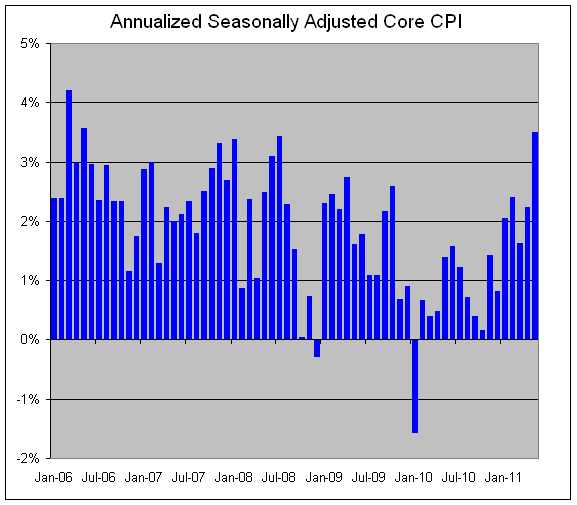
Posted by Eddy Elfenbein on June 15th, 2011 at 8:14 pmToday’s CPI report showed that inflation rose by 0.2% in May which was 0.1% ahead of expectations. The core rate, which excludes food and energy prices, rose by 0.3% which was also 0.1% ahead of expectations.
Breaking down the numbers, I took the monthly seasonally-adjusted core rates and annualized them. It turns out that May’s increase was the most in exactly four years. The seasonally adjusted core rate for May rose by 0.29%. Annualized, that comes to 3.50%. The last time it was higher was May 2006 when it rose by 3.57%.
-
Larry Called It
Posted by Eddy Elfenbein on June 15th, 2011 at 2:08 pmAfter $HPQ’s board fired Mark Hurd (or forced him to resign), Larry Ellison sent an e-mail to the New York Times:
Lawrence J. Ellison, the chief executive of Oracle, denounced Hewlett-Packard’s directors on Monday for forcing the resignation of the H.P. chief executive, Mark V. Hurd, who is a friend of Mr. Ellison’s.
Mr. Hurd stepped down Friday after a sexual harassment inquiry found that he had filed inaccurate expense reports.
In an impassioned e-mail sent to The New York Times, Mr. Ellison chided H.P.’s board for what he said was a grave mistake.
“The H.P. board just made the worst personnel decision since the idiots on the Apple board fired Steve Jobs many years ago,” Mr. Ellison wrote. “That decision nearly destroyed Apple and would have if Steve hadn’t come back and saved them.”
That was 10 months ago. Yep, I think Larry was right.
-
Louis Navellier’s E-Letter
Posted by Eddy Elfenbein on June 15th, 2011 at 11:56 amI want to give a shout-out to my good friend Louis Navellier. He has a great (and free) e-letter that you can sign up for here. I highly recommend it.
Louis is one of Wall Street’s legends. He’s one of the original “quant guys.” Nowadays, Wall Street is full of number crunchers, but Louis was doing this kind of work long before everyone else was. Not only that, but he has an amazing track record to boot.
His e-letter always has some interesting insight or take on the market that you can’t find anywhere else. If you want to see a sample, here’s his latest where he names beverage stocks that “bring in the bucks.”
To sign up, just follow this link.
-
Why Oracle Is a Good Value
Posted by Eddy Elfenbein on June 15th, 2011 at 9:54 amOracle‘s ($ORCL) fiscal Q4 earnings report comes out next week and I wanted to pass along this chart of the stock along with its earnings-per-share trend.
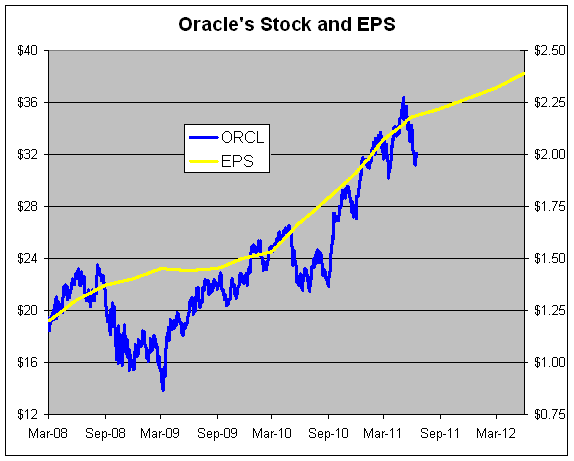
As I usually do, I put the share price in blue and it follows the left scale while the EPS is in gold and it follows the right scale. The two lines are scaled at a ratio of 16 to 1 which means that the P/E Ratio is exactly 16 whenever the lines cross. The future part of the earnings line represents Wall Street’s consensus.
The chart makes a few important points more clearly in graphic form than I could explain verbally. The first is that Oracle’s valuation is still rather subdued. The stock’s P/E Ratio is almost exactly the same as the S&P 500’s even though its earnings have fared much better than the overall market. As you can see, the earnings line was barely impacted by one of the worst recessions of the last 70 years. The rest of Corporate America, in contrast, saw its earnings plunge and we still haven’t made record earnings yet.
The other point is that you can see how tepid Wall Street’s earnings projections are. If the future earnings projection is correct, it would be a dramatic deceleration of earnings growth (slowing of growth).
I understand the need for conservative estimates and that’s most likely the sounder strategy, but I wanted to show you precisely what that means. If Oracle’s stock keeps tracking its earnings, I think it’s very likely that the stock will hit $36 before the end of the year. That’s about a 13% jump from yesterday’s close.
Oracle likes to the play the “set-the-bar-low-and-guide-higher” game, and they play it very well. In March, for example, Oracle “shocked” Wall Street when it said it was expecting fiscal Q4 earnings to range between 69 cents and 73 cents per share.
I think it’s interesting that Oracle was willing to give us this news when the quarter wasn’t even one month old. At the time, the Street was expecting 66 cents per share. Now the consensus is up to 71 cents per share.
The company also gave us a 20% dividend increase recently. (Well…it was from five cents to six cents.) Look for a modest earnings beat, say, 73 cents per share. I’ll be interested to hear any guidance for the August quarter. Wall Street currently expects earnings of 46 cents per share.
-
Morning News: June 15, 2011
Posted by Eddy Elfenbein on June 15th, 2011 at 7:43 amGreek Bailout Talks Deadlock as Pressure Mounts
Greek Unions Stage Strike Against Austerity
European Industrial Output Unexpectedly Increased in April
China Moves Closer to Letting Foreign Banks Underwrite Yuan Bonds
Oil Trades Near Three-Day High on U.S. Retail Sales; Stockpiles Decline
Asia Grain Outlook: Japan Buys Wheat; Demand Subdued Elsewhere
Stock Futures Slip After Rebound, CPI, Factory Data Due
Bernanke Calls Debt Limit ‘Wrong Tool’ for Forcing Budget Cuts
Fed Officials Discuss Explicit Inflation Target
Shuttle’s End Leaves NASA a Pension Bill
Mortgage Applications See Biggest Gain in 3 Months: MBA
J.C. Penney Nabbing Johnson From Apple Sets ‘Huge Expectation’
Pandora Prices Its I.P.O. at $16 Per Share
Chevron Bets on Volcanoes in Indonesia
Paul Kedrosky: Global Oil Crosses Into Structural Deficit
Phil Pearlman: Examining the Open Cloud w GigaOM Pro
Be sure to follow me on Twitter.
-
Archives
- June 2026
- May 2026
- April 2026
- March 2026
- February 2026
- January 2026
- December 2025
- November 2025
- October 2025
- September 2025
- August 2025
- July 2025
- June 2025
- May 2025
- April 2025
- March 2025
- February 2025
- January 2025
- December 2024
- November 2024
- October 2024
- September 2024
- August 2024
- July 2024
- June 2024
- May 2024
- April 2024
- March 2024
- February 2024
- January 2024
- December 2023
- November 2023
- October 2023
- September 2023
- August 2023
- July 2023
- June 2023
- May 2023
- April 2023
- March 2023
- February 2023
- January 2023
- December 2022
- November 2022
- October 2022
- September 2022
- August 2022
- July 2022
- June 2022
- May 2022
- April 2022
- March 2022
- February 2022
- January 2022
- December 2021
- November 2021
- October 2021
- September 2021
- August 2021
- July 2021
- June 2021
- May 2021
- April 2021
- March 2021
- February 2021
- January 2021
- December 2020
- November 2020
- October 2020
- September 2020
- August 2020
- July 2020
- June 2020
- May 2020
- April 2020
- March 2020
- February 2020
- January 2020
- December 2019
- November 2019
- October 2019
- September 2019
- August 2019
- July 2019
- June 2019
- May 2019
- April 2019
- March 2019
- February 2019
- January 2019
- December 2018
- November 2018
- October 2018
- September 2018
- August 2018
- July 2018
- June 2018
- May 2018
- April 2018
- March 2018
- February 2018
- January 2018
- December 2017
- November 2017
- October 2017
- September 2017
- August 2017
- July 2017
- June 2017
- May 2017
- April 2017
- March 2017
- February 2017
- January 2017
- December 2016
- November 2016
- October 2016
- September 2016
- August 2016
- July 2016
- June 2016
- May 2016
- April 2016
- March 2016
- February 2016
- January 2016
- December 2015
- November 2015
- October 2015
- September 2015
- August 2015
- July 2015
- June 2015
- May 2015
- April 2015
- March 2015
- February 2015
- January 2015
- December 2014
- November 2014
- October 2014
- September 2014
- August 2014
- July 2014
- June 2014
- May 2014
- April 2014
- March 2014
- February 2014
- January 2014
- December 2013
- November 2013
- October 2013
- September 2013
- August 2013
- July 2013
- June 2013
- May 2013
- April 2013
- March 2013
- February 2013
- January 2013
- December 2012
- November 2012
- October 2012
- September 2012
- August 2012
- July 2012
- June 2012
- May 2012
- April 2012
- March 2012
- February 2012
- January 2012
- December 2011
- November 2011
- October 2011
- September 2011
- August 2011
- July 2011
- June 2011
- May 2011
- April 2011
- March 2011
- February 2011
- January 2011
- December 2010
- November 2010
- October 2010
- September 2010
- August 2010
- July 2010
- June 2010
- May 2010
- April 2010
- March 2010
- February 2010
- January 2010
- December 2009
- November 2009
- October 2009
- September 2009
- August 2009
- July 2009
- June 2009
- May 2009
- April 2009
- March 2009
- February 2009
- January 2009
- December 2008
- November 2008
- October 2008
- September 2008
- August 2008
- July 2008
- June 2008
- May 2008
- April 2008
- March 2008
- February 2008
- January 2008
- December 2007
- November 2007
- October 2007
- September 2007
- August 2007
- July 2007
- June 2007
- May 2007
- April 2007
- March 2007
- February 2007
- January 2007
- December 2006
- November 2006
- October 2006
- September 2006
- August 2006
- July 2006
- June 2006
- May 2006
- April 2006
- March 2006
- February 2006
- January 2006
- December 2005
- November 2005
- October 2005
- September 2005
- August 2005
- July 2005
 Eddy Elfenbein is a Washington, DC-based speaker, portfolio manager and editor of the blog Crossing Wall Street. His