-
Market Update: June 28, 2011
Posted by Eddy Elfenbein on June 28th, 2011 at 8:58 pmI have to apologize for the lack of posting today but honestly, there’s not much going on.
The good news is that the stock market continues to recover. For now, it looks like the second bounce off the 200-DMA was a good one. The S&P 500 closed today at its highest level since June 3.
Bespoke notes that we’ve just completed our best two-day gain in nearly five months. But I should caution you that the big gainers over the last two days have been cyclical stocks and I’m suspicious that they can lead the market for long.
Remember how Oracle ($ORCL) fell after its “poor” earnings report? Perhaps Wall Street is starting to realize that this was a very good earnings report. The stock has recovered nearly everything it lost. Today Oracle closed at $32.34 which is just 12 cents below Thursday’s close. Imagine that! Patience FTW!
Shares of Nicholas Financial ($NICK) have also stabilized after being knocked around after being added to the Russell 2000.
Reynolds American ($RAI) fell along with the entire tobacco sector after the FDA said it was going to do an independent review of menthol cigarettes. This is a great stock and it carries a nice 5.7% yield.
Bed Bath & Beyond ($BBBY) is still rising after its great earnings report. The stock broke $58 per share today. The stock is an 18% winner on the year for us. I really like it when good companies are rewarded.
The one sector that’s been left behind by this market is the financial sector. It appears that investors are worried about exposure to Greece (or Portugal or Ireland or Iceland or ….). The earnings estimates for the major Wall Street banks are getting slashed in a big way.
Three months ago, the Street saw Goldman ($GS) earning $16.41 per share for this year. Now that’s down to $14.01. Banks like Citigroup ($C) and Bank of America ($BAC) continue to be disaster areas.
The sole exception, and not to my surprise, is JPMorgan Chase ($JPM). The last several earnings reports have come in much better than expectations. The bank is currently going for just eight times this year’s estimate. The stock, however, has suffered along with the rest of the banks.
What I would really like to see is another dividend increase, but that will take permission from the Fed. JPM already increased their quarterly dividend from five cents per share to 25 cents. At the current price, that gives the stock a yield of 2.52%. I wouldn’t mind seeing them double that. That’s probably unrealistic, but JPM could do it if they wanted to and had Fed approval.
Along with other financial stocks, AFLAC ($AFL) is still suffering. Wall Street is just being silly here. The company has made it abundantly clear that they’re not overly exposed to Europe. Plus, they keep delivering solid results. I don’t believe it’s a smart idea to bet against AFLAC.
-
Morning News: June 28, 2011
Posted by Eddy Elfenbein on June 28th, 2011 at 7:31 amGreek Unions Strike as Papandreou Seeks Support
Rescue Measures for Greece Advance as French Offer to Ease Debt
China Signs £1.4 Billion in UK Trade Deals
Women Break Down Barriers in Mideast Finance
Tokyo Electric Power Defeats Shareholders’ Efforts to Exit Nuclear Business
Gold Advances for First Time in Four Days on European Sovereign-Debt Woes
Crude Oil in New York Rises From Near Four-Month Low; Brent Premium Widens
U.K. Banking Giant Standard Chartered Sees Double-Digit Growth
Nike 4Q Net Up 14%; North America, China Sales Surge
Siemens Cautions on Slower Growth After Buoyant Q3
TomTom Slumps As Profit Shrinks
PepsiCo Wakes Up and Smells the Cola
Todd Sullivan: Florida Casinos
Robert Sinn via Josh Brown: Searching For and Finding an Edge
Be sure to follow me on Twitter.
-
WSJ: Private Sleuths for Investors in Chinese Companies
Posted by Eddy Elfenbein on June 27th, 2011 at 8:07 pm -
Our Buy List Is Up 3.82% YTD
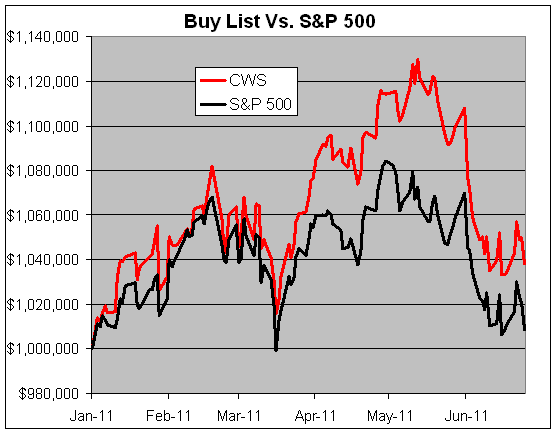
Posted by Eddy Elfenbein on June 27th, 2011 at 8:29 amThursday will be the final day of trading for the first half of this year. Despite the market’s ups and downs, our Buy List is on track to beat the S&P 500 for the fifth-straight year.
Through Friday, our Buy List is up 3.82% for the year compared with 0.86% for the S&P 500 (dividends not included).
-
Gas Prices Fall
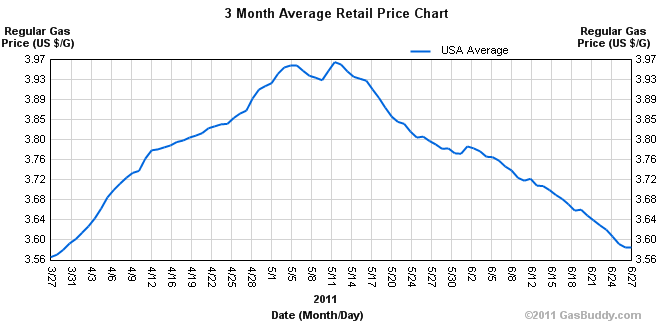
Posted by Eddy Elfenbein on June 27th, 2011 at 8:16 amFor the last six weeks, gas prices have pulled back. Gas is still pretty expensive compared with recent history but it’s just a little bit less expensive. Gas is still more than twice where it was during the financial crisis.
-
Larry Kudlow on Dow 50,000
Posted by Eddy Elfenbein on June 27th, 2011 at 8:09 amThink of the Internet as an economic freedom metaphor for our time. The Internet empowers ordinary people and disempowers government. The Internet creates wealth, expands growth, produces jobs and spreads prosperity. Standing behind the Net is the political power of well over 100 million investors and asset owners.
Because of this, I believe the future economy will outperform all expectations. The stock market will head toward 15,000 in a few years, then 30,000, then 50,000 and higher. Believe it or not, the Internet is more important than the Fed.
-
Morning News: June 27, 2011
Posted by Eddy Elfenbein on June 27th, 2011 at 6:42 amEuropean Banks May Need More Capital After Basel
Spain Can Finance Itself Despite Rising Yields – Finance Minister
South African Rand Slides to Lowest This Month Against Dollar on Investor Risk Aversion
Germans Becoming Resigned to Messy Euro Divorce
China Is Long-Term Investor in EU Bonds: Premier Wen
France’s Lagarde Poised to Become Next IMF Chief
Crude Falls In Asia; Stronger Dollar, Weak Sentiment Weigh
Average Price for U.S. Gas Falls to $3.63
Behind Veneer, Doubt on Future of Natural Gas
Nissan Outlines Growth Strategy Focusing On Emerging Markets
Stanley Black & Decker Agrees to Buy Niscayah for $1.2 Billion
Companies Are Erecting In-House Social Networks
Goldman Sachs: This Is The Best Stock For This Point In The Cycle
Howard Lindzon: Amazon (AMZN) to Buy Twitter (TWIT) ….The Monday Headline We Need!
Jeff Miller: Weighing the Week Ahead: Big News and Low Volume = High Volatility
James Altucher: Politics is a Scam – Why I Will Never Vote Again
Be sure to follow me on Twitter.
-
NICK’s Volume Surge
Posted by Eddy Elfenbein on June 26th, 2011 at 5:56 pmOn Friday, 1,284,100 shares of Nicholas Financial ($NICK) exchanged hands. That isn’t merely heavy volume; it’s off the scales.
Put it this way, until fairly recently, a day with one-hundredth as much volume as Friday’s would be considered a busy day. Friday’s volume was greater than the entire volume for the first nine months of 2009.
Friday’s volume represents more than 10% of all of NICK’s outstanding shares and more than 20% of the float.
So what’s going on? I have no idea. Volume in NICK started to grow shortly before the last earnings report came out. The shares very briefly surged over $13 per share but have slowly pulled back.
If someone is busy accumulating shares, they haven’t told me.
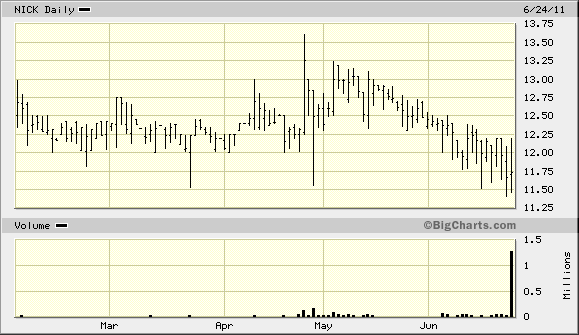
Update: A reader informs me of a fact I had forgotten, NICK’s volume surge is due to Russell’s rebalancing. NICK was added to their Global index.
-
Two-Year Close to All-Time Low Yield
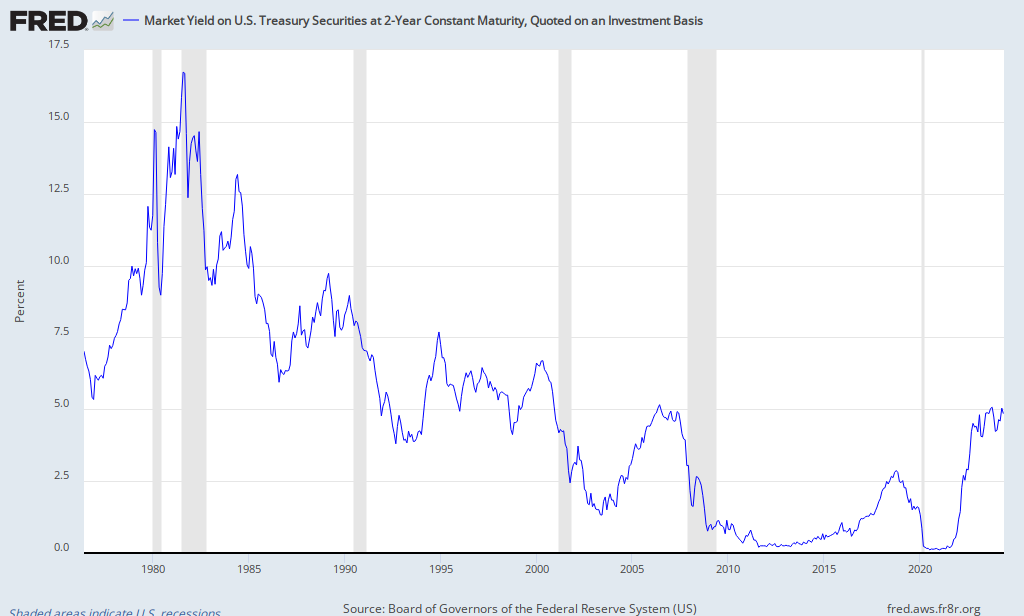
Posted by Eddy Elfenbein on June 24th, 2011 at 10:20 amThanks to the madness in Europe, investors have flocked to U.S. Treasury debt. The yield on the two-year has dropped to 0.35% which is only four basis points above the all-time low from last November.
-
This Monday Marks the Beginning of the Traditional Summer Rally
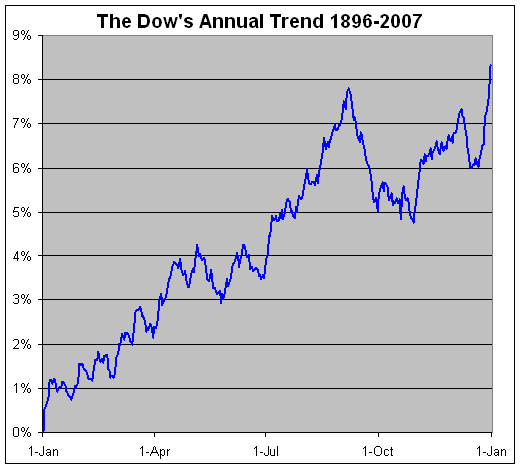
Posted by Eddy Elfenbein on June 24th, 2011 at 7:45 amWe’re coming up on one of the best times of the year to buy stocks. Not only is the start of the year good for stocks, but so is the start of the second half of the year (as is the turn of the month).
A few years ago, I calculated all of the Dow’s closings from 1896 to 2007 and found that July 1, July 3 and July 6 are all among the 25 best days for the Dow.
Historically, the market has gained an average of 4.17% from June 27 to September 6. That’s more than half of the average annual gain even though it covers just ten weeks.
-
Archives
- October 2026
- September 2026
- August 2026
- July 2026
- June 2026
- May 2026
- April 2026
- March 2026
- February 2026
- January 2026
- December 2025
- November 2025
- October 2025
- September 2025
- August 2025
- July 2025
- June 2025
- May 2025
- April 2025
- March 2025
- February 2025
- January 2025
- December 2024
- November 2024
- October 2024
- September 2024
- August 2024
- July 2024
- June 2024
- May 2024
- April 2024
- March 2024
- February 2024
- January 2024
- December 2023
- November 2023
- October 2023
- September 2023
- August 2023
- July 2023
- June 2023
- May 2023
- April 2023
- March 2023
- February 2023
- January 2023
- December 2022
- November 2022
- October 2022
- September 2022
- August 2022
- July 2022
- June 2022
- May 2022
- April 2022
- March 2022
- February 2022
- January 2022
- December 2021
- November 2021
- October 2021
- September 2021
- August 2021
- July 2021
- June 2021
- May 2021
- April 2021
- March 2021
- February 2021
- January 2021
- December 2020
- November 2020
- October 2020
- September 2020
- August 2020
- July 2020
- June 2020
- May 2020
- April 2020
- March 2020
- February 2020
- January 2020
- December 2019
- November 2019
- October 2019
- September 2019
- August 2019
- July 2019
- June 2019
- May 2019
- April 2019
- March 2019
- February 2019
- January 2019
- December 2018
- November 2018
- October 2018
- September 2018
- August 2018
- July 2018
- June 2018
- May 2018
- April 2018
- March 2018
- February 2018
- January 2018
- December 2017
- November 2017
- October 2017
- September 2017
- August 2017
- July 2017
- June 2017
- May 2017
- April 2017
- March 2017
- February 2017
- January 2017
- December 2016
- November 2016
- October 2016
- September 2016
- August 2016
- July 2016
- June 2016
- May 2016
- April 2016
- March 2016
- February 2016
- January 2016
- December 2015
- November 2015
- October 2015
- September 2015
- August 2015
- July 2015
- June 2015
- May 2015
- April 2015
- March 2015
- February 2015
- January 2015
- December 2014
- November 2014
- October 2014
- September 2014
- August 2014
- July 2014
- June 2014
- May 2014
- April 2014
- March 2014
- February 2014
- January 2014
- December 2013
- November 2013
- October 2013
- September 2013
- August 2013
- July 2013
- June 2013
- May 2013
- April 2013
- March 2013
- February 2013
- January 2013
- December 2012
- November 2012
- October 2012
- September 2012
- August 2012
- July 2012
- June 2012
- May 2012
- April 2012
- March 2012
- February 2012
- January 2012
- December 2011
- November 2011
- October 2011
- September 2011
- August 2011
- July 2011
- June 2011
- May 2011
- April 2011
- March 2011
- February 2011
- January 2011
- December 2010
- November 2010
- October 2010
- September 2010
- August 2010
- July 2010
- June 2010
- May 2010
- April 2010
- March 2010
- February 2010
- January 2010
- December 2009
- November 2009
- October 2009
- September 2009
- August 2009
- July 2009
- June 2009
- May 2009
- April 2009
- March 2009
- February 2009
- January 2009
- December 2008
- November 2008
- October 2008
- September 2008
- August 2008
- July 2008
- June 2008
- May 2008
- April 2008
- March 2008
- February 2008
- January 2008
- December 2007
- November 2007
- October 2007
- September 2007
- August 2007
- July 2007
- June 2007
- May 2007
- April 2007
- March 2007
- February 2007
- January 2007
- December 2006
- November 2006
- October 2006
- September 2006
- August 2006
- July 2006
- June 2006
- May 2006
- April 2006
- March 2006
- February 2006
- January 2006
- December 2005
- November 2005
- October 2005
- September 2005
- August 2005
- July 2005
 Eddy Elfenbein is a Washington, DC-based speaker, portfolio manager and editor of the blog Crossing Wall Street. His