-
Exceedingly Brief Market Update
Posted by Eddy Elfenbein on May 11th, 2011 at 10:39 amThis is another good day for our Buy List. The cyclicals are getting pounded and that’s always good for our relative performance.
Reynolds American ($RAI), Becton, Dickinson ($BDX), Joey Banks ($JOSB) and Johnson & Johnson ($JNJ) have all hit new 52-week highs. Notice that there are classic non-cyclicals like healthcare and consumer stocks.
At 10:30, the S&P 500 is down 0.58% while the Buy List is only down 0.05%. That’s a big outperformance for one day.
Don’t forget: You can follow me on Twitter at twitter.com/EddyElfenbein.
-
Soaring Oil Blasts the Trade Deficit
Posted by Eddy Elfenbein on May 11th, 2011 at 10:19 amThe trade numbers are out for March, and higher oil prices are widening out the trade deficit. Today’s trade report shows that exports rose by 4.6% in March to $172.7 billion. That’s the biggest gain since March 1994.
The trade gap rose 6 percent to $48.2 billion, the biggest since June, from $45.4 billion in February, the Commerce Department reported today in Washington. The median forecast of 72 economists surveyed by Bloomberg News projected it would widen to $47 billion. Sales abroad climbed by the most in 17 years.
Crude oil costs that surged above $100 a barrel for the first time in more than a year and a 9.4 percent drop in the dollar will probably keep driving up the cost of imports. At the same time, the weaker currency is making American goods more competitive to customers in emerging markets from Argentina to China, benefiting manufacturers like United Technologies Corp. (UTX) and Caterpillar Inc. (CAT).
The original report for Q1 GDP growth was 1.8%. Today’s report indicates that an upcoming revision may be slightly lower.
Four years ago, I looked at the impact of the euro on U.S. equity markets. The lesson is that a weaker euro is very good for our stocks. The biggest beneficiaries of a weak euro were tech, industrials and consumer discretionaries.
-
Morning News: May 11, 2011
Posted by Eddy Elfenbein on May 11th, 2011 at 7:32 amMerkel to Back Draghi as Trichet’s ECB Successor
Bank of England Signals Rate Increase This Year Amid Inflation
EU Slows Drive for More Greek Aid
Hong Kong Stocks Drop on China’s Inflation, Retail Sales Data
Gold, Silver Up On EU Worries, Short Covering
Crude Oil Futures Halt Two-Day Advance on Chinese Inflation, European Debt
US Stock Futures Gain Ground As Commodities Extend Rebound
Federal Retreat on Bigger Loans Rattles Housing
Toyota Profit Drops 77% on Strong Yen, Sluggish Japan Sales
Why The Microsoft-Skype Deal Has Big Implications For The Stock Market
AIG Offering Near Low End of Range
Danish Brewer Carlsberg’s Operating Profit Jumps 38%
Leon Black’s Apollo Agrees to Purchase ‘Idol’ Owner CKX for $509 Million
Howard Lindzon: Things that Make me say WOW!
-
The Plunge In Short-Term Yields
Posted by Eddy Elfenbein on May 10th, 2011 at 10:03 pmOver the past few weeks, the yields for short-term Treasuries have plunged. The yields are basically near 0%. It’s one thing to have very low yields for 1-month T-bills, but now you’re not getting much for socking you’re money away from 12 months.
To give you an idea of how low interest rates are, if you lend Uncle Sam $1 million for one day at one basis point, you get about 28 cents for your troubles.
Check out the plunge in yields:
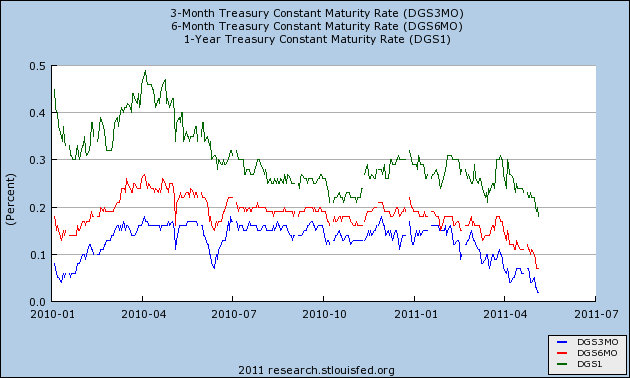
And don’t pin this on the Federal Reserve. Most of the QE2 buying has been in the middle of the yield curve.
Personally, I had been expecting the Fed to raise rates sooner than most people had expected. Apparently, Mr. Market disagrees and expects rates to stay low for a while longer.
-
NASDAQ Close to 10-1/2 Year High
Posted by Eddy Elfenbein on May 10th, 2011 at 4:23 pmWhile the S&P 500 is still below its high from October 2007, that NASDAQ Composite ($COMPQ) closed today just inches from its highest close since December 12, 2000.
Thanks to the news that Microsoft ($MSFT) is buying Skype for $8.5 billion, the NASDAQ closed today at 2,871.89 which is just 1.65 below the close from April 29, 2011.
-
Sysco Looking to Make Deals
Posted by Eddy Elfenbein on May 10th, 2011 at 10:54 amThanks to yesterday’s huge move from Sysco ($SYY), our Buy List gained 1.04% yesterday compared with 0.45% for the S&P 500. For the year, the Buy List is up 11.67% to the S&P 500’s 7.05%.
Sysco got as high as $32.76 yesterday but closed at $31.57. I was surprised by the magnitude of yesterday’s move, but sometimes the best stock to buy is the one you already own. Sysco also said that they’re looking to make acquisitions going forward.
“We are also committed to looking for acquisition opportunities both in and beyond the core,” DeLaney said on a conference call today. “We are doing this mainly through building a pipeline of high-quality potential domestic acquisitions and also by looking at adjacencies and new geographies.”
Sysco, which controls almost one-fifth of the restaurant- distribution industry’s more than $200 billion in sales, may look to Western Europe for growth as people there eat out more, said Jack Russo, an analyst at Edward Jones. Sysco has completed at least seven acquisitions in the past five years, the latest being the purchase of Nebraskan distributor Lincoln Poultry & Egg Co. last year.
Our Buy List continues to do well today. Both Jos. A. Bank ($JOSB) and Wright Express ($WXS) are at new 52-week highs.
-
Morning News: May 10, 2011
Posted by Eddy Elfenbein on May 10th, 2011 at 7:30 amMerkel Says No Aid Decisions Until Greek Assessment Reports
Unease About Greece Grows as S.&P. Downgrades Its Debt Again
ECB’s Bini Smaghi-Debt Restructuring Would Be Suicide
Yuan Forwards Rise for Second Day as Reference Rate Set Higher
U.S., Chinese Firms Sign Solar-Power Pact
Chinese Exports Hit Record for April
Australia Shrinks Spending to Combat Mining-Fueled Inflation
Crop Damage From Weather Growing as Cost of Grains Advances
Oil Inventories Increase to Near a Two-Year High in Survey
U.S. Gasoline Extends Gains as Mississippi River Threatens Refineries
Bernanke’s QE2 Averts Deflation, Spurs Rally, Expands Credit
Treasuries Hold Loss Before Debt Auctions; Gross Increases Bet on Decline
Microsoft in Talks to Acquire Skype for $8.5 Billion
Hertz Makes New Dollar Thrifty Bid of $2.1 Billion
Howard Lindzon: Megatrends…Mobile, Social, Cloud, Global and REINVESTMENT
-
StockTwits Partners With CNN
Posted by Eddy Elfenbein on May 9th, 2011 at 3:12 pmHoward Lindzon, the Grand Poobah of StockTwits, had this announcement on his blog this morning:
The team at Stocktwits has been relentless about our mission of ‘Real Ideas. Real Investors. Real Time‘ since we started in the fall of 2008. We believed that people would share ideas, their trades, market and life experiences, moods, wins AND losses. They have.
We believed that if people shared, they would get heard. Today, our community will be heard a little further once again.
StockTwits is pleased to announce a content partnership with CNNMoney!
CNNMoney will feature editorial content from The StockTwits Blog Network, link directly to individual blogs and implement an advertising revenue share program.
This is a complementary relationship all the way around.
For the bloggers, it provides an opportunity to increase brand exposure and blog traffic while monetizing content.
For CNNMoney, it provides access to an incredible variety of fresh, high quality content penned daily by real market pros.
For StockTwits, it extends further our global platform from which curated real time, actionable market focused ideas emanate.
For the Stocktwits community, the stream’s reach gets wider, and we believe… smarter and more efficient.
The StockTwits Blog Network brings together the smartest market pros on the real time web and provides a platform for them from which they can build brand by sharing in depth actionable ideas.
CNNMoney is the online home of Fortune, Money and serves as CNN.com’s exclusive business site. It attracts more than 13 million unique visitors per month on average (Comscore).
Exciting times.
-
More “Bernanke Warns”
Posted by Eddy Elfenbein on May 9th, 2011 at 1:28 pmThese are from the past few weeks.
Bernanke warns that regulators must avoid burdensome rules when enacting financial reform
Bernanke warns: US deficit ‘not sustainable’
Bernanke warns of inflation risks
Stocks fall as Bernanke warns about oil prices
Bernanke warns of catastrophe if debt limit not raised
Bernanke warns against steep U.S. budget cuts
Bernanke Warns on Debt-Limit ‘Chaos’Ben Bernanke warns US of risks from weak house prices and ailing banks
-
S&P 500 to Hit Record Earnings
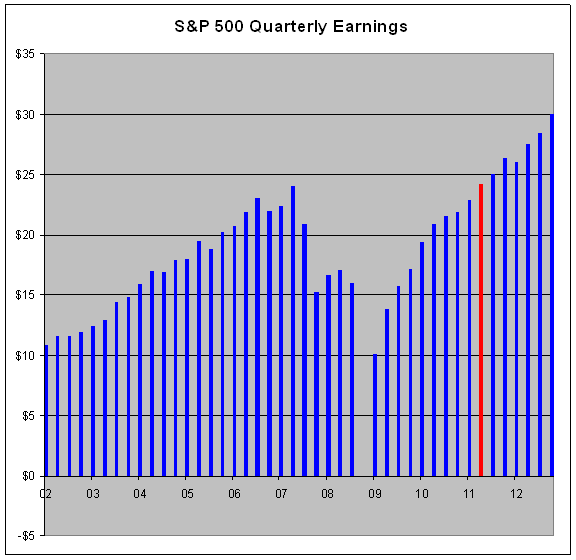
Posted by Eddy Elfenbein on May 9th, 2011 at 12:54 pmWe’re already nearly halfway through the second quarter and it looks like we’re going make record earnings for the S&P 500.
In Q2 of 2007, the S&P 500 made $24.06. Wall Street currently expects the S&P 500 to make $24.21 this quarter. The stock market, however, is still a long way from its record high close of 1,565.15 from October 9, 2007.
Wall Street expects the S&P 500 to make $98.55 this year and $112.06 next year.
-
Archives
- October 2026
- September 2026
- August 2026
- July 2026
- June 2026
- May 2026
- April 2026
- March 2026
- February 2026
- January 2026
- December 2025
- November 2025
- October 2025
- September 2025
- August 2025
- July 2025
- June 2025
- May 2025
- April 2025
- March 2025
- February 2025
- January 2025
- December 2024
- November 2024
- October 2024
- September 2024
- August 2024
- July 2024
- June 2024
- May 2024
- April 2024
- March 2024
- February 2024
- January 2024
- December 2023
- November 2023
- October 2023
- September 2023
- August 2023
- July 2023
- June 2023
- May 2023
- April 2023
- March 2023
- February 2023
- January 2023
- December 2022
- November 2022
- October 2022
- September 2022
- August 2022
- July 2022
- June 2022
- May 2022
- April 2022
- March 2022
- February 2022
- January 2022
- December 2021
- November 2021
- October 2021
- September 2021
- August 2021
- July 2021
- June 2021
- May 2021
- April 2021
- March 2021
- February 2021
- January 2021
- December 2020
- November 2020
- October 2020
- September 2020
- August 2020
- July 2020
- June 2020
- May 2020
- April 2020
- March 2020
- February 2020
- January 2020
- December 2019
- November 2019
- October 2019
- September 2019
- August 2019
- July 2019
- June 2019
- May 2019
- April 2019
- March 2019
- February 2019
- January 2019
- December 2018
- November 2018
- October 2018
- September 2018
- August 2018
- July 2018
- June 2018
- May 2018
- April 2018
- March 2018
- February 2018
- January 2018
- December 2017
- November 2017
- October 2017
- September 2017
- August 2017
- July 2017
- June 2017
- May 2017
- April 2017
- March 2017
- February 2017
- January 2017
- December 2016
- November 2016
- October 2016
- September 2016
- August 2016
- July 2016
- June 2016
- May 2016
- April 2016
- March 2016
- February 2016
- January 2016
- December 2015
- November 2015
- October 2015
- September 2015
- August 2015
- July 2015
- June 2015
- May 2015
- April 2015
- March 2015
- February 2015
- January 2015
- December 2014
- November 2014
- October 2014
- September 2014
- August 2014
- July 2014
- June 2014
- May 2014
- April 2014
- March 2014
- February 2014
- January 2014
- December 2013
- November 2013
- October 2013
- September 2013
- August 2013
- July 2013
- June 2013
- May 2013
- April 2013
- March 2013
- February 2013
- January 2013
- December 2012
- November 2012
- October 2012
- September 2012
- August 2012
- July 2012
- June 2012
- May 2012
- April 2012
- March 2012
- February 2012
- January 2012
- December 2011
- November 2011
- October 2011
- September 2011
- August 2011
- July 2011
- June 2011
- May 2011
- April 2011
- March 2011
- February 2011
- January 2011
- December 2010
- November 2010
- October 2010
- September 2010
- August 2010
- July 2010
- June 2010
- May 2010
- April 2010
- March 2010
- February 2010
- January 2010
- December 2009
- November 2009
- October 2009
- September 2009
- August 2009
- July 2009
- June 2009
- May 2009
- April 2009
- March 2009
- February 2009
- January 2009
- December 2008
- November 2008
- October 2008
- September 2008
- August 2008
- July 2008
- June 2008
- May 2008
- April 2008
- March 2008
- February 2008
- January 2008
- December 2007
- November 2007
- October 2007
- September 2007
- August 2007
- July 2007
- June 2007
- May 2007
- April 2007
- March 2007
- February 2007
- January 2007
- December 2006
- November 2006
- October 2006
- September 2006
- August 2006
- July 2006
- June 2006
- May 2006
- April 2006
- March 2006
- February 2006
- January 2006
- December 2005
- November 2005
- October 2005
- September 2005
- August 2005
- July 2005
 Eddy Elfenbein is a Washington, DC-based speaker, portfolio manager and editor of the blog Crossing Wall Street. His