-
Remember That Silver Rally…Yeah, About That
Posted by Eddy Elfenbein on May 5th, 2011 at 10:52 amThe Silver ETF ($SLV) is down 24% this week.
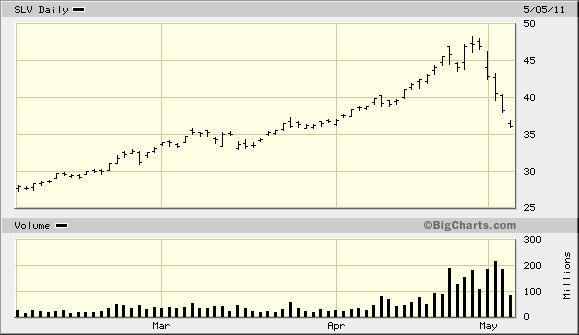
In 1980, Silver Thursday came four weeks before Desert One. So from two data points, I can conclude that U.S. military raids are bearish for silver.
-
Nicholas Financial Earned 40 Cents Per Share
Posted by Eddy Elfenbein on May 5th, 2011 at 9:53 amNICK did it again. Another great quarter:
Nicholas Financial, Inc. announced that for the three months ended March 31, 2011 net earnings increased 46% to $4,772,000 as compared to $3,260,000 for the three months ended March 31, 2010. Per share diluted net earnings increased 43% to $0.40 as compared to $0.28 for the three months ended March 31, 2010. Revenue increased 13% to $16,095,000 for the three months ended March 31, 2011 as compared to $14,256,000 for the three months ended March 31, 2010.
For the year ended March 31, 2011, net earnings increased 55% to $16,805,000 as compared to $10,865,000 for the year ended March 31, 2010. Per share diluted net earnings increased 52% to $1.41 as compared to $0.93 for the year ended March 31, 2010. Revenue increased 11% to $62,774,000 for the year ended March 31, 2011 as compared to $56,472,000 for the year ended March 31, 2010.
“Our strong growth in earnings per share for the fourth quarter and year ended March 31, 2011 were favorably impacted by the revenue contribution from new branches and a reduction in the net charge-off rate,” stated Peter L. Vosotas, Chairman and CEO. “We reported record revenues and earnings every quarter this year. In addition, we opened six new branch offices in the past year. We entered two new states with a branch in Chicago, Illinois and one in St. Louis, Missouri. We expect to add four to eight new branches during the upcoming year and will also continue to pursue buy-side opportunities as they arise.”
The March quarter is the end of NICK’s fiscal year. For the year, NICK made $1.41 per share which is an increase over the 93 cents per share they made in the year before.
Let’s add some perspective, shall we? Based on yesterday’s close, NICK is going for 9.22 times trailing earnings. That’s an earnings yield of 10.85%. Meanwhile, we know that NICK’s portfolio is vastly improving.
For this past quarter, the provisions for credit losses were just $101,000 or 0.16% as a percentage of average finance receivables, net of unearned interest. One year ago, that was running at 3%. A year before that, it was 6%.
Low interest rates continue to help NICK. The borrowing rate for this past quarter was just 4.21% (I believe NICK’s credit line is LIBOR plus 300 with some additional charges.)
Here’s my updated spreadsheet with all the details.
Optimistically, NICK can earn $1.60 to $1.70 per share for this fiscal year.
-
Nine Stocks Up over 900% Since 9/11
Posted by Eddy Elfenbein on May 5th, 2011 at 9:05 amJeff Reeves lists nine stocks that have risen over 900% since 9/11.
Here’s a summary:
Apple ($AAPL) +3,930%
Amazon ($AMZN) +2,120%
CNOOC ($CEO) +1,140%
Green Mountain Coffee ($GMCR) +2,840%
HMS Holdings ($HMSY) +4,670%
Imax Corp. ($IMAX) +3,390%
Intuitive Surgical ($ISRG) +1,830%
F5 Networks ($FFIV) +1,170%
Priceline ($PCLN) +1,530%
-
Morning News: May 5, 2011
Posted by Eddy Elfenbein on May 5th, 2011 at 7:55 amBOE Holds Interest Rate at 0.5% on Signs Recovery Is Fading
Portugal Says 78 Billion Euros Sufficient, Flags Recession
Banks Hit Stocks, Investors Jumpy Over Rates
China Yuan Flat Late Ahead Of China-US Meeting, Key Announcements
Silver Investors Dump Bets on Costs
Food Prices Rise to Near-Record as Inflation Accelerates
U.S. Stock Futures Fall, Indicating Fourth Decline for S&P 500
Fed Presidents Signal Record Stimulus Won’t Be Removed Soon
Debt Ceiling Has Some Give, Until Roof Falls In
Wal-Mart Tops Fortune 500 Again
Costco’s April Same-Store Sales Rise 12%
Banco Bilbao Vizcaya Argentaria First-Quarter Profit Drops to $1.7 Billion
ING Reports Rise in Q1 Earnings, Will Repay Dutch State
ConAgra May Have to Go Hostile After Ralcorp Rejects Offer
-
Thoughts on the U.K.’s Alternative Vote Referendum
Posted by Eddy Elfenbein on May 4th, 2011 at 10:00 pmTomorrow, voters in the U.K. will go to the polls for the second-ever nationwide referendum. The vote is to decide what electoral system is used to select members of the House of Commons.
The choice is between the present system which is known as First Past the Post (FPTP) and the alternative system known as Alternative Vote (AV).
FPTP is pretty straightforward. Whoever gets the most votes wins—even if it’s a minority of votes which often happens in a three-or-more party system.
The Alternative Vote system let’s the voters rank all of the candidates in order of preference. The candidate with the lowest total is eliminated. The votes for that candidate are then given to the next highest-preferred choice. The process continues until one candidate has a majority. In the U.S. this is often known as instant run-off.
The back story is that in the last general election, the Conservative Party fell 20 seats short of holding a majority in the House of Commons. In order to form a government, the Tories had to form a coalition with the Liberal Democrats. The pound of flesh secured by the Lib Dems was for this national referendum.
As the U.K.’s third party, the Lib Dems naturally thought AV would help them in future elections. This looks like an historic miscalculation. According to the latest polls, AV is trailing badly. In other words, their major concession turned out to be absolutely worthless.
I’m more interested in the mathematical strategy behind the two electoral systems. Critics of FPTP say that it unfairly gives out-sized results to the established parties. The numbers certainly back up this criticism. In the last general election, Labour (which came in second) outpolled the Lib Dems, 29% to 23%. Yet, Labour won 258 seats to the Lib Dems’ 57.
In this week’s Canadian election, the Conservative Party won 39.6% of the vote but they won 54.2% of the seats. In New Brunswick, the Conservatives won 43.9% of the vote but they took eight of the 10 seats. FPTP gives an advantage to top-tier parties that have broad geographic support. AV is generally favored by smaller parties or parties with a strong regional base.
In the United States, AV is often favored by political progressives but I think they tend to overstate its impact, especially its advantage for them. I’ve often noticed that when progressives are out of power, they criticize procedural issues like voting systems or cloture or campaigns finance. I don’t mean to suggest these issues aren’t worthy of criticism. I’m merely skeptical of how much reforms will truly change things or help the political left.
In the 2000 Presidential election, I think there were many voters who favored Ralph Nader over Al Gore but voted for Gore anyway out of a fear of throwing their vote away and thereby helping George W. Bush. Of course, this is precisely what happened.
In that case, AV almost certainly would have helped Gore, especially in Florida. However, other marginal parties would be helped by AV. I think libertarian candidates or paleo-conservative candidates might get a surprisingly high number of first-round votes.
It’s possible that right-of-center coalitions are inherently larger in a multi-party system and are therefore in a stronger position to win FPTP pluralities. The thinking is that it’s easier to rally disparate groups around the “No” banner than around the “Yes” banner.
Turning to stats-speak, I think AV would fatten the tails but would probably have little discernable impact on the median.
Ultimately, I’m a strong supporter of “Elfenbein’s Electoral Law” which states that as long as you have an open society with a free press and a robust culture of political debate, the electoral system doesn’t matter so much inregard to policy outcomes.
(One counterexample would be the U.S. Senate’s archaic cloture rules which probably kept Jim Crow alive for 20 years longer than a parliamentary system would have allowed. Maybe 30 years. But that’s a chamber’s rule, not an electoral system.)
The bottom line is that if you want to see your policy choice become law, you should start with having good arguments. Sigmund Freud said “The voice of Reason is small, but very persistent.”
Finally, here’s tomorrow’s ballot question in Welsh:
Ar hyn o bryd, mae’r DU yn defnyddio’r system “y cyntaf i’r felin” i ethol ASau i Dŷ’r Cyffredin. A ddylid defnyddio’r system “pleidlais amgen” yn lle hynny?
Happy voting!
-
The NL Is Out-Batting the AL
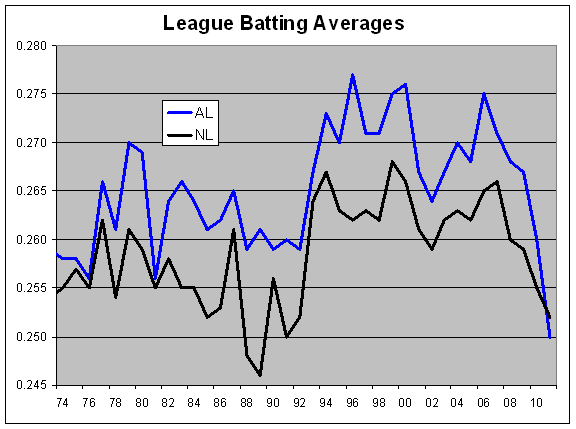
Posted by Eddy Elfenbein on May 4th, 2011 at 7:55 pmHere’s something strange I just noticed: Baseball defense is way up this year. The American League is currently batting 0.250 which is its lowest league average since 1972. Just five years ago, the AL batted 0.275. (Hmmm…it’s almost like there’s mysteriously less muscle in the game.)
In fact, the AL’s batting is so low that it’s slightly below the DH-less National League which is batting 0.252. That’s never happened since the DH was introduced in 1973.
Of course, it’s early May and this may be within the range of normal probability. Still, I’m curious if there’s something else going on.
-
How Much Is Google Really Worth?
Posted by Eddy Elfenbein on May 4th, 2011 at 3:19 pmGoogle ($GOOG) certainly gets a lot of attention but the stock really hasn’t done that well over the past few years. Three-and-a-half years ago, the stock was around $725 per share. Since then, Google has slightly underperformed the S&P 500 (plus the S&P 500 pays a dividend and Google doesn’t).

So how much should Google be worth? That’s hard to say. Let’s take a very basic look. Wall Street currently expects Google to earn $33.90 per share this year.
The S&P 500 is currently trading at 13.85 times this year’s earnings estimate. If Google were carrying that multiple, it would be about $470 per share.
However, Google is projected to grow its earnings faster than the overall market. Wall Street currently expects Google to earn $39.49 per share in 2012. The S&P 500 is going for 12.2 times next year’s estimate. So if Google carried that multiple, it would be $481 per share.
In other words, Google’s growth premium adds some value but not a whole lot. The current price of $537 assumes a growth premium that lasts well into the future — and in my opinion — too far of a distance to make a reasonable estimate.
This is a very rough estimate of Google’s price. What I mean to show you is the amount of future growth investors are placing in Google’s price. Sure, it may pay off, but consider that Google’s much-hoped-for future hasn’t paid off over the last three-and-a-half years.
-
Self-Directed Gen X Investors Outperformed Those With Advisors Last Year
Posted by Eddy Elfenbein on May 4th, 2011 at 10:05 amGen X affluent investors saw their investable assets grow by about 11% on average in 2010, with self-directed affluent Gen X investors seeing 28% asset growth and Gen X investors with an advisor just 3% growth on average during that same time period, according to the report.
You can read the full report here.
-
The New York Times and Efficient Markets
Posted by Eddy Elfenbein on May 4th, 2011 at 9:43 amCatherine Rampell has an unusually silly post at the New York Times Economix site. She looks at the giant spike in the price at Intrade’s contract to capture Osama Bin Laden and concludes that markets are inefficient.
I’m not sure how many times I’ve made this point, but that’s not what efficient markets mean. (And let me state clearly: I don’t believe markets are efficient).
Just because the price spikes doesn’t mean that a market “failed.” The market adjusts with new information. Efficient Market Hypothesis merely states that markets accurately price new information.
Sites like Intrade are mistakenly referred to as “predictions markets.” That’s not quite accurate. They’re really odds-setting markets. Those odds can change or a long-shot can pay-off. If you follow enough markets, a long-shot will pay off.
I don’t take Intrade’s markets very seriously. I think they’re fun to follow but they’re really just a sideshow. I also think Intrade does a poor job with their contracts. The real world futures contracts work best when there’s a lot of public information available on some event.
I remember when Intrade had contracts on who President Obama would appoint to the Supreme Court. That’s an awful contract because the outcome is based on one person’s decision. A better contract is who will win a party’s presidential nomination because there’s a lot of information available. Even that will mostly be a poll-watching contest.
-
Wright Express Beats and Guides Higher
Posted by Eddy Elfenbein on May 4th, 2011 at 9:15 amWright Express ($WXS) just released an amazing earnings report. The company had Q1 earnings of 75 cents per share which was six cents more than Wall Street’s estimate. Quarterly revenue jumped 43.3% to $120.1 million which also beat estimates.
For Q2, Wright sees earnings coming in between 83 cents and 89 cents per share. But I was really impressed by the new guidance. As I’ve said before, few things impress me more than when a company raises its full-year guidance. Wright raised its 2011 guidance by 23 cents per share. The old EPS range was $3.17 to $3.37 and the new range is $3.40 to $3.60.
Given the strong results during the first quarter, we are increasingly confident in our ability to deliver solid performance as we head into the second quarter. We are raising our guidance for the full-year 2011 to reflect the strength we saw during the first three months of the year, coupled with higher fuel prices, a lower tax rate and a stronger Australian dollar.
Not all companies issue quarterly or full-year guidance. I particularly like companies that do. As I see it, guidance is a matter of trust. I like to know where I stand with my stocks. I don’t mind terribly if a company reduces its guidance, as long as we know with enough lead time. Problems always come up. But I really like hearing that guidance is being raised. That’s probably the best news that long-term investors can get.
-
Archives
- October 2026
- September 2026
- August 2026
- July 2026
- June 2026
- May 2026
- April 2026
- March 2026
- February 2026
- January 2026
- December 2025
- November 2025
- October 2025
- September 2025
- August 2025
- July 2025
- June 2025
- May 2025
- April 2025
- March 2025
- February 2025
- January 2025
- December 2024
- November 2024
- October 2024
- September 2024
- August 2024
- July 2024
- June 2024
- May 2024
- April 2024
- March 2024
- February 2024
- January 2024
- December 2023
- November 2023
- October 2023
- September 2023
- August 2023
- July 2023
- June 2023
- May 2023
- April 2023
- March 2023
- February 2023
- January 2023
- December 2022
- November 2022
- October 2022
- September 2022
- August 2022
- July 2022
- June 2022
- May 2022
- April 2022
- March 2022
- February 2022
- January 2022
- December 2021
- November 2021
- October 2021
- September 2021
- August 2021
- July 2021
- June 2021
- May 2021
- April 2021
- March 2021
- February 2021
- January 2021
- December 2020
- November 2020
- October 2020
- September 2020
- August 2020
- July 2020
- June 2020
- May 2020
- April 2020
- March 2020
- February 2020
- January 2020
- December 2019
- November 2019
- October 2019
- September 2019
- August 2019
- July 2019
- June 2019
- May 2019
- April 2019
- March 2019
- February 2019
- January 2019
- December 2018
- November 2018
- October 2018
- September 2018
- August 2018
- July 2018
- June 2018
- May 2018
- April 2018
- March 2018
- February 2018
- January 2018
- December 2017
- November 2017
- October 2017
- September 2017
- August 2017
- July 2017
- June 2017
- May 2017
- April 2017
- March 2017
- February 2017
- January 2017
- December 2016
- November 2016
- October 2016
- September 2016
- August 2016
- July 2016
- June 2016
- May 2016
- April 2016
- March 2016
- February 2016
- January 2016
- December 2015
- November 2015
- October 2015
- September 2015
- August 2015
- July 2015
- June 2015
- May 2015
- April 2015
- March 2015
- February 2015
- January 2015
- December 2014
- November 2014
- October 2014
- September 2014
- August 2014
- July 2014
- June 2014
- May 2014
- April 2014
- March 2014
- February 2014
- January 2014
- December 2013
- November 2013
- October 2013
- September 2013
- August 2013
- July 2013
- June 2013
- May 2013
- April 2013
- March 2013
- February 2013
- January 2013
- December 2012
- November 2012
- October 2012
- September 2012
- August 2012
- July 2012
- June 2012
- May 2012
- April 2012
- March 2012
- February 2012
- January 2012
- December 2011
- November 2011
- October 2011
- September 2011
- August 2011
- July 2011
- June 2011
- May 2011
- April 2011
- March 2011
- February 2011
- January 2011
- December 2010
- November 2010
- October 2010
- September 2010
- August 2010
- July 2010
- June 2010
- May 2010
- April 2010
- March 2010
- February 2010
- January 2010
- December 2009
- November 2009
- October 2009
- September 2009
- August 2009
- July 2009
- June 2009
- May 2009
- April 2009
- March 2009
- February 2009
- January 2009
- December 2008
- November 2008
- October 2008
- September 2008
- August 2008
- July 2008
- June 2008
- May 2008
- April 2008
- March 2008
- February 2008
- January 2008
- December 2007
- November 2007
- October 2007
- September 2007
- August 2007
- July 2007
- June 2007
- May 2007
- April 2007
- March 2007
- February 2007
- January 2007
- December 2006
- November 2006
- October 2006
- September 2006
- August 2006
- July 2006
- June 2006
- May 2006
- April 2006
- March 2006
- February 2006
- January 2006
- December 2005
- November 2005
- October 2005
- September 2005
- August 2005
- July 2005
 Eddy Elfenbein is a Washington, DC-based speaker, portfolio manager and editor of the blog Crossing Wall Street. His