-
S&P 500 = 1,310
Posted by Eddy Elfenbein on April 12th, 2011 at 11:25 amSo far today, it’s a soggy day on Wall Street. The S&P 500 is off by a little over 1%. Once again, the cyclicals are leading the market lower. A few weeks ago, I talked about how the leadership of the cyclicals was coming to an end. Since then, the Morgan Stanley Cyclical Index ($CYC) largely kept pace with the market, but it started to break down yesterday. As I’ve said before, the cyclicals tend to move in…well, cycles. Once a trend gets started, it often lasts for a long time.
The good news is that although the Buy List is down today, it’s still running ahead of the market. This is because we don’t have as many cyclical stocks as the broader market. That really helped us yesterday. The S&P 500 dropped by 0.28% while our Buy List rose by 0.41%.
Let me say a few words about trading Nicholas Financial ($NICK). The stock traded as high as $12.99 yesterday but I think it was simply due to the internal mechanics of trading. The stock then traded at $12.32 before closing at $12.70. Today, it went back to $12.31 and is now at $12.50. Don’t be fooled into thinking there’s something more going on. The stock is absorbing more volume and is hence showing more volatility. I expect more good news from NICK when it reports earnings again in a few weeks.
-
Morning News: April 12, 2011
Posted by Eddy Elfenbein on April 12th, 2011 at 7:24 amThe Global Losing Streak Is Continuing, After An Ugly Night In Japan
U.K. Inflation Unexpectedly Slows as Stores Cut Food Prices
Bank of Japan Minutes Show Concern on Quake Impact
Allied Irish Banks’ Loss Soars to $15 Billion, Axes 2,000 Jobs
Yuan Forwards Decline After IMF Highlights Global Recovery Risk
IEA Says Oil Price Hurting Economy, Maintains Demand Outlook
Oil Advances a Fourth Day in New York on Libyan Conflict, Mideast Unrest
Gas Prices Rise, and Economists Seek Tipping Point
Building a Takeover Bid Over Takeout
The One Thing You Must Realize About PIMCO’s Big Bet Against Treasuries
Futures Slip as Alcoa Disappoints
Glencore Said to Plan $9 Billion to $11 Billion Initial Offering
Level 3 To Acquire Global Crossing In $1.9B All-Stock Deal
Google Goes Green, Invests $168 Million in Ivanpah Solar Power
-
NICK = $12.99
Posted by Eddy Elfenbein on April 11th, 2011 at 12:20 pmSomething’s up with Nicholas Financial ($NICK). The stock gapped up to $12.99 just now. The all-time high is $13.18 (split-adjusted) from five years ago.
I’m not sure why there’s a surge. It could just be due to an order imbalance. About 13,000 shares have been traded which is high but far from unprecedented.
-
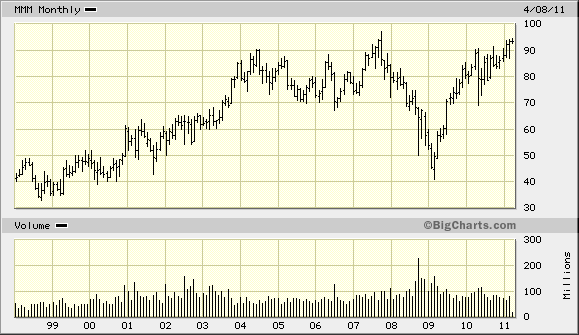
3M Close to All-Time High
Posted by Eddy Elfenbein on April 11th, 2011 at 11:41 amShares of 3M ($MMM) have been as high as $94.64 today which is a fresh 52-week high. That’s actually a three-and-a-half year high.
This recent rally brings MMM very close to its all-time high price of $97 reached in October 10, 2007.
I highlight MMM because it’s a very diversified manufacturing firm. If it’s near an all-time high, it suggests that much of the non-financial economy is recovering.
-
Stiglitz Calls for New Reserve Currency
Posted by Eddy Elfenbein on April 11th, 2011 at 11:01 amOver the weekend, Nobel laureate Joseph Stiglitz called for a new global reserve currency.
The world economy needs a new global reserve currency to help prevent trade imbalances that are reflected in the national debt of the U.S., said Nobel-prize winning economist Joseph Stiglitz.
A “global system” is needed to replace the dollar as a reserve currency and help avoid a weakening of U.S. credit quality, said Stiglitz, a professor at Columbia University in New York. The dollar fell to an almost 15-month low against the euro last week, and the U.S. trade deficit widened more than forecast in January to the highest level in seven months.
“By taking off the burden of any single country, we don’t have to have trade deficits,” Stiglitz said in an interview in Bretton Woods, New Hampshire. “Things would be much worse if it were not the case that Europe was having even more of a problem, but winning a negative beauty pageant is not the way to create a strong economy.”
Many others have floated this idea and I think it’s a fascinating concept.
The issue is that there’s one currency that the central banks of the world prefer to hold and that’s the U.S. dollar. That’s not much of a surprise since the United States has the world’s largest economy.
There’s debate around the idea that there can only be one reserve currency at a time. The reasoning is that the reserve currency needs to be unique and therefore there can be only one. I’m not sure if that’s theoretically true, but in practice it certainly has been true. The central banks of the world prefer U.S. dollars, though euros play a minor role as well.
But here’s the catch about having the dollar as the world’s reserve currency: there’s an inherent conflict in what the world needs out of it and what the United States needs out of it. We’re not always on the same page. Formally, this is known as the Triffin dilemma in honor the economist Robert Triffin. In fact, the Chinese specifically blamed the Triffin dilemma for the world economy going kablamo in 2008.
In real world concerns, being the world’s reserve currency means that the normal situation for the U.S. is to run a current account deficit. (Of course, one “unnormal” scenario would be a plunging dollar.) The world lets us finance our deficits on the keep and we waste little time in taking advantage of it.
No one has an inherent motive to change the status quo. Until a crisis comes, calling for a new global reserve currency is a futile exercise. The point of a reserve currency is that it doesn’t have to be called for—it’s immediately understood. It’s like telling visitors to Rome that they may want to check out some place called St. Peter’s.
The trend will continue until it stops. I don’t know when that will be, but I know that the end won’t be pleasant.
Edward Harrison has more.
-
Employment and Re-Election Chances
Posted by Eddy Elfenbein on April 11th, 2011 at 7:50 amSince 1948, ten presidents have run for re-election. Three times the unemployment rate was 7.4% or more in November of the election year. Each one of those times, the incumbent president has been defeated.
The other seven times, the jobless rate has been 7.2% or less. All seven times, those incumbent presidents have won re-election.
The March 2011 jobs report said the unemployment rate was 8.828%. If the relationship holds up, President Obama has 20 months to lower the jobless rate by 1.5%.
For the March jobless rate to be equal to the rate in November 1984 (the lowest on the chart for an incumbent victory), there would need to be 2.5 million more jobs.
Year Unemployment Rate Outcome 1976 7.835 Lose 1980 7.459 Lose 1992 7.447 Lose 1984 7.181 Win 1996 5.360 Win 2004 5.354 Win 1972 5.254 Win 1964 4.845 Win 1956 4.292 Win 1948 3.764 Win Interestingly, when an incumbent president hasn’t been on the ticket, the jobless rate hasn’t had much of an impact on which party wins.
Morning News: April 11, 2011
Posted by Eddy Elfenbein on April 11th, 2011 at 7:30 amBank of Japan Cuts Economic View of Seven of Nine Regions After Quake
Another Huge Economic Warning Comes From The U.K.
China Reports First Quarterly Trade Deficit in Seven Years
Brent Crude Oil Falls In Asia; Gadhafi Agrees To Peace Plan
Gold Drops on Selling After Rally to Record; Silver Reaches 31-Year High
Rising Gas Prices Cut Two Ways
NYSE Euronext Rejects Bid by Nasdaq and ICE
PIMCO Officially Goes SHORT The US Treasury Market
Endo Pharma to Buy American Medical Systems for $2.6 Billion
Google Seals ITA Deal But Antitrust Review Looms
Glencore Chief Says Listing Is ‘Imminent’
Enriching a Few at the Expense of Many
Joshua Brown: Volume on Everyone’s Mind
James Altucher: The Easiest Way to Succeed as an Entrepreneur
Wall Street’s Consensus for 2012
Posted by Eddy Elfenbein on April 8th, 2011 at 12:43 pmFor 2009, the S&P 500 earned $56.87. That jumped to $83.77 last year. Wall Street’s current forecast for 2011 is $96.96.
This means that even after the stock market’s huge rally over the past two years, the forward P/E Ratio is still just 13.75. That’s an earnings yield of 7.27% which is far higher than anything you see in the Treasury market.
For 2012, Wall Street sees the S&P 500 earning $110.10. Let me caution you that forecasts so far ahead in time should be given a reasonable amount of doubt. But even going by those numbers, it means that the S&P 500 is currently going for 12.11 times next year’s earnings. The earnings yield comes to 8.25%.
My point is that the fundamentals greatly favor stocks over bonds. Given the past 11 years’ activity, investors are duly wary of that notion.
Stocks Against Bonds
Posted by Eddy Elfenbein on April 8th, 2011 at 11:46 amI wish I had more to say, but this chart really says it all. The black line is the S&P 500 Spyders ETF ($SPY) and the gold line is the iShares Barclays 20+ Year Treasury Bond ETF ($TLT). They’re almost perfectly symmetrical.
Bed Bath & Beyond’s 2011 Projections
Posted by Eddy Elfenbein on April 8th, 2011 at 11:35 amCourtesy of Seeking Alpha, here’s part of the transcript of Bed Bath & Beyond‘s ($BBBY) conference call:
Based on these and other planning assumptions, we are modeling net earnings per diluted share to be in the range of approximately $0.58 to $0.61 for the fiscal first quarter of 2011. For all of fiscal 2011, we are modeling net earnings per diluted share to increase by approximately 10% to 15%.
Before concluding this afternoon’s call, a few additional comments relative to our recently concluded fiscal fourth quarter. Our balance sheet remains strong and debt free. We ended fiscal 2010 with cash and cash equivalents and investment securities of approximately $1.9 billion. This includes approximately $112.9 million of investments related to auction rate securities. These securities have an estimated temporary valuation adjustment of approximately $3.2 million to reflect their current lack of liquidity. Since this valuation adjustment is deemed temporary, it did not affect the company’s earnings.
During the fourth quarter, we had approximately $8.4 million of redemptions of auction rate securities at par. Subsequent to the fourth quarter, we had approximately $5.8 million of auction rate securities redemptions at par, leaving a balance of approximately $107.1 million of these securities. As we have said in the past, and as we have experienced to date, we believe that given the high credit quality of these investments, we will ultimately recover, at par, all amounts invested in these securities.
Inventories continue to be tailored by store to meet the anticipated demands of our customers and are in good condition. As of February 26, 2011, inventories at cost were approximately $2 billion or $56.17 per square foot. Inventory per square foot was higher than in the prior year, primarily due to increased inventory levels required to support recent increases in comp store sales and timing of receipts.
Consolidated shareholders equity at February 26, 2011, was approximately $3.9 billion, which is net of all share repurchases, including the approximately $199 million representing approximately 4.1 million shares repurchased during fiscal fourth quarter of 2010.
-
Archives
- October 2026
- September 2026
- August 2026
- July 2026
- June 2026
- May 2026
- April 2026
- March 2026
- February 2026
- January 2026
- December 2025
- November 2025
- October 2025
- September 2025
- August 2025
- July 2025
- June 2025
- May 2025
- April 2025
- March 2025
- February 2025
- January 2025
- December 2024
- November 2024
- October 2024
- September 2024
- August 2024
- July 2024
- June 2024
- May 2024
- April 2024
- March 2024
- February 2024
- January 2024
- December 2023
- November 2023
- October 2023
- September 2023
- August 2023
- July 2023
- June 2023
- May 2023
- April 2023
- March 2023
- February 2023
- January 2023
- December 2022
- November 2022
- October 2022
- September 2022
- August 2022
- July 2022
- June 2022
- May 2022
- April 2022
- March 2022
- February 2022
- January 2022
- December 2021
- November 2021
- October 2021
- September 2021
- August 2021
- July 2021
- June 2021
- May 2021
- April 2021
- March 2021
- February 2021
- January 2021
- December 2020
- November 2020
- October 2020
- September 2020
- August 2020
- July 2020
- June 2020
- May 2020
- April 2020
- March 2020
- February 2020
- January 2020
- December 2019
- November 2019
- October 2019
- September 2019
- August 2019
- July 2019
- June 2019
- May 2019
- April 2019
- March 2019
- February 2019
- January 2019
- December 2018
- November 2018
- October 2018
- September 2018
- August 2018
- July 2018
- June 2018
- May 2018
- April 2018
- March 2018
- February 2018
- January 2018
- December 2017
- November 2017
- October 2017
- September 2017
- August 2017
- July 2017
- June 2017
- May 2017
- April 2017
- March 2017
- February 2017
- January 2017
- December 2016
- November 2016
- October 2016
- September 2016
- August 2016
- July 2016
- June 2016
- May 2016
- April 2016
- March 2016
- February 2016
- January 2016
- December 2015
- November 2015
- October 2015
- September 2015
- August 2015
- July 2015
- June 2015
- May 2015
- April 2015
- March 2015
- February 2015
- January 2015
- December 2014
- November 2014
- October 2014
- September 2014
- August 2014
- July 2014
- June 2014
- May 2014
- April 2014
- March 2014
- February 2014
- January 2014
- December 2013
- November 2013
- October 2013
- September 2013
- August 2013
- July 2013
- June 2013
- May 2013
- April 2013
- March 2013
- February 2013
- January 2013
- December 2012
- November 2012
- October 2012
- September 2012
- August 2012
- July 2012
- June 2012
- May 2012
- April 2012
- March 2012
- February 2012
- January 2012
- December 2011
- November 2011
- October 2011
- September 2011
- August 2011
- July 2011
- June 2011
- May 2011
- April 2011
- March 2011
- February 2011
- January 2011
- December 2010
- November 2010
- October 2010
- September 2010
- August 2010
- July 2010
- June 2010
- May 2010
- April 2010
- March 2010
- February 2010
- January 2010
- December 2009
- November 2009
- October 2009
- September 2009
- August 2009
- July 2009
- June 2009
- May 2009
- April 2009
- March 2009
- February 2009
- January 2009
- December 2008
- November 2008
- October 2008
- September 2008
- August 2008
- July 2008
- June 2008
- May 2008
- April 2008
- March 2008
- February 2008
- January 2008
- December 2007
- November 2007
- October 2007
- September 2007
- August 2007
- July 2007
- June 2007
- May 2007
- April 2007
- March 2007
- February 2007
- January 2007
- December 2006
- November 2006
- October 2006
- September 2006
- August 2006
- July 2006
- June 2006
- May 2006
- April 2006
- March 2006
- February 2006
- January 2006
- December 2005
- November 2005
- October 2005
- September 2005
- August 2005
- July 2005
 Eddy Elfenbein is a Washington, DC-based speaker, portfolio manager and editor of the blog Crossing Wall Street. His