-
Sprint Nextel Is a Financial Black Hole
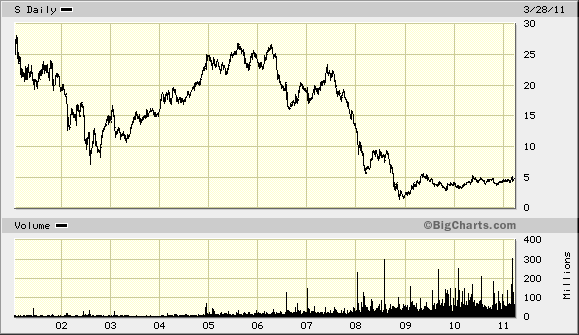
Posted by Eddy Elfenbein on March 29th, 2011 at 1:31 pmCheck out some of these numbers on Sprint Nextel ($S):
Year Sales EBIT Depreciation Total Net Income EPS 2001 $25,562 -$2,350 $4,576 -$1,599 -$1.16 2002 $26,679 $401 $4,890 $451 $0.32 2003 $26,197 -$504 $4,973 -$292 -$0.21 2004 $21,647 -$3,244 $3,658 -$2,006 -$1.40 2005 $28,771 $1,291 $5,200 $821 $0.40 2006 $41,003 $1,483 $9,592 $995 $0.33 2007 $40,146 -$29,775 $8,933 -$29,444 -$10.24 2008 $35,635 -$4,060 $8,407 -$2,796 -$0.98 2009 $32,260 -$3,494 $7,416 -$2,436 -$0.84 2010 $32,563 -$3,299 $6,248 -$3,465 -$1.16 The company is a money-losing machine. Wall Street expects Sprint to lose another 80 cents per share this year and 59 cents per share next year.
Looking at the S&P 500’s Valuation
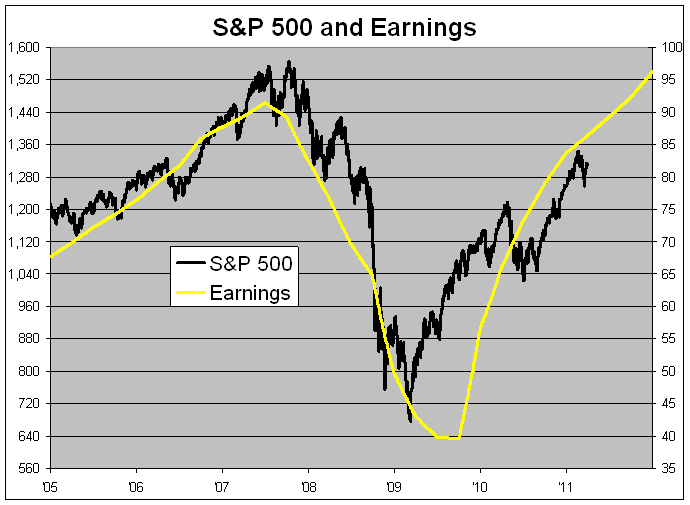
Posted by Eddy Elfenbein on March 29th, 2011 at 12:44 pmThanks to the mini-pullback following the Japanese earthquake, the S&P 500 hit a closing low of 1,256.88 on March 16th, which is a P/E Ratio of 14.62.
In the chart below, the S&P 500 and its earnings are scaled at a ratio of 16-to-1 since 16 seems to be the best value for a long-term earnings multiple. We actually haven’t been as high as 16 since last May.
For 2010, the S&P 500’s earnings were $83.76 which was a 47% increase over 2009. For 2011, Wall Street’s current consensus is for earnings of $96.23. With a P/E Ratio of 16, that gives us a year-end possible target of 1,539.28. That’s a 17.5% rally from yesterday’s close.
So That’s What It Got Us
Posted by Eddy Elfenbein on March 29th, 2011 at 12:10 pmAP: March 29, 2011
Pentagon: Libya mission has cost US $550 Million so far
NYT: July 15, 2010
The Yen’s Impact on the Stock Market
Posted by Eddy Elfenbein on March 29th, 2011 at 10:17 amHere’s a look at the yen’s impact on the stock market. More correctly, I should say this is a look at how the yen is correlated with the U.S. stock market.
I looked at all the daily market activity from 1989 through 2010 and then I annualized what the stock market did on days when the yen rose against the dollar and on days when it fell against the dollar. The results are below.
As you might expect, the movement of the currencies has the least impact on domestic-oriented sectors like staples and healthcare, but it has a big impact on areas like tech and finance.


 Eddy Elfenbein is a Washington, DC-based speaker, portfolio manager and editor of the blog Crossing Wall Street. His