-
Morning News: February 4, 2011
Posted by Eddy Elfenbein on February 4th, 2011 at 7:57 amOil Climbs, Heads for Second Week of Gains, on Economic Optimism
Asian Shares End Higher; Merger Talks Boost Japan Steel Plays
Merkel Turns Crisis into Opportunity to Reshape Euro Zone
In Asia, Hello to Faster Trades and Goodbye to Lunch Hour
Gold Falls as Recovering Economy Curbs Alternative-Asset Demand
Bernanke Takes Sides on Debt Limit Vote
Municipal Bond Yields Rise as Market Rally Stalls
Aetna Lifts Dividend as Profit Tops Views
Blackstone Posts 56% Rise in Quarterly Profit
Luxury Goods’ LVMH Falls After 2010 Operating Profit Trails Estimate
Joshua Brown: Brian Shannon: The Answer is Real Simple
Leigh Drogen: Rupert Murdoch Just Doesn’t Get It
Paul Kedrosky: Niall Ferguson on Systemic Risk in Egypt
Turkey Claimed by Ethel Kennedy Sought for Harassing Mail Trucks
-
Fiserv Misses by a Penny
Posted by Eddy Elfenbein on February 3rd, 2011 at 11:07 pmAfter the closing bell, Fiserv (FISV) reported Q4 earnings of $1.06 per share which was a penny below expectations. The market may not be pleased tomorrow by the earnings miss, but I’m not worried about one penny. My concern was a major miss and I thought that was a very remote possibility. In October, I wrote: “if they make less than $1 per share this quarter, we’ll know something went very wrong. In fact, if they made less than $1.04, it would be ugly.” So $1.06 is fine by me.
For all of 2010, the company earned $4.05 compared with $3.66 in 2009. Quarterly sales rose from $1.06 billion to $1.08 billion. In October, Fiserv’s full-year guidance was $3.96 to $4.07 per share. I had wanted them to at least raise the low end because it seemed very obvious that they would easily top that. As it turns out, they did.
The earnings miss is a disappointment, but not a major one. By far, the most important news is that Fiserv gave us full-year earnings guidance of $4.42 to $4.54 per share. Wall Street had been expecting $4.46.
I think we’ll see a lower open tomorrow but that’s just the Street being a drama queen. My view hasn’t changed at all. Even going by the low end, FISV is going for 14.1 times 2011’s estimate. That’s a good buy.

-
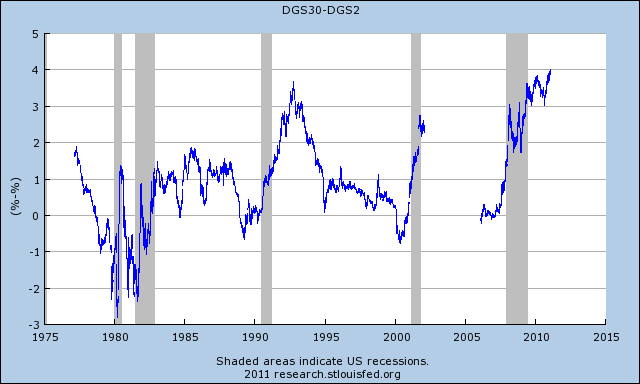
Yield Curve At All-Time Steepiness
Posted by Eddy Elfenbein on February 3rd, 2011 at 2:32 pmThe spread between the two-year and the 30-year Treasury is now over 400 basis points. That’s the widest spread since the Treasury started issuing 30-year paper in the 1970s.
-
Your Efficient Market Data Point of the Day
Posted by Eddy Elfenbein on February 3rd, 2011 at 1:52 pmAccording to Sportsbook.com, the odds for both heads and tails for Sunday’s big coin toss is -101. That means that you have to put up $101 to win $100.
Since something has to go to the house, you can’t even get 50-50 odds on a coin toss. However, the house’s take on this bet is extremely small so I’m guessing they’re just using it to entice customers to wager on bets with wider spreads.
Still, that’s better than betting on which team will win the coin toss which is -105 for both teams.
For the winner of the game, Sportsbook.com has the Steelers at +120 and the Packers at -140.
That’s like saying the Packers have a 58.3% chance of winning and the Steelers have a 45.5% chance of winning. You may have noticed that those add up to more than 100%, and that excess is the house’s cut.
I think it’s interesting that on the biggest bet of the year, the vig is still—in my eyes—pretty sizeable.
According to Brian Burke, one of the top football number crunchers around, the Steelers and Packers are almost perfectly matched. He has the Steelers at 50.07% and the Packers at 49.93%.
Burke thinks the public’s turn toward the Packers is due to their strong playoff run which he places under the cognitive bias known as the recency effect.
-
Reynolds American Earns 60 Cents Per Share
Posted by Eddy Elfenbein on February 3rd, 2011 at 10:41 amFor Q4, Reynolds American (RAI) earned 60 cents per share which was a penny below the Street. The company sees full-year 2011 earnings-per-share coming in between $2.60 and $2.70.
The number of cigarettes sold fell by 5.1% but the total revenue in dollars fell just by less than 1%. In other words, RAI was able to raise prices. I was very impressed by RAI’s gross margins which rose from 45.2% to 46.8%.
The shares pulled back below $32, but don’t be alarmed, Reynolds is still a very good buy. The stock pays a quarterly dividend of 49 cents per share which works out to a yield of 6.1% at the current share price.
-
Time To Fine The SEC
Posted by Eddy Elfenbein on February 3rd, 2011 at 7:52 amGuess what company has screwed up its accounting for the past seven years in a row? Actually it’s even worse than that. They’ve screwed up basic tasks like tracking income.
You’d probably think the SEC would be all over them. Yeah…about that.
“A reasonable possibility exists that a material misstatement of S.E.C.’s financial statements would not be prevented, or detected and corrected on a timely basis,” the auditor concluded.
The auditor did not accuse the S.E.C. of cooking its books, and the mistakes were corrected before its latest financial statements were completed. But the fact that basic accounting continually bedevils the agency responsible for guaranteeing the soundness of American financial markets could prove especially awkward just as the S.E.C. is saying it desperately needs money to increase its regulatory power.
Like the rest of the federal government, the S.E.C. is operating without an increase in its budget, which was $1.1 billion last year. With President Obama talking about extending the freeze and lawmakers continuing their criticism of its embarrassing performance before the financial crisis, the agency’s prospects for more money appear bleak.
That has ominous implications for investors. The S.E.C.’s technology systems, for example, lack the ability to perform sophisticated analysis of large batches of financial material. As a result, a Congressional report says, S.E.C. analysts sometimes resort to printouts, calculators and pencils. While investigating the “flash crash” of May 6, 2010, S.E.C. computers were so strained by the crush of data from just one day of trading that it took three months to figure out what had happened.
-
TARP Nearly Even
Posted by Eddy Elfenbein on February 3rd, 2011 at 7:31 amPromise not to tell anyone…the TARP program is nearly in the money:
The U.S. Department of Treasury on Wednesday said the government’s bank bailout program has recouped nearly everything it issued in loans two years ago.
The Troubled Asset Relief Program lent out about $245 billion and has received repayments of $243 billion with the latest repayment of $3.4 billion from Fifth Third Bank. The Cincinnati bank took $1.7 billion from existing capital and generated the other $1.7 billion by creating shares of stock to sell.
The TARP loan program is expected to ultimately yield a $20 billion profit to taxpayers, Treasury said in a release.
Including money provided to banks, automakers and AIG, as well as programs to improve lending and prevent foreclosure, the government provided $410 billion. About $274 billion has been received in repayments and income.
-
Morning News: February 3, 2011
Posted by Eddy Elfenbein on February 3rd, 2011 at 7:30 amCrude Oil Rises As Violence In Egypt Worsens
France to Present Joint EU Proposal with Germany
ECB’s Trichet Fights to Curb Pay Pressures as Inflation Accelerates
S&P Says No Plans to Cut U.S. Rating in Medium Term
S.E.C. Proposes Rules on Derivative Prices
Bill Gross’s Recent CEF Purchases: Highly Impressive Performance
Sony’s Profit Falls 8.6% in Third Quarter
Unilever Sees Increased Commodity Expenses Dragging on 2011 Profitability
News Corp.’s Net Income More Than Doubles, Led by Its Cable Networks
Starwood Hotels Q4 Profit Tops Wall Street
Nippon Steel, Sumitomo Metal Plan Merger to Form World’s No. 2 Steelmaker
Leigh Drogen: The Absurdity of Making Brokers Into Fiduciaries
-
The Rally By Day of the Week
Posted by Eddy Elfenbein on February 2nd, 2011 at 3:32 pmThe stock market closed at a new 29-month high yesterday. Since the rally began in March 2009, the S&P 500 is up 93.28%. We’re quickly approaching one of the fastest doublings in history.
Here’s the rally broken down by day of the week:
Monday 31.22%
Tuesday 2.60%
Wednesday 24.14%
Thursday 23.47%
Friday -6.34% -
Stocks Mirror Bonds
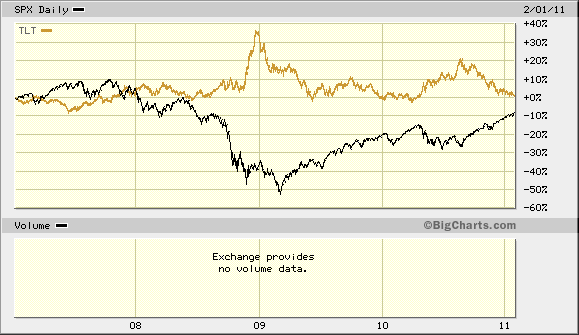
Posted by Eddy Elfenbein on February 2nd, 2011 at 11:47 amHere’s an interesting chart. This shows the S&P 500 in black along with the long-term Treasury ETF (TLT). Viewed this way you can see that they’re almost perfect mirror images.
Yesterday, the 30-year closed at a yield of 4.61%. That’s the second-highest yield in over nine months while the S&P 500 closed at its highest level since June 25, 2008.
The message over the last few months is clear: stocks have been rising as bonds have been falling. As I wrote earlier, this is exactly what QE2 was supposed to do.
-
Archives
- October 2026
- September 2026
- August 2026
- July 2026
- June 2026
- May 2026
- April 2026
- March 2026
- February 2026
- January 2026
- December 2025
- November 2025
- October 2025
- September 2025
- August 2025
- July 2025
- June 2025
- May 2025
- April 2025
- March 2025
- February 2025
- January 2025
- December 2024
- November 2024
- October 2024
- September 2024
- August 2024
- July 2024
- June 2024
- May 2024
- April 2024
- March 2024
- February 2024
- January 2024
- December 2023
- November 2023
- October 2023
- September 2023
- August 2023
- July 2023
- June 2023
- May 2023
- April 2023
- March 2023
- February 2023
- January 2023
- December 2022
- November 2022
- October 2022
- September 2022
- August 2022
- July 2022
- June 2022
- May 2022
- April 2022
- March 2022
- February 2022
- January 2022
- December 2021
- November 2021
- October 2021
- September 2021
- August 2021
- July 2021
- June 2021
- May 2021
- April 2021
- March 2021
- February 2021
- January 2021
- December 2020
- November 2020
- October 2020
- September 2020
- August 2020
- July 2020
- June 2020
- May 2020
- April 2020
- March 2020
- February 2020
- January 2020
- December 2019
- November 2019
- October 2019
- September 2019
- August 2019
- July 2019
- June 2019
- May 2019
- April 2019
- March 2019
- February 2019
- January 2019
- December 2018
- November 2018
- October 2018
- September 2018
- August 2018
- July 2018
- June 2018
- May 2018
- April 2018
- March 2018
- February 2018
- January 2018
- December 2017
- November 2017
- October 2017
- September 2017
- August 2017
- July 2017
- June 2017
- May 2017
- April 2017
- March 2017
- February 2017
- January 2017
- December 2016
- November 2016
- October 2016
- September 2016
- August 2016
- July 2016
- June 2016
- May 2016
- April 2016
- March 2016
- February 2016
- January 2016
- December 2015
- November 2015
- October 2015
- September 2015
- August 2015
- July 2015
- June 2015
- May 2015
- April 2015
- March 2015
- February 2015
- January 2015
- December 2014
- November 2014
- October 2014
- September 2014
- August 2014
- July 2014
- June 2014
- May 2014
- April 2014
- March 2014
- February 2014
- January 2014
- December 2013
- November 2013
- October 2013
- September 2013
- August 2013
- July 2013
- June 2013
- May 2013
- April 2013
- March 2013
- February 2013
- January 2013
- December 2012
- November 2012
- October 2012
- September 2012
- August 2012
- July 2012
- June 2012
- May 2012
- April 2012
- March 2012
- February 2012
- January 2012
- December 2011
- November 2011
- October 2011
- September 2011
- August 2011
- July 2011
- June 2011
- May 2011
- April 2011
- March 2011
- February 2011
- January 2011
- December 2010
- November 2010
- October 2010
- September 2010
- August 2010
- July 2010
- June 2010
- May 2010
- April 2010
- March 2010
- February 2010
- January 2010
- December 2009
- November 2009
- October 2009
- September 2009
- August 2009
- July 2009
- June 2009
- May 2009
- April 2009
- March 2009
- February 2009
- January 2009
- December 2008
- November 2008
- October 2008
- September 2008
- August 2008
- July 2008
- June 2008
- May 2008
- April 2008
- March 2008
- February 2008
- January 2008
- December 2007
- November 2007
- October 2007
- September 2007
- August 2007
- July 2007
- June 2007
- May 2007
- April 2007
- March 2007
- February 2007
- January 2007
- December 2006
- November 2006
- October 2006
- September 2006
- August 2006
- July 2006
- June 2006
- May 2006
- April 2006
- March 2006
- February 2006
- January 2006
- December 2005
- November 2005
- October 2005
- September 2005
- August 2005
- July 2005
 Eddy Elfenbein is a Washington, DC-based speaker, portfolio manager and editor of the blog Crossing Wall Street. His