-
Morning News: December 10, 2010
Posted by Eddy Elfenbein on December 10th, 2010 at 7:40 amWall Street Futures Signal Higher Open
China Raises Banks’ Reserve Ratios Again
Fitch Downgrades Republic of Ireland’s Ratings to BBB+; Outlook Is Stable
Household Wealth Grows $1.2 Trillion
China Trade Surplus Tops Estimates, Adding to Tension
Mortgage Rates are Up So The Sky Must Be Falling
OPEC Raises 2011 Forecast for Non-OPEC Supply on Russia, China
Day Trading Still Alive, Outsourced to China
Dell’s Pursuit of Compellent Deal Would Help Fill Storage Need
Sinopec to Buy Occidental Argentine Assets
-
Manning and Brady Are Nearly Tied in Lifetime Passer Rating
Posted by Eddy Elfenbein on December 9th, 2010 at 3:12 pmSince I like to cover statistical anomalies on Wall Street and other places, I thought I’d share a fun one: Tom Brady and Peyton Manning are nearly tied in the NFL’s (mostly useless) Passer Rating.
I won’t even try to settle the argument of who is better, but the Manning camp could always say that their guy had the better passing rating. This was true for most of the past few years.
But thanks to throwing 11 interceptions in the last three weeks, Manning’s Passer Rating has dropped to 94.7567. Tom Brady’s is 94.6978. They’re now separated by less than 0.06 points. Just seven weeks ago, Manning was leading by over two full points. Four years ago, he was leading by more than six points.

-
Your Cash Hoarding Data Point of the Day
Posted by Eddy Elfenbein on December 9th, 2010 at 1:30 pm
From WSJ:
U.S. companies continued to hoard cash in the third quarter, while households pared back borrowing, according to a Federal Reserve report.
U.S. nonfinancial companies had $1.93 trillion stashed in cash and short-term assets at the end of the third quarter—7.4% of total assets—up from $1.8 trillion, or 6.9% of total assets. That’s the highest level in more than 50 years.
The total debt in the U.S. nonfinancial sectors grew 4.2% in the third quarter, boosted by increased government and business debt.
Household debt, however, fell by 1.7%, the 10th straight quarterly decline, the Fed on Thursday said in its “Flow of Funds” data. Home mortgage debt dropped, as did consumer credit. Another Fed report this week showed credit-card use by U.S. consumers tumbled a 26th straight time in October, as Americans keep working to clean up their balance sheets amid high joblessness that’s restraining the economic recovery.
Though consumers avoided taking on new debt, the report showed the net worth of Americans rose last summer on a rebound in stock-market prices.
U.S. households’ total net worth rose 2.2% during July through September, to $54.89 trillion.
Net worth represents total assets such as homes and stock portfolios, minus liabilities like mortgages and credit card debt. Rising stock market assets offset declines in real estate holdings in the third quarter, the Fed report showed. Stock market wealth had fallen in the second quarter, contributing to a decline in total net worth during those three months.
The “Flow of Funds” said household net worth rose to about 4.81 times disposable personal income in the third quarter from about 4.72 times income in the second quarter.
-
Discussion of Irish Economy With Actual Irishman
Posted by Eddy Elfenbein on December 9th, 2010 at 11:48 amNeedless to say, hysterical but NSFW:
I want to see this guy on Fast Money. This needs to happen.
-
Morning News: December 9, 2010
Posted by Eddy Elfenbein on December 9th, 2010 at 8:02 amBOE Maintains Bond Plan as Economy Sustains Momentum
Futures Rise as Treasuries Steady, Jobs Data Due
EU to Decide Greek Loan Extension in Early 2011
Home Values Tumble $1.7 Trillion in 2010
Oil Rises for First Day in Three as Recovery Trims Supply Excess
Japan’s 3Q Growth Revised Up to 4.5 Percent
U.S. 10-year Yields Rise to Highest Level Since June
AIG Strikes Deal to Retire Fed Credit Line, Wind Down Bailout
Mastercard Set to Buy Part of Travelex
Home Depot Ups Outlook Slightly
-
Stryker Raises Dividend By 20%
Posted by Eddy Elfenbein on December 8th, 2010 at 9:19 pmGood news for Stryker (SYK). The company is raising its quarterly dividend from 15 cents per share to 18 cents per share. The dividend will be paid on January 31st to shareholders of record on December 31st.
The company also announced that it’s buying back $500 million of its stock.
-
Poll: Americans Think China has the World’s Largest Economy
Posted by Eddy Elfenbein on December 8th, 2010 at 12:24 pmThis passage caught my attention:
Asked which nation now has the world’s strongest economy, just 20 percent picked the United States. More than twice as many (47 percent) picked China. Eleven percent chose Japan. White working-class voters—the group that turned most sharply against the Democrats in November—were the most pessimistic: Just one in seven of them placed the U.S. atop the list; half named China. But the pessimism was widespread. Almost half of both college-educated whites and minority adults also tabbed China as No. 1. Americans who consider themselves politically independent were especially downbeat (53 percent went with China), but both Republicans and Democrats were also twice as likely to name China as the U.S.
Few economists would second that judgment. China this year became the world’s second-largest economy, but the U.S. gross domestic product remains more than two and a half times bigger than China’s, according to the International Monetary Fund. On a per capita basis, the advantage is nearly 11-to-1. China’s economy has grown much faster than the U.S. for years, however, and Beijing has amassed an enormous surplus in its international accounts while accumulating huge amounts of U.S. government debt.
-
The New Yorker’s John Cassidy on China and Trade
Posted by Eddy Elfenbein on December 8th, 2010 at 11:57 amIn this week’s New Yorker, John Cassidy writes about China and state capitalism. The article is only for subscribers, but here’s some audio of Cassidy discussing the piece.
-
What Wikileaks has on BofA
Posted by Eddy Elfenbein on December 8th, 2010 at 11:25 amThe Onion has the story:
* TARP bailout funded the Men’s Warehouse spree needed to restore confidence in the company
* List of employees who have generously contributed to executive Catherine P. Bessant’s Bank of America fun run, employees who have not
* Whenever CEO Brian Moynihan needs to buy a cup of coffee, he takes a few dollars from a random customer’s account
* CFO Charles Noski has had to have the concept of interest explained to him eight times since being hired
* There is nothing in the Bank of America vaults excepts bones of poor people
* Tellers have been secretly cramming 51 cents into each roll of pennies to try and get rid of them all
* Executives attempted to cover up a video showing a Bank of America helicopter strike on squatters in a Tampa-area foreclosed home
* During the October 2008 collapse, then-CEO Ken Lewis proposed removing lollipops from lobbies to cut costs
-
Costco Posts Good Earnings
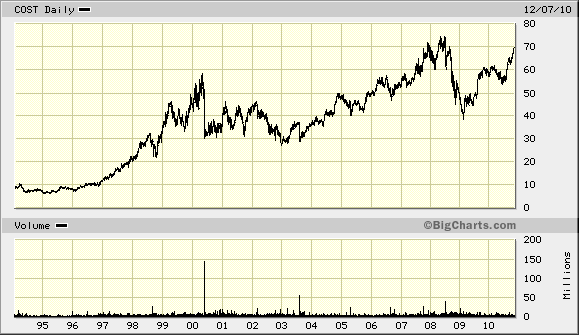
Posted by Eddy Elfenbein on December 8th, 2010 at 11:15 amShares of Costco (COST) have been in a blistering rally since last August. This is probably a good indication of the strength of the consumer (or at least, employed consumers).
The stock recently broke $70 per share. It reached its all-time high in May 2008 at $75.23. Today this company reported decent earnings. The company earned 71 cents per share which was two cents more than the Street was expecting. Margins continue to expand as profits rose by 17% while sales rose by 11%.
Costco has lifted sales since the recession by luring bargain-hungry consumers to pay for membership, which lets shoppers and small businesses buy discounted goods including groceries and televisions. Membership increased 3.6 percent to 58 million in the year through August, and fee revenue rose 10 percent to $416 million last fiscal quarter.
“The quarter continued the theme of modest gross margin expansion, strong membership fee growth and execution on curtailing expenses,” Brian Sozzi, an analyst for Wall Street Strategies Inc. in New York, said in a note to clients.
Costco fell 46 cents, or less than 1 percent, to $69.18 at 10:13 a.m. New York time in Nasdaq Stock Market trading. The stock rose 18 percent this year before today, while competitor BJ’s Wholesale Club Inc. gained 44 percent. Wal-Mart Stores Inc., the world’s largest retailer and operator of wholesaler Sam’s Club, climbed 3.1 percent in 2010.
Membership Fees Up
Costco’s gross profit, or income after cost of goods sold, as a percentage of total revenue rose to 12.9 percent from 12.8 percent. Selling and administrative costs as a portion of revenue dropped 0.2 percentage points.
Sales at stores open at least a year, excluding fluctuations in gasoline prices and currency exchange rates, rose 5 percent, Costco said. Sales advanced 10 percent at the company’s 157 stores outside the U.S. and 4 percent at its 425 locations in the U.S. and Puerto Rico.
Total revenue, including membership fees, rose to $19.2 billion from $17.3 billion a year earlier, the company said. Analysts predicted $18.8 billion, the average of 16 estimates.
In many ways, this story is a like a microcosm of the broader economy. The earnings report is good and Costco’s stock has performed well over the past several months, but it seems like the margin-expansion story is hitting a wall. Gross profit margins aren’t even expanding any more, and SG&A can only be cut so much.
The message is clear: For Costco and others to continue to grow, they need to see top-line growth. More sales means more consumers which means more employed consumers.
-
Archives
- June 2026
- May 2026
- April 2026
- March 2026
- February 2026
- January 2026
- December 2025
- November 2025
- October 2025
- September 2025
- August 2025
- July 2025
- June 2025
- May 2025
- April 2025
- March 2025
- February 2025
- January 2025
- December 2024
- November 2024
- October 2024
- September 2024
- August 2024
- July 2024
- June 2024
- May 2024
- April 2024
- March 2024
- February 2024
- January 2024
- December 2023
- November 2023
- October 2023
- September 2023
- August 2023
- July 2023
- June 2023
- May 2023
- April 2023
- March 2023
- February 2023
- January 2023
- December 2022
- November 2022
- October 2022
- September 2022
- August 2022
- July 2022
- June 2022
- May 2022
- April 2022
- March 2022
- February 2022
- January 2022
- December 2021
- November 2021
- October 2021
- September 2021
- August 2021
- July 2021
- June 2021
- May 2021
- April 2021
- March 2021
- February 2021
- January 2021
- December 2020
- November 2020
- October 2020
- September 2020
- August 2020
- July 2020
- June 2020
- May 2020
- April 2020
- March 2020
- February 2020
- January 2020
- December 2019
- November 2019
- October 2019
- September 2019
- August 2019
- July 2019
- June 2019
- May 2019
- April 2019
- March 2019
- February 2019
- January 2019
- December 2018
- November 2018
- October 2018
- September 2018
- August 2018
- July 2018
- June 2018
- May 2018
- April 2018
- March 2018
- February 2018
- January 2018
- December 2017
- November 2017
- October 2017
- September 2017
- August 2017
- July 2017
- June 2017
- May 2017
- April 2017
- March 2017
- February 2017
- January 2017
- December 2016
- November 2016
- October 2016
- September 2016
- August 2016
- July 2016
- June 2016
- May 2016
- April 2016
- March 2016
- February 2016
- January 2016
- December 2015
- November 2015
- October 2015
- September 2015
- August 2015
- July 2015
- June 2015
- May 2015
- April 2015
- March 2015
- February 2015
- January 2015
- December 2014
- November 2014
- October 2014
- September 2014
- August 2014
- July 2014
- June 2014
- May 2014
- April 2014
- March 2014
- February 2014
- January 2014
- December 2013
- November 2013
- October 2013
- September 2013
- August 2013
- July 2013
- June 2013
- May 2013
- April 2013
- March 2013
- February 2013
- January 2013
- December 2012
- November 2012
- October 2012
- September 2012
- August 2012
- July 2012
- June 2012
- May 2012
- April 2012
- March 2012
- February 2012
- January 2012
- December 2011
- November 2011
- October 2011
- September 2011
- August 2011
- July 2011
- June 2011
- May 2011
- April 2011
- March 2011
- February 2011
- January 2011
- December 2010
- November 2010
- October 2010
- September 2010
- August 2010
- July 2010
- June 2010
- May 2010
- April 2010
- March 2010
- February 2010
- January 2010
- December 2009
- November 2009
- October 2009
- September 2009
- August 2009
- July 2009
- June 2009
- May 2009
- April 2009
- March 2009
- February 2009
- January 2009
- December 2008
- November 2008
- October 2008
- September 2008
- August 2008
- July 2008
- June 2008
- May 2008
- April 2008
- March 2008
- February 2008
- January 2008
- December 2007
- November 2007
- October 2007
- September 2007
- August 2007
- July 2007
- June 2007
- May 2007
- April 2007
- March 2007
- February 2007
- January 2007
- December 2006
- November 2006
- October 2006
- September 2006
- August 2006
- July 2006
- June 2006
- May 2006
- April 2006
- March 2006
- February 2006
- January 2006
- December 2005
- November 2005
- October 2005
- September 2005
- August 2005
- July 2005
 Eddy Elfenbein is a Washington, DC-based speaker, portfolio manager and editor of the blog Crossing Wall Street. His