-
Ireland To Get Bailed Out
Posted by Eddy Elfenbein on November 22nd, 2010 at 8:54 amNow it’s Ireland’s turn for a bailout. This is a tough one since Ireland had been the shining star of the benefits of European economic integration. Sure, we all kinda knew that Greece was a mess, but Ireland? They were supposed to be the good student doing it right.
European Union officials, who had been pushing Ireland to accept help, quickly agreed to the request late Sunday, committing a staggering amount of funds to an ailing member for the second time in six months.
The total amount of the package was not announced, but several officials said it would be €80 billion to €90 billion, or $109 billion to $123 billion. Last spring, Europe disbursed €110 billion to Greece to save it from bankruptcy.
What happened is that Ireland, like many countries, bailed out its banks two years ago. The problem was that Irish banks were in much bigger trouble than everyone thought, and now the bailouters need a bailout. The reason it’s taken so long between 2008 and today is that only now have investors wised up and started to dump Irish bonds. Up until two weeks ago, the Irish government was telling us that nothing was wrong. The lesson is that markets, for all their noise, are more honest than governments.
Now there are worries that Spain and Portugal are next. The Prime Minister of Luxembourg, Jean-Claude Juncker, said “Speculative actions against Portugal and Spain are not justified, though it can’t be excluded.” Hate to break this to you, Jean-Claude, but if they can’t be excluded, they are by a certain measure, justified. For reasons unclear, Mr. Juncker is a big-time muckety muck in European affairs.
There’s an odd perception/reality game in these situations. If people think Ireland will be bailed out, the yield spreads on Irish debt will narrow and that will greatly help the country’s fiscal situation. If the EU had elected to “Bear Stearnsify” Ireland, well…things would be very different right now.
-
Morning News: November 22, 2010
Posted by Eddy Elfenbein on November 22nd, 2010 at 7:54 amIreland is Second Euro Nation to Seek Aid as Banks Wobble
Stock Index Futures Rise After Irish Bailout
After Ireland, traders turn to Portugal, Spain
Lack of Hiring to Restrain U.S. Economy in 2011, Survey Shows
Yuan Loses to Taiwan Dollar as Growth Rates Converge at 10%: China Credit
Economists See ‘Sub-par’ Growth Ahead
Top Banks Face $100 Billion Basel Shortfall
China Takes Aim at Inflation Expectations
Orascom Telecom to Sell Tunisia Stake in $1.2B Deal
-
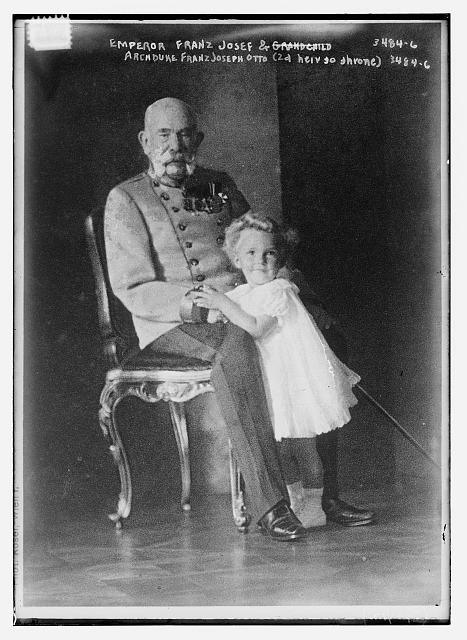
Happy Birthday Otto
Posted by Eddy Elfenbein on November 22nd, 2010 at 7:04 amI’d like to wish a belated happy birthday to Otto von Habsburg who turned 98 on Saturday.
For the last 88 years, he’s been the pretender to the Austrian throne. His father, Charles I, was the last Emperor of Austria and King of Hungary. Charles became emperor after Franz Joseph, who was born in 1830, died in 1916. He had been on the throne since 1848.
The heir had been Archduke Franz Ferdinand, but in 1914…well, you probably know what happened. After that, Charles was next in line, and Otto after Charles.
If things had worked out differently, Austria would have had two kings for 156 of the last 162 years.
Here’s a picture of Otto with Franz Joseph. In others, he’s a picture of a man alive today with a man born 180 years ago.
-
Reader Poll: Which State Would You Kick Out?
Posted by Eddy Elfenbein on November 19th, 2010 at 4:24 pm
-
Time to Shut Down the Laptop
Posted by Eddy Elfenbein on November 19th, 2010 at 4:01 pmThe weekend is here. Enjoy some classic E&B:
-
Days of Wine and Liquidity
Posted by Eddy Elfenbein on November 19th, 2010 at 3:04 pmGary Alexander celebrates what would be Johnny Mercer’s 101st birthday (yesterday) with some market talk:
Call me Old Fashioned, but if I Had my Druthers, markets would rise Day In and Day Out, Come Rain or Come Shine. But Jeepers Creepers, the Days of Wine and Roses can also be a Charade. Fools Rush In, seeking Out of This World riches, while those who Hit the Road to Dreamland may be Building Up for an Awful Letdown, and I Wanna Be Around to Pick up the Pieces when they sing The Blues in the Night.
Turning to the Fed, Something’s Gotta Give in the war between inflation and deflation, so the Lazy Bones at the Fed use That Old Black Magic to print more money, saying “This Time the Dream’s on Me.”
Seasonally, markets tend to fall in Early Autumn, when Autumn Leaves begin to fall In the Cool, Cool, Cool of the Evening. But When October Goes, If I Had a Million Dollars (One for My Baby and Another One for the Road), my Dream (My Shining Hour) would be to Take the Long Road Home, on the Atcheson, Topeka and the Santa Fe, with my Dearly Beloved Satin Doll (Laura), to Moon River, where the Skylark and Bob White sing. After all, Any Place I Hang My Hat is Home. It’s all Too Marvelous for Words!
-
Hansen Natural Takes Out 2006 High
Posted by Eddy Elfenbein on November 19th, 2010 at 1:00 pmHow’s this for a comeback? Hansen Natural (HANS), the Monster Energy Drink stock, just took out its 2006 high.

For those of you keeping score at home, the stock went from 50 cents (post-split) in 2003 to a high of $52.72 in 2006. HANS then dropped to $26 before rising to an all-time high of $68. By October 2008, it was back below $21 and now it’s been as high as $52.85 today.
We try to analyze stocks as best as we can using reason and logic, yet sometimes the market has other ideas.
-
Harrah’s Shelves IPO
Posted by Eddy Elfenbein on November 19th, 2010 at 10:33 amHarrah’s Entertainment Inc. was set to IPO this week but canceled due to “market conditions.” I’m not sure what changed so much over the past week, but they didn’t ask my opinion.
In the years leading up to the financial crisis, gobs of companies were taken off the market by private equity firms. Now the companies are being unloaded and many are for losses. Bloomberg estimates that 40% of the IPOs from private equity firms are for losses.
Harrah’s had been bought out by Apollo Global Management and TPG Capital in January 2008. The stock had been hugely successful for investors over the years.
-
Bernanke Defends QE2
Posted by Eddy Elfenbein on November 19th, 2010 at 9:17 amI continue to think Ben Bernanke is doing a very good job. Instead of hearing what other people say his plans are, you can listen to him.
Here’s a brief excerpt of his defense of QE2:
The Federal Reserve’s policy target for the federal funds rate has been near zero since December 2008, so another means of providing monetary accommodation has been necessary since that time. Accordingly, the FOMC purchased Treasury and agency-backed securities on a large scale from December 2008 through March 2010, a policy that appears to have been quite successful in helping to stabilize the economy and support the recovery during that period. Following up on this earlier success, the Committee announced this month that it would purchase additional Treasury securities. In taking that action, the Committee seeks to support the economic recovery, promote a faster pace of job creation, and reduce the risk of a further decline in inflation that would prove damaging to the recovery.
Although securities purchases are a different tool for conducting monetary policy than the more familiar approach of managing the overnight interest rate, the goals and transmission mechanisms are very similar. In particular, securities purchases by the central bank affect the economy primarily by lowering interest rates on securities of longer maturities, just as conventional monetary policy, by affecting the expected path of short-term rates, also influences longer-term rates. Lower longer-term rates in turn lead to more accommodative financial conditions, which support household and business spending. As I noted, the evidence suggests that asset purchases can be an effective tool; indeed, financial conditions eased notably in anticipation of the Federal Reserve’s policy announcement.
Incidentally, in my view, the use of the term “quantitative easing” to refer to the Federal Reserve’s policies is inappropriate. Quantitative easing typically refers to policies that seek to have effects by changing the quantity of bank reserves, a channel which seems relatively weak, at least in the U.S. context. In contrast, securities purchases work by affecting the yields on the acquired securities and, via substitution effects in investors’ portfolios, on a wider range of assets.
This policy tool will be used in a manner that is measured and responsive to economic conditions. In particular, the Committee stated that it would review its asset-purchase program regularly in light of incoming information and would adjust the program as needed to meet its objectives. Importantly, the Committee remains unwaveringly committed to price stability and does not seek inflation above the level of 2 percent or a bit less that most FOMC participants see as consistent with the Federal Reserve’s mandate. In that regard, it bears emphasizing that the Federal Reserve has worked hard to ensure that it will not have any problems exiting from this program at the appropriate time. The Fed’s power to pay interest on banks’ reserves held at the Federal Reserve will allow it to manage short-term interest rates effectively and thus to tighten policy when needed, even if bank reserves remain high. Moreover, the Fed has invested considerable effort in developing tools that will allow it to drain or immobilize bank reserves as needed to facilitate the smooth withdrawal of policy accommodation when conditions warrant. If necessary, the Committee could also tighten policy by redeeming or selling securities.
-
Fiserv Buys Back “Up To” 7 Million Shares
Posted by Eddy Elfenbein on November 19th, 2010 at 8:46 amFiserv, Inc., the leading global provider of financial services technology solutions, today announced that its Board of Directors has authorized a repurchase of up to seven million additional shares of the company’s common stock, which represents approximately five percent of its outstanding shares.
Fiserv may repurchase shares in the open market or in privately negotiated transactions at the discretion of management subject to its assessment of market conditions and other factors. This authorization does not expire.
Let’s work out the math. Seven million shares at the current price comes to $385 million. At last count, FISV has 149 million shares outstanding.
I’m pretty sure most shareholders would rather have $2.58 per share of cash dividends in their pockets than have the board buying FISV shares near a 52-week high.
Of course, the board has only authorized a purchase “up to” 7 million, which also includes zero shares. These share repurchase statements are good for PR, but they don’t do much for shareholders.
-
Archives
- July 2026
- June 2026
- May 2026
- April 2026
- March 2026
- February 2026
- January 2026
- December 2025
- November 2025
- October 2025
- September 2025
- August 2025
- July 2025
- June 2025
- May 2025
- April 2025
- March 2025
- February 2025
- January 2025
- December 2024
- November 2024
- October 2024
- September 2024
- August 2024
- July 2024
- June 2024
- May 2024
- April 2024
- March 2024
- February 2024
- January 2024
- December 2023
- November 2023
- October 2023
- September 2023
- August 2023
- July 2023
- June 2023
- May 2023
- April 2023
- March 2023
- February 2023
- January 2023
- December 2022
- November 2022
- October 2022
- September 2022
- August 2022
- July 2022
- June 2022
- May 2022
- April 2022
- March 2022
- February 2022
- January 2022
- December 2021
- November 2021
- October 2021
- September 2021
- August 2021
- July 2021
- June 2021
- May 2021
- April 2021
- March 2021
- February 2021
- January 2021
- December 2020
- November 2020
- October 2020
- September 2020
- August 2020
- July 2020
- June 2020
- May 2020
- April 2020
- March 2020
- February 2020
- January 2020
- December 2019
- November 2019
- October 2019
- September 2019
- August 2019
- July 2019
- June 2019
- May 2019
- April 2019
- March 2019
- February 2019
- January 2019
- December 2018
- November 2018
- October 2018
- September 2018
- August 2018
- July 2018
- June 2018
- May 2018
- April 2018
- March 2018
- February 2018
- January 2018
- December 2017
- November 2017
- October 2017
- September 2017
- August 2017
- July 2017
- June 2017
- May 2017
- April 2017
- March 2017
- February 2017
- January 2017
- December 2016
- November 2016
- October 2016
- September 2016
- August 2016
- July 2016
- June 2016
- May 2016
- April 2016
- March 2016
- February 2016
- January 2016
- December 2015
- November 2015
- October 2015
- September 2015
- August 2015
- July 2015
- June 2015
- May 2015
- April 2015
- March 2015
- February 2015
- January 2015
- December 2014
- November 2014
- October 2014
- September 2014
- August 2014
- July 2014
- June 2014
- May 2014
- April 2014
- March 2014
- February 2014
- January 2014
- December 2013
- November 2013
- October 2013
- September 2013
- August 2013
- July 2013
- June 2013
- May 2013
- April 2013
- March 2013
- February 2013
- January 2013
- December 2012
- November 2012
- October 2012
- September 2012
- August 2012
- July 2012
- June 2012
- May 2012
- April 2012
- March 2012
- February 2012
- January 2012
- December 2011
- November 2011
- October 2011
- September 2011
- August 2011
- July 2011
- June 2011
- May 2011
- April 2011
- March 2011
- February 2011
- January 2011
- December 2010
- November 2010
- October 2010
- September 2010
- August 2010
- July 2010
- June 2010
- May 2010
- April 2010
- March 2010
- February 2010
- January 2010
- December 2009
- November 2009
- October 2009
- September 2009
- August 2009
- July 2009
- June 2009
- May 2009
- April 2009
- March 2009
- February 2009
- January 2009
- December 2008
- November 2008
- October 2008
- September 2008
- August 2008
- July 2008
- June 2008
- May 2008
- April 2008
- March 2008
- February 2008
- January 2008
- December 2007
- November 2007
- October 2007
- September 2007
- August 2007
- July 2007
- June 2007
- May 2007
- April 2007
- March 2007
- February 2007
- January 2007
- December 2006
- November 2006
- October 2006
- September 2006
- August 2006
- July 2006
- June 2006
- May 2006
- April 2006
- March 2006
- February 2006
- January 2006
- December 2005
- November 2005
- October 2005
- September 2005
- August 2005
- July 2005
 Eddy Elfenbein is a Washington, DC-based speaker, portfolio manager and editor of the blog Crossing Wall Street. His