-
Time for Lilly to Go Shopping
Posted by Eddy Elfenbein on October 22nd, 2010 at 10:53 amThere’s no question that Eli Lilly (LLY) is a cheap stock based on its earnings. The problem, however, isn’t past earnings but future earnings. The company is running out of new drugs and they need to get on the stick very soon.
Lilly has repeatedly said that they have a lot of products in development. But everyone, including me, expects them to open their wallet to make an acquisition.
The bad news is that Lilly just got slammed by Byetta (though not as badly as Amylin was hurt). The good news is that this may further spur them to make an acquisition. The talk now is that Lilly will buy either Cephalon (CEPH) or Endo Pharmaceuticals (ENDP).
By 2013, Lilly loses patents on medicines responsible for almost half its revenue. The Bydureon rejection, which stalled a new revenue source for at least two years, was compounded Oct. 20 when the company halted tests on a second experimental diabetes medicine because it wasn’t effective. Lilly Chief Executive Officer John Lechleiter yesterday ruled out “large- scale combinations” while expressing interest in smaller deals.
“An outright acquisition of Amylin certainly could make sense” if Lilly thinks Bydureon will be approved, Fernandez said in a telephone interview from Boston. Amylin, based in San Diego, lost half its market value on Oct. 20 after the Food and Drug Administration requested a study of Bydureon’s effect on heart rhythm.
Eli Lilly currently has over $5 billion cash on hand — and it ain’t earning much interest in the bank.
“Our fundamental strategy remains intact,” Lechleiter (that’s LLY’s CEO – Eddy) said during a conference call yesterday. “We’re not interested in large-scale combinations (yeah, right). I think there are many other opportunities that I think we could consider along the lines of several that we have done this year.”
Lechleiter’s plan to stick to small purchases or licensing deals won’t give investors much confidence, said Barbara Ryan, an analyst with Deutsche Bank in New York, in a telephone interview.
“A lot of those companies will just be adding to the pipeline and they’re not going to be something that the market will accrue much value to on Lilly,” Ryan said.
United Therapeutics Corp. may also be a good fit because Lilly has an 11 percent stake and the two companies are partnered on Adcirca, a lung treatment made from the ingredient in Lilly’s impotence pill Cialis, according to Fernandez. Forest Laboratories Inc. (no, gag!) would be another option to complement Lilly’s research in antidepressants and arthritis medicines, he said.
-
Morning News: October 22, 2010
Posted by Eddy Elfenbein on October 22nd, 2010 at 7:21 amStock Index Futures Signal Falls as G20 and Earnings Eyed
Geithner Push for Current Account Targets Splits G-20 Nations
AIG Raises $17.8 Billion in Record AIA Hong Kong IPO
Fannie and Freddie May Need Infusion
UK Debt Cost Falls to Lowest Since 1980s
Boeing Sales Beat `New Normal’ Pessimism as Fed May Act
Caterpillar to Acquire MWM Holding for $806 Million
Schlumberger’s Profit More Than Doubles
UPS Profit Tops Analysts’ Estimates on Global Economic Pickup
-
$10
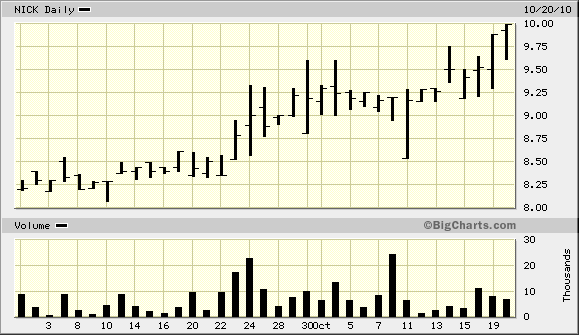
Posted by Eddy Elfenbein on October 21st, 2010 at 1:31 pmNICK printed $10 moments ago.
It happened. It really happened.
-
Google Pays 2.4% Taxes on Overseas Profits
Posted by Eddy Elfenbein on October 21st, 2010 at 11:55 amHow much are you paying on your overseas taxes? Or do you even have overseas taxes? Well, if your name is Google then you’re only paying 2.4% on the profits you generate outside the country.
For the record, the U.S. corporate tax rate is 35%.
One analyst thinks that if Google followed the normal rules the stock would be $100 lower. Mind you, Google isn’t doing anything illegal, at least not as the laws now stand. Also, there are plenty more companies doing the exact same thing.
These companies use a complicated maneuver where they send their taxes through Ireland to a tax-haven island. This is known at the “Double Irish.” Google uses Bermuda after a stop in the Netherlands. From 2007 to 2009, Google saved $3.1 billion.
This Bermuda-managed entity is owned by a pair of Google subsidiaries that list as their directors two attorneys and a manager at Conyers Dill & Pearman, a Hamilton, Bermuda law firm.
Tax planners call such an arrangement a Double Irish because it relies on two Irish companies. One pays royalties to use intellectual property, generating expenses that reduce Irish taxable income. The second collects the royalties in a tax haven like Bermuda, avoiding Irish taxes.
To steer clear of an Irish withholding tax, payments from Google’s Dublin unit don’t go directly to Bermuda. A brief detour to the Netherlands avoids that liability, because Irish tax law exempts certain royalties to companies in other EU- member nations. The fees first go to a Dutch unit, Google Netherlands Holdings B.V., which pays out about 99.8 percent of what it collects to the Bermuda entity, company filings show. The Amsterdam-based subsidiary lists no employees.
At least no one can be laid off.
-
Three More Earnings Reports
Posted by Eddy Elfenbein on October 21st, 2010 at 10:37 amThe most-hated rally in history continues to rally, and our Buy List is now up over 10% for the year. The S&P 500 finally broke through 1,185 this morning after failing two times before.
First, though, let’s get to three more earnings reports this morning. They all sound the same—beating forecasts and raising guidance.
Eli Lilly (LLY) reported earnings of $1.21 per share which is six cents more than Wall Street’s consensus. That’s a good showing, but the weak spot is that revenues rose only 1.7% to $5.65 billion, $120 million short of Wall Street’s estimates. As a result, the stock has pulled back modestly this morning.
Bloomberg writes:Top-selling Zyprexa fell 0.8 percent to $1.21 billion, while the antidepressant Cymbalta gained 4.4 percent to $825.3 million and the cancer treatment Alimta rose 21 percent to $560.3 million. Higher demand outside the U.S. drove revenue growth, Lilly said.
Watch for Lilly to make some acquisitions soon. They need new drugs in the pipeline. The good news is that Lilly raised its full-year EPS forecast to a range of $4.65 to $4.75. Two months ago, the company said to expect $4.50 to $4.65. The shares are currently down about 1%.
Baxter International (BAX) is up nearly 4% today thanks to a very good earnings report. For the third quarter, Baxter earned $1.01 per share which is four cents more than Wall Street’s forecast. The company also said to expect full-year earnings of $3.96 to $3.98 per share. (Wow—that’s a narrow range, but there’s only one quarter to go.) The earlier range was $3.93 to $3.98. For Q4, Baxter sees earnings of $1.09 to $1.11 per share.
Sales of $3.22 billion, up 2.5%, topped Wall Street’s $3.16 billion forecast. Baxter noted that international sales growth was nicked by unfavorable foreign currency rates.
Sales in the bioscience business were flat at $1.39 billion, or up 3% excluding the currency impact, but Baxter noted better performance there. Contributing factors included hemophilia treatments and strong demand for a plasma-based treatment for immune disorders and another that treats an inherited condition that can hurt the lungs.
Sales in medication delivery, which includes items like intravenous solutions and drug infusion pumps. rose 5% to $1.23 billion, with growth reduced by the currency impact. Sales in the renal unit, which includes products for managing patients with end-stage kidney failure, grew 3% to $594 million.
Reynolds American (RAI) earned $1.35 per share, one penny more than estimates. The company also raised the low end of its full-year forecast. Reynolds now expects full-year EPS to range between $4.95 and $5.05. The earlier range was $4.90 to $5.05.
The number of cigarettes the company sold fell 2.6 percent to 20.1 billion sticks, but its market share rose slightly to 28.2 percent with increases in the market shares of both Camel and Pall Mall. Camel volumes grew 1.5 percent, and Pall Mall grew 45.1 percent in the quarter.
Although the company has been selling fewer cigarettes, they’ve been able to raise the price. The AP writes:
Reynolds American has aggressively promoted Pall Mall as a longer-lasting and more affordable cigarette as smokers weather the weak economy and high unemployment. During the quarter, the brand’s market share increased 2.8 points to 7.8 percent of the U.S. market.
“Pall Mall is the right product at the right time,” Daniel M. Delen, the head of R.J. Reynolds Tobacco Co., said in a news release.
Reynolds American and other tobacco companies are also focusing on cigarette alternatives — such as snuff and chewing tobacco — for future sales growth as tax increases, smoking bans, health concerns and social stigma make the cigarette business tougher.
Reynolds American said third-quarter volumes of its Kodiak and Grizzly smokeless tobacco grew only 1.2 percent due to higher levels of promotion from its competitors.
Shares of RAI are currently down about 1%.
-
Morning News: October 21, 2010
Posted by Eddy Elfenbein on October 21st, 2010 at 7:39 amFederal Reserve Bank Pay Soars
China Yuan Up Late On Lower Central Parity, Weak Dollar
G-20 Seeks To Forge Currency Consensus, But Deal Elusive
Nokia Third Quarter Results Beat Forecasts
New York Fed Faces `Inherent Conflict’ in Mortgage Buybacks
Germany Doubles Growth Forecast
French Industry ‘Losing at Least £100 Million a Day’
Toyota To Recall 1.5M Vehicles for Brake Concerns
-
CWS Earnings Calendar
Posted by Eddy Elfenbein on October 20th, 2010 at 6:59 pmHere’s an update of our Buy List earnings calendar:
Company Ticker Symbol Earnings Date Estimated EPS Reported EPS Intel INTC 12-Oct $0.50 $0.52 Gilead GILD 19-Oct $0.87 $0.90 Johnson & Johnson JNJ 19-Oct $1.15 $1.23 Stryker SYK 19-Oct $0.77 $0.80 SEI Investments SEIC 20-Oct $0.26 $0.30 Baxter BAX 21-Oct $0.97 Eli Lilly LLY 21-Oct $1.15 Reynolds American RAI 21-Oct $1.34 Fiserv FISV 26-Oct $1.00 AFLAC AFL 27-Oct $1.39 Moog MOG-A 4-Nov $0.70 Wright Express WXS 4-Nov $0.68 Becton Dickinson BDX 4-Nov $1.25 Sysco SYY 8-Nov $0.51 -
The Macbeth Market
Posted by Eddy Elfenbein on October 20th, 2010 at 4:42 pmThe S&P 500 close one week ago: 1178.10.
The S&P 500 close today: 1178.17.
This market is “a tale told by an idiot, full of sound and fury, signifying nothing.”
But there is good news. Nicholas Financial (NICK) got to $9.99 today, just one penny from the big One-Oh.
Gilead Sciences (GILD) and Stryker (SYK) held on to their gains today. Medtronic (MDT) also did well thanks to a good earnings report from Boston Scientific (BSX). The Buy List gained 1.29% for the day which was 0.24% better than the S&P 500. Since the end of August, the Buy List is up 16.00% compared with 12.28% for the S&P 500.
Tomorrow we have earnings reports from Baxter (BAX), Eli Lilly (LLY) and Reynolds American (RAI).
-
The One-Point Trend Finally Ends
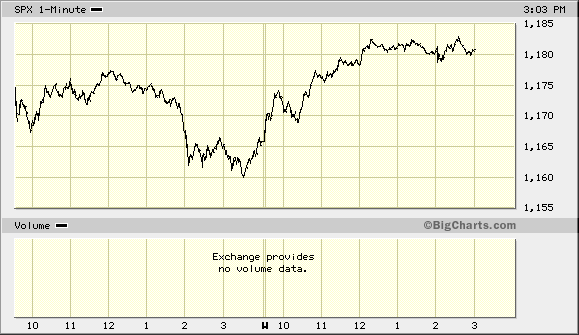
Posted by Eddy Elfenbein on October 20th, 2010 at 3:02 pmTo paraphrase Churchill: “Never in the field of capital markets have so many taken so much confirmation from so little.”
-
The Return of the Nifty Fifty
Posted by Eddy Elfenbein on October 20th, 2010 at 2:20 pmIn the early 1970s, there was a spectacular run in a small group of stocks known as the Nifty Fifty. Here’s a list of the names.
These stocks were popular because they were seen as stable growing stocks. There was also a belief at the time that capitalism could help “bring people together” after the tumult of the 1960s.
I think the Coca-Cola ad of kids on a hilltop singing the Coke Song best captured this worldview. Other stocks like McDonalds, Disney and Eastman Kodak really tapped this idea.
What I’ve noticed recently is that a lot of these Old School Nifty Fifty guys have been doing quite well recently.
Coke (KO) just gapped up higher earnings. McDonalds (MCD) hit an all-time high today. Also, 3M (MMM), Altria (MO) and Procter & Gamble (PG) are near new 52-week highs (Philip Morris was a Nifty Fifty stock).
Is this 1972 or 2010?
-
Archives
- June 2026
- May 2026
- April 2026
- March 2026
- February 2026
- January 2026
- December 2025
- November 2025
- October 2025
- September 2025
- August 2025
- July 2025
- June 2025
- May 2025
- April 2025
- March 2025
- February 2025
- January 2025
- December 2024
- November 2024
- October 2024
- September 2024
- August 2024
- July 2024
- June 2024
- May 2024
- April 2024
- March 2024
- February 2024
- January 2024
- December 2023
- November 2023
- October 2023
- September 2023
- August 2023
- July 2023
- June 2023
- May 2023
- April 2023
- March 2023
- February 2023
- January 2023
- December 2022
- November 2022
- October 2022
- September 2022
- August 2022
- July 2022
- June 2022
- May 2022
- April 2022
- March 2022
- February 2022
- January 2022
- December 2021
- November 2021
- October 2021
- September 2021
- August 2021
- July 2021
- June 2021
- May 2021
- April 2021
- March 2021
- February 2021
- January 2021
- December 2020
- November 2020
- October 2020
- September 2020
- August 2020
- July 2020
- June 2020
- May 2020
- April 2020
- March 2020
- February 2020
- January 2020
- December 2019
- November 2019
- October 2019
- September 2019
- August 2019
- July 2019
- June 2019
- May 2019
- April 2019
- March 2019
- February 2019
- January 2019
- December 2018
- November 2018
- October 2018
- September 2018
- August 2018
- July 2018
- June 2018
- May 2018
- April 2018
- March 2018
- February 2018
- January 2018
- December 2017
- November 2017
- October 2017
- September 2017
- August 2017
- July 2017
- June 2017
- May 2017
- April 2017
- March 2017
- February 2017
- January 2017
- December 2016
- November 2016
- October 2016
- September 2016
- August 2016
- July 2016
- June 2016
- May 2016
- April 2016
- March 2016
- February 2016
- January 2016
- December 2015
- November 2015
- October 2015
- September 2015
- August 2015
- July 2015
- June 2015
- May 2015
- April 2015
- March 2015
- February 2015
- January 2015
- December 2014
- November 2014
- October 2014
- September 2014
- August 2014
- July 2014
- June 2014
- May 2014
- April 2014
- March 2014
- February 2014
- January 2014
- December 2013
- November 2013
- October 2013
- September 2013
- August 2013
- July 2013
- June 2013
- May 2013
- April 2013
- March 2013
- February 2013
- January 2013
- December 2012
- November 2012
- October 2012
- September 2012
- August 2012
- July 2012
- June 2012
- May 2012
- April 2012
- March 2012
- February 2012
- January 2012
- December 2011
- November 2011
- October 2011
- September 2011
- August 2011
- July 2011
- June 2011
- May 2011
- April 2011
- March 2011
- February 2011
- January 2011
- December 2010
- November 2010
- October 2010
- September 2010
- August 2010
- July 2010
- June 2010
- May 2010
- April 2010
- March 2010
- February 2010
- January 2010
- December 2009
- November 2009
- October 2009
- September 2009
- August 2009
- July 2009
- June 2009
- May 2009
- April 2009
- March 2009
- February 2009
- January 2009
- December 2008
- November 2008
- October 2008
- September 2008
- August 2008
- July 2008
- June 2008
- May 2008
- April 2008
- March 2008
- February 2008
- January 2008
- December 2007
- November 2007
- October 2007
- September 2007
- August 2007
- July 2007
- June 2007
- May 2007
- April 2007
- March 2007
- February 2007
- January 2007
- December 2006
- November 2006
- October 2006
- September 2006
- August 2006
- July 2006
- June 2006
- May 2006
- April 2006
- March 2006
- February 2006
- January 2006
- December 2005
- November 2005
- October 2005
- September 2005
- August 2005
- July 2005
 Eddy Elfenbein is a Washington, DC-based speaker, portfolio manager and editor of the blog Crossing Wall Street. His