-
The Return of the Nifty Fifty
Posted by Eddy Elfenbein on October 20th, 2010 at 2:20 pmIn the early 1970s, there was a spectacular run in a small group of stocks known as the Nifty Fifty. Here’s a list of the names.
These stocks were popular because they were seen as stable growing stocks. There was also a belief at the time that capitalism could help “bring people together” after the tumult of the 1960s.
I think the Coca-Cola ad of kids on a hilltop singing the Coke Song best captured this worldview. Other stocks like McDonalds, Disney and Eastman Kodak really tapped this idea.
What I’ve noticed recently is that a lot of these Old School Nifty Fifty guys have been doing quite well recently.
Coke (KO) just gapped up higher earnings. McDonalds (MCD) hit an all-time high today. Also, 3M (MMM), Altria (MO) and Procter & Gamble (PG) are near new 52-week highs (Philip Morris was a Nifty Fifty stock).
Is this 1972 or 2010?
-
Bailout Profits Beat Treasuries
Posted by Eddy Elfenbein on October 20th, 2010 at 1:55 pmBloomberg notes that the government’s profits from TARP are running ahead of the yield on U.S. Treasury bonds so far. In other words, the proceeds have covered the expenses:
The government has earned $25.2 billion on its investment of $309 billion in banks and insurance companies, an 8.2 percent return over two years, according to data compiled by Bloomberg. That beat U.S. Treasuries, high-yield savings accounts, money- market funds and certificates of deposit. Investing in the stock market or gold would have paid off better.
When the government first announced its intention to plow funds into the nation’s banks in October 2008 to resuscitate the financial system, many expected it to lose hundreds of billions of dollars. Two years later TARP’s bank and insurance investments have made money, and about two-thirds of the funds have been paid back. Yet Democrats are struggling to turn those gains into political capital, and the indirect costs of propping up banks could have longer-term consequences for the economy.
“From the perspective of the taxpayers getting their money back, TARP has been a great success,” said Todd Petzel, chief investment officer at New York-based Offit Capital Advisors LLC, which has more than $5 billion of assets under management. “But there are other costs as the government made it possible for the banks to pay back TARP. Those costs can turn out to be larger, and their legacy could last longer.”
That’s good news. The problem is that taxpayers could have — and should have — made a much larger profit. Warren Buffett was able to loan money to Goldman Sachs for 10%. That’s twice what the government got.
-
Bill Miller: Best Time to Invest Since Early 1980s
Posted by Eddy Elfenbein on October 20th, 2010 at 10:41 amThis is pretty long (27 minutes) but worth it. Bill Miller beat the market for 15-straight years. He said he’d be surprised if the market isn’t up 20% in the next 12 months.
-
SEI Investments Earns 30 Cents Per Share
Posted by Eddy Elfenbein on October 20th, 2010 at 10:25 amThe market is shaking off yesterday’s loss and trading higher this morning. The good news is that Stryker (SYK) and Gilead (GILD) are doing well thanks to their positive earnings reports.
Our only earnings report today is from SEI Investments (SEIC). For the third quarter, SEIC earned 30 cents per share which is four cents more than Wall Street was expecting. The stock is currently up about 0.6%.
The weak spot today is coming from Eli Lilly (LLY) due to the FDA, once again, not approving a weekly version of Byetta, a diabetes drug.
-
Morning News: October 20, 2010
Posted by Eddy Elfenbein on October 20th, 2010 at 7:43 amN.Y. Fed Joins Investors Demanding Bank of America Buy Back Mortgages
China’s Move May Push Capital Controls in Asia
U.S. Mortgage Applications Fall by the Most in Four Months
Stock Index Futures Signal Small Rebound
Wall Street Bailout Returns 8.2% Profit Beating Treasury Bonds
Yahoo Disappoints on Revenue Forecast
Russia to Join WTO within a Year, Obama Aid Says
Rio to Boost Iron Ore Output Despite Mine-Tax Fears
-
Earnings from Gilead and Stryker
Posted by Eddy Elfenbein on October 19th, 2010 at 4:30 pmToday was a rough day for stocks. The S&P 500 dropped 18.91 points or 1.59%. Johnson & Johnson (JNJ) didn’t get hurt too badly by its earnings report from this morning. The stock dropped 57 cents today which was just 0.89%.
After the bell, Gilead Sciences (GILD) reported earnings of 90 cents per share which was three cents higher than the Street’s forecast. Revenue rose 8% to $1.94 billion which was $20 million ahead of the Street’s estimate. The stock is up 2.78% after-hours. Let me caution you not to get too excited by after-hours moves—they don’t guarantee a higher open tomorrow.
Stryker (SYK) also reported very good earnings after the bell. For Q3, the company earned 80 cents per share which is three cents ahead of the Street’s projection. The shares are trading 6.7% higher after-hours.
The company said domestic sales jumped 9.7 percent to about $1.73 billion, while international sales rose 1.7 percent to $593.8 million. Overall, sales of orthopedic equipment rose 1.2 percent to $1.03 billion while sales of surgical equipment jumped 16.1 percent to $738.8 million.
The company tightened its full-year outlook and now expects full-year adjusted profit between $3.27 and $3.30 per share, up from prior guidance of $3.20 to $3.30 per share. It also tightened its sales outlook to an increase between 7 percent and 8 percent from prior guidance of a 5 percent to 8 percent boost.
Analysts are forecasting net income of $3.26 per share on $7.23 billion in revenue for 2010.
The best news today is that Nicholas Financial (NICK) closed at $9.89. Wow! Our Buy List finally snapped its seven-day win streak, but we only fell 0.99% which was 60 basis points better than the S&P 500.
Here’s a recap of our earnings calendar:
Company Ticker Symbol Earnings Date Wall Street’s Estimate Gilead GILD 19-Oct $0.87 Johnson & Johnson JNJ 19-Oct $1.15 Stryker SYK 19-Oct $0.77 SEI Investments SEIC 20-Oct $0.26 Baxter BAX 21-Oct $0.97 Eli Lilly LLY 21-Oct $1.15 Reynolds American RAI 21-Oct $1.34 Fiserv FISV 26-Oct $1.00 AFLAC AFL 27-Oct $1.39 Moog MOG-A 4-Nov $0.70 Wright Express WXS 4-Nov $0.68 Becton Dickinson BDX 4-Nov $1.25 Sysco SYY 8-Nov $0.51 -
Cramer on Goldman Sachs
Posted by Eddy Elfenbein on October 19th, 2010 at 4:13 pmIncidentally, he’s got a good point.
-
Johnson & Johnson Lifts Forecast
Posted by Eddy Elfenbein on October 19th, 2010 at 10:35 amJohnson & Johnson (JNJ) came out with its earnings report this morning. Personally, I don’t worry so much about the details of JNJ’s earnings report. I’m more concerned with their earnings forecast. JNJ is such a solid blue-chip stock that they’re always going to come in pretty close to their forecast. If it’s up or down a few pennies per share, I don’t really much care.
Three months ago, JNJ lowered their 2010 full-year EPS guidance from $4.80 to $4.90 to a range of $4.65 to $4.75. The good news today is that they raised their full-year guidance to $4.70 to $4.80 thanks to favorable exchange rates. That’s it. I’m done. I have all I need to know.
If you’re interested in the details, however, I’ll mention that JNJ earned $1.23 per share which was eight cents higher than Wall Street’s consensus, and three cents higher than one year ago. Revenue came in at $15 billion which was below Wall Street’s forecast of $15.2 billion; and that’s probably why the stock is down today.
To recap, they beat by eight cents and raised full-year guidance, and the stock is down. This is why I don’t much worry about short-term market moves. When I own a stock I just want to know that everything is fine, and everything is fine at JNJ.
Update: The Wall Street Journal reports, “Johnson & Johnson Ekes Out Profit.” Just so we’re clear, by “eke” they mean “earned $3.42 billion.”
-
23 Years Ago Today
Posted by Eddy Elfenbein on October 19th, 2010 at 8:03 amTwenty-three years ago today was Black Monday, Wall Street’s worst day ever. The Dow dropped from 2246.74 to 1738.74—a loss of 508 points or -22.61%.
To put this in some perspective, the second-worst percentage loss was roughly half that (-12.91% on October 28, 1929).
Now let’s take another look at this historic market crash. From the day the market crashed until today, the Dow has gained 540.96%. Add in dividends and it’s up 1,050.32%. (Yes, dividends do that much!) Annualized, that comes out to 11.20%. Let’s not forget inflation which has climbed by 89.95% over the last 23 years, which is 2.83% annualized.
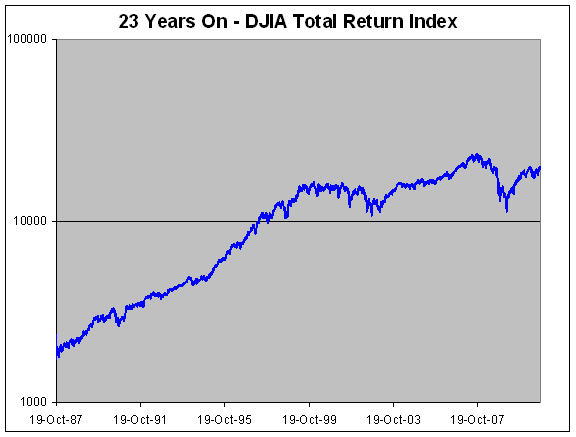
But what if you had invested right before Black Monday, on the previous Friday? (Wow, you’d be one unlucky SOB!) From that starting line, the Dow has gained 395.99%. Throw in dividends and you’re up 750.57%. Annualized, that’s 9.97%.
Now I’m not saying that Black Monday wasn’t a big deal, but viewing it from the very long term adds a new dimension. Calling it right by one day changes your annualized returns from 11.20% to 9.97%. That’s just 123 basis points per year.
So the biggest crash in history isn’t too different from what investors throw away all the time every year with needless trading or exorbitant mutual fund fees.
Bottom line: Using common sense can be just as good as making a once-in-a-century call.
-
Morning News: October 19, 2010
Posted by Eddy Elfenbein on October 19th, 2010 at 7:49 amAsian Stocks, U.S. Futures Fall After Apple, IBM Results; Oil, Dollar Drop
World Bank Blames U.S. for Unruly Capital Flows
Basel Committee Agrees on Liquidity Rules for Banks
Bank of America Reports $7.3 Billion Loss, Citing Charges
Federal Bank’s Kansas City President Warns Against Low Rates
UnitedHealth Profit Soars Past Estimates
BNY Mellon Third-Quarter Profit Rises as Market Rebound Lifts Assets, Fees
-
Archives
- October 2026
- September 2026
- August 2026
- July 2026
- June 2026
- May 2026
- April 2026
- March 2026
- February 2026
- January 2026
- December 2025
- November 2025
- October 2025
- September 2025
- August 2025
- July 2025
- June 2025
- May 2025
- April 2025
- March 2025
- February 2025
- January 2025
- December 2024
- November 2024
- October 2024
- September 2024
- August 2024
- July 2024
- June 2024
- May 2024
- April 2024
- March 2024
- February 2024
- January 2024
- December 2023
- November 2023
- October 2023
- September 2023
- August 2023
- July 2023
- June 2023
- May 2023
- April 2023
- March 2023
- February 2023
- January 2023
- December 2022
- November 2022
- October 2022
- September 2022
- August 2022
- July 2022
- June 2022
- May 2022
- April 2022
- March 2022
- February 2022
- January 2022
- December 2021
- November 2021
- October 2021
- September 2021
- August 2021
- July 2021
- June 2021
- May 2021
- April 2021
- March 2021
- February 2021
- January 2021
- December 2020
- November 2020
- October 2020
- September 2020
- August 2020
- July 2020
- June 2020
- May 2020
- April 2020
- March 2020
- February 2020
- January 2020
- December 2019
- November 2019
- October 2019
- September 2019
- August 2019
- July 2019
- June 2019
- May 2019
- April 2019
- March 2019
- February 2019
- January 2019
- December 2018
- November 2018
- October 2018
- September 2018
- August 2018
- July 2018
- June 2018
- May 2018
- April 2018
- March 2018
- February 2018
- January 2018
- December 2017
- November 2017
- October 2017
- September 2017
- August 2017
- July 2017
- June 2017
- May 2017
- April 2017
- March 2017
- February 2017
- January 2017
- December 2016
- November 2016
- October 2016
- September 2016
- August 2016
- July 2016
- June 2016
- May 2016
- April 2016
- March 2016
- February 2016
- January 2016
- December 2015
- November 2015
- October 2015
- September 2015
- August 2015
- July 2015
- June 2015
- May 2015
- April 2015
- March 2015
- February 2015
- January 2015
- December 2014
- November 2014
- October 2014
- September 2014
- August 2014
- July 2014
- June 2014
- May 2014
- April 2014
- March 2014
- February 2014
- January 2014
- December 2013
- November 2013
- October 2013
- September 2013
- August 2013
- July 2013
- June 2013
- May 2013
- April 2013
- March 2013
- February 2013
- January 2013
- December 2012
- November 2012
- October 2012
- September 2012
- August 2012
- July 2012
- June 2012
- May 2012
- April 2012
- March 2012
- February 2012
- January 2012
- December 2011
- November 2011
- October 2011
- September 2011
- August 2011
- July 2011
- June 2011
- May 2011
- April 2011
- March 2011
- February 2011
- January 2011
- December 2010
- November 2010
- October 2010
- September 2010
- August 2010
- July 2010
- June 2010
- May 2010
- April 2010
- March 2010
- February 2010
- January 2010
- December 2009
- November 2009
- October 2009
- September 2009
- August 2009
- July 2009
- June 2009
- May 2009
- April 2009
- March 2009
- February 2009
- January 2009
- December 2008
- November 2008
- October 2008
- September 2008
- August 2008
- July 2008
- June 2008
- May 2008
- April 2008
- March 2008
- February 2008
- January 2008
- December 2007
- November 2007
- October 2007
- September 2007
- August 2007
- July 2007
- June 2007
- May 2007
- April 2007
- March 2007
- February 2007
- January 2007
- December 2006
- November 2006
- October 2006
- September 2006
- August 2006
- July 2006
- June 2006
- May 2006
- April 2006
- March 2006
- February 2006
- January 2006
- December 2005
- November 2005
- October 2005
- September 2005
- August 2005
- July 2005
 Eddy Elfenbein is a Washington, DC-based speaker, portfolio manager and editor of the blog Crossing Wall Street. His