-
Everybody Predicted the Financial Crisis
Posted by Eddy Elfenbein on June 10th, 2010 at 11:33 pmBusinessWeek has a story on the emerging optimism of folks who, we’re told, predicted the financial crisis. I’ve never understood the fetish the media has for finding gurus.
More importantly, if you look closely at the predictions these folks made, none of them was right, and more than a few were comically wrong. Specifically, the story mentions Michael Panzner, Nouriel Roubini, Gary Shilling, Robert Prechter, Peter Schiff, Nassim Nicholas Taleb, Marc Faber, Stephen Roach, Meredith Whitney, David Rosenberg, Jeremy Grantham and James Grant.
Some like Grant and Roubini are interesting to listen to though I don’t credit Roubini with predicting the crash. However, he was closer than anybody. Rosenberg has been massively wrong. Still others like Prechter, Taleb and Roach, I can’t even take seriously.
I’ll repeat what I’ve said before, it always pays being a perma-bear. All you need to do is be vague and never give a date. Disaster is just around the corner. Then, whenever anything bad happens, immediately take credit for predicting it. With investing, there’s always something to worry about.
I’d also add that be able to predicting complex events like the credit crisis doesn’t mean you’ll be better at seeing other events. The event will often be so unusual that the skill set needed to see it and the problems underneath is a very poor prerequisite for seeing other complex events. Time and chance happeneth to us all.
Being right most likely means that you have some advantage at the center of a bubble. Predicting the markets isn’t like shooting foul shots. If you get one in the bucket, it doesn’t say much about how you’ll do next. In fact, if you get the last event right, you’re probably at a disadvantage in seeing the next turn of the market because your biases have been confirmed.
Both George Soros and Nassim Nicholas Taleb said that what we’re in is worse than the Great Depression. Not only is that empirically incorrect, it’s incorrect by a lot. The fall in GDP this time around is much less than the 1930s. Here’s a prediction for you: Neither will be held accountable for this prediction. -
Another Defeat for Humans
Posted by Eddy Elfenbein on June 10th, 2010 at 2:48 pm
Artificial Intelligence beats the pros in investing:The ability to predict the stock market is, as any Wall Street quantitative trader (or quant) will tell you, a license to print money. So it should be of no small interest to anyone who likes money that a new system that works in a radically different way than previous automated trading schemes appears to be able to beat Wall Street’s best quantitative mutual funds at their own game.
It’s called the Arizona Financial Text system, or AZFinText, and it works by ingesting large quantities of financial news stories (in initial tests, from Yahoo Finance) along with minute-by-minute stock price data, and then using the former to figure out how to predict the latter. Then it buys, or shorts, every stock it believes will move more than 1% of its current price in the next 20 minutes – and it never holds a stock for longer.Yes, I think it’s call front-running — acting on information before anyone else. The strategy was invented by Nathan Rothschild 200 years ago when he used carrier-pigeons to get the 411 on the Battle of Waterloo.
Personally, I’m more impressed than someone actually reads the articles at Yahoo Finance. -
Bernanke Warns
Posted by Eddy Elfenbein on June 9th, 2010 at 3:37 pm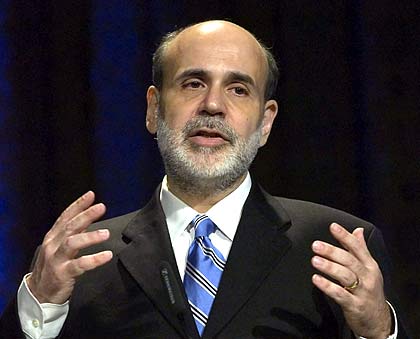
Some recent headlines:
Bernanke Warns Congress Not To Cut Spending, Cautions About ‘Fragile’ Recovery
Bernanke Says the Federal Debt Is ‘Unsustainable’
Bernanke warns about creating new bubbles
Bernanke Warns Deficits Threaten Financial Stability
Bernanke warns US economy still faces ailing housing and employment
Fed’s Bernanke warns of risk to bank independence
Bernanke Warns of Small-Bank Risks
Bernanke warns of political meddling
Bernanke warns of lower lending -
The World Cup: How to Get Out of the First Round
Posted by Eddy Elfenbein on June 9th, 2010 at 12:10 pmThe World Cup starts on Friday and I was curious as to America’s chances of making it to the knockout tournament.
Let’s go over the rules: The World Cup is divided into two parts. In the first stage, the 32 teams are divided into eight groups of four teams each. The four teams play each other in a round-robin tournament and the two teams that do the best advance to the knockout stage. In the round-robin, you get three points for a win and one point for a tie. If teams have the same number of points, the tie-breakers are (in order) goal differential, total goals, head-to-head and then they draw lots.
(I’ve only looked at the results since 1998 and they came very close to drawing lots in 2002 but ultimately didn’t need to. Paraguay edged out Slovenia 3-1 at the same time South Africa lost to Spain 3-2. Paraguay advanced on account of having scored one more goal.)
The current format started in 1998. For this year, the U.S. is in Group B which has England, Algeria and Slovenia. The quality ranking is generally considered to be England, us, Slovenia then Algeria.
So what do we need to do to advance? In the round-robin, you can score anywhere from zero to nine points (eight is mathematically impossible). Here are how the teams have done by point totals in the round-robin since the current format started in 1998:
Points……………Advancing
0…………………..0-8
1…………………..0-14
2…………………..0-6
3…………………..1-13
4…………………..7-7
5…………………..11-0
6…………………..7-0
7…………………..14-0
9…………………..8-0
The bubble seems to be four points. That’s what we got in 2002 and we made it to the knockout round. We even made it to the Final 8 after we beat Mexico. After that, we lost to Germany.
Theoretically, it’s possible to get five points and not advance, but that would be highly unusual. Conversely, it’s possible to get two points and advance. It’s possible to advance without winning a game as Chile did in 1998 (three ties). In all practical senses, if you get five points (a win and two ties), you’re in.
So if we lose to England on Saturday, we’re not out of it. Coming away with a tie would be great and a win, of course, would be spectacular. The tough games will come against Algeria and Slovenia in particular. There’s little room for error in the games you’re supposed to win. If we go 1-1-1, then our destiny may not be in our own hands.
Even if we do advance, that’s only the beginning. Here’s how the teams have done in the championship round by points scored in the round-robin:
3…………………..0-1
4…………………..4-7
5…………………..7-11
6…………………..6-7
7…………………..13-13
9…………………..15-6 -
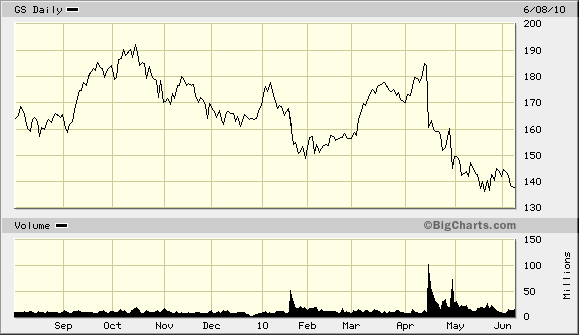
Goldman’s P/E Ratio = 5.7
Posted by Eddy Elfenbein on June 9th, 2010 at 12:04 amWow, the trailing Price/Earnings Ratio for Goldman Sachs (GS) is 5.74.
For the year, Wall Street expects Goldman to earn $19.57 a year, then $20.57 in 2011.
At Goldman’s current price, this year’s earnings estimate represent 14.2%, and 14.9% for next year. The stock is just 7% above its book value.
I’m not saying that Goldman is a bargain but the market certainly doesn’t have much faith in the bank’s future earnings potential.
-
Becky Quick: Obama Sullied Office with Ass-Kick Remark
Posted by Eddy Elfenbein on June 8th, 2010 at 1:36 pmThe relevant part starts around 5:40.
In other news, CNBC did special reports on porn and weed. -
Arden Group
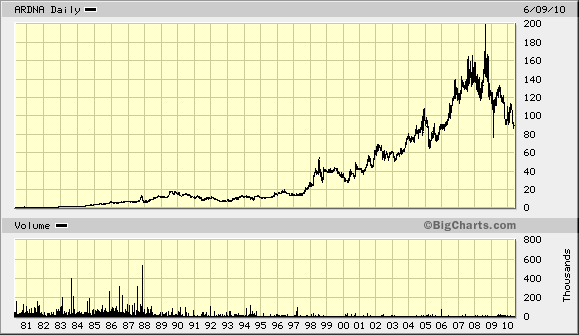
Posted by Eddy Elfenbein on June 8th, 2010 at 11:48 amHere’s another little-known stock with an amazing track record. Arden Group (ARDNA) runs 18 Gelson’s supermarkets in Southern California.
The company has a market value of about $280 million and it’s almost entirely ignored by Wall Street. In fact, it’s not uncommon for Arden to trade a few hundred shares a day.
Twenty-eight years ago, the stock was going for about 84 cents a share. In September 2008, ARDNA reached a high of $199.99 a share. That’s a gain of about 24,000% which easily beat the S&P 500’s gain of about 1,000% over the same period.
The stock has plunged all the way to $88 a share. It reached a new 52-week low last week. For some reason, the company pays a microscopic dividend of 25 cents a quarter.
Here’s Arden’s EPS for the last few years.
Year……….EPS
2000………….$3.41
2001………….$3.79
2002………….$4.14
2003………….$4.90
2004………….$6.70
2005………….$5.87
2006………….$7.16
2007………….$9.24
2008………….$7.80
2009………….$6.84
-
Europe’s Effect on the US
Posted by Eddy Elfenbein on June 8th, 2010 at 10:40 amChicago Fed President Charles Evans made some interesting remarks about the economy. He said that the problems in Europe are bad but they made not hurt us that much:
There are a few channels through which the European sovereign debt problems could influence us here. European efforts to lower debt will likely weigh on their economic growth over the medium term. This will translate into less demand by Europeans for U.S. products. In addition, the dollar already has appreciated relative to the euro. This means that European consumers find our products to be relatively more expensive than before. At the same time, prices for European goods in terms of the dollar have fallen, boosting our demand for European imports. All of these channels work in the direction of lowering U.S. net exports, which, all else being equal, would tend to reduce the outlook for U.S. GDP growth.
However, a couple of factors suggest that these trade effects of the European fiscal situation on the U.S. economy are likely to be limited. Although the euro-11 economy is large, it represents only about 15 percent of U.S. exports. In comparison, our single largest trading partner, Canada, accounted for over 19 percent of domestic exports last year. And while the dollar has appreciated almost 18 percent relative to the euro since late November, the broad dollar exchange rate that is a trade-weighted average across all currencies has appreciated only 5.1 percent over the same period.
Nonetheless, if events in Europe evolve so that they have a more severe and broad impact on financial markets, then the scope of the problems for the U.S. could be magnified. Fortunately, our direct exposure to European debt is limited. But an intensification of liquidity or solvency problems in Europe and some related spillover losses in U.S. markets could cause a marked increase in investor risk aversion. More lenders could pull back on intermediation, restricting the flow of credit to fund worthy spending projects of U.S. firms and households. -
Intel Looks Good Below $20 a Share
Posted by Eddy Elfenbein on June 8th, 2010 at 10:22 amIntel (INTC) dropped below $20 a share this morning. The stock has been as low as $19.88. Bear in mind that the company has solidly beaten estimates for the last three quarters.
Just one month ago, Intel said it was “highly confident” that it would achieve its goal for the second quarter.Intel Corp expects to double its earnings growth in the next few years and on Tuesday raised its long-term margin outlook, as the world’s top microchip maker spreads its chips beyond PCs to gadgets like smartphones and televisions.
Chief Executive Paul Otellini told investors on Tuesday that Intel is eager to establish a footprint in fast-growing — but intensely competitive — markets, diversifying beyond a PC market it now dominates.
“We are poised to take smart computing into whole new segments where it hasn’t been before,” Otellini said at the company’s annual investor meeting at Intel’s Santa Clara, California, headquarters.
The company also said it remains “highly confident” that it will achieve its financial goals for the current quarter despite rising concerns about European economies amid Greece’s financial crisis. -
The Economics of the World Cup
Posted by Eddy Elfenbein on June 8th, 2010 at 9:45 amGoldman Sachs has an interesting report on the economics of the World Cup.
Foreign Policy writes:UEFA’s (Union of European Football Associations) selection of the 2012 Euro Cup host proved prescient, as well. Picking in 2007, Poland won the rights to host the tournament (OK, co-host with Ukraine, but since then UEFA has suggested Poland be the sole host, which the Poles have graciously declined to accept). Poland, however, was the only bid country that hasn’t suffered economic decline since — and yes, Greece was the first bid country eliminated.
Other notable findings: the Growth Environment Scores (a Goldman-devised figure of sustainable economic growth and productivity) of respective countries loosely correlate to soccer performance, but a much stronger connection exists between the improvement of economic conditions and national soccer teams. (Algeria, which did not qualify for the 2006 finals in Germany, posted the highest GES improvement among developing countries over the last four years.) The report also argues that success is partially dependent on the number of males aged 18-34 in countries, and provides a UN chart with predictions for 2050. If the claim is accurate, the Nigerian Super Eagles are going to be really, really good in a few decades.
Lastly, Goldman offers their own predictions of the semi-finals (I won’t spoil, though I will say it’s what my predictions are as well), and lists the probability (with their metrics) that each country will become World Cup champions.
It’s lengthy, but an extremely interesting read, and provides the best rundown of the Cup to come that I’ve seen. Check it out.
-
Archives
- October 2026
- September 2026
- August 2026
- July 2026
- June 2026
- May 2026
- April 2026
- March 2026
- February 2026
- January 2026
- December 2025
- November 2025
- October 2025
- September 2025
- August 2025
- July 2025
- June 2025
- May 2025
- April 2025
- March 2025
- February 2025
- January 2025
- December 2024
- November 2024
- October 2024
- September 2024
- August 2024
- July 2024
- June 2024
- May 2024
- April 2024
- March 2024
- February 2024
- January 2024
- December 2023
- November 2023
- October 2023
- September 2023
- August 2023
- July 2023
- June 2023
- May 2023
- April 2023
- March 2023
- February 2023
- January 2023
- December 2022
- November 2022
- October 2022
- September 2022
- August 2022
- July 2022
- June 2022
- May 2022
- April 2022
- March 2022
- February 2022
- January 2022
- December 2021
- November 2021
- October 2021
- September 2021
- August 2021
- July 2021
- June 2021
- May 2021
- April 2021
- March 2021
- February 2021
- January 2021
- December 2020
- November 2020
- October 2020
- September 2020
- August 2020
- July 2020
- June 2020
- May 2020
- April 2020
- March 2020
- February 2020
- January 2020
- December 2019
- November 2019
- October 2019
- September 2019
- August 2019
- July 2019
- June 2019
- May 2019
- April 2019
- March 2019
- February 2019
- January 2019
- December 2018
- November 2018
- October 2018
- September 2018
- August 2018
- July 2018
- June 2018
- May 2018
- April 2018
- March 2018
- February 2018
- January 2018
- December 2017
- November 2017
- October 2017
- September 2017
- August 2017
- July 2017
- June 2017
- May 2017
- April 2017
- March 2017
- February 2017
- January 2017
- December 2016
- November 2016
- October 2016
- September 2016
- August 2016
- July 2016
- June 2016
- May 2016
- April 2016
- March 2016
- February 2016
- January 2016
- December 2015
- November 2015
- October 2015
- September 2015
- August 2015
- July 2015
- June 2015
- May 2015
- April 2015
- March 2015
- February 2015
- January 2015
- December 2014
- November 2014
- October 2014
- September 2014
- August 2014
- July 2014
- June 2014
- May 2014
- April 2014
- March 2014
- February 2014
- January 2014
- December 2013
- November 2013
- October 2013
- September 2013
- August 2013
- July 2013
- June 2013
- May 2013
- April 2013
- March 2013
- February 2013
- January 2013
- December 2012
- November 2012
- October 2012
- September 2012
- August 2012
- July 2012
- June 2012
- May 2012
- April 2012
- March 2012
- February 2012
- January 2012
- December 2011
- November 2011
- October 2011
- September 2011
- August 2011
- July 2011
- June 2011
- May 2011
- April 2011
- March 2011
- February 2011
- January 2011
- December 2010
- November 2010
- October 2010
- September 2010
- August 2010
- July 2010
- June 2010
- May 2010
- April 2010
- March 2010
- February 2010
- January 2010
- December 2009
- November 2009
- October 2009
- September 2009
- August 2009
- July 2009
- June 2009
- May 2009
- April 2009
- March 2009
- February 2009
- January 2009
- December 2008
- November 2008
- October 2008
- September 2008
- August 2008
- July 2008
- June 2008
- May 2008
- April 2008
- March 2008
- February 2008
- January 2008
- December 2007
- November 2007
- October 2007
- September 2007
- August 2007
- July 2007
- June 2007
- May 2007
- April 2007
- March 2007
- February 2007
- January 2007
- December 2006
- November 2006
- October 2006
- September 2006
- August 2006
- July 2006
- June 2006
- May 2006
- April 2006
- March 2006
- February 2006
- January 2006
- December 2005
- November 2005
- October 2005
- September 2005
- August 2005
- July 2005
 Eddy Elfenbein is a Washington, DC-based speaker, portfolio manager and editor of the blog Crossing Wall Street. His