-
Has Healthcare Become a Utility?
Posted by Eddy Elfenbein on March 24th, 2010 at 2:03 pmHere’s a look at the P/E Ratios of the different sectors within the S&P 500:
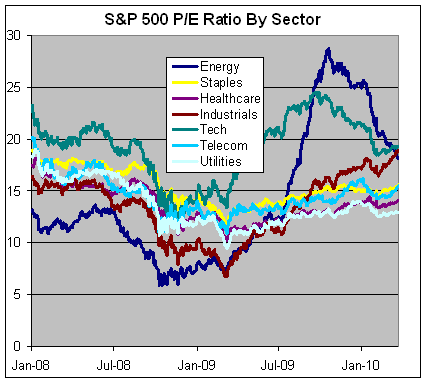
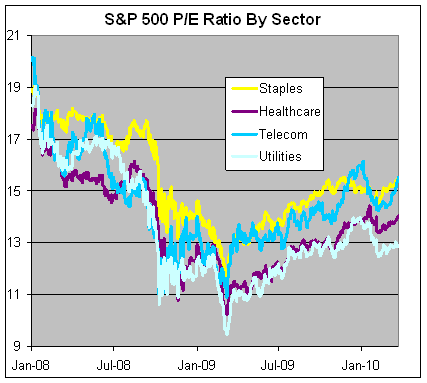
What really strikes me is how low the healthcare sector is relative to the other sectors. In fact, healthcare seems to be follow the utilities very closely. Does this mean that the healthcare sector is now a public utility?
For readability, I had to knock out three groups; Materials, Financials and Consumer Discretionaries. During recessions, the P/E Ratio can lose some of its importance as a valuation metric.
The Materials sector had a big loss for the fourth quarter of 2008 which eventually pushed the trailing four-quarter earnings down to just 0.42. That gave the index a P/E Ratio of over 400. Things have come back to normal somewhat and the P/E Ratio is now down to 24 on a trailing basis and 17.7 based on this year’s estimate.
This Discretionaries had a similar effect as the P/E Ratio soared to 55. Now it’s back down to 19 trailing and 17.1 based on 2010’s estimate.
As far as the financials, ugh, what can you say? The sector had losses for five straight quarters that totaled over 25, and the index got to as low as 81 a year ago. Even since then, the earnings have only been slightly positive. Based on trialing earnings, the financial sector is still going for over 33 times earnings. For 2010’s estimate, the sector is going for 16.3.
Here’s a look at the sector’s P/E Ratios based on this year’s earnings estimate, which I think gives a better picture of their value:Materials 17.70 Industrials 17.58 Discretionary 17.11 Financials 16.28 Tech 15.94 Staples 14.93 Telecom 14.66 Energy 12.75 Healthcare 12.41 Utilities 11.82 Here’s the same chart above but this time I only have the four defensive sectors; utes, healthcare, staples and telecom.
-
U.S. Homes Dropped to Lowest on Record
Posted by Eddy Elfenbein on March 24th, 2010 at 9:16 amSales of new homes in the U.S. unexpectedly fell in February to a record low as blizzards, unemployment and foreclosures depressed the market.
Purchases decreased 2.2 percent to an annual pace of 308.000, figures from the Commerce Department showed today in Washington. The median sales price climbed by the most in more than two years.
The new-home market is vying with foreclosure-induced declines in prices for existing homes in an economy where unemployment is forecast to average 9.6 percent this year, close to a 26-year high. Treasury Secretary Timothy F. Geithner yesterday said it would take a “long time” to repair the housing market as the administration takes steps to overhaul real-estate financing and regulation.
“It’s going to be a long, slow slog and the lagging sector will be new home sales because they have to compete with existing sales and foreclosures,” Bill Hampel, chief economist at the Credit Union National Association in Washington, said before the report. “New home sales probably have until the fourth quarter until they start recovering.”Also today, Lennar (LEN) said that its last quarterly loss narrowed. Last quarter, they lost four cents a share compared with a loss of 98 cents a share a year ago.
At least you can say that things are improving for Lennar. Here are their fiscal year EPS results for ’07, ’08 and ’09 — -$12.31, -$7.00 and -$2.45. Yep, that’s improvement!
The company also said its expects to make a profit this year which Wall Street wasn’t expecting, and neither was I. -
The SEC’s Porn Problem
Posted by Eddy Elfenbein on March 24th, 2010 at 9:07 amFrom the NYT:
It seems that the Securities and Exchange Commission may have a pornography problem even bigger than expected.
Gawker reported that S.E.C. is investigating rampant pornography surfing by employees on their work computers.
The blog writes:Now we’ve obtained reports of 16 investigations into porn-surfing by SEC employees and contractors (one of them is a woman!), including one man who said his daily porn viewing at work was limited to “no longer than an hour and a half a day.”
The sixteen cases reported by Gawker follows a February article by The Washington Times, which first reported details of the S.E.C.’s internal investigation.
In a semiannual report by the S.E.C.’s internal watchdog to Congress released in December, H. David Kotz, the S.E.C.’s inspector general outlines numerous cases of misconduct by former and current employees, including two instances of S.E.C. officials using their office computers to view pornography on the Internet -
Starbucks to Pay First Ever Dividend
Posted by Eddy Elfenbein on March 24th, 2010 at 8:43 amAt the beginning of year, I said that this is the year that investors will rediscover dividends. I’m happy to see that Starbucks (SBUX) has said that it will issue its first ever dividend payment.
Next month, the coffee stock will pay 10 cents a share to its shareholders. That translates to a dividend yield of…not much…about 1.6%. Still, it’s something. The company has said that it plans to pay out about 35% to 40% of its net income in the form of dividends. I think this is a good move.
What’s not a good move is that the company is also going to buyback shares. As a shareholder (I don’t own SBUX), I’d much rather have some tangible. Still, I’m happy to welcome SBUX to the world of dividend payers. As far as the stock goes, it’s way too pricey right now. -
The Coming Satellite Image Boom
Posted by Eddy Elfenbein on March 23rd, 2010 at 11:02 amOne of the fun parts about looking for profitable stocks is that you come across industries that you never knew existed. For example, there are two publicly traded companies— GeoEye (GEOY) and DigitalGlobe (DGI)—that operate in the field of providing satellite images for customers. Think Google Earth.
This is an appealing business because it has many applications from oil & gas to disaster rescue and government intelligence. What strikes me is that this could be a great business model because the entry costs are high (getting a satellite up there) and the variables costs are low (click!).
Last April, the Denver Business Journal reported that business might soon get much better for this sector:A new government intelligence strategy to buy more commercial space-surveillance images could drive growth and satellite development for two Colorado employers that dominate the industry in the United States.
U.S. military and spy agencies will buy more imagery from commercial vendors to use as unclassified intelligence they can publicly disseminate or share with allies. The federal government also will scale back earlier plans to build its own satellites for such purposes, making commercial vendors more important to its long-term intelligence strategy.
That’s according to Dennis Blair, director of the Office of the Director of National Intelligence, whose office oversees all of the nation’s 16 intelligence-gathering agencies, such as the CIA, and who advises the president.
Longmont-based DigitalGlobe Inc. and Dulles, Va.-based GeoEye Inc., which employs 130 people in Thornton, are the only domestic companies that gather and sell high-resolution images taken by orbiting satellites.
Government contracts are already the companies’ largest revenue generator, but Blair’s directive is seen as an unprecedented commitment.
“The federal government appears to have decided to stop dating the industry and marry it,” said Jeff Evanson, a commercial satellite industry analyst with Minneapolis-based Dougherty & Company LLC.Here we are a year later and things are going well. GEOY recently reported Q4 earnings of 55 cents a share compared with a loss of 20 cents a share a year before. Revenue jumped 80% to $73.2 million. The company also said it got $215 million in financing from Cerberus Capital Management LP which it will use to get its new satellite off the ground.
I’m curious if the best way to play this is to invest in both stocks. -
No, the Political Futures Markets Didn’t Fail
Posted by Eddy Elfenbein on March 23rd, 2010 at 9:17 amJust after the healthcare bill passed, Daniel Gross shows up to deliver his annual misunderstanding of the political futures markets:
Is there a larger lesson here? (Aside from the obvious one, which is political futures markets usually aren’t very good at predicting what actually will happen in the future?) I think so. And it’s this: Don’t short Obama. In fact, that’s been the lesson of Obama’s entire career so far.
Think of Obama as a stock. When he came onto the national scene, he was small and undercapitalized. Some investors (i.e., donors and organizers) went long, but plenty of the heaviest hitters bet against him. During the campaign, the prospects of his success were continually downplayed by the Clintons, the national media, and the Republicans.Leaving aside his schoolgirl crush on the president, we have to once again say that political futures markets are not “predictions markets,” they merely odds setting markets. They attempt to place the odds that some event will happen in the future. And guess what, those odds can change!
Just because the odds for healthcare’s passing went from low to high doesn’t mean the markets got it wrong. Perhaps it was an accurate reflection of reality. As far as I follow these things, that seems to be pretty much what happened. After Scott Brown won in Massachusetts, lots of people thought healthcare was dead. The outlook changed and the futures market followed.
Also, the futures markets were correct in the end. The contract to pass healthcare cross 50 three weeks ago, and was running around 97 moments before the roll call, which had a margin of just four votes. Doesn’t sound like failing to me. Also, just because something happen doesn’t mean it wasn’t a long shot. That’s what odds are about. Shares of DuPont (DD) are at a new high today. Does that mean that the stock market has failed?
There are problems with the political futures markets. These markets tend to be very small and illiquid. I also think Intrade does a very poor job of selecting what real world events to follow. They should steer clear of things like who will be the Vice-Presidential or Supreme Court pick. That outcome is solely determined by one person’s judgment. The markets work better when they’re trying to determine the outcome of something with many more variables. Even the outcome of the healthcare bill was largely determined by Nancy Pelosi’s determinations (or intransigence, depending on your point of view).
The markets didn’t fail. They adjusted. That’s what markets do. -
Odd Lots
Posted by Eddy Elfenbein on March 22nd, 2010 at 4:09 pmGary Gorton vs. Michael Lewis
Ritholtz’s Agenda for Financial Reform
Seabreeze’s Kass on U.S. stocks: ‘I have been wrong’
Buffett Better Credit Risk than Obama
RIP: Shirley Eleanor Nash
WW II bombs threaten AC/DC concert
Goat grabbing competition held in Kyrgyzstan
10 Luxury Business Hotels That Will Make You Forget You’re On Business -
We’re Up 11.82% in Six Weeks
Posted by Eddy Elfenbein on March 22nd, 2010 at 3:58 pmToday was an outstanding day for our Buy List. The average of our 20 stocks was up 0.95% which nearly doubled the S&P’s gain of 0.51%. Seventeen of our 20 stocks closed higher. Ten were up more than 1% and two were up more than 2%.
Since the near-term low on February 8, the S&P 500 is up 10.32% but we’re up 11.82%. That’s a 150 basis point outperformance in just six weeks.
Barron’s just noted that Gilead (GILD) is going for “only 12 times expected-forward earnings. The company has plenty of free cash and impressive growth.” -
Gene Simmons on Estate Planning
Posted by Eddy Elfenbein on March 22nd, 2010 at 1:59 pmFrom Bloomberg. Yes, Bloomberg:
Gene Simmons, singer and bassist for the rock band Kiss, said high-net-worth individuals should better prepare to protect their wealth after they die.
“You should know what your choices are in planning your estate,” said Simmons, co-founder of Cool Springs Life Equity Strategy, in an interview with Bloomberg Television in New York today.
Simmons said his company can benefit athletes and entertainers who earned fortunes without building financial expertise. Kiss has broken box-office records set by Elvis Presley and the Beatles, according to Simmons’s Web site. The band benefits from licensing agreements that sell apparel, wine bottles and jewelry emblazoned with the Kiss logo.Kiss wine? It says too little and yet too much.
-
What If Women Ran Wall Street?
Posted by Eddy Elfenbein on March 22nd, 2010 at 1:41 pmNew York Magazine has an article provocatively titled “What If Women Ran Wall Street?” It says pretty much what you’d expect.
I will add one thing about finance and gender. Wall Street is the world’s capital of the overcompensating male. Far from the hunter-gathering, trading demands that your brain hunts, but physically you’re only gathering. There’s a huge disconnect and as a result, Wall Streeters are excessively aggressive and obnoxious. If any of these guys were in a real work crew or infantry platoon, their strutting behavior would quickly stop.
-
Archives
- June 2026
- May 2026
- April 2026
- March 2026
- February 2026
- January 2026
- December 2025
- November 2025
- October 2025
- September 2025
- August 2025
- July 2025
- June 2025
- May 2025
- April 2025
- March 2025
- February 2025
- January 2025
- December 2024
- November 2024
- October 2024
- September 2024
- August 2024
- July 2024
- June 2024
- May 2024
- April 2024
- March 2024
- February 2024
- January 2024
- December 2023
- November 2023
- October 2023
- September 2023
- August 2023
- July 2023
- June 2023
- May 2023
- April 2023
- March 2023
- February 2023
- January 2023
- December 2022
- November 2022
- October 2022
- September 2022
- August 2022
- July 2022
- June 2022
- May 2022
- April 2022
- March 2022
- February 2022
- January 2022
- December 2021
- November 2021
- October 2021
- September 2021
- August 2021
- July 2021
- June 2021
- May 2021
- April 2021
- March 2021
- February 2021
- January 2021
- December 2020
- November 2020
- October 2020
- September 2020
- August 2020
- July 2020
- June 2020
- May 2020
- April 2020
- March 2020
- February 2020
- January 2020
- December 2019
- November 2019
- October 2019
- September 2019
- August 2019
- July 2019
- June 2019
- May 2019
- April 2019
- March 2019
- February 2019
- January 2019
- December 2018
- November 2018
- October 2018
- September 2018
- August 2018
- July 2018
- June 2018
- May 2018
- April 2018
- March 2018
- February 2018
- January 2018
- December 2017
- November 2017
- October 2017
- September 2017
- August 2017
- July 2017
- June 2017
- May 2017
- April 2017
- March 2017
- February 2017
- January 2017
- December 2016
- November 2016
- October 2016
- September 2016
- August 2016
- July 2016
- June 2016
- May 2016
- April 2016
- March 2016
- February 2016
- January 2016
- December 2015
- November 2015
- October 2015
- September 2015
- August 2015
- July 2015
- June 2015
- May 2015
- April 2015
- March 2015
- February 2015
- January 2015
- December 2014
- November 2014
- October 2014
- September 2014
- August 2014
- July 2014
- June 2014
- May 2014
- April 2014
- March 2014
- February 2014
- January 2014
- December 2013
- November 2013
- October 2013
- September 2013
- August 2013
- July 2013
- June 2013
- May 2013
- April 2013
- March 2013
- February 2013
- January 2013
- December 2012
- November 2012
- October 2012
- September 2012
- August 2012
- July 2012
- June 2012
- May 2012
- April 2012
- March 2012
- February 2012
- January 2012
- December 2011
- November 2011
- October 2011
- September 2011
- August 2011
- July 2011
- June 2011
- May 2011
- April 2011
- March 2011
- February 2011
- January 2011
- December 2010
- November 2010
- October 2010
- September 2010
- August 2010
- July 2010
- June 2010
- May 2010
- April 2010
- March 2010
- February 2010
- January 2010
- December 2009
- November 2009
- October 2009
- September 2009
- August 2009
- July 2009
- June 2009
- May 2009
- April 2009
- March 2009
- February 2009
- January 2009
- December 2008
- November 2008
- October 2008
- September 2008
- August 2008
- July 2008
- June 2008
- May 2008
- April 2008
- March 2008
- February 2008
- January 2008
- December 2007
- November 2007
- October 2007
- September 2007
- August 2007
- July 2007
- June 2007
- May 2007
- April 2007
- March 2007
- February 2007
- January 2007
- December 2006
- November 2006
- October 2006
- September 2006
- August 2006
- July 2006
- June 2006
- May 2006
- April 2006
- March 2006
- February 2006
- January 2006
- December 2005
- November 2005
- October 2005
- September 2005
- August 2005
- July 2005
 Eddy Elfenbein is a Washington, DC-based speaker, portfolio manager and editor of the blog Crossing Wall Street. His