-
Quote of the Day
Posted by Eddy Elfenbein on March 2nd, 2010 at 11:11 am“I think failure is the only thing that works.” – Rick Santelli on CNBC moments ago
-
How Much Worse Can It Get?
Posted by Eddy Elfenbein on March 1st, 2010 at 3:06 pmSpider-Man has just become unemployed.
On Monday, Marvel said that in a plot line that begins in issue No. 623 of Amazing Spider-Man, Peter Parker — who has lately given up his gig at The Daily Bugle to become the official photographer of the mayor of New York — will lose that job and, potentially, his career as he becomes blacklisted throughout the city.
-
Unemployment Rate of Fed Governors Hits 42%
Posted by Eddy Elfenbein on March 1st, 2010 at 2:32 pmDonald Kohn, the Vice-Chairman of the Federal Reserve, announced his retirement today.
This is interesting because his retirement will bring the number of Fed governors down to four. There are supposed to be seven.
President Obama and the Senate need to get on the stick. There are three vacancies to fill. Obama has only had one appointment so far plus reappointing Bernanke as Fed Chair which is a separate appointment.
The Fed’s Board is not to be confused with the Federal Open Market Committee which makes decisions on interest rates. The FOMC has 12 members; the seven Fed Board members, called governors, plus five presidents of the regional Fed banks. The head of the New York Fed is a permanent member, the other presidents rotate.
The idea of the Federal Reserve Act is that the bank presidents will always be outnumbered by the political appointees. Unless that’s done soon, the bank presidents will have a majority although Kohn can serve until there’s a replacement. -
The Federal Reserve’s “Kid’s Page”
Posted by Eddy Elfenbein on March 1st, 2010 at 2:09 pm -
Bristol-Myers Squibb Looks Inexpensive
Posted by Eddy Elfenbein on March 1st, 2010 at 11:17 amBristol-Myers Squibb (BMY) has popped up on my radar screen as a decent value. The company had a lousy third-quarter earnings report, but the one for the fourth-quarter was pretty good. I was also impressed by their forward guidance.
Here’s a look at the stock (in blue, left scale), earnings-per-share (gold, right scale) and dividend (black, right scale). The graph is scaled at a ratio of 16-to-1 so when the blue and gold lines cross, the P/E Ratio is 16; when the blue and black lines cross, the dividend yield is 6.66%.
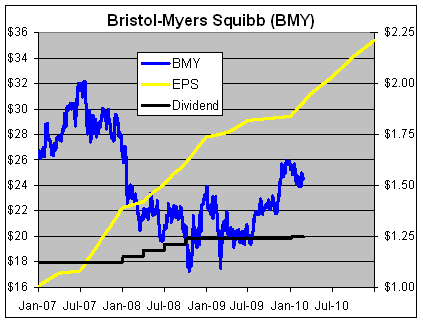
After the fourth-quarter earnings report, BMY said it expects EPS for 2010 to come in between $2.15 and $2.25 a share. As the rise in the gold line shows, that’s a pretty bold forecast. The future numbers for the gold line represent analyst estimates.
Even if the stock trades at 14 times earnings by the end of the year, that would represent 26% growth. I’m not predicting that will happen. I’m just showing you how cheap the stock is relative to what the company expects. -
Stocks Higher on Merger News
Posted by Eddy Elfenbein on March 1st, 2010 at 9:50 amThe stock market is up early today. The S&P 500 is above 1100 which is nice to see. The market is digesting some major buyout news. First, AIG is rallying on news that it’s selling its Asian unit to Britian’s Prudential for $35.5 billion.
The German Merck is buying Millipore (MIL) for $6 billion. Millipore is a toolmaker in the biotech sector. Last week, Thermo Fisher (TMO) began the bidding war for Millipore and Merck seems to have ended it. Finally, MSCI (MXB) is acquiring RiskMetrics (RISK) for $1.55 billion.
The market is also talking about the news that the board at Goldman Sachs (GS) has rejected a proposal on executive compensation from some of its shareholders, though I’m not familiar with the specifics of the proposal. One thing is certain: Goldman will be heavily criticized. -
Tobin Smith on ChinaTel Group (CHTL)
Posted by Eddy Elfenbein on February 28th, 2010 at 10:46 pmTobin Smith, formerly of ChangeWave Research, now of NBT Equity Research has a new reseach piece on ChinaTel Group (CHTL). Full disclosure: I own 1,000 shares of CHTL:
Strong Buy $7-$8 target 2011 (with new deployment schedule/pro-forma TBD)
PIPE Funding: $3.01 price per share, $640M total, $1.33 billion private market value
Tobin Smith, Chief Research Officer
With no indication from ANY of the funding parties or CHTL of a change in the equity funding schedule, I want to change the focus of the CHTL discussion to the POST-funding scenario.
I can report my conversations with The Isaac Organization that indicate a willingness on their part to accelerate their equity contribution amount prior to March 30/$10M schedule.
Reports from those close to the Excel Era group indicate ZERO funding issues or delays. Minor correction: the founder and Chairman of Excel Era and its holding company is Charles WANG, not Li. The Wang family is a very old, very prosperous and very private group. I will have the pleasure of interviewing Mr. Wang in the very near future and will bring what I can to light about their company and its relationship with ChinaTel Group, Inc.
The Isaac Group move is important in that WITH the $240M of new stock purchased by Excel Era and say $40-$50M from the Isaac Group before March 30, CHTL (by OUR estimates) will have MORE than enough capital in the bank to complete up to a 15 city simultaneous deployment over the next 12-18 months. -
Ford Motor: My Stock of the Decade
Posted by Eddy Elfenbein on February 26th, 2010 at 12:00 pmWith two months already under our belt this decade, I decided to get a jump on things and announce that Ford Motor (F) is my Stock of the Decade. You heard it here first.
Now you may be thinking this is a bit pre-mature. I understand, but lets it’s never too early to get on a good story.
While every business journalist writes a new column every time someone at Goldman Sachs hiccups, they’re ignoring one of the most remarkable business turnarounds in recent history. Just 15 months ago, shares of Ford reached a low of $1.01. The stock is currently close to $12 today.
Most impressive of all, despite a nasty recession Ford is actually making a profit. Not a big profit, but a profit nonetheless. More money is coming in then going out. These days, that’s something to notice. Also, Ford hasn’t taken a dime in bailout money.
Not only has Ford made a profit in its last two quarters, but the company has beaten Wall Street’s earnings forecast for the last four quarters in a row. In November, Wall Street was expecting a loss of 12 cents a share. Instead, Ford posted a profit of 26 cents a share. That impressed Wall Street so much that they expected 26 cents a gain when Ford reported earnings again a month ago. This time, Ford said it made 43 cents a share.
In 2006, the company unveiled its “The Way Forward” strategy designed to get the company moving again. Later that year, Bill Ford stepped down as CEO and Alan Mulally came in. Shortly after he joined, he bet everything—and I mean everything—on a gigantic $23 billion loan. They even had to put up Ford’s name as collateral. So far, it’s working. The company has slashed its workforce in half and shut down plants. Mulally sold off brands like Jaguar, Land Rover and Aston Martin and concentrated on smaller cars.
Ford’s 7.45% bond due in 2031 had a yield to a maturity of 33.2%. Now it’s down below 9%. Still, Ford has a long way to go. Mulally said they won’t be solidly profitable until next year. But if all goes well, Ford could easily be a $20 stock. -
Krugman on Core Inflation
Posted by Eddy Elfenbein on February 26th, 2010 at 10:09 amCore inflation is one of those topics that people love to get angry about. I recently had a post mentioning that core inflation had its first substantial fall since 1982. When this was picked up by Seeking Alpha, several commentors wrote to say that of course prices are rising as anyone in the real world can plainly see.
Paul Krugman writes that this misses the point of what core inflation tells us:First, let me clear up a couple of misconceptions. Core inflation is not used for things like calculating cost-of-living adjustments for Social Security; those use the regular CPI.
And people who say things like “That’s a stupid concept — people have to spend money on food and gas, so they should be in your inflation measures” are missing the point. Core inflation isn’t supposed to measure the cost of living, it’s supposed to measure something else: inflation inertia.
Think about it this way. Some prices in the economy fluctuate all the time in the face of supply and demand; food and fuel are the obvious examples. Many prices, however, don’t fluctuate this way — they’re set by oligopolistic firms, or negotiated in long-term contracts, so they’re only revised at intervals ranging from months to years. Many wages are set the same way. -
Maxine Waters Attempts Monetary Policy
Posted by Eddy Elfenbein on February 25th, 2010 at 11:57 am
-
Archives
- June 2026
- May 2026
- April 2026
- March 2026
- February 2026
- January 2026
- December 2025
- November 2025
- October 2025
- September 2025
- August 2025
- July 2025
- June 2025
- May 2025
- April 2025
- March 2025
- February 2025
- January 2025
- December 2024
- November 2024
- October 2024
- September 2024
- August 2024
- July 2024
- June 2024
- May 2024
- April 2024
- March 2024
- February 2024
- January 2024
- December 2023
- November 2023
- October 2023
- September 2023
- August 2023
- July 2023
- June 2023
- May 2023
- April 2023
- March 2023
- February 2023
- January 2023
- December 2022
- November 2022
- October 2022
- September 2022
- August 2022
- July 2022
- June 2022
- May 2022
- April 2022
- March 2022
- February 2022
- January 2022
- December 2021
- November 2021
- October 2021
- September 2021
- August 2021
- July 2021
- June 2021
- May 2021
- April 2021
- March 2021
- February 2021
- January 2021
- December 2020
- November 2020
- October 2020
- September 2020
- August 2020
- July 2020
- June 2020
- May 2020
- April 2020
- March 2020
- February 2020
- January 2020
- December 2019
- November 2019
- October 2019
- September 2019
- August 2019
- July 2019
- June 2019
- May 2019
- April 2019
- March 2019
- February 2019
- January 2019
- December 2018
- November 2018
- October 2018
- September 2018
- August 2018
- July 2018
- June 2018
- May 2018
- April 2018
- March 2018
- February 2018
- January 2018
- December 2017
- November 2017
- October 2017
- September 2017
- August 2017
- July 2017
- June 2017
- May 2017
- April 2017
- March 2017
- February 2017
- January 2017
- December 2016
- November 2016
- October 2016
- September 2016
- August 2016
- July 2016
- June 2016
- May 2016
- April 2016
- March 2016
- February 2016
- January 2016
- December 2015
- November 2015
- October 2015
- September 2015
- August 2015
- July 2015
- June 2015
- May 2015
- April 2015
- March 2015
- February 2015
- January 2015
- December 2014
- November 2014
- October 2014
- September 2014
- August 2014
- July 2014
- June 2014
- May 2014
- April 2014
- March 2014
- February 2014
- January 2014
- December 2013
- November 2013
- October 2013
- September 2013
- August 2013
- July 2013
- June 2013
- May 2013
- April 2013
- March 2013
- February 2013
- January 2013
- December 2012
- November 2012
- October 2012
- September 2012
- August 2012
- July 2012
- June 2012
- May 2012
- April 2012
- March 2012
- February 2012
- January 2012
- December 2011
- November 2011
- October 2011
- September 2011
- August 2011
- July 2011
- June 2011
- May 2011
- April 2011
- March 2011
- February 2011
- January 2011
- December 2010
- November 2010
- October 2010
- September 2010
- August 2010
- July 2010
- June 2010
- May 2010
- April 2010
- March 2010
- February 2010
- January 2010
- December 2009
- November 2009
- October 2009
- September 2009
- August 2009
- July 2009
- June 2009
- May 2009
- April 2009
- March 2009
- February 2009
- January 2009
- December 2008
- November 2008
- October 2008
- September 2008
- August 2008
- July 2008
- June 2008
- May 2008
- April 2008
- March 2008
- February 2008
- January 2008
- December 2007
- November 2007
- October 2007
- September 2007
- August 2007
- July 2007
- June 2007
- May 2007
- April 2007
- March 2007
- February 2007
- January 2007
- December 2006
- November 2006
- October 2006
- September 2006
- August 2006
- July 2006
- June 2006
- May 2006
- April 2006
- March 2006
- February 2006
- January 2006
- December 2005
- November 2005
- October 2005
- September 2005
- August 2005
- July 2005
 Eddy Elfenbein is a Washington, DC-based speaker, portfolio manager and editor of the blog Crossing Wall Street. His