-
Odd Lots
Posted by Eddy Elfenbein on February 18th, 2010 at 6:27 pmHow to Make a Crayon Rocket
UBS: World’s Largest Trading Floor
A Look at the Tax Returns of the Top 400 Taxpayers
The Mouth of Sauron
Ugly Dogs
School used student laptop webcams to spy on them at school and home
Behind the Scenes at Footnoted.org
America’s Most Dangerous Drivers By Profession
An economist predicts the Olympic medal standings
Flesh-Eating Vultures Descend on Luxury Condo Building
New Beta Stock Twits -
Fed Raises Discount Rate
Posted by Eddy Elfenbein on February 18th, 2010 at 4:33 pmThis is the Discount Rate not the Fed Funds rate:
The Federal Reserve Board on Thursday announced that in light of continued improvement in financial market conditions it had unanimously approved several modifications to the terms of its discount window lending programs.
Like the closure of a number of extraordinary credit programs earlier this month, these changes are intended as a further normalization of the Federal Reserve’s lending facilities. The modifications are not expected to lead to tighter financial conditions for households and businesses and do not signal any change in the outlook for the economy or for monetary policy, which remains about as it was at the January meeting of the Federal Open Market Committee (FOMC). At that meeting, the Committee left its target range for the federal funds rate at 0 to 1/4 percent and said it anticipates that economic conditions are likely to warrant exceptionally low levels of the federal funds rate for an extended period.
The changes to the discount window facilities include Board approval of requests by the boards of directors of the 12 Federal Reserve Banks to increase the primary credit rate (generally referred to as the discount rate) from 1/2 percent to 3/4 percent. This action is effective on February 19.
In addition, the Board announced that, effective on March 18, the typical maximum maturity for primary credit loans will be shortened to overnight. Primary credit is provided by Reserve Banks on a fully secured basis to depository institutions that are in generally sound condition as a backup source of funds. Finally, the Board announced that it had raised the minimum bid rate for the Term Auction Facility (TAF) by 1/4 percentage point to 1/2 percent. The final TAF auction will be on March 8, 2010.
Easing the terms of primary credit was one of the Federal Reserve’s first responses to the financial crisis. On August 17, 2007, the Federal Reserve reduced the spread of the primary credit rate over the FOMC’s target for the federal funds rate to 1/2 percentage point, from 1 percentage point, and lengthened the typical maximum maturity from overnight to 30 days. On December 12, 2007, the Federal Reserve created the TAF to further improve the access of depository institutions to term funding. On March 16, 2008, the Federal Reserve lowered the spread of the primary credit rate over the target federal funds rate to 1/4 percentage point and extended the maximum maturity of primary credit loans to 90 days.
Subsequently, in response to improving conditions in wholesale funding markets, on June 25, 2009, the Federal Reserve initiated a gradual reduction in TAF auction sizes. As announced on November 17, 2009, and implemented on January 14, 2010, the Federal Reserve began the process of normalizing the terms on primary credit by reducing the typical maximum maturity to 28 days.
The increase in the discount rate announced Thursday widens the spread between the primary credit rate and the top of the FOMC’s 0 to 1/4 percent target range for the federal funds rate to 1/2 percentage point. The increase in the spread and reduction in maximum maturity will encourage depository institutions to rely on private funding markets for short-term credit and to use the Federal Reserve’s primary credit facility only as a backup source of funds. The Federal Reserve will assess over time whether further increases in the spread are appropriate in view of experience with the 1/2 percentage point spread.Was this news leaked?
-
2-Year/10-Year Treasury Spread Hits All-Time Record
Posted by Eddy Elfenbein on February 18th, 2010 at 1:03 pmThe gap in yield between Treasury 2- and 10-year notes, known as the yield curve, steepened to a record as reports showed that Philadelphia region manufacturing and U.S. leading indicators rose.
The Treasury Department said it will sell $126 billion in notes and bonds next week: billion in 30-year Treasury Inflation Protected Securities, or TIPS, $44 billion in two-year debt, $42 billion in five-year notes and $32 billion in seven-year securities on successive days beginning Feb. 22. The producer price index rose more than forecast last month.
“The steep yield curve is starting to reflect signs of stagflation,” said Michael Franzese, managing director and head of Treasury trading at Wunderlich Securities in New York. “The short end will remain tied to the Fed funds. Yet we are seeing inflation signs and as a result, long dated maturities are getting hurt.”
The yield curve increased to 2.92 percentage points, beating the record of 2.90 percentage points set on Jan. 11.
The 10-year note yield advanced five basis points, or 0.05 percentage point, to 3.78 percent, the highest level since Jan. 14, at 11:13 a.m. in New York, according to BGCantor Market Data. The two-year note yield rose two basis points to 0.86 percent.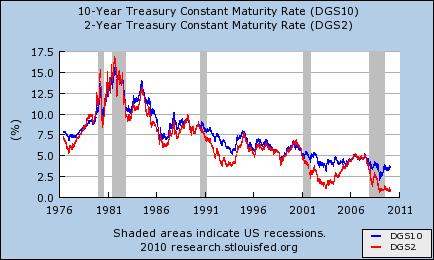
(HT: Alea) -
There’s a Constitution Laying Around Here Somewhere
Posted by Eddy Elfenbein on February 18th, 2010 at 11:26 amThe WSJ:
President Barack Obama on Thursday created a bipartisan commission to confront what he calls the federal deficit’s “disturbing” trajectory.
Correct me if I’m wrong, but don’t we already have a bipartisan commission in charge of the confronting the deficit called Congress?
Not that they’re any good but why would a commission be any better? -
Courtier of the Hip Class
Posted by Eddy Elfenbein on February 18th, 2010 at 10:55 amLots of people love Matt Taibbi’s reporting. I find him entertaining, but not very worthwhile. I don’t see him as a journalist but as a courtier to the hip class. He distorts his stories to flatter their prejudices which is everything a journalist should not be.
Taibbi consistently leaves out important details. He takes already known facts and bends them into dishonest narratives. Moreover, his sex and drug references sound forced and hint at a dramatic inferiority complex.
Taibbi first attacked Goldman Sachs in July with his famous Vampire Squid article which was later shredded to pieces. Then in October, he went after naked short-selling and strolled into the propellers once again. Now he goes after Goldman again and compares their business to several con jobs.
Taibbi includes this charmer about Goldman: “They raped the taxpayer, and they raped their clients.”
See how edgy that is? Of course, he could also talk with some actual rape victims. -
The Hemline Theory Strikes Again!
Posted by Eddy Elfenbein on February 18th, 2010 at 9:20 am
The AP reports that long hemlines are back in fashion:So long, miniskirts. The up-to-there trend gave way to longer hemlines at New York Fashion Week.
There were more pants, too, than in recent seasons when the dress ruled the runways. Even designers who showed shorter dresses paired them with leg-warmers for a less leggy look.
On Wednesday, Oscar de la Renta showed long slim skirts for daytime, while Michael Kors had the slim shape just below the knee as well as more free-flowing knits that grazed the floor.
The old saying that hemlines go up in a good economy and down in a bad one is not always the case, but many did see the longer hemline as a reflection of the Great Recession.
“There’s a general growing up of fashion after a very difficult year,” said Joanna Coles, editor in chief of Marie Claire magazine. “Women don’t want dressing up to be so complicated. The hemline dropping is part of that.”This is a change from four years ago when hemlines were rising.
-
Sandler O’Neill Cut Estimates and Price Target Price for Eaton Vance
Posted by Eddy Elfenbein on February 18th, 2010 at 9:06 amFrom Barron’s:
Based on our math, we think Eaton Vance generated about $2 billion of net inflows during fiscal first quarter, translating into 5%-plus annualized organic growth. Though down from the $5.5 billion (15% growth) in fiscal fourth quarter (Oct.), the prior quarter included $3 billion-plus of lower-fee institutional mandates.
Looking ahead, we expect Eaton Vance to continue to gain market share reflecting strong long-term investment performance track records, reaccelerating equity volumes, broadening flows, and rising demand for the firm’s equity income and tax-managed strategies given the specter of higher tax rates.
As January AUM came in below our forecast, we are taking down our fiscal 2010 (Oct) and fiscal 2011 earnings-per-share estimates from $1.68/$2.04 to $1.59/$1.93, bringing us about in line with consensus.
Moreover, our fiscal-first-quarter forecast falls by two cents to 37 cents. As a result of our lower earnings outlook, we are reducing our price target by $1 to $32, or less than 10% upside potential from current levels.
While Eaton Vance continues to generate above-average flows, we think further upside from here is limited given the stock’s seemingly full valuation. Eaton Vance is currently trading at 19 times our revised fiscal 2010 EPS estimate, or about 15% higher than the peer group average of 16-17 times. -
Missy Francis Basis for Avery Jessup
Posted by Eddy Elfenbein on February 18th, 2010 at 8:51 am
The New York Post reports that former child star and CNBC anchor Melissa Francis was the basis for Avery Jessup, the love interest of Jack Donaghy on NBC’s “30 Rock”:Avery Jessup, the new love interest of Alec Baldwin’s “30 Rock” character played by Elizabeth Banks, is based on a real person. A source close to the show said that Jessup, who hosts a fictional CNBC show called “Hot Box,” was inspired by real-life CNBC anchor Melissa Francis. Our source said that Francis herself, who hosts morning show “The Call,” pitched the idea to a “30 Rock” producer. “Francis was hoping to be asked to play the character herself, but they ended up going with Banks,” our source says.
As a girl, Melissa played Cassandra Cooper Ingalls on Little House on the Prairie. Jason Bateman played her brother James.
-
The Federal Reserve’s Profit Machine
Posted by Eddy Elfenbein on February 18th, 2010 at 8:36 amWorried about the Federal Reserve’s profits? Maybe at some point, but for now the central bank is raking it in.
Any profit the Fed makes over 6% goes directly to the U.S. Treasury. For the month of January, the Fed forked over $5.2 billion (see page 6). For the first four months of this fiscal year, the Fed has paid the Treasury over $24 billion which is twice as much as one year ago.
For the 2009 calendar year, the Fed’s net jumped 46% to $52.1 billion, and $46.1 billion of that went to the Treasury. -
Self-Parody Alert
Posted by Eddy Elfenbein on February 18th, 2010 at 7:43 amFrom Nassim Taleb:
Giving businessreaders my book: like giving vintage Bordeaux to drinkers of Diet Coke and listening to their comments about it [TBS-2nd ed]
Oh dear lord. Let’s ponder the irony that that thought was a Twitter tweet.
-
Archives
- June 2026
- May 2026
- April 2026
- March 2026
- February 2026
- January 2026
- December 2025
- November 2025
- October 2025
- September 2025
- August 2025
- July 2025
- June 2025
- May 2025
- April 2025
- March 2025
- February 2025
- January 2025
- December 2024
- November 2024
- October 2024
- September 2024
- August 2024
- July 2024
- June 2024
- May 2024
- April 2024
- March 2024
- February 2024
- January 2024
- December 2023
- November 2023
- October 2023
- September 2023
- August 2023
- July 2023
- June 2023
- May 2023
- April 2023
- March 2023
- February 2023
- January 2023
- December 2022
- November 2022
- October 2022
- September 2022
- August 2022
- July 2022
- June 2022
- May 2022
- April 2022
- March 2022
- February 2022
- January 2022
- December 2021
- November 2021
- October 2021
- September 2021
- August 2021
- July 2021
- June 2021
- May 2021
- April 2021
- March 2021
- February 2021
- January 2021
- December 2020
- November 2020
- October 2020
- September 2020
- August 2020
- July 2020
- June 2020
- May 2020
- April 2020
- March 2020
- February 2020
- January 2020
- December 2019
- November 2019
- October 2019
- September 2019
- August 2019
- July 2019
- June 2019
- May 2019
- April 2019
- March 2019
- February 2019
- January 2019
- December 2018
- November 2018
- October 2018
- September 2018
- August 2018
- July 2018
- June 2018
- May 2018
- April 2018
- March 2018
- February 2018
- January 2018
- December 2017
- November 2017
- October 2017
- September 2017
- August 2017
- July 2017
- June 2017
- May 2017
- April 2017
- March 2017
- February 2017
- January 2017
- December 2016
- November 2016
- October 2016
- September 2016
- August 2016
- July 2016
- June 2016
- May 2016
- April 2016
- March 2016
- February 2016
- January 2016
- December 2015
- November 2015
- October 2015
- September 2015
- August 2015
- July 2015
- June 2015
- May 2015
- April 2015
- March 2015
- February 2015
- January 2015
- December 2014
- November 2014
- October 2014
- September 2014
- August 2014
- July 2014
- June 2014
- May 2014
- April 2014
- March 2014
- February 2014
- January 2014
- December 2013
- November 2013
- October 2013
- September 2013
- August 2013
- July 2013
- June 2013
- May 2013
- April 2013
- March 2013
- February 2013
- January 2013
- December 2012
- November 2012
- October 2012
- September 2012
- August 2012
- July 2012
- June 2012
- May 2012
- April 2012
- March 2012
- February 2012
- January 2012
- December 2011
- November 2011
- October 2011
- September 2011
- August 2011
- July 2011
- June 2011
- May 2011
- April 2011
- March 2011
- February 2011
- January 2011
- December 2010
- November 2010
- October 2010
- September 2010
- August 2010
- July 2010
- June 2010
- May 2010
- April 2010
- March 2010
- February 2010
- January 2010
- December 2009
- November 2009
- October 2009
- September 2009
- August 2009
- July 2009
- June 2009
- May 2009
- April 2009
- March 2009
- February 2009
- January 2009
- December 2008
- November 2008
- October 2008
- September 2008
- August 2008
- July 2008
- June 2008
- May 2008
- April 2008
- March 2008
- February 2008
- January 2008
- December 2007
- November 2007
- October 2007
- September 2007
- August 2007
- July 2007
- June 2007
- May 2007
- April 2007
- March 2007
- February 2007
- January 2007
- December 2006
- November 2006
- October 2006
- September 2006
- August 2006
- July 2006
- June 2006
- May 2006
- April 2006
- March 2006
- February 2006
- January 2006
- December 2005
- November 2005
- October 2005
- September 2005
- August 2005
- July 2005
 Eddy Elfenbein is a Washington, DC-based speaker, portfolio manager and editor of the blog Crossing Wall Street. His