-
Where has the money gone?
Posted by Eddy Elfenbein on October 22nd, 2009 at 2:35 pmHere’s a conversation to contemplate (2:48 mark):
Maria Bartiromo: Where has the money gone?
Elizabeth Warren: We not only don’t know, Maria, we’re not ever going to know. -
Danaher Beats Estimates and Guides Higher
Posted by Eddy Elfenbein on October 22nd, 2009 at 1:19 pmDanaher (DHR) has had a rough year, but the earnings are better than I thought they’d be. Today the company reported 3Q EPS of 89 cents which was three cents better than estimates.
For Q4, the company said to expect EPS between 99 cents and $1.09. That’s pretty good guidance, however the shares seem a bit on the high side. I’m not sure if Danaher will be on the Buy List next year. -
The NICK Sell Storm
Posted by Eddy Elfenbein on October 22nd, 2009 at 10:13 amI’m not sure exactly what happened, but it appears that someone sold off about 100,000 shares of Nicholas Financial (NICK) this week (some mutual funds follow an October 31 accounting year). The stock didn’t take it well. Such are the risks in owning a very small-cap stock. Nevertheless, it’s still an excellent stock and the next earnings report should be out in the first week of November.
-
Black Thursday—Eighty Years Ago
Posted by Eddy Elfenbein on October 22nd, 2009 at 9:17 amThe Great Depression began 80 years ago. Wall Street suffered Black Thursday on October 24, 1929. (The actual anniversary is Saturday, but since today is Thursday, I’m going for it).
The Dow had peaked on September 3 at 381.17. Traders were even breaking out their Dow 400 hats. Slowly, the market started losing ground. On October 23, the Dow dropped 6.33% to 305.85. Then on Thursday morning, the Dow dropped nearly 11% to 272.32.
In one of the great scenes in Wall Street history, around mid-day on Thursday several bankers got together and had Richard Whitney, the future president of the NYSE, to go down to the exchange and make a great show of buying huge blocks of stock for the pool. Whitney walked across the trading floor placing order far above current prices. A visitor named Winston Churchill watched in the gallery.
The tactic worked and stocks rallied. On Black Thursday, the Dow closed down just 2.1%. Check out this article from The Guardian. Here’s the final paragraph:Most experts claim that there is nothing in the general conditions to warrant pessimism. The deluge of selling today is said merely to have pumped water from a number of highly saturated overvalued securities. But the fact is that today’s crash affected good issues as much as bad ones. New York bankers were tonight blaming the panic on the technical inadequacy of the ticker-tape system (Quick! Call Patrick Byrne) in processing such massive volume trading. Whatever the reasons, the spree of easy money and over-confidennce is now over. The bear market has returned with a vengeance, crushing the dreams of an army of small investors some of whom lost everything: 11 speculators are said to have committed suicide.
The following Tuesday, the Dow crashed 12.8%, then another 11.7% on Wednesday bringing the index down to 230.07.
The closing low came on November 13 when the Dow hit 198.69. After that began a sucker’s rally as the Dow topped 290 by mid-April.
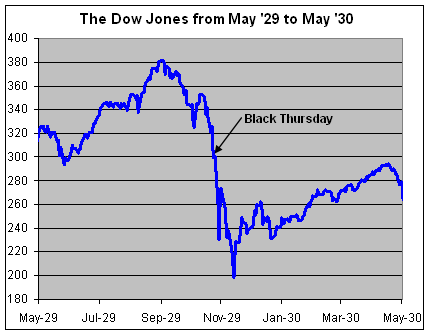
On July 8, 1932, the Dow bottomed out at 41.12 for a loss of 89%. An equivalent loss from today would bring the Dow to about 1,075.
Oh, I nearly forgot. That Richard Whitney guy? It turns out he a little embezzlement problem and got his ass locked up in Sing Sing.
Here he is denouncing Securities Exchange Act of 1934. Except for the name of the bill, this speech could be delivered verbatim today.
-
From the New Yorker
Posted by Eddy Elfenbein on October 22nd, 2009 at 8:46 am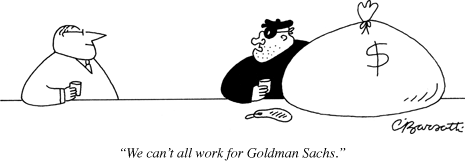
-
So How Was Your Day?
Posted by Eddy Elfenbein on October 21st, 2009 at 8:19 pmIf you’re Steve Jobs…pretty good.
Shortly after 2 p.m., before the market tanked, Apple was up 9.71 points to an all-time intraday high of 208.62, and Disney was up .36 points to $29.71, together adding $103.5 million to Jobs’ bottom line.
-
Newsweek Asks
Posted by Eddy Elfenbein on October 21st, 2009 at 7:55 pmWas Germany better off under the Nazis? Let’s look at key comparisons like forestry and divorces.
-
The VIX Is Close to Going Below 20
Posted by Eddy Elfenbein on October 21st, 2009 at 11:43 amThe VIX has been as low as 20.10 today. We haven’t been below 20 since August 29, 2008.
The VIX isn’t strongly correlated to market returns. The only exception is that a very low VIX — lower than 13 — seems to be good for stocks. -
Buy List Earnings from Stryker, Lilly and SEI Investments
Posted by Eddy Elfenbein on October 21st, 2009 at 11:16 amThis is a bit strange. Lilly is down today on good news and Stryker is up on bad news. I don’t get it, but I didn’t write the rules.
Eli Lilly (LLY) earned $1.20 a share which was 18 cents better than estimates. The company also raised EPS guidance for next year to $4.30 to $4.40 from their earlier estimate of $4.20 to $4.30. The stock was up in the pre-market but is down now. I have no idea why, but Lilly is a great stock.
Stryker (SYK) is our big winner today. The company said it earned 69 cents a share for the third quarter which matched estimates. The company also cut its 2009 EPS forecast to $2.90 and $3 from $3.12 to $3.22, but that’s hardly a big deal since it’s just one more quarter.
SEI Investments’ (SEIC) business got hit hard last year, but it’s recovering nicely. The company earned 27 cents a share for the third quarter which is a 50% jump from the 18 cents a share it earned a year ago. They beat the Street by two cents a share.
Cognizant (CTSH), Danaher (DHR) and Sysco (SYY) are all at new 52-week highs today. -
No More Historical Comparisons Graphs
Posted by Eddy Elfenbein on October 21st, 2009 at 9:54 amStarting today, I refuse to look at any more charts that contain five or more squiggly lines, one labeled 2009, another labeled 1929, another 1974, another 1379. Enough!
These charts were kind of fun to look at a few months ago, but seriously, markets don’t trace out precise patterns from decades ago. On the morning of October 19, 1987, the WSJ famously ran a similar chart comparing the Dow’s current run with the market’s run-up in 1929, but there was one major difference. They altered the x-axis to make it a better fit. Once you start toying around with the data, you can make anything fit.
-
Archives
- June 2026
- May 2026
- April 2026
- March 2026
- February 2026
- January 2026
- December 2025
- November 2025
- October 2025
- September 2025
- August 2025
- July 2025
- June 2025
- May 2025
- April 2025
- March 2025
- February 2025
- January 2025
- December 2024
- November 2024
- October 2024
- September 2024
- August 2024
- July 2024
- June 2024
- May 2024
- April 2024
- March 2024
- February 2024
- January 2024
- December 2023
- November 2023
- October 2023
- September 2023
- August 2023
- July 2023
- June 2023
- May 2023
- April 2023
- March 2023
- February 2023
- January 2023
- December 2022
- November 2022
- October 2022
- September 2022
- August 2022
- July 2022
- June 2022
- May 2022
- April 2022
- March 2022
- February 2022
- January 2022
- December 2021
- November 2021
- October 2021
- September 2021
- August 2021
- July 2021
- June 2021
- May 2021
- April 2021
- March 2021
- February 2021
- January 2021
- December 2020
- November 2020
- October 2020
- September 2020
- August 2020
- July 2020
- June 2020
- May 2020
- April 2020
- March 2020
- February 2020
- January 2020
- December 2019
- November 2019
- October 2019
- September 2019
- August 2019
- July 2019
- June 2019
- May 2019
- April 2019
- March 2019
- February 2019
- January 2019
- December 2018
- November 2018
- October 2018
- September 2018
- August 2018
- July 2018
- June 2018
- May 2018
- April 2018
- March 2018
- February 2018
- January 2018
- December 2017
- November 2017
- October 2017
- September 2017
- August 2017
- July 2017
- June 2017
- May 2017
- April 2017
- March 2017
- February 2017
- January 2017
- December 2016
- November 2016
- October 2016
- September 2016
- August 2016
- July 2016
- June 2016
- May 2016
- April 2016
- March 2016
- February 2016
- January 2016
- December 2015
- November 2015
- October 2015
- September 2015
- August 2015
- July 2015
- June 2015
- May 2015
- April 2015
- March 2015
- February 2015
- January 2015
- December 2014
- November 2014
- October 2014
- September 2014
- August 2014
- July 2014
- June 2014
- May 2014
- April 2014
- March 2014
- February 2014
- January 2014
- December 2013
- November 2013
- October 2013
- September 2013
- August 2013
- July 2013
- June 2013
- May 2013
- April 2013
- March 2013
- February 2013
- January 2013
- December 2012
- November 2012
- October 2012
- September 2012
- August 2012
- July 2012
- June 2012
- May 2012
- April 2012
- March 2012
- February 2012
- January 2012
- December 2011
- November 2011
- October 2011
- September 2011
- August 2011
- July 2011
- June 2011
- May 2011
- April 2011
- March 2011
- February 2011
- January 2011
- December 2010
- November 2010
- October 2010
- September 2010
- August 2010
- July 2010
- June 2010
- May 2010
- April 2010
- March 2010
- February 2010
- January 2010
- December 2009
- November 2009
- October 2009
- September 2009
- August 2009
- July 2009
- June 2009
- May 2009
- April 2009
- March 2009
- February 2009
- January 2009
- December 2008
- November 2008
- October 2008
- September 2008
- August 2008
- July 2008
- June 2008
- May 2008
- April 2008
- March 2008
- February 2008
- January 2008
- December 2007
- November 2007
- October 2007
- September 2007
- August 2007
- July 2007
- June 2007
- May 2007
- April 2007
- March 2007
- February 2007
- January 2007
- December 2006
- November 2006
- October 2006
- September 2006
- August 2006
- July 2006
- June 2006
- May 2006
- April 2006
- March 2006
- February 2006
- January 2006
- December 2005
- November 2005
- October 2005
- September 2005
- August 2005
- July 2005
 Eddy Elfenbein is a Washington, DC-based speaker, portfolio manager and editor of the blog Crossing Wall Street. His