-
Nicholas Financial Reports Earnings of 20 Cents a Share
Posted by Eddy Elfenbein on May 5th, 2009 at 12:23 pmExcellent news! Our favorite little micro-cap, Nicholas Financial (NICK) reported Q1 earnings of 20 cents per share, the same as last year’s Q1. Revenues increased 3.9% to $13,224,000.
I’ll have to look more into the numbers when I have a chance, but this is great news. The stock has been up by as much as 37% today! -
Cognizant Beats the Street and Guides Higher
Posted by Eddy Elfenbein on May 5th, 2009 at 11:56 amThis is turning into a very good day for the Buy List. Cognizant Technology Solutions (CTSH) reported earnings of 42 cents a share, five cents more than estimates. For Q2, CTSH said it expects to earn 42 cents a share and $1.71 for the full year. The shares are still reasonably priced. The stock is up for the sixth day in a row.
-
How David Beats Goliath
Posted by Eddy Elfenbein on May 5th, 2009 at 11:41 amI have to confess having a love-hate relationship with Malcolm Gladwell. He writes very well and I’m always eager to read his next Big Think-Middle Brow article. I want to like his articles, but whenever I finish one, I feel like I just ate a bowl of whipped cream.
Gladwell has a winning formula. Take an interesting law of social science (or a humdrum truism) and show how it’s applied in several incomprehensively different scenarios. Self-parody lurks behind the scenes.
Seeing the scenarios is the payoff of any Gladwell piece. Personally, I fill out a little bingo grid before hand. In each box, I’ll write things like “wine-making in the Yukon” or “hedge funds during the Ming Dynasty.” Then I check off each one Gladwell references.
His latest article is about how underdogs can win by resorting to unconventional strategies—or as he says, how David can beat Goliath (Biblical reference…bingo!). Seems pretty obvious to me, but now I have to know the connections!
The connections Malcolm! What are the connections??
Twelve-year-old girls basketball and Lawrence of Arabia! No, I’m not making this up. Hell, I couldn’t make it up.
The coach of the 12-year-old girls team decided to press the entire basketball floor and challenge every in-bounds pass. This was an unconventional strategy. The opposing teams got flustered and often turned over the ball, and the weaker team could pull off the upset.
I have a great deal of sympathy for this type of thinking. How can you look at a game, or any activity, in a different way and challenge orthodoxy? That’s what investing is all about. For example, I think there’s good evidence showing that punting on fourth-down isn’t worth it. But it will be odd for a pro team to start doing that. I’ve also heard that shooting foul shots underhanded is far superior than overhand. Yet what macho ball player will start doing that? The numbers geeks have shown that stealing bases is very risky and you shouldn’t do it unless you’re pretty darn sure you’ll make it.
The crawl style of swimming was unknown to the West until a competition in 1844 when Native American crushed a bunch of British swimmers who used the preferred-method, the breaststroke. (I used to think the crawl style was called freestyle.) It’s rather disquieting to think that some strategy that has stood the test of time is simply wrong.The economist Joseph Schumpeter said that innovation isn’t merely part of the economy, it’s the heart of the economy.
So I do enjoy Gladwell’s pieces yet I feel as if he stretches his themes further than the facts allow. For example, the last scenario presents a computer programmer who wins a naval war-game contest by ignoring strategies and crunching the numbers in the rulebook. That doesn’t sound too innovative to me. I wouldn’t call it poor sportsmanship but it’s hardly within the spirit of the law. In that case, I’d rather go with Goliath. -
Wasn’t There a 10th Amendment?
Posted by Eddy Elfenbein on May 5th, 2009 at 11:37 amIn a historic first, Uncle Sam has supplanted sales, property and income taxes as the biggest source of revenue for state and local governments.
(Via: Arnold Kling and Nick Schulz)
-
Cayman Islands’ Tax Haven
Posted by Eddy Elfenbein on May 5th, 2009 at 10:45 amUgland House is a five-story office building on on South Church Street in the Caymans. Guess how many companies are based there?
Answer: 18,857. -
The Credit Crisis Explained
Posted by Eddy Elfenbein on May 5th, 2009 at 9:54 amThe Crisis of Credit Visualized from Jonathan Jarvis on Vimeo.
-
The Cyclicals Have Led the Charge
Posted by Eddy Elfenbein on May 5th, 2009 at 8:10 amOne thing to point out about this rally is that it’s been hugely led by cyclicals. Since March 9, the S&P 500 is up 34% but the Morgan Stanley Cyclical Index (^CYC) is up a stunning 98%. That’s a huge move for an index. Cyclicals have outperformed the market for 19 of the last 23 sessions.
Too many analysts like to downplay a rally because it’s slanted one way or the other. But almost all rallies are initially geared toward one sector or another — and just because it starts that way doesn’t mean it will end up that way. Broad-based rallied are far more the exception than the rule.
I like to follow the ratio of the CYC to the S&P 500 because it tends to move in long-term cycles (hence the name cyclicals). See the chart below, and note how dramatic the move has been over the last six months.
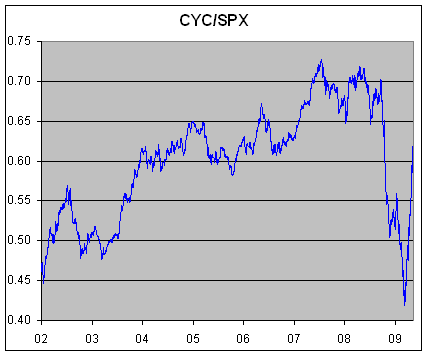
I’ll warn you not to mistake this for a market-timing device. Instead, it’s a way to get a look at the internals of the market. I think the broader rally still has legs but I’m beginning to doubt that the cyclicals will continue their lead. They’ve earned a nice rest for now.
P.S. The ratio reached its peak on July 19, 2007 at 0.7273. One month before, I warned investors that the cyclical party was coming to an end. -
The California Problem
Posted by Eddy Elfenbein on May 5th, 2009 at 1:22 amGeorge Will has a good albeit scary column on the political economics of California. He calls Arnold Schwarzenegger, “the best governor the states contiguous to California have ever had.”
Here’s a sample:Liberal orthodoxy has made the state dependent on a volatile source of revenue — high income tax rates on the wealthy. In 2006, the top 1 percent of earners paid 48 percent of the income taxes. California’s income and sales taxes are among the nation’s highest and its business conditions among the worst, as measured by 16 variables directly influenced by the Legislature. Unemployment, the nation’s fourth-highest, is 11.2 percent.
I’m worried that the issue isn’t simply one of balancing a budget. I’m afraid that it’s deeper than that. It’s that the model of California’s society is fundamentally broken. Big government and high taxes combined with massive immigration and multiculturalism.
I can’t help but think of New York during the 1970s when the city experienced a dramatic downfall. Crime exploded and the population imploded. In 1965, there was a blackout and the city was calm. Twelve years later, there was a blackout and massive looting.
Think of all those great 70s movies that showed the grit and grim of New York, or Howard Cossell saying during the World Series, “There it is, ladies and gentlemen, The Bronx is burning.”
This could be California’s future. -
Re: S&P Nears 2009 High
Posted by Eddy Elfenbein on May 4th, 2009 at 11:53 pmThanks to a late-day surge, the S&P 500 broke 900 and closed at 907.24. The index is now positive for the year! (Slightly). Our Buy List is currently up 10.34%. Since March 9, the S&P 500 is up 34% which works out to a cool $2 trillion.
-
Inflation Nation
Posted by Eddy Elfenbein on May 4th, 2009 at 10:37 pmAllan Meltzer has a good article in today’s New York Times on the threat of inflation created by the Fed’s policies. The Fed has tossed tons of money into the economy and there will be a reckoning. Policy is, of course, a matter of choices and the Fed has decided to put inflation concerns on the back-burner while trying to help the economy right now.
Once the economy finally gets back on its feet, tough decisions will need to be made. What needs to be done isn’t hard to figure out—massively drain liquidity. Instead, it will be a question of political will. Meltzer is concerned that the Fed has “sacrificed its independence and become the monetary arm of the Treasury.” That’s a good point.
I currently lean toward downplaying the impact of inflation. Why? Well, because everyone else sees it as inevitable. No one seemed terribly worried that Mine That Bird would come flying up the inside rail…so it happened.
With Tall Paul in his corner, I think Obama realizes the importance of the Fed’s role in combating inflation. I guess there really is no such thing as an independent Fed.
-
Archives
- June 2026
- May 2026
- April 2026
- March 2026
- February 2026
- January 2026
- December 2025
- November 2025
- October 2025
- September 2025
- August 2025
- July 2025
- June 2025
- May 2025
- April 2025
- March 2025
- February 2025
- January 2025
- December 2024
- November 2024
- October 2024
- September 2024
- August 2024
- July 2024
- June 2024
- May 2024
- April 2024
- March 2024
- February 2024
- January 2024
- December 2023
- November 2023
- October 2023
- September 2023
- August 2023
- July 2023
- June 2023
- May 2023
- April 2023
- March 2023
- February 2023
- January 2023
- December 2022
- November 2022
- October 2022
- September 2022
- August 2022
- July 2022
- June 2022
- May 2022
- April 2022
- March 2022
- February 2022
- January 2022
- December 2021
- November 2021
- October 2021
- September 2021
- August 2021
- July 2021
- June 2021
- May 2021
- April 2021
- March 2021
- February 2021
- January 2021
- December 2020
- November 2020
- October 2020
- September 2020
- August 2020
- July 2020
- June 2020
- May 2020
- April 2020
- March 2020
- February 2020
- January 2020
- December 2019
- November 2019
- October 2019
- September 2019
- August 2019
- July 2019
- June 2019
- May 2019
- April 2019
- March 2019
- February 2019
- January 2019
- December 2018
- November 2018
- October 2018
- September 2018
- August 2018
- July 2018
- June 2018
- May 2018
- April 2018
- March 2018
- February 2018
- January 2018
- December 2017
- November 2017
- October 2017
- September 2017
- August 2017
- July 2017
- June 2017
- May 2017
- April 2017
- March 2017
- February 2017
- January 2017
- December 2016
- November 2016
- October 2016
- September 2016
- August 2016
- July 2016
- June 2016
- May 2016
- April 2016
- March 2016
- February 2016
- January 2016
- December 2015
- November 2015
- October 2015
- September 2015
- August 2015
- July 2015
- June 2015
- May 2015
- April 2015
- March 2015
- February 2015
- January 2015
- December 2014
- November 2014
- October 2014
- September 2014
- August 2014
- July 2014
- June 2014
- May 2014
- April 2014
- March 2014
- February 2014
- January 2014
- December 2013
- November 2013
- October 2013
- September 2013
- August 2013
- July 2013
- June 2013
- May 2013
- April 2013
- March 2013
- February 2013
- January 2013
- December 2012
- November 2012
- October 2012
- September 2012
- August 2012
- July 2012
- June 2012
- May 2012
- April 2012
- March 2012
- February 2012
- January 2012
- December 2011
- November 2011
- October 2011
- September 2011
- August 2011
- July 2011
- June 2011
- May 2011
- April 2011
- March 2011
- February 2011
- January 2011
- December 2010
- November 2010
- October 2010
- September 2010
- August 2010
- July 2010
- June 2010
- May 2010
- April 2010
- March 2010
- February 2010
- January 2010
- December 2009
- November 2009
- October 2009
- September 2009
- August 2009
- July 2009
- June 2009
- May 2009
- April 2009
- March 2009
- February 2009
- January 2009
- December 2008
- November 2008
- October 2008
- September 2008
- August 2008
- July 2008
- June 2008
- May 2008
- April 2008
- March 2008
- February 2008
- January 2008
- December 2007
- November 2007
- October 2007
- September 2007
- August 2007
- July 2007
- June 2007
- May 2007
- April 2007
- March 2007
- February 2007
- January 2007
- December 2006
- November 2006
- October 2006
- September 2006
- August 2006
- July 2006
- June 2006
- May 2006
- April 2006
- March 2006
- February 2006
- January 2006
- December 2005
- November 2005
- October 2005
- September 2005
- August 2005
- July 2005
 Eddy Elfenbein is a Washington, DC-based speaker, portfolio manager and editor of the blog Crossing Wall Street. His