-
Canadian Euro Has Best Month in 60 Years
Posted by Eddy Elfenbein on May 29th, 2009 at 4:28 pmThe loonie is making us look like a bunch of hosers:
Canada’s currency headed for the biggest monthly gain since the Korean War as commodities surged, global stocks rallied and the U.S. dollar tumbled.
The Canadian dollar rose 9.2 percent since April 30, the most since at least October 1950, according to data from the Bank of Canada and Bloomberg.
“This does seem like a historic move,” said David Watt, a senior currency strategist in Toronto at RBC Capital Markets. “The biggest driver has been the decline in general fear, compounded by an increase in specific fear for the U.S. dollar, which might or might not be appropriate.”
The Canadian currency appreciated as much as 2.1 percent to C$1.0898 per U.S. dollar, the strongest level since Oct. 6, and traded at C$1.0908 at 2:15 p.m. in Toronto, from C$1.1133 yesterday. One Canadian dollar buys 91.68 U.S. cents.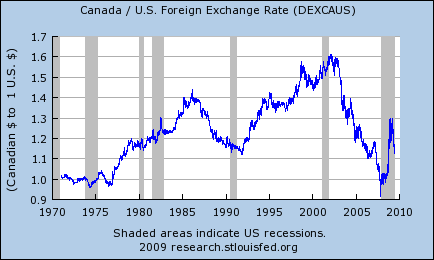
The Onion notes: U.S. Dollar Slips Against Canadian Acorn -
Best Name of a Penny Stock You’ll See Today
Posted by Eddy Elfenbein on May 29th, 2009 at 4:19 pmLadies and gentleman, I give you Jedi Mind, Inc. (JEDM).
The company just announced a share buyback, but I have to add, these aren’t the shares you’re looking for. -
Arianna Huffington: Only subsription that works is selling “weird porn.” With video (of the quote, not of porn weird or otherwise)
Posted by Eddy Elfenbein on May 29th, 2009 at 10:25 amThe Huffington Post will not be seeking subscription revenues anytime soon, Arianna Huffington told Kara Swisher on stage yesterday at the All Things D Conference.
“Unless you’re selling porn — especially weird porn — I would not go the subscription route,” Arianna told the crowd.
It’s advice we think the woman sitting next to Arianna on stage, Katharine Weymouth of the Washington Post, will probably have to eventually ignore.
But then, Katharine’s media company has a different cost base than the HuffPo, spending $1 million dollars a year on a Baghdad bureau, for example. -
Schumpeter’s Moment
Posted by Eddy Elfenbein on May 29th, 2009 at 9:16 amCarl Schramm has a good article on Joseph Schumpeter in today’s WSJ. Here’s a taste:
From Schumpeter’s vantage point, capitalism’s very success allows rich societies to use government to relax the impersonal rules that govern markets, creating new rules that buffer citizens from the rigors of risk-taking and failure. In that sense, government invents for itself the task of mediating market outcomes. Schumpeter had seen the dangers of this play out in Bismarck’s conception of Prussia’s welfare state. In the face of the Marxist threat, the elite secured its position by causing government to dispense social benefits. Political entrenchment, not charity, had motivated Bismarck. When distorted in such a way, free-market capitalism is seen to suppress — rather than to encourage — social and economic mobility.
Since the New Deal, Americans have come to see government as somehow the ultimate protector of their financial welfare. In reality, though, the evidence of the U.S. government behaving in this way during the New Deal is thin to say the least. Although it is largely forgotten now, much of the government’s action during the Depression actually had a marginal impact on individual lives. Monetary expansion and technological innovation boosted the economy, while the “second” depression of 1937-1938 is widely understood as having been induced by Roosevelt’s attempt to manipulate credit markets. -
Ted Tuner: AOL/TWX Meger “Better than Sex”
Posted by Eddy Elfenbein on May 29th, 2009 at 8:41 amMark Hulbert writes on the dissolution of AOL and Time Warner’s nine-year marriage. I had never heard this quote before but Ted Turner said that the deal was “better than sex.” He was married to Jane Fonda at the time.
-
Exceedingly Bizarre Marx Brothers Trivia That I Must Be the Only One Interested In
Posted by Eddy Elfenbein on May 28th, 2009 at 9:17 pmI noticed this story today that the two surviving Dionne quintuplets just turned 75. That’s whom Chico is referring to in the classic “contract” scene from A Night at the Opera (0:47 to 1:02):
-
The 90s Finally End
Posted by Eddy Elfenbein on May 28th, 2009 at 10:03 amTime Warner to Spin Off AOL
Time Warner says its board has approved plans to spin off AOL, the company’s lagging Internet unit.
The New York company, which owns 95 percent of AOL, said Thursday it will buy out Google’s 5 percent stake during the third quarter and spin the unit off to Time Warner shareholders.
The long-anticipated move is expected to be completed around the end of the year.
AOL and Time Warner combined in 2001 in a deal they said would produce a powerful marriage of content and the Internet. But it produced big losses instead.
In a statement, Time Warner Chief Executive Jeff Bewkes said, “We believe AOL will then have a better opportunity to achieve its full potential as a leading independent Internet company.”
Time Warner shares rose almost 3 percent in premarket trading.For a good laugh, here’s the CNN story announcing the merger more than nine years ago.
In a stunning development, America Online Inc. announced plans to acquire Time Warner Inc. for roughly $182 billion in stock and debt Monday, creating a digital media powerhouse with the potential to reach every American in one form or another.
With dominating positions in the music, publishing, news, entertainment, cable and Internet industries, the combined company, called AOL Time Warner, will boast unrivaled assets among other media and online companies.
The merger, the largest deal in history, combines the nation’s top internet service provider with the world’s top media conglomerate. The deal also validates the Internet’s role as a leader in the new world economy, while redefining what the next generation of digital-based leaders will look like.
“Together, they represent an unprecedented powerhouse,” said Scott Ehrens, a media analyst with Bear Stearns. “If their mantra is content, this alliance is unbeatable. Now they have this great platform they can cross-fertilize with content and redistribute.”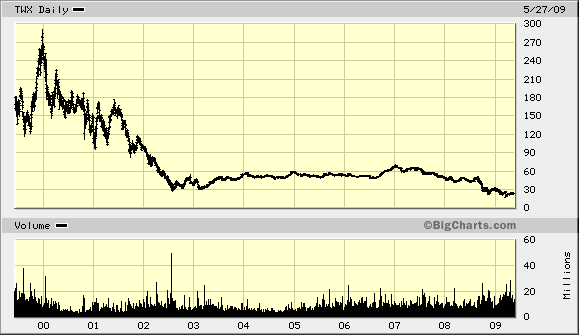
-
The Most Useless Index of the Financial Crisis
Posted by Eddy Elfenbein on May 28th, 2009 at 9:03 amDaniel M. Harrison awards the honor of most useless index of the financial crisis to Dow Jones and their Economic Stimulus Index:
In other words, the DJ Economic Stimulus Index aims to capture how well bailout recipients are faring among investors. That in turn is supposed to be some sort of indicator of U.S. economic momentum.
But there are two factors that make this index really redundant, and even dangerous to use.
Firstly, as I discussed yesterday, companies’ capitalizations are more or less irrelevant as a sign of economic growth unless consumer spending is being directed at the products these firms manufacture. Just because there’s a bunch of investors looking to get in on beaten-down share prices, that doesn’t mean that economic conditions in the U.S. are fundamentally getting any better.
For example, higher share prices among banks and automakers says nothing about lending conditions, home foreclosure rates, auto sales or any of the other indicators you would traditionally associate with economic growth.
Instead of tracking share prices, a really useful economic stimulus index would monitor the earnings of the top 50 stocks which are recipients of the bailout funds. Then we’d have a much better idea of how these companies are performing.
But most of all: why does anyone want an index tracking these companies when the stock market is pretty much moving in tandem with their trading patterns these days anyway? Since the stimulus packages were put in place, you could just as easily have glanced at any of the major indexes on pretty much any day and concluded how GM, Bank of America, Citigroup, or Ford are faring.Read the whole thing.
Update: S&P has upped the competition. They have a new index that follows companies that adhere to Sharia Islamic law. In other words, no alcohol, pork or tobacco. Best of all…it’s Canadian! -
The Yield Curve Steepens
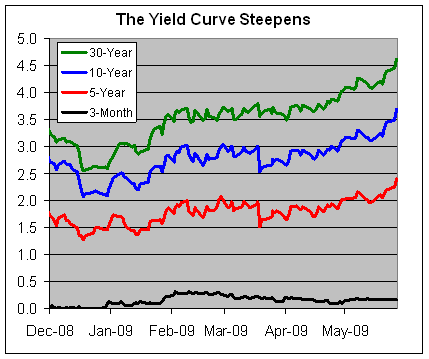
Posted by Eddy Elfenbein on May 28th, 2009 at 8:32 amThe widening yield curve is the most important recent development on Wall Street. Long-term interest rates had already been creeping upward, but they started to break out after mid-May.
Tyler Durden notes that the spread between the 2- and 10-year yield is now at an all-time record. Arnold Kling says that the short-term effect of stimulus package is negative.
Here’s a look at the yield curve since December.
-
South Wins Civil War
Posted by Eddy Elfenbein on May 28th, 2009 at 8:07 amThe WSJ reports:
Some laid-off workers in the financial-services industry are making a novel pitch for jobs: They are offering to work for nothing.
“People have been sending their CVs to our New York office saying, ‘hire me for free for six months.’” says Christophe Chouard, head of sales at French fund of hedge funds manager HDF Finance. “The CVs we are receiving are pretty good. These people are saying, ‘just let me show you what I can do.’”
Headhunters said redundant financial-services staffers, particularly those working on institutional sales, were keen to keep their knowledge of the industry and their contacts up to date when they weren’t earning.
It isn’t just the prospect of cheap labor that might appeal to companies. The chief executive of one asset-management company said it was sad to see rows of empty desks–fully equipped but vacated–as a result of cost cutting.
-
Archives
- October 2026
- September 2026
- August 2026
- July 2026
- June 2026
- May 2026
- April 2026
- March 2026
- February 2026
- January 2026
- December 2025
- November 2025
- October 2025
- September 2025
- August 2025
- July 2025
- June 2025
- May 2025
- April 2025
- March 2025
- February 2025
- January 2025
- December 2024
- November 2024
- October 2024
- September 2024
- August 2024
- July 2024
- June 2024
- May 2024
- April 2024
- March 2024
- February 2024
- January 2024
- December 2023
- November 2023
- October 2023
- September 2023
- August 2023
- July 2023
- June 2023
- May 2023
- April 2023
- March 2023
- February 2023
- January 2023
- December 2022
- November 2022
- October 2022
- September 2022
- August 2022
- July 2022
- June 2022
- May 2022
- April 2022
- March 2022
- February 2022
- January 2022
- December 2021
- November 2021
- October 2021
- September 2021
- August 2021
- July 2021
- June 2021
- May 2021
- April 2021
- March 2021
- February 2021
- January 2021
- December 2020
- November 2020
- October 2020
- September 2020
- August 2020
- July 2020
- June 2020
- May 2020
- April 2020
- March 2020
- February 2020
- January 2020
- December 2019
- November 2019
- October 2019
- September 2019
- August 2019
- July 2019
- June 2019
- May 2019
- April 2019
- March 2019
- February 2019
- January 2019
- December 2018
- November 2018
- October 2018
- September 2018
- August 2018
- July 2018
- June 2018
- May 2018
- April 2018
- March 2018
- February 2018
- January 2018
- December 2017
- November 2017
- October 2017
- September 2017
- August 2017
- July 2017
- June 2017
- May 2017
- April 2017
- March 2017
- February 2017
- January 2017
- December 2016
- November 2016
- October 2016
- September 2016
- August 2016
- July 2016
- June 2016
- May 2016
- April 2016
- March 2016
- February 2016
- January 2016
- December 2015
- November 2015
- October 2015
- September 2015
- August 2015
- July 2015
- June 2015
- May 2015
- April 2015
- March 2015
- February 2015
- January 2015
- December 2014
- November 2014
- October 2014
- September 2014
- August 2014
- July 2014
- June 2014
- May 2014
- April 2014
- March 2014
- February 2014
- January 2014
- December 2013
- November 2013
- October 2013
- September 2013
- August 2013
- July 2013
- June 2013
- May 2013
- April 2013
- March 2013
- February 2013
- January 2013
- December 2012
- November 2012
- October 2012
- September 2012
- August 2012
- July 2012
- June 2012
- May 2012
- April 2012
- March 2012
- February 2012
- January 2012
- December 2011
- November 2011
- October 2011
- September 2011
- August 2011
- July 2011
- June 2011
- May 2011
- April 2011
- March 2011
- February 2011
- January 2011
- December 2010
- November 2010
- October 2010
- September 2010
- August 2010
- July 2010
- June 2010
- May 2010
- April 2010
- March 2010
- February 2010
- January 2010
- December 2009
- November 2009
- October 2009
- September 2009
- August 2009
- July 2009
- June 2009
- May 2009
- April 2009
- March 2009
- February 2009
- January 2009
- December 2008
- November 2008
- October 2008
- September 2008
- August 2008
- July 2008
- June 2008
- May 2008
- April 2008
- March 2008
- February 2008
- January 2008
- December 2007
- November 2007
- October 2007
- September 2007
- August 2007
- July 2007
- June 2007
- May 2007
- April 2007
- March 2007
- February 2007
- January 2007
- December 2006
- November 2006
- October 2006
- September 2006
- August 2006
- July 2006
- June 2006
- May 2006
- April 2006
- March 2006
- February 2006
- January 2006
- December 2005
- November 2005
- October 2005
- September 2005
- August 2005
- July 2005
 Eddy Elfenbein is a Washington, DC-based speaker, portfolio manager and editor of the blog Crossing Wall Street. His