-
Morning News: October 5, 2022
Posted by Eddy Elfenbein on October 5th, 2022 at 6:09 amEU Chief Urges Funds for Energy Pivot, Floats Gas Price Cap
Oil Holds Surge as OPEC+ Mulls Biggest Supply Cut Since 2020
World’s Largest Oilfield Contractor Tackles Lithium’s Water Woes
U.S. Electric-Vehicle Tax Rules Rile Asian, European Allies
Lebanese Lawmaker Enters Bank Branch to Demand Frozen Savings
As Asia’s Borrowers Turn Homeward, Local Bond Issuance Surges
The First Global Deflation Has Begun, and It’s Unclear Just How Painful It Will Be
Fed Official Says Inflation Fight Will Take Time, Despite Signs of Progress
US Stocks Have Just Started Pricing In Recession, Citi Quants Say
U.S. National Debt Tops $31 Trillion for First Time
Endowment Tax on Wealthiest Universities Netted a Fraction of Predictions in 2021
Musk’s Everything App ‘X’ Sounds a Lot Like China’s WeChat
Facebook Is the Only Game in Town for Digital Political Ads
Amazon Freezes Corporate Hiring in Its Retail Business
N.L.R.B. Issues Complaint Against Apple
Who’s Operating Your Flight? Air Travel Is Getting More Complicated
Bayer Hits Courtroom Winning Streak as It Battles Remaining Roundup Lawsuits
433 People Won a $4 Million Lottery. Was It Pure Luck?
Be sure to follow me on Twitter.
-
CWS Market Review – October 4, 2022
Posted by Eddy Elfenbein on October 4th, 2022 at 7:16 pm(This is the free version of CWS Market Review. If you like what you see, then please sign up for the premium newsletter for $20 per month or $200 for the whole year. If you sign up today, you can see our two reports, “Your Handy Guide to Stock Orders” and “How Not to Get Screwed on Your Mortgage.”)
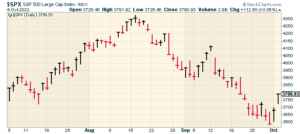
The Stock Market Rallies 5.7% in Two Days
The stock market put on a furious rally over the last two days, but is it just another bear-market rally? After this summer’s rally got blown apart in a few weeks, it’s hard to feel hopeful.
In just two days, the S&P 500 has gained 5.73%. Sadly, big moves like this don’t normally come in healthy markets. Historically, most of the market’s big short-term gains have come during rough markets. They’re usually snapbacks from major lows.
The smart take is to view the last two days with a healthy dose of skepticism. We’ve been fooled before.

Still, I’m willing to take whatever profits Wall Street wants to throw our way. Look at Trex (TREX), our worst-performing Buy List stock this year. It’s up 11.8% over the last two days.
The next big test for the market will come this Friday when the Labor Department releases the September jobs report. It will also update the numbers for July and August. The last report was a good one. According to the government, the U.S. economy created 315,000 net new jobs during August, and the unemployment rate ticked up to 3.7%. For Friday, the consensus on Wall Street is to see a gain of 275,000 jobs in September and that the jobless rate will stay at 3.7%.
One interesting feature of the unemployment rate is that it tends to oscillate between extremes. This is the idea behind the “Sahm Rule,” named for economist Claudia Sahm. My shorthand definition for the rule is that if the unemployment rate goes up a little, then there’s a good chance it will go up a lot.
More technically, the Sahm Rule says that we’re probably in a recession if the three-month average of the unemployment rate rises by 0.5% from its low over the last 12 months. Best of all, it’s easy to calculate.
The lowest unemployment rate of the last 12 months came in July when it got down to 3.5%. That means that we’re not that far away from a recession. Friday’s report will tell us a lot more.
One promising sign is that the jobless-claims numbers have been much improved since the summer. That number tends to be whatever stats people call “noisy,” which means it bounces around a lot. That’s why economists like to look at a rolling average to smooth out the bumps.
If Friday’s jobs report comes in weak, that could take some pressure off the Federal Reserve. On the other hand, if the number is strong, then it could reiterate the Fed’s commitment to higher interest rates.
Interestingly, the bond market shot up yesterday and the rally continued into today. That could be a bet that the Fed may ease up a bit. Still, I think the safe assumption is that the Fed will hike again at its next meeting in November by 0.75%. After that, it’s hard to say. For their part, futures traders are leaning towards a smaller hike in December. That could be right, but it depends on the direction of the economy.
One worrying sign for the economy came out yesterday. The ISM Manufacturing Index fell to 50.9 for September. That’s down from 52.8 in August. Any number above 50 means that the factory sector of the economy is growing; below 50, and it’s contracting. This was the 28th month in a row of a growth.
After the jobs report, the next big report for us will be the CPI report for September. While most people follow the CPI for the official inflation number, the Federal Reserve prefers to follow the Personal Consumption Expenditure stats.
The last PCE report came out on Friday, and as I expected, inflation is still worse than many people think. The core PCE number rose by 0.6% in August which was 0.1% higher than estimates. Over the past year, core PCE rose by 4.9%. Wall Street had been expecting 4.7%.
The non-core rate rose by just 0.3% in August. Falling energy prices played a big role in keeping that number low. Either way, the annual numbers are running well above the Fed’s target of 2%.
Lael Brainard, the Vice Chair of the Fed and someone who is considered more of a dove, nevertheless spoke in strong terms regarding inflation:
“Monetary policy will need to be restrictive for some time to have confidence that inflation is moving back to target,” the central bank official said in remarks prepared for a speech in New York. “For these reasons, we are committed to avoiding pulling back prematurely.”
Earlier today we got the latest JOLTS report. That’s the Job Openings and Labor Turnover Survey which is put out by the Bureau of Labor Statistics. According to the report, the number of job openings dropped by 1.1 million in August. That’s huge.
The number of available positions fell by 10% to 10.05 million. Wall Street had been expecting 11.1 million. This was the biggest drop since the early days of the pandemic. A major problem for the Fed has been to manage inflation during a very tight labor market. There used to be two jobs for every unemployed person. Now it’s 1.67.
One interesting side note is that lumber prices are back to where they were before the pandemic. That’s a good sign of normalcy. The construction spending report should show a decline of 0.7% in August. Construction spending is still 8.5% above the number from one year ago.
I still think the economy is likely to fall into a recession sometime next year. I suspect it will be a fairly shallow recession, but a lot of this will be determined by how successful the Fed will be in fighting inflation.
Elon Musk to Buy Twitter
It’s really happening! Well, maybe it’s really happening.
This afternoon, news broke that Elon Musk has agreed to buy Twitter (TWTR) for the original offer price of $54.20 per share. (Yes, Musk worked “420” into his offer price.)
If you recall, Musk had originally offered to buy Twitter in April for $54.20 per share, but then he seemed to get cold feet. Instead of simply admitting that, he claimed that Twitter was less than upfront about its user data.
Then the lawyers got involved, and it looked like Twitter was ready to take the matter to court. It’s difficult to imagine a scenario where a person is forced to buy a company even when making commitments to do so, but it looked like that was about to happen. The trial was scheduled to start on October 17.
I’m making a few guesses. The first is that Musk’s lawyers told him that he if were to take it to court, then there’s a very good chance he would lose. In many of the pre-trial motions, the judge repeatedly sided with Twitter.
Musk and Twitter’s management have had a, shall we say, less-than-cordial relationship. Ever since Musk made his original offer, he’s been a constant critic of Twitter, and most importantly, he’s accused Twitter of lying about its number of users.
Another guess of mine is that Musk was simply impulsive, and the “bot issue” was his strategy to back out of the deal. Once it became clear that that wasn’t going to work, Musk chose the best way to lose.
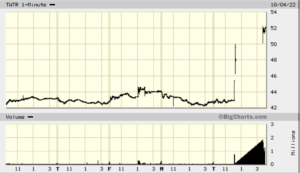
Twitter stuck by the original offer and last month, Twitter shareholders voted to approve the deal. According to a filing with the SEC, Musk made the offer to Twitter yesterday. The stock immediately shot up higher on the news and trading in Twitter was eventually halted. Twitter said it aims to close the deal at the original price.
If you look very closely at this chart, you can make out when the Musk news broke:
How did this all begin? Earlier this year, Twitter suspended the satirical news site called the Babylon Bee for referring to a trans woman as “Man of the Year.” That seems to have spurred Musk on. Twitter has received a lot of criticism for its suspension policies which seem to be arbitrary and politically motivated. I suspect that once Twitter is private, it will allow former President Trump back on the platform.
Given that shares of Twitter closed today at $52 per share, this suggests to me that the market is taking this offer seriously. In fact, the deal may happen quickly. Of course, this is a very different stock market than what we had this past spring.
Another guess is that Twitter’s people told them that the deal is a lot more than Twitter is truly worth. Let’s look at some numbers. Wall Street expects Twitter to earn $1.20 per share this year and 60 cents per share next year. I should add that that’s a major decrease in expectations. Three months ago, Twitter was expected to make $1.68 per share for this year and $1.31 per share for 2023.
Frankly, Twitter simply isn’t that profitable, and it never has been, Personally, I’d be skeptical paying half of Elon’s price. The only hitch is if there’s some way to alter Twitter’s business model to be more profitable. If there is, I don’t know it and I’m not sure Musk does, either. He has said he could get Twitter to 500 million daily users, which is a significant part of the planet.
The lesson here is to be cautious in your business dealings. It may cost you $44 billion.
That’s all for now. I’ll have more for you in the next issue of CWS Market Review.
– Eddy
P.S. If you want to learn more about the stocks on our Buy List, please sign up for our premium service. It’s $20 per month, or $200 per an entire year.
-
Morning News: October 4, 2022
Posted by Eddy Elfenbein on October 4th, 2022 at 7:03 amBusinesses Brace for Currency Chaos in Asia, a Region With a History of Crisis
Britain’s Economic Experiment Stumbles at the Start
Less Turnover, Smaller Raises: Hot Job Market May Be Losing Its Sizzle
Rising Interest Rates Test Demand for Cars
Crypto Needs More Rules and Better Enforcement, Regulators Warn
Kim Kardashian Could Be ‘Tip of the Iceberg’ for Celeb Crypto Crackdown
Ray Dalio No Longer Thinks ‘Cash Is Trash’
Samsung Kicks Advanced-Chipmaking Race Into High Gear With Road Map
South Korean Internet Giant Buys Poshmark in $1.2 Billion Deal
Credit Suisse’s Options Worsen as Markets Mayhem Takes Toll
Apple Will Be Forced to Use New Charger After EU Votes for USB-C
Meta Is Closing One New York Office With Cutbacks Looming
Pfizer’s Unthinkable Boom Now Leaves Investors Anxious
Warren Buffett’s Successor Is Building an $68 Million Berkshire Holding
How McKinsey Cashed In by Consulting for Both Companies and Their Regulators
Few Customers Get Refunds for ‘Rampant’ Zelle Fraud, Senator’s Report Says
Be sure to follow me on Twitter.
-
The Market Snaps Back
Posted by Eddy Elfenbein on October 3rd, 2022 at 2:19 pmThe stock market is having a nice rally today. As I write this, the S&P 500 is up more than 2.4%. On Friday, the stock market closed out a lousy day, week, month and quarter. Give it time and we can add “year” to that sentence.
The bond market is doing quite well today which may suggest that we’re returning to a daily battle of stocks against bond. This is a change from before when both stocks and bonds moved lower. That’s what inflation can do. The 10-year yield is down about 16 basis points.
This morning’s ISM Manufacturing Index came in at 50.9. Any number below 50 means the factory sector of the economy is contracting.
-
Morning News: October 3, 2022
Posted by Eddy Elfenbein on October 3rd, 2022 at 7:00 amOPEC Plus Considering Major Production Cut to Prop Up Oil Prices
Europe Faces ‘Unprecedented Risk’ of Gas Shortage, IEA Says
Cargo Shipowners Cancel Sailings as Global Trade Flips From Backlogs to Empty Containers
Inflation in Europe Now Looks Even Less Transitory Than in US
Liz Truss Drops Tax Cut for Top UK Earners to Fend Off Rebellion
Central Banks’ Higher Rates, Bond Sales Clash With Government Needs
Inflation Keeps the U.S. From Stepping In to Slow Dollar’s Rapid Rise
Relentless Dollar Rally Raises Bets on Interventions, Investors Say
Wealthy Use Loophole to Reap Tax Breaks — And Delay Giving Away Money
Millions in Cryptocurrency Vanished as Agents Watched Helplessly
Credit Suisse Market Turmoil Deepens After CEO Memo Backfires
Supermarket Discounts Are Harder to Find as Food Prices Rise
US Home Prices Now Posting Biggest Monthly Drops Since 2009
Tesla Slumps as Deliveries Disappoint Due to Logistic Snarls
These Job-Training Programs Work, and May Show Others the Way
Walgreens Turns to Prescription-Filling Robots to Free Up Pharmacists
Backing Lindt, Swiss Court Orders Lidl to ‘Destroy’ Its Chocolate Bunnies
Producer Bets Streamers Want the Next ‘Judge Judy,’ Not ‘Game of Thrones’
Be sure to follow me on Twitter.
-
This Morning’s August PCE Report
Posted by Eddy Elfenbein on September 30th, 2022 at 11:28 amThis morning, the government released the Personal Consumption Expenditure stats for August. This report gets attention because the PCE is the Fed’s preferred measure of inflation.
The core PCE number rose by 0.6% in August which was 0.1% higher than estimates. Over the past year, core PCE rose by 4.9%. Wall Street had been expecting 4.7%.
The non-core rate rose by just 0.3% in August. Falling energy prices played a big role in keeping that number low. Either way, the annual numbers are running well above the Fed’s target of 2%.
Lael Brainard, the Vice Chair of the Fed and someone who is considered more of a dove, nevertheless spoke in strong terms regarding inflation:
“Monetary policy will need to be restrictive for some time to have confidence that inflation is moving back to target,” the central bank official said in remarks prepared for a speech in New York. “For these reasons, we are committed to avoiding pulling back prematurely.”
The stock market is up so far today but it looks to close out a difficult week, month and quarter.
-
Morning News: September 30, 2022
Posted by Eddy Elfenbein on September 30th, 2022 at 7:03 amIndia’s Central Bank Calls Aggressive Monetary Policy a Shock to Global Economy
China’s Service Sector Slows in Latest Economic Warning Sign
Eurozone Inflation Hits Record 10% Amid Energy Crunch
Pound Drops After Reports UK Won’t Speed Up Watchdog Forecast
Britain’s Gamble on Tax Cuts Has Economists Warning of Past Mistakes
U.S. Penalizes Chinese Companies for Aiding Iran’s Oil Exports
Even as Oil Prices Ease, U.S. Keeps Tapping Strategic Reserve
Bonds May Be Having Their Worst Year Yet
One of the Hottest Trends in the World of Investing Is a Sham
High Interest Rates Were Just What Bonkers Housing Needed
Drought in U.S. West Leads Farmers to Look Elsewhere for Revenue
Why Are Companies Still Hiring When GDP Is Shrinking?
Apple’s Tech Supply Chain Shows Difficulty of Dumping China
China’s Challenger to Boeing and Airbus Clears Major Hurdle
Nike Shares Tumble After It Reports 44% Surge in Inventories
India Markets Regulator to Restart Review of $440 Million Digit Insurance IPO
Texts Released Ahead of Twitter Trial Show Elon Musk Assembling the Deal
Be sure to follow me on Twitter.
-
Morning News: September 29, 2022
Posted by Eddy Elfenbein on September 29th, 2022 at 7:06 amDeveloping Countries Face Stiff Economic Headwinds, World Bank Chief Says
Sabotaged Pipelines and a Mystery: Who Did It? (Was It Russia?)
LME to Discuss Banning Russian Metal, Sources Say
Truss’s ‘Fairy Tale’ Economics Plunge UK Into a Market Nightmare
To Calm Markets, Bank of England Will Buy Bonds on ‘Whatever Scale Is Necessary’
Pound’s Swoon Echoes Declines in British Power, Past and Present
Return of Inflation Makes Deficits More Dangerous
The Unstoppable Dollar Is Wreaking Havoc Everywhere But America
With Everything Else Falling, Cash Is Back
FOMO Helped Drive Up Housing Prices in the Pandemic. What Can We Expect Next?
Business Groups Sue CFPB Over Antidiscrimination Guidelines
Tech IPO Market Faces Worst Year Since Global Financial Crisis
Porsche Rises in Landmark IPO to €75 Billion Valuation
Chevron Sells Global Headquarters, Pares Back in California Amid Texas Expansion
McDonald’s Will Have Adult Happy Meals this October
How McKinsey Got Into the Business of Addiction
MacKenzie Scott, Billionaire Philanthropist, Files for Divorce
Be sure to follow me on Twitter.
-
Morning News: September 28, 2022
Posted by Eddy Elfenbein on September 28th, 2022 at 7:05 amBOE Steps Back Into Bond Market to Restore Stability
Pound’s Crash Creates Accidental Student-Loan Currency Traders
On Portugal’s ‘Bitcoin Beach,’ Crypto Optimism Still Reigns
Consumer Moods Improved in September as Gasoline Prices Fell
10-Year Treasury Yield Tops 4% for the First Time in 14 Years
Larry Summers Says Hard Landing ‘Substantially More Likely’
Texting on Private Apps Costs Wall Street Firms $1.8 Billion in Fines
U.S. Mortgage Interest Rates Jump to 6.52%, Highest Since Mid-2008
Apple Ditches iPhone Production Increase After Demand Falters
Meta Removes Chinese Effort to Influence U.S. Elections
U.S. Companies Are Reshoring Jobs From China at Record Levels
EV Tax Credits to Spur More Vehicle Sales Are Entering a Critical Phase
The Long Road to Driverless Trucks
Best Buy, Home Depot Lock Up Goods to Fight Theft
Alzheimer’s Drug Slows Disease Progression in Trial
GM Delays Return-to-Office after Employee Uproar: ‘General Motors is Doomed’
The 400 Richest People In America
Be sure to follow me on Twitter.
-
CWS Market Review – September 27, 2022
Posted by Eddy Elfenbein on September 27th, 2022 at 6:29 pm(This is the free version of CWS Market Review. If you like what you see, then please sign up for the premium newsletter for $20 per month or $200 for the whole year. If you sign up today, you can see our two reports, “Your Handy Guide to Stock Orders” and “How Not to Get Screwed on Your Mortgage.”)
The Stock Market Plunges to a 21-Month Low
Alas, the bear market is still with us. The S&P 500 fell on Tuesday for the sixth day in a row. Four of those times, the market lost more than 1%. In the last 11 sessions, the market has lost more than 11%. Yuck!
The S&P 500 finished Tuesday at its lowest level since December 14, 2020. Today was actually the market’s best day of the last six with a loss of only 0.21%. The S&P 500 has now traded below its 200-day moving average for over 110 days in a row. That’s one of the longest such streaks in the last 15 years.
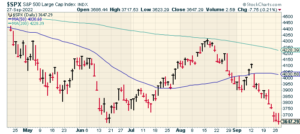
During the summer, the stock market staged an impressive rally. The S&P 500 gained more than 17% in two months. Was the bear market finally over? Frankly, I was skeptical. Bear-market rallies exist to lure us back in and convince us that things are safe, only to then slam the door on us. Well, that’s exactly what happened.
In just six weeks, we gave the entire summer rally back. Not only did the S&P 500 break below its June low but the Dow Jones dropped below its pre-Covid high from 31 months ago—and I’m not adjusting for the impact of inflation, which is running at close to 14% over the last two years.
Earlier today, the S&P 500 dropped below its intra-day low from June 17. Previously, that had been the low point of the bear market, until today. This has been a terrible year for stocks.
It’s not some giant mystery what’s going on. The issues that first spooked the market are still with us. The last inflation report was surprisingly high. Core inflation doubled expectations. We also know that the Federal Reserve is committed to raising interest rates to fight inflation.
Last week, the Fed hiked interest rates by 0.75%. That was its third 75-point hike in the last three meetings. According to the futures market, we should expect a fourth 0.75% hike in November, just a few days before the mid-term elections. The futures market sees the Fed funds target range getting to a high of 4.50% to 4.75% in less than six months from now. That’s what’s hanging over the entire market.
To give you an idea of how much things have changed, two years ago, the yield on the three-year Treasury was going for 0.1%. Today, the yield hit 4.39%. In fact, the one-year yield had previously been the highest-yielding Treasury. The highest-yield crown has been passed to the three-year Treasury. In simple terms, that means the market sees interest rates staying higher for longer. I think the market is right on that.
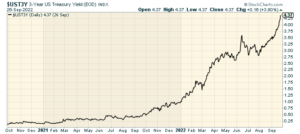
This gets to the heart of what interest rates do to stocks. Higher interest rates are like kryptonite to the stock market. It’s a double whammy effect. For one thing, it cuts into profits because it raises borrowing costs. That makes it more expensive to fund operations or expansion plans. Higher rates also make it more difficult for consumers to buy large-ticket items like houses or cars. The average adjustable-rate mortgage payment has rocketed higher over the last year.
The Q3 earnings season will start in about two weeks. Wall Street analysts have been busily lowering their earnings estimates. Again, that’s what higher rates do.
There’s also the competition factor. Just looking at where we stand in the market, I’m sure there are investors who would prefer to sit out this market and relax in a 4.3% Treasury for a year or so. Sure, it’s not a big gain, but at least you don’t have to worry about the market’s frenetic volatility. It’s not for me, but I understand why some people would happily go for it. Who needs the headache?
The bond market has been a trainwreck as well. Bloomberg notes that the 10-year yield is up 235 basis points this year. That’s the most since the data goes back to, 1962.
Higher rates means that lower earnings are discounted at a faster rate. That adds up to lower share prices. Historically, stocks have not done well during rising rate environments. Interestingly, it’s not necessarily the overall level of interest rates. Rather, it’s the direction of rates.
When rates go down, the process works in reverse. Borrowing costs are lower and that puts less pressure on balance sheets. Also, it forces investors to bear more risk in the stock market. Bear in mind how willing investors were to invest in any kind of high-risk venture (meme stocks, crypto, NFTs) when rates were near 0%. That’s all changed. AMC Entertainment (AMC) is down about 60% this year.
I won’t be completely satisfied until we start seeing interest rates come down. That could happen sooner than expected. If we see more evidence that the economy is slowing down and inflation has been put back in its box, then there will be pressure on the Fed to cut rates. The futures market sees a decent shot of that happening sometime in 2023.
The tough part about this is that market bottoms often come during extreme pessimism. The typical environment for a market low comes during a slow economy, lower earnings, higher unemployment and interest rates that are believed to be too high.
This is why I caution investors against trying to time the market. Bernard Baruch famously said, “Don’t try to buy at the bottom and sell at the top. It can’t be done, except by liars.”
I’d add, “or on Twitter.”
It’s been a tough time to be a mega-zillionaire. Forbes reports that the largest tech billionaires have lost $315 billion in the past year. Shares of Meta Platforms (META), formerly known as FaceBook, plunged to another fresh 52-week low today. The stock is down over 62% from its high. META is now going for about 12 times next year’s earnings (assuming those estimates are accurate). Mark Zuckerberg is, apparently, no longer one of the richest 10 Americans. (My sympathies.)
Low Vol Vs. High Beta
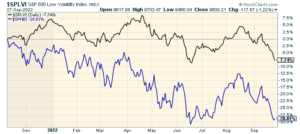
More seriously, the selloff has had a very unequal effect on the stock market. I like to look at the relative performance of the S&P 500 Low Volatility Index versus the S&P 500 High Beta Index. In short, these are indexes of safe stocks versus risky stocks. It’s not that one group is in any sense better than the other. Instead, we can see how investors change what they want.
Consider these stats: From March 19, 2020 to November 8, 2021, the S&P 500 Low Vol Index gained more than 42%, but the High Beta Index zoomed 220%. When the Fed lowered rates to the floor, taking on risk was a no-brainer, and it paid off handsomely.
But then things started to change. It’s interesting that the market started to shift last November, several months before the Fed’s first rate cut. (When in doubt, pay attention to what prices say before what government officials say.)
Since November 8 of last year, the Low Volatility Index has lost 7.7% but the High Beta Index is down 28.8%. The equation is simple. Higher rates make investors more conservative. Lower rates make them willing to take on more risk. The effect has been especially acute lately.
One thing I’ve learned from many years of being a professional investor is that market trends can last longer than you thought possible. While I caution against trying to time the market’s low point, one major benefit of a bear market is that it gives us some bargains. We don’t fully realize how cheap some starts are right now. Shelby Cullom Davis said, “You make most of your money in a bear market; you just don’t realize it at the time.”
A good example is Altria Group (MO), the tobacco company. I understand that some investors prefer to avoid tobacco stocks, but my point here is about the stock’s risk profile.
A few weeks ago, Altria raised its quarterly dividend from 90 to 94 cents per share. There’s an implied promise, though not official, that once a company raises its dividend, it is committed to keeping it there unless the business outlook severely deteriorates.
Altria’s dividend works out to a yearly dividend of $3.76 per share, and that dividend appears to be safe. Altria is expected to earn $4.85 per share this year and $5.09 per share next year.
Here’s what’s important: Shares of MO hit a new 52-week low today. At Tuesday’s closing price, the dividend yield comes to 9.2%. Sometimes when you see unusually high dividend yields, that’s because the market is assuming a dividend cut is on its way. That doesn’t appear to be the case with Altria. Folks are just plain scared of stocks.
I’m not recommending Altria, but I want to show you how rattled the market is. Look at Citigroup (C). The stock is going for six times next year’s earnings. This is a good time to be a stock-picker. You just need some patience.
What the Soaring Dollar Means for Investors
One important effect of the Fed hiking up rates is that it’s making the U.S. dollar more attractive. Money likes to go where it’s treated best and right now, that’s in the USA.
The strong dollar has a benefit and a cost. While it helps the purchasing power of Americans, it also helps accelerate inflation in other countries.
Earlier this week, in the U.K., investors were scared by the government’s tax cut plans. That led the British pound to hit a 37-year low against the greenback. China has had a tamer response. The government keeps a tight leash on the foreign exchange rate, but it let the dollar rise modestly.
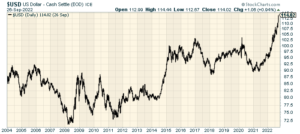
Since the dollar is the world’s reserve currency, its impact is hard to escape. An estimated 40% of the world’s transactions are done in dollars, whether the U.S. is involved or not.
When currencies are traded, the trade isn’t usually from currency A to currency B. Instead, it goes from currency A to the dollar, then from the dollar to currency B. That’s how ubiquitous the dollar is.
There’s also a geopolitical angle. With a global pandemic and supply chain issues plus the war in Ukraine, the dollar has acted as a safe haven for investors around the world. A few months ago, the euro reached parity against the dollar for the first time in 20 years.
However, one disturbing side effect is that the strong dollar pushes up the cost of food and medicine in developing countries. As bad as the economic outlook is for the United States, it’s still better than for many other countries.
One fear of the strong dollar is that it creates a reinforcing cycle, the “Doom Loop.” As things get bad, investors flee to the dollar. In turn, the strong dollar hurts other countries, which further aids the dollar. The cycle could get worser and worse.
Sometimes a weak currency can help soften problems for a country as it helps them import less and export more. I was recently traveling in Asia, and I was surprised how inexpensive things were to someone used to American prices. Lately, however, I don’t know if countries with weaker currencies are experiencing much of a lift.
These problems especially impact poorer countries who often need to pay back loans that are denominated in dollars. The exchange rate can make already dire problems even worse.
Eventually a strong dollar can hurt American businesses. It holds back exports, and it will impact the repatriation of profits made overseas. During the Q3 earnings season, we’re going to hear a lot more about how companies would have done much better, if it had not have been for that pesky strong dollar.
That’s all for now. I’ll have more for you in the next issue of CWS Market Review.
– Eddy
P.S. If you want to learn more about the stocks on our Buy List, please sign up for our premium service. It’s $20 per month, or $200 per an entire year.
-
Archives
- August 2026
- July 2026
- June 2026
- May 2026
- April 2026
- March 2026
- February 2026
- January 2026
- December 2025
- November 2025
- October 2025
- September 2025
- August 2025
- July 2025
- June 2025
- May 2025
- April 2025
- March 2025
- February 2025
- January 2025
- December 2024
- November 2024
- October 2024
- September 2024
- August 2024
- July 2024
- June 2024
- May 2024
- April 2024
- March 2024
- February 2024
- January 2024
- December 2023
- November 2023
- October 2023
- September 2023
- August 2023
- July 2023
- June 2023
- May 2023
- April 2023
- March 2023
- February 2023
- January 2023
- December 2022
- November 2022
- October 2022
- September 2022
- August 2022
- July 2022
- June 2022
- May 2022
- April 2022
- March 2022
- February 2022
- January 2022
- December 2021
- November 2021
- October 2021
- September 2021
- August 2021
- July 2021
- June 2021
- May 2021
- April 2021
- March 2021
- February 2021
- January 2021
- December 2020
- November 2020
- October 2020
- September 2020
- August 2020
- July 2020
- June 2020
- May 2020
- April 2020
- March 2020
- February 2020
- January 2020
- December 2019
- November 2019
- October 2019
- September 2019
- August 2019
- July 2019
- June 2019
- May 2019
- April 2019
- March 2019
- February 2019
- January 2019
- December 2018
- November 2018
- October 2018
- September 2018
- August 2018
- July 2018
- June 2018
- May 2018
- April 2018
- March 2018
- February 2018
- January 2018
- December 2017
- November 2017
- October 2017
- September 2017
- August 2017
- July 2017
- June 2017
- May 2017
- April 2017
- March 2017
- February 2017
- January 2017
- December 2016
- November 2016
- October 2016
- September 2016
- August 2016
- July 2016
- June 2016
- May 2016
- April 2016
- March 2016
- February 2016
- January 2016
- December 2015
- November 2015
- October 2015
- September 2015
- August 2015
- July 2015
- June 2015
- May 2015
- April 2015
- March 2015
- February 2015
- January 2015
- December 2014
- November 2014
- October 2014
- September 2014
- August 2014
- July 2014
- June 2014
- May 2014
- April 2014
- March 2014
- February 2014
- January 2014
- December 2013
- November 2013
- October 2013
- September 2013
- August 2013
- July 2013
- June 2013
- May 2013
- April 2013
- March 2013
- February 2013
- January 2013
- December 2012
- November 2012
- October 2012
- September 2012
- August 2012
- July 2012
- June 2012
- May 2012
- April 2012
- March 2012
- February 2012
- January 2012
- December 2011
- November 2011
- October 2011
- September 2011
- August 2011
- July 2011
- June 2011
- May 2011
- April 2011
- March 2011
- February 2011
- January 2011
- December 2010
- November 2010
- October 2010
- September 2010
- August 2010
- July 2010
- June 2010
- May 2010
- April 2010
- March 2010
- February 2010
- January 2010
- December 2009
- November 2009
- October 2009
- September 2009
- August 2009
- July 2009
- June 2009
- May 2009
- April 2009
- March 2009
- February 2009
- January 2009
- December 2008
- November 2008
- October 2008
- September 2008
- August 2008
- July 2008
- June 2008
- May 2008
- April 2008
- March 2008
- February 2008
- January 2008
- December 2007
- November 2007
- October 2007
- September 2007
- August 2007
- July 2007
- June 2007
- May 2007
- April 2007
- March 2007
- February 2007
- January 2007
- December 2006
- November 2006
- October 2006
- September 2006
- August 2006
- July 2006
- June 2006
- May 2006
- April 2006
- March 2006
- February 2006
- January 2006
- December 2005
- November 2005
- October 2005
- September 2005
- August 2005
- July 2005
 Eddy Elfenbein is a Washington, DC-based speaker, portfolio manager and editor of the blog Crossing Wall Street. His