-
Pfizer & Wyeth
Posted by Eddy Elfenbein on January 27th, 2009 at 9:26 pmNow that Pfizer (PFE) and Wyeth (WYE) are getting together, I wanted to take a quick look at the long-term performance of both stocks. They’re done pretty well. Since the beginning of 1982, Pfizer’s stock is up 1,346.4% while Wyeth is up 875.4% (neither figure includes dividends). For comparison, the S&P 500 is up 589.1%.
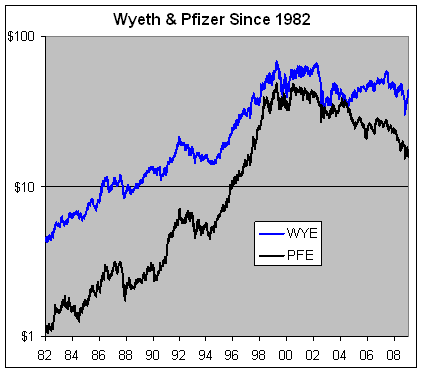
Interestingly, both stocks peaked nearly ten years ago on the same day, April 12, 1999. -
The Most Predictive Factor: Momentum
Posted by Eddy Elfenbein on January 27th, 2009 at 12:37 pmMebane Faber posts about Richard Tortoriello’s book, Quantitative Strategies for Achieving Alpha.
In the more than 40 single factors he tested from 1987-2006, guess which factor was most predictive?
Momentum.This isn’t a surprise to me. I think the power of momentum is one of the great mysteries of finance. Why has it been so successful and can it make me money?
Mebane also notes the limitations of quant analysis. Right now, everyone is working from the same data so how can anyone gain an advantage? -
Credit Default Swaps
Posted by Eddy Elfenbein on January 27th, 2009 at 10:44 amPeter J. Wallison writes “Everything You Wanted to Know about Credit Default Swaps–but Were Never Told.” This comes on the heels of Gretchen Morgenson’s recent column, “Time to Unravel the Knot of Credit-Default Swaps.”
-
Thain Doing His Part
Posted by Eddy Elfenbein on January 27th, 2009 at 10:13 amAccording to the New York Post, while dining recently, John Thain, “loudly told the waiter, for all to hear, ‘under the circumstances with this tough economy, I think I’ll have tap water.'”
Going by his recent track record, I’m guessing he offered to pay $3.7 billion for the tap water. -
Dividends Being Cut at Fastest Pace in 50 Years
Posted by Eddy Elfenbein on January 27th, 2009 at 9:54 amBank of America (BAC) recently cut its annual dividend from $1.28 a share to four cents. (Why even keep it?) Of course, now that you’re on Uncle Sam’s bailout list, it’s hard to justify send profit checks to your owners. Dividends had made a big comeback in recent years, now it looks like the trend is in the other direction:
Already this year, seven companies in the Standard & Poor’s 500 index have decreased their dividends, removing some $12 billion from shareholders’ pockets in the coming months. On Monday, Pfizer became the latest blue-chip company to do so.
These cuts serve up another hit to shareholders who have already been battered by the steep declines in the stock market. That is especially true of retirees, who tend to be attracted to so-called “widows and orphans” stocks that provide them with a steady cash flow.
If the trend continues, this will be the worst year for dividend cuts since 1958, when annual payments fell by 8.4 percent, according to new research from S&P.
“It is easy to say this is going to be the worst in 50 years, but the bigger question is whether it is going to be much worse than that,” said Howard Silverblatt, senior index analyst at S&P. -
Geithner Is Confirmed
Posted by Eddy Elfenbein on January 26th, 2009 at 6:24 pmThe Senate votes to confirm Geithner 60-34.
-
Cyclical Stocks Still Have a Long Way to Fall
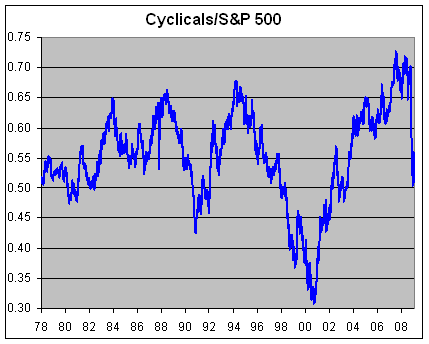
Posted by Eddy Elfenbein on January 26th, 2009 at 3:59 pmHere’s a look at the Morgan Stanley Cyclical Index (^CYC) divided by the S&P 500 (^SPX). For such a simple metric, I think is an often-revealing look at the market’s mentality. What it tells us is how well economically sensitive stocks are performing compared with the overall market.
About two years ago, I started warnings investors that cyclical stocks were heading towards a top. On July 19, 2007, the CYC reached its peak ratio against the S&P 500 at 0.7273. Since then, all most all kinds of stocks have down poorly but cyclical stocks have down much worse. Through Friday, the S&P 500 is down 46.4% from July 19, 2007, but the CYC is down 62.3%.
The other reason why I like to follow this ratio is that it tends to move in multi-year waves, as one would expect from looking at economic cycles. Until the ratio starts to show some improvement, I’m not going to be terribly optimistic for the broader economy. The ratio is currently around 0.51 which is still well above typical cycle lows.
-
Blame China
Posted by Eddy Elfenbein on January 26th, 2009 at 12:56 pmSebastian Mallaby claims China’s currency policy was a major cause of the housing bubble:
Geithner is correct that China manipulates its currency. What’s more, this manipulation is arguably the most important cause of the financial crisis. Starting around the middle of this decade, China’s cheap currency led it to run a massive trade surplus. The earnings from that surplus poured into the United States. The result was the mortgage bubble.
China’s leaders protest that they are being unfairly scapegoated. Yet while there are rival accounts of the origins of the crisis, neither has the explanatory force of the blame-China narrative. -
A Capital-less Financial System
Posted by Eddy Elfenbein on January 26th, 2009 at 12:19 pmHere’s a sample of a fascinating article from Ricardo Caballero at the Financial Times Economists Forum:
Forcing institutions to raise capital, be it private or public, at panic-driven fire sale prices threatens enormous dilutions to already shell-shocked shareholders, further exacerbating uncertainty and fuelling the downward spiral. This is self-defeating.
The question then is whether it is feasible to run a (nearly) capital-less financial system until panic subsides. If it is, then a solution to the financial crisis is in sight since it would free up trillions of dollars of hard to raise funds, covering more than even the most extreme estimate of losses.
I believe it is feasible to run such a system for a while, because, essentially, distressed financial institutions need (regulatory) capital for two basic purposes: To act as a buffer for negative shocks, and to reduce their risk-shifting incentives by exposing them to their losses.
However these two functions can be replaced, respectively, by the provision of a comprehensive public insurance, and by strict (and intrusive) government supervision while this insurance is in place.
A few days ago the UK announced a policy package that almost got it right, by pledging to insure banks’ balance sheets and other private liabilities.
Unfortunately, it backfired and caused a worldwide run on financials because it did not dissipate, and even exacerbated, the fear of forced capital raising (or nationalisation).
The events following Lehman’s demise should have taught us that this fear needs to be put to rest until we can return to normality. Financial institutions are too intertwined to predict with any precision the impact of diluting any significant stakeholder, and the markets are too fearful to feed them more uncertainty. Strong guarantees with strict supervision, and the commitment of no further capital injections at fire sale prices (directly or through convertible bonds) should go a long way in building a foundation for a sustained recovery. -
Buy List Updates
Posted by Eddy Elfenbein on January 26th, 2009 at 10:48 amThere are a couple of items to pass along this morning. Danaher’s (DHR) earnings were down from last year, but the company still beat estimates. Excluding charges, DHR made $1.11 a share, seven cents more than what the Street was expecting. The stock has been up by as much as 11% this morning.
Moog (MOG-A) also has a good earnings report, but it lowered its revenue estimate for this year. The company’s Q1 EPS came in at 70 cents which is up from 64 cents last year, plus it’s two cents more than Street expectations. Moog cut its revenue outlook for the year from $2 billion to $1.95 billion. The shares are up about 5% so far today.
Stryker (SYK) was downgraded from Buy to Hold by Needham. The company reports earnings tomorrow (Andrew Leckey has a good summary of SYK). Bed Bath & Beyond (BBBY) was downgrade by J.P. Morgan from neutral to underweight, although the downgrade doesn’t seem to be hurting the shares at all.
Overall, the Buy List is having a good morning.
-
Archives
- July 2026
- June 2026
- May 2026
- April 2026
- March 2026
- February 2026
- January 2026
- December 2025
- November 2025
- October 2025
- September 2025
- August 2025
- July 2025
- June 2025
- May 2025
- April 2025
- March 2025
- February 2025
- January 2025
- December 2024
- November 2024
- October 2024
- September 2024
- August 2024
- July 2024
- June 2024
- May 2024
- April 2024
- March 2024
- February 2024
- January 2024
- December 2023
- November 2023
- October 2023
- September 2023
- August 2023
- July 2023
- June 2023
- May 2023
- April 2023
- March 2023
- February 2023
- January 2023
- December 2022
- November 2022
- October 2022
- September 2022
- August 2022
- July 2022
- June 2022
- May 2022
- April 2022
- March 2022
- February 2022
- January 2022
- December 2021
- November 2021
- October 2021
- September 2021
- August 2021
- July 2021
- June 2021
- May 2021
- April 2021
- March 2021
- February 2021
- January 2021
- December 2020
- November 2020
- October 2020
- September 2020
- August 2020
- July 2020
- June 2020
- May 2020
- April 2020
- March 2020
- February 2020
- January 2020
- December 2019
- November 2019
- October 2019
- September 2019
- August 2019
- July 2019
- June 2019
- May 2019
- April 2019
- March 2019
- February 2019
- January 2019
- December 2018
- November 2018
- October 2018
- September 2018
- August 2018
- July 2018
- June 2018
- May 2018
- April 2018
- March 2018
- February 2018
- January 2018
- December 2017
- November 2017
- October 2017
- September 2017
- August 2017
- July 2017
- June 2017
- May 2017
- April 2017
- March 2017
- February 2017
- January 2017
- December 2016
- November 2016
- October 2016
- September 2016
- August 2016
- July 2016
- June 2016
- May 2016
- April 2016
- March 2016
- February 2016
- January 2016
- December 2015
- November 2015
- October 2015
- September 2015
- August 2015
- July 2015
- June 2015
- May 2015
- April 2015
- March 2015
- February 2015
- January 2015
- December 2014
- November 2014
- October 2014
- September 2014
- August 2014
- July 2014
- June 2014
- May 2014
- April 2014
- March 2014
- February 2014
- January 2014
- December 2013
- November 2013
- October 2013
- September 2013
- August 2013
- July 2013
- June 2013
- May 2013
- April 2013
- March 2013
- February 2013
- January 2013
- December 2012
- November 2012
- October 2012
- September 2012
- August 2012
- July 2012
- June 2012
- May 2012
- April 2012
- March 2012
- February 2012
- January 2012
- December 2011
- November 2011
- October 2011
- September 2011
- August 2011
- July 2011
- June 2011
- May 2011
- April 2011
- March 2011
- February 2011
- January 2011
- December 2010
- November 2010
- October 2010
- September 2010
- August 2010
- July 2010
- June 2010
- May 2010
- April 2010
- March 2010
- February 2010
- January 2010
- December 2009
- November 2009
- October 2009
- September 2009
- August 2009
- July 2009
- June 2009
- May 2009
- April 2009
- March 2009
- February 2009
- January 2009
- December 2008
- November 2008
- October 2008
- September 2008
- August 2008
- July 2008
- June 2008
- May 2008
- April 2008
- March 2008
- February 2008
- January 2008
- December 2007
- November 2007
- October 2007
- September 2007
- August 2007
- July 2007
- June 2007
- May 2007
- April 2007
- March 2007
- February 2007
- January 2007
- December 2006
- November 2006
- October 2006
- September 2006
- August 2006
- July 2006
- June 2006
- May 2006
- April 2006
- March 2006
- February 2006
- January 2006
- December 2005
- November 2005
- October 2005
- September 2005
- August 2005
- July 2005
 Eddy Elfenbein is a Washington, DC-based speaker, portfolio manager and editor of the blog Crossing Wall Street. His