-
Harvard Forced to Make Do With Less
Posted by Eddy Elfenbein on December 15th, 2008 at 10:27 amAll the chappers down at Porcellian have been most dreadfully upset:
It’s as if an heiress had lost her trust fund.
At Harvard University, the talk of billion-dollar losses in its massive endowment has blown in a new age of austerity across the campus.
Faculty, administrators, and students – who had been riding what one professor termed “the gravy train” for as long as anyone could remember – are suddenly living a different reality in Cambridge.
The cuts are big and small. There are the hiring freezes that run to the core of the university’s mission. But there are also the cookies and soft drinks eliminated from small faculty gatherings. A noon-hour seminar series that used to provide catered lunches from local ethnic restaurants will now serve pizza. -
Bernie Made-Off
Posted by Eddy Elfenbein on December 15th, 2008 at 9:36 amEven by Wall Street’s standards, the Madoff scandal is stunning. It’s hard to imagine anyone with a better reputation than Madoff, and his entire enterprise was a scam. The wealthy enclaves of Florida are especially feeling the effects of Bernie’s downfall. Here’s the Palm Beach Post:
Bernard Madoff didn’t accept money from just anyone. Clients ideally had to have at least $10 million to open an account with his New York investment firm.
While such wealthy people don’t turn up just anywhere, the Palm Beach Country Club provided enough to make Madoff’s membership in the predominantly Jewish club worthwhile.
On Friday, many of those who had considered themselves lucky to invest their millions with the part-time Palm Beacher were calling their accountants, their brokers and each other, wondering whether they had lost it all.
“Everyone is in shock,” said Richard Rampell, a Palm Beach accountant. “They’re embarrassed. They don’t want to believe they got taken.”
But, according to federal investigators, that’s exactly what happened.
“It’s all just one big lie … basically a giant Ponzi scheme,” Madoff told senior employees this week, according to documents filed in U.S. District Court in New York City.
The feds swooped in quickly and arrested the 70-year-old, who splits his time between a Manhattan apartment and a $9.3 million mansion on the Intracoastal Waterway just north of Flagler Memorial Bridge. The five-bedroom, seven-bath Palm Beach property once belonged to Herbert and Hilary Pulitzer.
After he told the employees that he had lost $50 billion invested with him, investigators were afraid he would carry through with plans to give the $200 million to $300 million that remained to favored employees, family and friends, according to court documents.
The $50 billion loss, if accurate, would be one of the biggest frauds in history. By comparison, when energy trading giant Enron filed for bankruptcy in 2001, it had $63.4 billion in assets. -
Deconstructing Rushing Yardage
Posted by Eddy Elfenbein on December 14th, 2008 at 2:18 pmFor a nice weekend diversion, here’s another stab at pro football sabermetrics. I’m new at this, so if anyone’s interested in this subject, I’d welcome any feedback, particular with the statistical analysis.
I wanted to look at rushing yards which is an interesting data set. I’m amazed at the wide dispersion of rushing gains in football. Basically, it works likes this—when running the ball, the key is to break out for a big gain.
While this sounds obvious to anyone familiar with football, the numbers are pretty striking. Consider that roughly 92% of a team’s rushing yards come on just half its rushing plays. The other half accounts for just 8%.
I could go so far as to say that we should no longer look at a rushing as the some total of yardage, but rather as a question, did the runner break out or not. I also wanted to see if a particular break out point could be identified.
For my data, I went to FootballOutsiders.com and bought the play data sets for the 2005, 2006 and 2007 seasons (the final week of the 2005 regular season isn’t included). I then separated out the 40,000+ running plays.
Here are some stats: The average run is for 4.24 yards. The median run is for 3 yards and the mode is for 2 yards. Both numbers suggest that the histogram has a strong rightward tilt.
What I wanted to do was construct a running play as a series of odds. Think of it as a probability game. If you gain one yard, what’s the probability that you’ll gain at least one more. Let’s say you pass that threshold and now have a two-yard gain, what’s the probability that you’ll gain at least one more. As I expected the probability that you’ll gain one more yard increases the farther down the field you go. In other words, rushing gains accelerate.
Here’s a graph of what rushing gains look like. The chart shows: if you can at least X yards what are the odds you’ll get at least X+1.
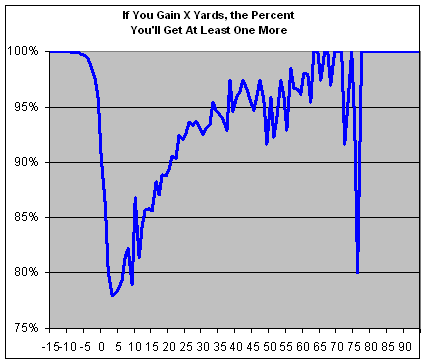
As you can see, as the running back breaks out, the yards are increasingly easier to gain. Gains beget more gains — that’s the key. (If you’ve notice a stock market equivalent, then you’ve probably read this blog before.)
Here are a few items I need to mention. There’s an unusual depression and spike at the 9- and 10-year mark. That’s probably due to NFL accounting which creates an unusually high number of 9-yard gains (plays that are just short of a first down). For my purposes, I’m side-stepping that issue since it’s not what I’m looking at nor does it seem to have an impact of the trend I’ve found.
You’ll also notice that the data become much more volatile as the run goes down the field. This is due to less data. For example, the outlier at the 76-yard mark (80%) is simply due to three runners being tackled there. Remarkably, Fred Taylor accounted for two of those runs! I should add that the graph refers to runs that are stopped, not touchdowns.
The hardest yard to gain is going from 3 yards to 4 yards. That’s just a 78.00% chance. But 4 to 5 is 78.11% so it’s not much better, and 5 to 6 is 78.52%. After that the yards are increasingly easier to gain. It would seem that the defense dominates 18 feet behind the line of scrimmage. After that, the field slowly turns in the runners favor. Runs of 7 or more yards make up about 20% of all runs but 60% of all yards gained.
Here’s a histogram of the rushing gains with a log scale. I had to exclude the extremes since the ones and zeros don’t work well with a log scale.
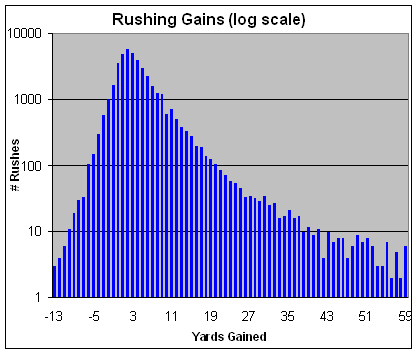
It’s that long, fat tail that’s so, so important.Here’s a spreadsheet of my data.
-
Peter Cook & Dudley Moore
Posted by Eddy Elfenbein on December 13th, 2008 at 2:52 pmNot terribly mature or safe for work.
-
Contrary Indicator
Posted by Eddy Elfenbein on December 12th, 2008 at 4:01 pmHarry Reid’s market call from yesterday: “I dread, Mr. President, I dread looking at Wall Street tomorrow. It’s not going to be a pleasant sight.”
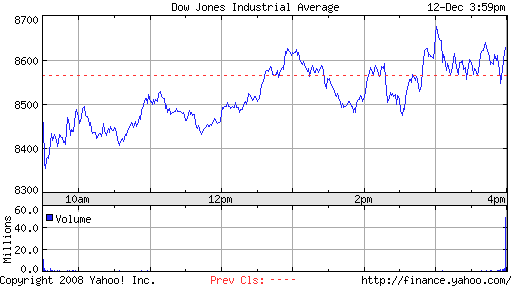
Perhaps he was short. -
Think You’re Having a Bad Day?
Posted by Eddy Elfenbein on December 11th, 2008 at 2:54 pmVisa CEO loses his credit cards
Imagine running the world’s largest credit card network, and not having your own plastic.
That’s what happened to Visa Inc Chief Executive Joseph Saunders.
He spoke Thursday morning at a Goldman Sachs financial services conference in New York, and had come from San Francisco, Visa’s headquarters.
Unfortunately, his credit cards didn’t make the trip.
“I’m supposed to start off, and say that I’m very happy to be here, and I guess I am. But it’s 4:15 in the morning as far as I’m concerned, and I lost my wallet on the way here,” Saunders said. “It’s rather embarrassing when somebody steals my credit cards.” The comment prompted laughter. -
Truth in Advertising
Posted by Eddy Elfenbein on December 11th, 2008 at 10:47 am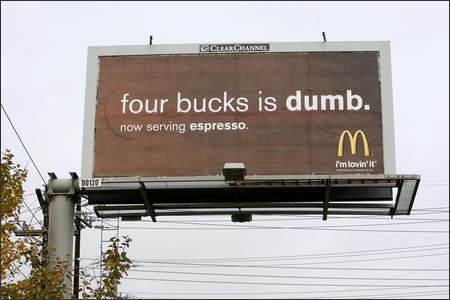
I’ve never understood the appeal of Starbucks. This McDonald’s ad sums it up pretty well. -
First Jobs of The Richest American Entrepreneurs
Posted by Eddy Elfenbein on December 11th, 2008 at 10:35 amI like reading lists like this:
John D. Rockefeller
Greatest Wealth – $318 Billion at age 74
First Job – Book keeper
Andrew Carnegie
Greatest Wealth – $298 Billion at age 68
First Job – Textile laborer
Henry Ford
Greatest Wealth – $188 Billion at age 57
First Job – Machinist
Warren Buffet
Greatest Wealth – $62 Billion at age 77
First Job – Newspaper delivery boy
Bill Gates
Greatest Wealth – $57 Billion at age 53
First Job – Congressional page
Sergey Brin
Greatest Wealth – $18.7 Billion at age 35
First “Job” – Student
Michael Dell
Greatest Wealth – $17.3 Billion at age 43
First Job – Dishwasher for a Chinese restaurant
Steve Jobs
Greatest Wealth – $5.4 Billion at age 53
First Job – Gopher at Hewlett Packard
Oprah Winfrey
Greatest Wealth – $2.7 Billion at age 54
First Job – Part time radio news broadcaster
Mark Cuban
Greatest Wealth – $2.8 Billion at age 50 (and probably half of that after his divorce)
First Job – Bartender
* All financial figures based on 2008 US Dollar ValuePersonally, I think being a gopher at Hewlett Packard could have been cool.
-
T-Bill Yields Go Negative
Posted by Eddy Elfenbein on December 10th, 2008 at 1:55 pmHere, take my money. I’ll pay you.
Treasuries rose, pushing rates on the three-month bill negative for the first time, as investors gravitate toward the safety of U.S. government debt amid the worst financial crisis since the Great Depression.
The Treasury sold $27 billion of three-month bills yesterday at a discount rate of 0.005 percent, the lowest since it starting auctioning the securities in 1929. The U.S. also sold $30 billion of four-week bills today at zero percent for the first time since it began selling the debt in 2001.
“It’s the year-end factor,” said Chris Ahrens, an interest-rate strategist in Greenwich, Connecticut, at UBS Securities LLC, one of the 17 primary dealers that trade directly with the Federal Reserve. “Everyone wants to be in bills going into year-end. Buy now while the opportunity is still there.” -
Stat of the Day
Posted by Eddy Elfenbein on December 10th, 2008 at 10:01 amIn 2007, Toyota sold 9.37 million vehicles.
In 2007, General Motors sold 9.37 million vehicles.
In 2007, Toyota made $17.1 billion.
In 2007, General Motors lost $38.7 billion.
(Source: Mises Blog)
-
Archives
- October 2026
- September 2026
- August 2026
- July 2026
- June 2026
- May 2026
- April 2026
- March 2026
- February 2026
- January 2026
- December 2025
- November 2025
- October 2025
- September 2025
- August 2025
- July 2025
- June 2025
- May 2025
- April 2025
- March 2025
- February 2025
- January 2025
- December 2024
- November 2024
- October 2024
- September 2024
- August 2024
- July 2024
- June 2024
- May 2024
- April 2024
- March 2024
- February 2024
- January 2024
- December 2023
- November 2023
- October 2023
- September 2023
- August 2023
- July 2023
- June 2023
- May 2023
- April 2023
- March 2023
- February 2023
- January 2023
- December 2022
- November 2022
- October 2022
- September 2022
- August 2022
- July 2022
- June 2022
- May 2022
- April 2022
- March 2022
- February 2022
- January 2022
- December 2021
- November 2021
- October 2021
- September 2021
- August 2021
- July 2021
- June 2021
- May 2021
- April 2021
- March 2021
- February 2021
- January 2021
- December 2020
- November 2020
- October 2020
- September 2020
- August 2020
- July 2020
- June 2020
- May 2020
- April 2020
- March 2020
- February 2020
- January 2020
- December 2019
- November 2019
- October 2019
- September 2019
- August 2019
- July 2019
- June 2019
- May 2019
- April 2019
- March 2019
- February 2019
- January 2019
- December 2018
- November 2018
- October 2018
- September 2018
- August 2018
- July 2018
- June 2018
- May 2018
- April 2018
- March 2018
- February 2018
- January 2018
- December 2017
- November 2017
- October 2017
- September 2017
- August 2017
- July 2017
- June 2017
- May 2017
- April 2017
- March 2017
- February 2017
- January 2017
- December 2016
- November 2016
- October 2016
- September 2016
- August 2016
- July 2016
- June 2016
- May 2016
- April 2016
- March 2016
- February 2016
- January 2016
- December 2015
- November 2015
- October 2015
- September 2015
- August 2015
- July 2015
- June 2015
- May 2015
- April 2015
- March 2015
- February 2015
- January 2015
- December 2014
- November 2014
- October 2014
- September 2014
- August 2014
- July 2014
- June 2014
- May 2014
- April 2014
- March 2014
- February 2014
- January 2014
- December 2013
- November 2013
- October 2013
- September 2013
- August 2013
- July 2013
- June 2013
- May 2013
- April 2013
- March 2013
- February 2013
- January 2013
- December 2012
- November 2012
- October 2012
- September 2012
- August 2012
- July 2012
- June 2012
- May 2012
- April 2012
- March 2012
- February 2012
- January 2012
- December 2011
- November 2011
- October 2011
- September 2011
- August 2011
- July 2011
- June 2011
- May 2011
- April 2011
- March 2011
- February 2011
- January 2011
- December 2010
- November 2010
- October 2010
- September 2010
- August 2010
- July 2010
- June 2010
- May 2010
- April 2010
- March 2010
- February 2010
- January 2010
- December 2009
- November 2009
- October 2009
- September 2009
- August 2009
- July 2009
- June 2009
- May 2009
- April 2009
- March 2009
- February 2009
- January 2009
- December 2008
- November 2008
- October 2008
- September 2008
- August 2008
- July 2008
- June 2008
- May 2008
- April 2008
- March 2008
- February 2008
- January 2008
- December 2007
- November 2007
- October 2007
- September 2007
- August 2007
- July 2007
- June 2007
- May 2007
- April 2007
- March 2007
- February 2007
- January 2007
- December 2006
- November 2006
- October 2006
- September 2006
- August 2006
- July 2006
- June 2006
- May 2006
- April 2006
- March 2006
- February 2006
- January 2006
- December 2005
- November 2005
- October 2005
- September 2005
- August 2005
- July 2005
 Eddy Elfenbein is a Washington, DC-based speaker, portfolio manager and editor of the blog Crossing Wall Street. His