-
HR 1424
Posted by Eddy Elfenbein on October 1st, 2008 at 12:17 pmHere’s the Senate’s bill. It checks in at 451 pages.
If you turn to page 299, you’ll find:20 SEC. 503. EXEMPTION FROM EXCISE TAX FOR CERTAIN
21 WOODEN ARROWS DESIGNED FOR USE BY
22 CHILDREN.
23 (a) IN GENERAL.—Paragraph (2) of section 4161(b)
24 is amended by redesignating subparagraph (B) as sub
1 paragraph (C) and by inserting after subparagraph (A)
2 the following new subparagraph:
3 ‘‘(B) EXEMPTION FOR CERTAIN WOODEN
4 ARROW SHAFTS.—Subparagraph (A) shall not
5 apply to any shaft consisting of all natural
6 wood with no laminations or artificial means of
7 enhancing the spine of such shaft (whether sold
8 separately or incorporated as part of a finished
9 or unfinished product) of a type used in the
10 manufacture of any arrow which after its as
11 sembly—
12 ‘‘(i) measures 5⁄16 of an inch or less in
13 diameter, and
14 ‘‘(ii) is not suitable for use with a bow
15 described in paragraph (1)(A).’’.
16 (b) EFFECTIVE DATE.—The amendments made by
17 this section shall apply to shafts first sold after the date
18 of enactment of this Act. -
Here We Go Again
Posted by Eddy Elfenbein on October 1st, 2008 at 1:39 amThe Senate will vote later today on a revised bailout plan.
Senate Majority Leader Harry M. Reid (D-Nev.) called the Senate’s revised legislation “the best thing to move forward.” Reid was joined on the floor by Senate Minority Leader Mitch McConnell (R-Ky.), who said the plan was “one of the finer moments in the Senate.”
A senior House Republican adviser, who spoke on the condition of anonymity to talk about private strategy, said the addition of the FDIC cap increase and the tax credits — without any corresponding tax increases — could have “substantial appeal” in that caucus. Boehner was consulted by Senate leaders and gave his approval, the aide said.
But the addition of the tax provisions may entail new risks in the House, which returns to action Thursday. Speaker Nancy Pelosi (D-Calif.) responded tepidly to the Senate announcement, and it remained unclear when the House would would consider the revised bill, though a vote is likely by week’s end. “The Senate has made a decision about how to proceed and what can pass that body. The Senate will vote . . . and the Congress will work its will,” Pelosi said.I’m honestly a little confused. I believe the Constitution requires all money bills to start in the House. Perhaps this Senate vote would be to test the waters, then it would go to the House and back to Senate.
The FDIC provision, which would raise the insurance cap for bank accounts to $250,000 from the current $100,000, was discussed during weekend negotiations in Pelosi’s office but was not included in the final package. But in what negotiators from both parties considered a critical breakthrough, the largest banking lobby in Washington embraced the idea. “We now see this as a way to help the package pass,” said Ed Yingling, president of the American Bankers Association.
While the move would result in banks paying higher fees on their insurance premiums, advocates say it would provide important assurances to small businesses that keep large sums of cash in bank accounts and are reeling from the credit crunch. “We are having an awful lot of people come into banks and ask questions,” Yingling said. -
The Third Quarter Ends
Posted by Eddy Elfenbein on September 30th, 2008 at 5:24 pmInteresting times. On a huge down day yesterday, the Buy List outperformed the S&P 500 by 266 basis points. Today was a huge up day and we underperformed by 172 basis points.
Over two days, we’re down 2.81% compared with a 4.00% loss for the S&P 500, with far less volatility. Score one for buy and hold. -
Investing in 2008
Posted by Eddy Elfenbein on September 30th, 2008 at 4:31 pmFrom Guest of a Guest, the 401-keg:
If you had purchased $1,000.00 of AIG stock one year ago you would have $44.34 left.
With Wachovia, you would have had $54.74 left of the original $1,000.00.
With Lehman, you would have had $0.00 left.
But, if you had purchased $1,000.00 worth of beer one year ago…drank all of the beer, then turned in the cans for the aluminum recycling REFUND, you would have $214.00 cash. -
Worst Percentage Days for the Dow
Posted by Eddy Elfenbein on September 30th, 2008 at 4:04 pmDate………………………………..% Chg
10/19/1987………………………..-22.61
10/28/1929………………………..-12.82
10/29/1929………………………..-11.73
11/6/1929………………………….-9.92
12/18/1899………………………..-8.72
8/12/1932………………………….-8.40
3/14/1907………………………….-8.29
10/26/1987………………………..-8.04
7/21/1933………………………….-7.84
10/18/1937………………………..-7.75
2/1/1917……………………………-7.24
10/27/1997………………………..-7.18
10/5/1932…………………………-7.15
9/17/2001…………………………-7.13
9/24/1931…………………………-7.07
7/20/1933…………………………-7.07
9/29/2008…………………………-6.98
7/30/1914…………………………-6.91
10/13/1989……………………….-6.91
1/8/1988…………………………..-6.85 -
The Dow Vs. the S&P 500
Posted by Eddy Elfenbein on September 29th, 2008 at 11:10 pmAs I mentioned before, the Dow held up much better than the S&P 500. The number 777 is already taken a title for today’s activity, but if the Dow had fallen the same percentage as the S&P 500, the loss would have been 981 points. The 181 basis point difference between the two indexes is one of the biggest gaps in history.
-
This Seems Appropriate
Posted by Eddy Elfenbein on September 29th, 2008 at 10:43 pm -
Flashback: WaMu Ad
Posted by Eddy Elfenbein on September 29th, 2008 at 10:35 pm
(Via: Wall Street Fighter) -
House to Wall Street: Drop Dead
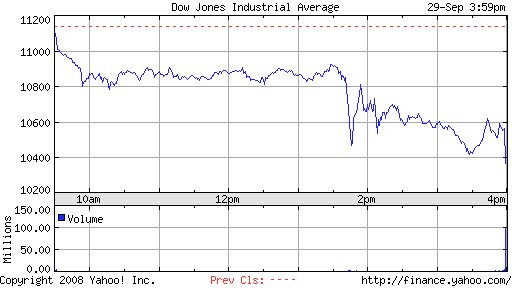
Posted by Eddy Elfenbein on September 29th, 2008 at 9:17 pmToday was the Dow’s worst point decline ever. The decline amounted to 777.68 points which is more than the Dow was worth at its 1982 low (btw, the Nasdaq closed at 1983 today). On a percentage basis, the Dow lost 6.98%.
Think about this: The sell-off erased $1.2 trillion off the stock market which was in response to a bailout plan of $700 billion.
The S&P 500 lost 106.62 points which is a total of 8.79%. That’s unusual that the Dow held up so much better than the S&P. Our Buy List was “only” down 6.11%.
By percentage terms, this was the worst selloff for the S&P 500 since 1987. My data only goes back to 1950, so it’s the second-worse sell-off since then.
By my records, this is 21st worst percentage decline for the Dow since the index began in 1896. Although, I saw a report from AP saying it was the 17th worst. The Christian Science Monitor said it was the 18th worst.
-
HR 3997
Posted by Eddy Elfenbein on September 29th, 2008 at 3:33 pmWell, I guess they were right..it was a partisan vote. Large sections of both parties voted against the bill. The Democrats voted 140-95. The Republicans voted 65-133.
Here’s the roll call.
-
Archives
- June 2026
- May 2026
- April 2026
- March 2026
- February 2026
- January 2026
- December 2025
- November 2025
- October 2025
- September 2025
- August 2025
- July 2025
- June 2025
- May 2025
- April 2025
- March 2025
- February 2025
- January 2025
- December 2024
- November 2024
- October 2024
- September 2024
- August 2024
- July 2024
- June 2024
- May 2024
- April 2024
- March 2024
- February 2024
- January 2024
- December 2023
- November 2023
- October 2023
- September 2023
- August 2023
- July 2023
- June 2023
- May 2023
- April 2023
- March 2023
- February 2023
- January 2023
- December 2022
- November 2022
- October 2022
- September 2022
- August 2022
- July 2022
- June 2022
- May 2022
- April 2022
- March 2022
- February 2022
- January 2022
- December 2021
- November 2021
- October 2021
- September 2021
- August 2021
- July 2021
- June 2021
- May 2021
- April 2021
- March 2021
- February 2021
- January 2021
- December 2020
- November 2020
- October 2020
- September 2020
- August 2020
- July 2020
- June 2020
- May 2020
- April 2020
- March 2020
- February 2020
- January 2020
- December 2019
- November 2019
- October 2019
- September 2019
- August 2019
- July 2019
- June 2019
- May 2019
- April 2019
- March 2019
- February 2019
- January 2019
- December 2018
- November 2018
- October 2018
- September 2018
- August 2018
- July 2018
- June 2018
- May 2018
- April 2018
- March 2018
- February 2018
- January 2018
- December 2017
- November 2017
- October 2017
- September 2017
- August 2017
- July 2017
- June 2017
- May 2017
- April 2017
- March 2017
- February 2017
- January 2017
- December 2016
- November 2016
- October 2016
- September 2016
- August 2016
- July 2016
- June 2016
- May 2016
- April 2016
- March 2016
- February 2016
- January 2016
- December 2015
- November 2015
- October 2015
- September 2015
- August 2015
- July 2015
- June 2015
- May 2015
- April 2015
- March 2015
- February 2015
- January 2015
- December 2014
- November 2014
- October 2014
- September 2014
- August 2014
- July 2014
- June 2014
- May 2014
- April 2014
- March 2014
- February 2014
- January 2014
- December 2013
- November 2013
- October 2013
- September 2013
- August 2013
- July 2013
- June 2013
- May 2013
- April 2013
- March 2013
- February 2013
- January 2013
- December 2012
- November 2012
- October 2012
- September 2012
- August 2012
- July 2012
- June 2012
- May 2012
- April 2012
- March 2012
- February 2012
- January 2012
- December 2011
- November 2011
- October 2011
- September 2011
- August 2011
- July 2011
- June 2011
- May 2011
- April 2011
- March 2011
- February 2011
- January 2011
- December 2010
- November 2010
- October 2010
- September 2010
- August 2010
- July 2010
- June 2010
- May 2010
- April 2010
- March 2010
- February 2010
- January 2010
- December 2009
- November 2009
- October 2009
- September 2009
- August 2009
- July 2009
- June 2009
- May 2009
- April 2009
- March 2009
- February 2009
- January 2009
- December 2008
- November 2008
- October 2008
- September 2008
- August 2008
- July 2008
- June 2008
- May 2008
- April 2008
- March 2008
- February 2008
- January 2008
- December 2007
- November 2007
- October 2007
- September 2007
- August 2007
- July 2007
- June 2007
- May 2007
- April 2007
- March 2007
- February 2007
- January 2007
- December 2006
- November 2006
- October 2006
- September 2006
- August 2006
- July 2006
- June 2006
- May 2006
- April 2006
- March 2006
- February 2006
- January 2006
- December 2005
- November 2005
- October 2005
- September 2005
- August 2005
- July 2005
 Eddy Elfenbein is a Washington, DC-based speaker, portfolio manager and editor of the blog Crossing Wall Street. His