-
NYC Strippers Screwed by Sucky Stocks
Posted by Eddy Elfenbein on September 21st, 2008 at 2:10 amIs stripping too big to fail?
So the NYC economy is headed for the crapper, sure — but who’s really suffering? Weep for the strippers.
We’re told first-hand by the pole-gymnasts at joints like the Penthouse Executive Club in NYC that biz has come to a grinding halt — and to add insult to injury, strippers say one-dollar bills have replaced tens and twenties. Oh, the humanity!
Sources tell us traffic at some super-exclusive Manhattan nightspots is down 40-50% since the wheels came off. -
Howard on the New Financial Frontier
Posted by Eddy Elfenbein on September 20th, 2008 at 3:34 pmGreat post from Howard Lindzon:
The best strategy to come out of this mess will be Global Macro Funds, funds with deep pools making concentrated bets in sectors and countries. They will be funds focused on a longer term horizon with bigger pools of capital. They embrace the volatility because of their connections, patience and deep knowledge of their sectors. The displaced talent from the industry will gravitate to these funds first. It is their best opportunity to be paid for their experience. I am digging through some of the worst performing funds of the last few years in the Global Macro sector and with the help of some of my friends in the industry plan to find a few and make some investments.
At the other end will be the nimble, the creative and the opportunistic. Those willing to change the industry through hard work and the profiting from niche markets afforded to them in the new financial landscape. This is where I will focus my energies and am already writing a few business plans. I now my strengths and weaknesses. I am not a ‘Shark’, but a ‘Pilot Fish’ and very in tune with the limits, and opportunities that affords me.
Thousands of great traders were thrown out into the wild the last few months. They are disoriented, pissed, nervous, but for the most part, they will end up on their feet and contribute back into the financial system in new ways – small hedge funds, start-up economy and other leadership roles. Some will write books and some will leave the financial world for good.
The financial media world on the other hand will continue to talk about ‘BOTTOMS’ – Was this one? If not when?
I am licking my chops because this bottom talk and regulation talk and babble will go on for 6-12 months. It’s noise and it will drag you in if not careful. In the meantime, I will be working towards one end of what I know is going to be a hugely profitable niche and start cranking.Read the whole thing.
-
Jimmy Stewart Singing Easy to Love
Posted by Eddy Elfenbein on September 20th, 2008 at 9:43 amSince it’s Saturday, I figure we all need a break from the financial mayhem, so here’s Jimmy Stewart singing “Easy to Love” to Eleanor Powell in the 1936 movie Born To Dance.
Jimmy Stewart used to make fun of his singing, but I think he does a really nice job. He has an innocent charm that’s just so perfect. BTW, this is the original version with the lyric “so sweet to waken with/so nice to sit down to eggs and bacon with.”
I think we all know what THAT means! Bowmp chicka bowmp bowmp….
Since the Hays Code was still fairly new, Cole Porter changed the offending lyric to “so worth the yearning for/so swell to keep ev’ry homefire burning for….” -
Swedish Prostitutes Want to Pay Taxes
Posted by Eddy Elfenbein on September 20th, 2008 at 12:32 amMore and more Swedish prostitutes want to pay taxes in order to receive the social welfare benefits that come with doing so.
“So far this year I’ve spoken with several women who want to make things right,” said Pia Blank Thörnroos, a legal expert with Sweden’s Tax Authority, to the Göteborgs-Posten (GP) newspaper.
While it remains against the law to purchase sex in Sweden, selling sex is perfectly legal according to Sweden’s unique prostitution law, which came into force in 1999.
Moreover, prostitution has been considered a business activity in Sweden since 1982 and as a result proceeds from the sale of sex subject to taxation just like any other form of income.
“You have to keep track of all your income and expenses; all compensation should be accounted for,” explained Blank Thörnroos.
“One should really have accounting records. And in actuality [customers] should write out a receipt, because the transaction is considered a private operation which is subject to value added tax. But customers’ names need not be on the receipt.”
Income recorded on prostitutes’ tax returns gives them the right to sick-leave pay, parental leave benefits, and a pension.
“It’s important to pay taxes if you want to live a normal life,” said ‘Lisa’, a prostitute who spoke with the newspaper.I’m not sure “Lisa” understands the irony of her statement.
-
Warren Buffett Made $7 Billion on Friday
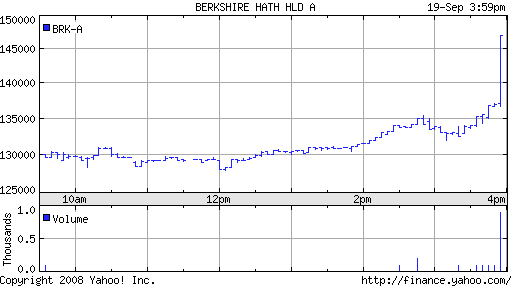
Posted by Eddy Elfenbein on September 19th, 2008 at 10:07 pmShares of Berkshire Hathaway (BRKA) gapped up $18,990 on Friday which is an increase of 14.8%. Given that Warren Buffett owns 350,000 shares, that increased his wealth by about $6.7 billion. (Buffett also owns two million shares of Class B stock which increased by $345 yesterday, but that only added $700 million to his fortune.)
The Class A shares jumped up about $10,000 starting at 3:57, which means Buffett made over $3.5 billion in about three minutes.
And I thought I did well on my MS buy! -
The Decline and Fall of the Roman Economy
Posted by Eddy Elfenbein on September 19th, 2008 at 9:43 pmHistorians have long debated what caused the downfall of the Roman Empire. What about its tax policies?
As early as the rule of Nero (54-68 A.D.) there is evidence that the demand for revenue led to debasement of the coinage. Revenue was needed to pay the increasing costs of defense and a growing bureaucracy. However, rather than raise taxes, Nero and subsequent emperors preferred to debase the currency by reducing the precious metal content of coins. This was, of course, a form of taxation; in this case, a tax on cash balances (Bailey 1956).
Throughout most of the Empire, the basic units of Roman coinage were the gold aureus, the silver denarius, and the copper or bronze sesterce. [8] The aureus was minted at 40-42 to the pound, the denarius at 84 to the pound, and a sesterce was equivalent to one-quarter of a denarius. Twenty-five denarii equaled one aureus and the denarius was considered the basic coin and unit of account.
The aureus did not circulate widely. Consequently, debasement was mainly limited to the denarius. Nero reduced the silver content of the denarius to 90 percent and slightly reduced the size of the aureus in order to maintain the 25 to 1 ratio. Trajan (98-117 A.D.) reduced the silver content to 85 percent, but was able to maintain the ratio because of a large influx of gold. In fact, some historians suggest that he deliberately devalued the denarius precisely in order to maintain the historic ratio. Debasement continued under the reign of Marcus Aurelius (161-180 A.D.), who reduced the silver content of the denarius to 75 percent, further reduced by Septimius Severus to 50 percent. By the middle of the third century A.D., the denarius had a silver content of just 5 percent.
Interestingly, the continual debasements did not improve the Empire’s fiscal position. This is because of Gresham’s Law (“bad money drives out good”). People would hoard older, high silver content coins and pay their taxes in those with the least silver. Thus the government’s “real” revenues may have actually fallen. As Aurelio Bernardi explains:
At the beginning the debasement proved undoubtedly profitable for the state. Nevertheless, in the course of years, this expedient was abused and the [fn2]century of inflation which had been thus brought about was greatly to the disadvantage of the State’s finances. Prices were rising too rapidly and it became impossible to count on an immediate proportional increase in the fiscal revenue, because of the rigidity of the apparatus of tax collection. [9]
At first, the government could raise additional revenue from the sale of state property. Later, more unscrupulous emperors like Domitian (81-96 A.D.) would use trumped-up charges to confiscate the assets of the wealthy. They would also invent excuses to demand tribute from the provinces and the wealthy. Such tribute, called the aurum corinarium, was nominally voluntary and paid in gold to commemorate special occasions, such as the accession of a new emperor or a great military victory. Caracalla (198-217 A.D.) often reported such dubious “victories” as a way of raising revenue. Rostovtzeff (1957: 417) calls these levies “pure robbery.” -
This Isn’t a New Game
Posted by Eddy Elfenbein on September 19th, 2008 at 3:08 pmFrom 2006:
Enron’s fault was not having its former CEO as Treasury Secretary. -
Here’s the List
Posted by Eddy Elfenbein on September 19th, 2008 at 1:06 pmI got 799 stocks you can’t short right here.
Included on the list is National Atlantic Holdings (NAHC) which was bought out several weeks ago. -
Bush: “Anyone engaging in illegal financial transactions will be caught and persecuted.”
Posted by Eddy Elfenbein on September 19th, 2008 at 12:10 pmHere’s President Bush this morning (source White House website).
The Securities and Exchange Commission has issued new rules temporarily suspending the practice of short selling on the stocks of financial institutions. This is intended to prevent investors from intentionally driving down particular stocks for their own personal gain. The SEC is also requiring certain investors to disclose their short selling, and has launched rigorous enforcement actions to detect fraud and manipulation in the market. Anyone engaging in illegal financial transactions will be caught and persecuted [sic].
No we’re talking! Let’s make the shorts use separate water fountains. -
New Rule
Posted by Eddy Elfenbein on September 19th, 2008 at 11:02 amDon’t invade Russia in the winter, and don’t conduct a short raid on Goldman Sachs when the former CEO is the Treasury Secretary.
-
Archives
- June 2026
- May 2026
- April 2026
- March 2026
- February 2026
- January 2026
- December 2025
- November 2025
- October 2025
- September 2025
- August 2025
- July 2025
- June 2025
- May 2025
- April 2025
- March 2025
- February 2025
- January 2025
- December 2024
- November 2024
- October 2024
- September 2024
- August 2024
- July 2024
- June 2024
- May 2024
- April 2024
- March 2024
- February 2024
- January 2024
- December 2023
- November 2023
- October 2023
- September 2023
- August 2023
- July 2023
- June 2023
- May 2023
- April 2023
- March 2023
- February 2023
- January 2023
- December 2022
- November 2022
- October 2022
- September 2022
- August 2022
- July 2022
- June 2022
- May 2022
- April 2022
- March 2022
- February 2022
- January 2022
- December 2021
- November 2021
- October 2021
- September 2021
- August 2021
- July 2021
- June 2021
- May 2021
- April 2021
- March 2021
- February 2021
- January 2021
- December 2020
- November 2020
- October 2020
- September 2020
- August 2020
- July 2020
- June 2020
- May 2020
- April 2020
- March 2020
- February 2020
- January 2020
- December 2019
- November 2019
- October 2019
- September 2019
- August 2019
- July 2019
- June 2019
- May 2019
- April 2019
- March 2019
- February 2019
- January 2019
- December 2018
- November 2018
- October 2018
- September 2018
- August 2018
- July 2018
- June 2018
- May 2018
- April 2018
- March 2018
- February 2018
- January 2018
- December 2017
- November 2017
- October 2017
- September 2017
- August 2017
- July 2017
- June 2017
- May 2017
- April 2017
- March 2017
- February 2017
- January 2017
- December 2016
- November 2016
- October 2016
- September 2016
- August 2016
- July 2016
- June 2016
- May 2016
- April 2016
- March 2016
- February 2016
- January 2016
- December 2015
- November 2015
- October 2015
- September 2015
- August 2015
- July 2015
- June 2015
- May 2015
- April 2015
- March 2015
- February 2015
- January 2015
- December 2014
- November 2014
- October 2014
- September 2014
- August 2014
- July 2014
- June 2014
- May 2014
- April 2014
- March 2014
- February 2014
- January 2014
- December 2013
- November 2013
- October 2013
- September 2013
- August 2013
- July 2013
- June 2013
- May 2013
- April 2013
- March 2013
- February 2013
- January 2013
- December 2012
- November 2012
- October 2012
- September 2012
- August 2012
- July 2012
- June 2012
- May 2012
- April 2012
- March 2012
- February 2012
- January 2012
- December 2011
- November 2011
- October 2011
- September 2011
- August 2011
- July 2011
- June 2011
- May 2011
- April 2011
- March 2011
- February 2011
- January 2011
- December 2010
- November 2010
- October 2010
- September 2010
- August 2010
- July 2010
- June 2010
- May 2010
- April 2010
- March 2010
- February 2010
- January 2010
- December 2009
- November 2009
- October 2009
- September 2009
- August 2009
- July 2009
- June 2009
- May 2009
- April 2009
- March 2009
- February 2009
- January 2009
- December 2008
- November 2008
- October 2008
- September 2008
- August 2008
- July 2008
- June 2008
- May 2008
- April 2008
- March 2008
- February 2008
- January 2008
- December 2007
- November 2007
- October 2007
- September 2007
- August 2007
- July 2007
- June 2007
- May 2007
- April 2007
- March 2007
- February 2007
- January 2007
- December 2006
- November 2006
- October 2006
- September 2006
- August 2006
- July 2006
- June 2006
- May 2006
- April 2006
- March 2006
- February 2006
- January 2006
- December 2005
- November 2005
- October 2005
- September 2005
- August 2005
- July 2005
 Eddy Elfenbein is a Washington, DC-based speaker, portfolio manager and editor of the blog Crossing Wall Street. His