-
Timmay Radio Is Born
Posted by Eddy Elfenbein on May 1st, 2008 at 1:30 pmIf you’ve never heard of Tim Sykes, at this point, that’s probably your fault. He’s a one-man media, blogging and trading empire.
Tim has redesigned his site which now includes a podcast with yours truly. Enjoy. -
The Strange BBBY Rally
Posted by Eddy Elfenbein on May 1st, 2008 at 12:47 pmEver since Bed Bath & Beyond (BBBY) reported its poor quarter a few weeks ago, the stock has rallied. The stock is now up about 20% from its low.
We often look to clear reasons to explain stock price movements. It’s disquieting to think that sometimes there simply aren’t any. Of course, I never thought BBBY should have been that cheap to begin with. -
Setting the Bar High
Posted by Eddy Elfenbein on May 1st, 2008 at 12:43 pmIt’s got to be rough for a company that earns $10.9 billion in a quarter, and the results are called disappointing.
-
De Beers Finds Shipwreck, Treasure From Columbus Era
Posted by Eddy Elfenbein on May 1st, 2008 at 10:34 amDe Beers, the world’s biggest undersea diamond miner, said its geologists in Namibia found the wreckage of an ancient sailing ship still laden with treasure, including six bronze cannons, thousands of Spanish and Portuguese gold coins and more than 50 elephant tusks.
The wreckage was discovered in the area behind a sea wall used to push back the Atlantic Ocean in order to search for diamonds in Namibia’s Sperrgebiet or “Forbidden Zone.”
“If the experts’ assessments are correct, the shipwreck could date back to the late 1400s or early 1500s, making it a discovery of global significance,” Namdeb Diamond Corp., a joint venture between De Beers and the Namibian government, said in an e-mailed statement from the capital, Windhoek, today.
The site yielded a wealth of objects, including several tons of copper, more than 50 elephant tusks, pewter tableware, navigational instruments, weapons and the gold coins, which were minted in the late 1400s and early 1500s, according to the statement. -
The S&P 500 and Earnings
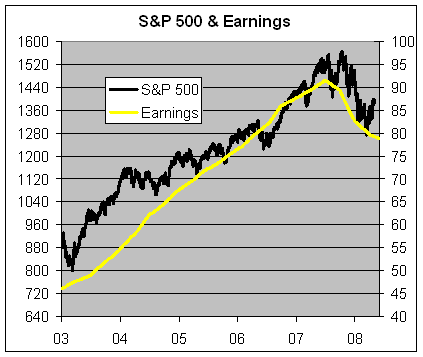
Posted by Eddy Elfenbein on May 1st, 2008 at 10:14 amHere’s a chart of the S&P 500 (black line, left scale) and its earnings (yellow line, right scale). I scaled this graph at a ratio of 16-to-1, so whenever the lines cross, the P/E ratio is exactly 16. As you can see, even as the market has risen and sold off, the market is basically following earnings pretty closely.
-
Another 25 Points
Posted by Eddy Elfenbein on April 30th, 2008 at 2:24 pmThe Fed cuts. Here’s their statement:
The Federal Open Market Committee decided today to lower its target for the federal funds rate 25 basis points to 2 percent.
Recent information indicates that economic activity remains weak. Household and business spending has been subdued and labor markets have softened further. Financial markets remain under considerable stress, and tight credit conditions and the deepening housing contraction are likely to weigh on economic growth over the next few quarters.
Although readings on core inflation have improved somewhat, energy and other commodity prices have increased, and some indicators of inflation expectations have risen in recent months. The Committee expects inflation to moderate in coming quarters, reflecting a projected leveling-out of energy and other commodity prices and an easing of pressures on resource utilization. Still, uncertainty about the inflation outlook remains high. It will be necessary to continue to monitor inflation developments carefully.
The substantial easing of monetary policy to date, combined with ongoing measures to foster market liquidity, should help to promote moderate growth over time and to mitigate risks to economic activity. The Committee will continue to monitor economic and financial developments and will act as needed to promote sustainable economic growth and price stability.
Voting for the FOMC monetary policy action were: Ben S. Bernanke, Chairman; Timothy F. Geithner, Vice Chairman; Donald L. Kohn; Randall S. Kroszner; Frederic S. Mishkin; Sandra Pianalto; Gary H. Stern; and Kevin M. Warsh. Voting against were Richard W. Fisher and Charles I. Plosser, who preferred no change in the target for the federal funds rate at this meeting.
In a related action, the Board of Governors unanimously approved a 25-basis-point decrease in the discount rate to 2-1/4 percent. In taking this action, the Board approved the requests submitted by the Boards of Directors of the Federal Reserve Banks of New York, Cleveland, Atlanta, and San Francisco. -
Apparantly Short Sellers Are the New Terrorists
Posted by Eddy Elfenbein on April 30th, 2008 at 12:33 pmFrom the NYT:
In the days when square-rigged galleons plied the spice route to the East, the Dutch outlawed a band of rebels that they feared might plunder their new-found riches.
The troublemakers were neither Barbary pirates nor Spanish spies — they were certain traders on the stock exchange in Amsterdam. Their offense: shorting the shares of the Dutch East India Company, purportedly the first company in the world to issue stock.
Short sellers, who sell assets like stocks in the hope that the price will fall, have been reviled ever since. England banned them for much of the 18th and 19th centuries. Napoleon deemed them enemies of the state. And Germany’s last kaiser enlisted them to attack American markets (or so some Americans feared).There’s also a new academic study that suggests shorts may know what they’re talking about.
We construct a long daily panel of short sales using proprietary NYSE order data. From 2000 to 2004, shorting accounts for more than 12.9% of NYSE volume, suggesting that shorting constraints are not widespread. As a group, these short sellers are well informed. Heavily shorted stocks underperform lightly shorted stocks by a risk-adjusted average of 1.16% over the following 20 trading days (15.6% annualized). Institutional nonprogram short sales are the most informative; stocks heavily shorted by institutions underperform by 1.43% the next month (19.6% annualized). The results indicate that, on average, short sellers are important contributors to efficient stock prices.
-
An Investing Lesson
Posted by Eddy Elfenbein on April 30th, 2008 at 11:56 amConsider these recent headlines.
So Warren Buffett not only thinks we’re in a recession, but he thinks it will be worse than feared. So what does he do? He buys.
To quote George Bailey:Can’t you understand what’s happening here? Don’t you see what’s happening? Potter isn’t selling. Potter’s buying! And why? Because we’re panicky and he’s not. That’s why. He’s picking up some bargains.
-
What If Bernanke Is Winning?
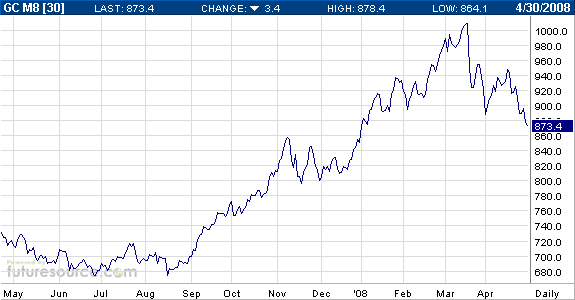
Posted by Eddy Elfenbein on April 30th, 2008 at 10:57 amHere’s a scary thought. What if Ben Bernanke has been doing the right thing? Not only did GDP come in positive for the month, but core inflation has been running between 2% and 2.5%. Most shocking of all has been the decline in gold. The June contract dropped below $870 an ounce today. That’s a major fall from six weeks ago.
-
The Economy Grew But Just Barely
Posted by Eddy Elfenbein on April 30th, 2008 at 8:41 amFirst-quarter GDP came in at +0.6%. That’s not a lot, but it is positive. Naturally, this number will be subject to several revisions and re-revisions of previous revisions.
Even though we haven’t reached an official recession yet, which is usually defined as back-to-back quarters of negative GDP, the economy has had below-trend growth for six of the last eight quarters. Below is a table showing economic growth for the trailing eight quarters (not annualized but adjusted for inflation). You can really see how much economic growth has down-shifted.

On a bizarre note, today’s GDP report showed that the economy grew by almost exactly the same rate in the first quarter of 2008 as in the first quarter in 2007. One year ago, the economy grew by 0.6009%. For this year’s first quarter, the number was 0.5966%.
-
Archives
- July 2026
- June 2026
- May 2026
- April 2026
- March 2026
- February 2026
- January 2026
- December 2025
- November 2025
- October 2025
- September 2025
- August 2025
- July 2025
- June 2025
- May 2025
- April 2025
- March 2025
- February 2025
- January 2025
- December 2024
- November 2024
- October 2024
- September 2024
- August 2024
- July 2024
- June 2024
- May 2024
- April 2024
- March 2024
- February 2024
- January 2024
- December 2023
- November 2023
- October 2023
- September 2023
- August 2023
- July 2023
- June 2023
- May 2023
- April 2023
- March 2023
- February 2023
- January 2023
- December 2022
- November 2022
- October 2022
- September 2022
- August 2022
- July 2022
- June 2022
- May 2022
- April 2022
- March 2022
- February 2022
- January 2022
- December 2021
- November 2021
- October 2021
- September 2021
- August 2021
- July 2021
- June 2021
- May 2021
- April 2021
- March 2021
- February 2021
- January 2021
- December 2020
- November 2020
- October 2020
- September 2020
- August 2020
- July 2020
- June 2020
- May 2020
- April 2020
- March 2020
- February 2020
- January 2020
- December 2019
- November 2019
- October 2019
- September 2019
- August 2019
- July 2019
- June 2019
- May 2019
- April 2019
- March 2019
- February 2019
- January 2019
- December 2018
- November 2018
- October 2018
- September 2018
- August 2018
- July 2018
- June 2018
- May 2018
- April 2018
- March 2018
- February 2018
- January 2018
- December 2017
- November 2017
- October 2017
- September 2017
- August 2017
- July 2017
- June 2017
- May 2017
- April 2017
- March 2017
- February 2017
- January 2017
- December 2016
- November 2016
- October 2016
- September 2016
- August 2016
- July 2016
- June 2016
- May 2016
- April 2016
- March 2016
- February 2016
- January 2016
- December 2015
- November 2015
- October 2015
- September 2015
- August 2015
- July 2015
- June 2015
- May 2015
- April 2015
- March 2015
- February 2015
- January 2015
- December 2014
- November 2014
- October 2014
- September 2014
- August 2014
- July 2014
- June 2014
- May 2014
- April 2014
- March 2014
- February 2014
- January 2014
- December 2013
- November 2013
- October 2013
- September 2013
- August 2013
- July 2013
- June 2013
- May 2013
- April 2013
- March 2013
- February 2013
- January 2013
- December 2012
- November 2012
- October 2012
- September 2012
- August 2012
- July 2012
- June 2012
- May 2012
- April 2012
- March 2012
- February 2012
- January 2012
- December 2011
- November 2011
- October 2011
- September 2011
- August 2011
- July 2011
- June 2011
- May 2011
- April 2011
- March 2011
- February 2011
- January 2011
- December 2010
- November 2010
- October 2010
- September 2010
- August 2010
- July 2010
- June 2010
- May 2010
- April 2010
- March 2010
- February 2010
- January 2010
- December 2009
- November 2009
- October 2009
- September 2009
- August 2009
- July 2009
- June 2009
- May 2009
- April 2009
- March 2009
- February 2009
- January 2009
- December 2008
- November 2008
- October 2008
- September 2008
- August 2008
- July 2008
- June 2008
- May 2008
- April 2008
- March 2008
- February 2008
- January 2008
- December 2007
- November 2007
- October 2007
- September 2007
- August 2007
- July 2007
- June 2007
- May 2007
- April 2007
- March 2007
- February 2007
- January 2007
- December 2006
- November 2006
- October 2006
- September 2006
- August 2006
- July 2006
- June 2006
- May 2006
- April 2006
- March 2006
- February 2006
- January 2006
- December 2005
- November 2005
- October 2005
- September 2005
- August 2005
- July 2005
 Eddy Elfenbein is a Washington, DC-based speaker, portfolio manager and editor of the blog Crossing Wall Street. His