-
Harris Teeter Finally Opens in Adams Morgan
Posted by Eddy Elfenbein on April 23rd, 2008 at 8:20 amWe in Adams Morgan have been promised a Harris Teeter since, oh, about the Taft Administration. After countless delays, Washington’s first Harris Teeter opened this morning. I captured the details.
Here’s the ribbon ceremony:

OMG, it blows away anything else we have in the neighborhood, especially the gawdawful Safeway. Here the fruits and vegetables get my approval:

Look, a real salad bar! Check out the chrome. I bet they had salad bars like this on Star Trek:

Here’s the Jewel in the Crown. The vino section. It’s two freakin aisles!

-
Lincare & UnitedHealth
Posted by Eddy Elfenbein on April 22nd, 2008 at 2:55 pmLincare (LNCR) has been one of our worst Buy List stocks this year, but Q1 earnings were pretty good. The company earned 79 cents a share compared with 59 cents last year. Wall Street was expecting just 71 cents. On the downside, Lincare said that it now expects a $100 million impact from Medicare price reductions. Earlier, the company expected an impact of $65 million to $70 million.
The bad news today came from UnitedHealth (UNH). The company had been pretty consistent in saying it would earn $3.95 to $4 a share for this year. Well, not anymore. For the first quarter, UNH earned 78 cents, which was two cents below Street estimates. But the company lowered its full-year guidance to $3.55 to $3.60 per share. Ouch, that’s a major downgraded. The shares are getting rightly punished today. -
Financial Analysts Offer To Talk About Recession For $5
Posted by Eddy Elfenbein on April 22nd, 2008 at 12:09 pmFrom The Onion:
NEW YORK—With the nation almost certainly headed toward a recession, a coalition of top financial analysts announced Monday that they would be willing to discuss the economic future of the U.S. at any time for a negotiable fee of $5. “There are many complicated factors that will dictate the direction the economy will take in the coming months,” said commodity trading adviser Lucas Brockton, who repeatedly urged reporters at the press conference to leave any empty soda cans with him before they left. “We are more than happy to talk about these factors at length just as soon as we can get a wink from Mr. Lincoln, if you catch my drift.” As of press time, the analysts were considering an offer of $3.50 and half a turkey sandwich.
-
Texas Passes New York on Fortune 500 List
Posted by Eddy Elfenbein on April 22nd, 2008 at 10:15 amFrom the AP:
Texas is king of the hill when it comes to corporate headquarters.
The Lone Star State passed New York as home to the most big companies in the latest list compiled by Fortune magazine.
Texas now boasts 58 headquarters, three more than New York, the previous No. 1, and California, with 52.
Business experts say it’s a matter of simple economics – Texas attracts companies with its low taxes, affordable land and large labor force. -
Deutsche Bank Gets Mean
Posted by Eddy Elfenbein on April 21st, 2008 at 4:04 pmThis, my friends, is an outrage:
Germany’s biggest bank today banned staff from visiting brothels on expenses and putting hotel TV porn channels on their company credit card.
The crackdown came in new rules issued to executives as Deutsche Bank cuts costs after losing at least £2billion so far in the global credit crunch.
“Deutsche Bank does not approve of any adult entertainments and such expenditures will not be reimbursed”, according to the memo leaked to news magazine Spiegel.
According to Spiegel, the new edict was aimed at senior staff in the bank’s communications and social responsibility department.
The memo further warns that the bank’s credit cards must not be used for such purposes.
Whether the ruling was prompted by a recent upsurge in executives seeking erotic relief from subprime deals that have gone bad was not specified.
Further belt-tightening at the bank includes prior approval from a boss before a taxi can be taken, a limit of £50 on a business meal and train rides in Germany must all be second class if they are under one hour.
In the UK, the rule for bank employees is second class unless the journey is over two hours.
One further stiupulation is that employees stepping off of overnight flights who are expected in work or at a business meeting are now to shower at the airport instead of booking a hotel room to do so.
The reason for the memo: apparently there have been “minor infringements” of late which the bank wants to stamp out in hard times. -
More Q1 Earnings Reports
Posted by Eddy Elfenbein on April 21st, 2008 at 3:27 pmJust to bring you up to speed, there are a few Buy List earnings reports due this week. Lincare Holdings (LNCR) reports after the bell today. SEI Investments (SEIC) and Unitedhealth (UNH) report tomorrow, and AFLAC (AFL) reports on Wednesday.
-
Decline and Fall
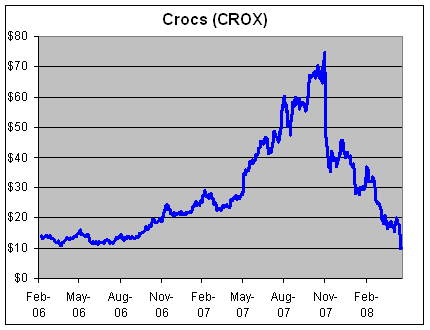
Posted by Eddy Elfenbein on April 21st, 2008 at 3:15 pmTwo years ago, Crocs (CROX) went public at $10.50. By last October, it got to $75. Now it’s back down to $10.29, slightly below its IPO price.
But it was a fun ride while it lasted.
-
Isaac Newton: Master of the Mint
Posted by Eddy Elfenbein on April 21st, 2008 at 11:07 amIn Vanity Fair, Christopher Hitchens writes on Sir Isaac Newton, who not only had some rather bizarre ideas on gravity, but some truly whacked-out thoughts on sex and religion, and of course, gold.
In contrast with this clarity and purity, however, Newton spent much of his time dwelling in a self-generated fog of superstition and crankery. He believed in the lost art of alchemy, whereby base metals can be transmuted into gold, and the surviving locks of his hair show heavy traces of lead and mercury in his system, suggesting that he experimented upon himself in this fashion, too.
But his gold obsession didn’t end there. Newton also served as Master of the Mint and he had to deal with one of the great questions that men have pondered for centuries–what’s the correct price ratio of gold to silver.
Great Britain didn’t formally adopt the gold standard until 1819, but it was in effect set over one hundred years before when Newton overvalued gold. For the previous 500 years, Britain had been on the silver standard. -
Leucadia Buys 14% of Jefferies
Posted by Eddy Elfenbein on April 21st, 2008 at 10:33 amI noticed that Leucadia (LUK) just bought a 14% stake in Jefferies (JEF). I think we’re going to see more of this in the near future. Jefferies is not in good shape and they need the cash. For our purposes, I think we can consider Leucadia to be private equity firm.
Of course, there’s the question of why so many banks and brokerages are turning to private equity and SWFs instead of the public market. The easy answer is that they’ve been completely shut out of the public markets. The other sources are, to borrow from Willie Sutton, where the money is.
Felix Salmon has more. -
Social Networks Just Got Much Less Cool
Posted by Eddy Elfenbein on April 21st, 2008 at 10:27 amI’m embarrassed to say that I don’t know much about social networking sites. I thought it was where teenagers gathered to discuss Gossip Girl. I understand that it’s that and much, much more. Anyway, I finally broke down and joined Facebook. You can add me as a friend, but please don’t discuss Gossip Girl.
-
Archives
- October 2026
- September 2026
- August 2026
- July 2026
- June 2026
- May 2026
- April 2026
- March 2026
- February 2026
- January 2026
- December 2025
- November 2025
- October 2025
- September 2025
- August 2025
- July 2025
- June 2025
- May 2025
- April 2025
- March 2025
- February 2025
- January 2025
- December 2024
- November 2024
- October 2024
- September 2024
- August 2024
- July 2024
- June 2024
- May 2024
- April 2024
- March 2024
- February 2024
- January 2024
- December 2023
- November 2023
- October 2023
- September 2023
- August 2023
- July 2023
- June 2023
- May 2023
- April 2023
- March 2023
- February 2023
- January 2023
- December 2022
- November 2022
- October 2022
- September 2022
- August 2022
- July 2022
- June 2022
- May 2022
- April 2022
- March 2022
- February 2022
- January 2022
- December 2021
- November 2021
- October 2021
- September 2021
- August 2021
- July 2021
- June 2021
- May 2021
- April 2021
- March 2021
- February 2021
- January 2021
- December 2020
- November 2020
- October 2020
- September 2020
- August 2020
- July 2020
- June 2020
- May 2020
- April 2020
- March 2020
- February 2020
- January 2020
- December 2019
- November 2019
- October 2019
- September 2019
- August 2019
- July 2019
- June 2019
- May 2019
- April 2019
- March 2019
- February 2019
- January 2019
- December 2018
- November 2018
- October 2018
- September 2018
- August 2018
- July 2018
- June 2018
- May 2018
- April 2018
- March 2018
- February 2018
- January 2018
- December 2017
- November 2017
- October 2017
- September 2017
- August 2017
- July 2017
- June 2017
- May 2017
- April 2017
- March 2017
- February 2017
- January 2017
- December 2016
- November 2016
- October 2016
- September 2016
- August 2016
- July 2016
- June 2016
- May 2016
- April 2016
- March 2016
- February 2016
- January 2016
- December 2015
- November 2015
- October 2015
- September 2015
- August 2015
- July 2015
- June 2015
- May 2015
- April 2015
- March 2015
- February 2015
- January 2015
- December 2014
- November 2014
- October 2014
- September 2014
- August 2014
- July 2014
- June 2014
- May 2014
- April 2014
- March 2014
- February 2014
- January 2014
- December 2013
- November 2013
- October 2013
- September 2013
- August 2013
- July 2013
- June 2013
- May 2013
- April 2013
- March 2013
- February 2013
- January 2013
- December 2012
- November 2012
- October 2012
- September 2012
- August 2012
- July 2012
- June 2012
- May 2012
- April 2012
- March 2012
- February 2012
- January 2012
- December 2011
- November 2011
- October 2011
- September 2011
- August 2011
- July 2011
- June 2011
- May 2011
- April 2011
- March 2011
- February 2011
- January 2011
- December 2010
- November 2010
- October 2010
- September 2010
- August 2010
- July 2010
- June 2010
- May 2010
- April 2010
- March 2010
- February 2010
- January 2010
- December 2009
- November 2009
- October 2009
- September 2009
- August 2009
- July 2009
- June 2009
- May 2009
- April 2009
- March 2009
- February 2009
- January 2009
- December 2008
- November 2008
- October 2008
- September 2008
- August 2008
- July 2008
- June 2008
- May 2008
- April 2008
- March 2008
- February 2008
- January 2008
- December 2007
- November 2007
- October 2007
- September 2007
- August 2007
- July 2007
- June 2007
- May 2007
- April 2007
- March 2007
- February 2007
- January 2007
- December 2006
- November 2006
- October 2006
- September 2006
- August 2006
- July 2006
- June 2006
- May 2006
- April 2006
- March 2006
- February 2006
- January 2006
- December 2005
- November 2005
- October 2005
- September 2005
- August 2005
- July 2005
 Eddy Elfenbein is a Washington, DC-based speaker, portfolio manager and editor of the blog Crossing Wall Street. His