-
W.R. Berkley’s Earnings
Posted by Eddy Elfenbein on February 11th, 2008 at 12:56 pmW.R. Berkley (BER) just reported its fourth-quarter earnings. For the last three months of the year, net income dropped to from $198.1 million to $184.1 million. On a per-share basis, that’s a fall from 98 cents to 97 cents. With insurance companies, it’s better to look at operating results. Here, BER saw its number drop from $193.7 million to $183.2 million, which is actually a penny per share increase to 97 cents a share. That beat Wall Street’s estimate by two cents a share.
For the full year, Berkley’s operating income was $3.73 per share which was a nice increase over the $3.46 per share from 2006. Wall Street currently sees BER earnings $3.86 for 2008 which is a pretty small increase. Still, it means that the shares are going for less than eight times this year’s earnings. This is a good company going for a good price. -
Changes to the Dow
Posted by Eddy Elfenbein on February 11th, 2008 at 9:09 amThe gatekeepers of the Dow Jones Industrial Average (^DJI) have decided to boot Altria (MO) and Honeywell (HON) from the index. The two new additions will be Bank of America (BAC) and Chevron (CHV).
Chevron was in the index from 1930 to 1999, though for much of the time it was known as Standard Oil of California. Honeywell was first included in the index in 1925. Altria was added in 1985. Personally, I would get rid of Alcoa (AA) and General Motors (GM).
Here’s a look at all the changes to the Dow going back to the original rail index.
The Dow is often criticized for being unrepresentative of the market. That’s true and I prefer to the use the S&P 500 (^GSPC) which is market-weighted. Still, the Dow isn’t that bad. The index that should be ignored is the Nasdaq (^IXIC). That index is dominated by a few big names that are highly correlated to each other and little else.
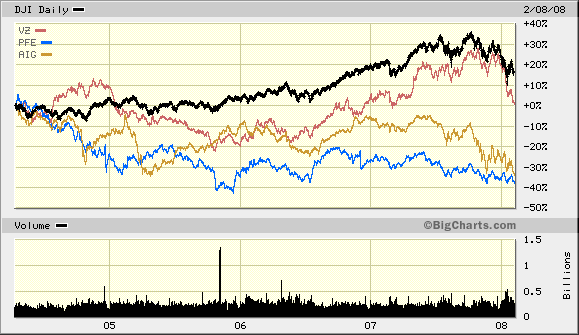
Being added to the Dow isn’t much of a buy signal. Here’s what happened since AIG (AIG), Pfizer (PFE) and Verizon (VZ) were added in 2004:
Here’s what happened when Microsoft (MSFT), Intel (INTC), SBC (SBC) and Home Depot (HD) were added in 1999:
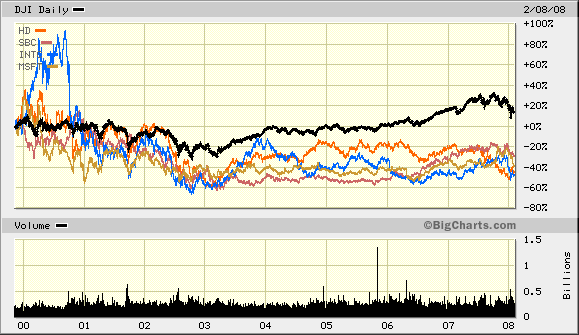
The Dow is zero for the last seven. -
Calling All Technical Analysts
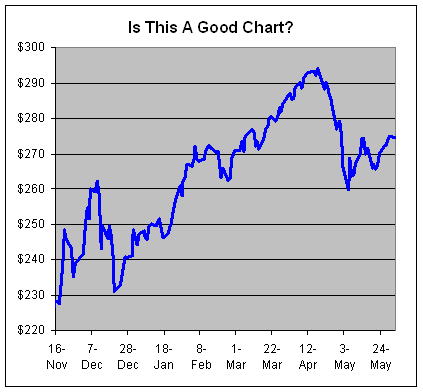
Posted by Eddy Elfenbein on February 8th, 2008 at 2:21 pmIs this a good chart?
-
Department of Strained Metaphors
Posted by Eddy Elfenbein on February 8th, 2008 at 1:26 pmThe goal of monetary is famously described as taking away the punchbowl once the party gets started. Dallas Fed president Richard Fisher explains his dissenting vote:
In the current financial-market turmoil, credit markets have been cutting back on lending to important segments of the nation’s economy. As a result, “instead of taking the punchbowl away, the Fed is now faced with the task of replenishing the punch,” Dallas Fed president Richard Fisher said Thursday.
Monetary policy acts with a lag, much like “good single malt whisky or perhaps truly great tequila,” Fisher told an audience in Mexico City.
“It takes time before you feel its full effect,” he explained.
“My dissenting vote last week was simply a difference of opinion about how far and how fast we might re-spike the monetary punchbowl,” Fisher said.Yes, but cutting 125 points in eight days is less like tequila and closer to doing lines of blow off the hooker’s ass.
-
The $72 Billion Social-Climber
Posted by Eddy Elfenbein on February 7th, 2008 at 12:30 pmIf you get a chance, I recommend Irwin M. Stelzer’s article on Jérôme Kerviel and Société Général. It’s a complex story and there’s more going on than appears. The scandal seems to have taken on a Tom Wolfe-like angle with socio-political dimensions as well.
-
Trading Is Like Sex and Drugs
Posted by Eddy Elfenbein on February 7th, 2008 at 12:15 pmIt’s official, we’re all trading junkies. The New York Times reports:
It is easy to dismiss Jérôme Kerviel, the rogue trader at Société Générale, as a fluke.
So here is a sobering thought for Wall Street: There may be a bit of Mr. Kerviel in all of us.
A small group of scientists, including some psychologists, say they are starting to discover what many Wall Street professionals have long suspected — that people are hard-wired for money. The human brain, these researchers say, responds to high-stakes trading just as it does to the lure of sex. And the riskier the trades get, the more the brain craves them.If trading is like sex, then think of Crossing Wall Street as your friend with benefits.
-
Buy List Updates
Posted by Eddy Elfenbein on February 7th, 2008 at 11:15 amThere are a few news items to pass along for stocks on our Buy List. Danaher (DHR) was upgraded at Deutsche Bank from Hold to Buy.
Joe Banks (JOSB) reported that same-store sales dropped 1.2% in January. The company forecasts earnings growth of 12% to 14% for 2008.
Yesterday, Fiserv (FISV) reported Q4 earnings of 69 cents a share (after charges), two pennies below the Street. The company sees 2008 EPS of $3.33 to $3.47. That seems like low-balling to me. The Street was looking for $3.46. -
Dow Jones Channels Emily Litella
Posted by Eddy Elfenbein on February 7th, 2008 at 10:38 amDo you remember Gilda Radnor’s SNL character Emily Litella? She was the older lady who would do news commentary on an item that she invariably misheard. This led her to discuss topics such as free Soviet jewelry, Presidential erections or making Puerto Rico a steak.
Yesterday, Dow Jones reported that Warren Buffett said that if the current account deficits continue, the dollar will be “worthless.”
One small problem. He actually said it will be “worth less.”
Nevermind.
(Via DealBreaker) -
That’s Our Ballmer
Posted by Eddy Elfenbein on February 7th, 2008 at 10:20 amHere’s a small tidbit on Steve Ballmer I noticed in an article on Microsoft/Yahoo:
Ballmer doesn’t delay when he decides on a purchase. Tellme Networks Inc. CEO Mike McCue held meetings with Ballmer for two days before the Super Bowl professional football championship last year and figured his group would hear back after the game.
That Sunday morning, Ballmer, a math major at Harvard College in Cambridge, Massachusetts, called them back in for what he called “Math Camp,” helping him plug numbers into a spreadsheet to decide whether the combination would work. At one point Ballmer grew so excited he started gesturing wildly while holding an open can of soda, spraying McCue and his executives. -
Astrologers offer Year of the Rat stock tips
Posted by Eddy Elfenbein on February 7th, 2008 at 9:47 amFrom Reuters:
Forget about graphs, charts and economic forecasts. Wary investors in Asia are turning to feng shui masters to tell them which way the markets will head in the Chinese Year of the Rat.
Perhaps not surprisingly for investors already burnt by recent stock market slides, feng shui experts are predicting a gloomy year for shares, not good news for those hoping for a rebound in global markets hit by worries over the U.S. economy.
“The rat will become aggressive at the tail end of the year and its underlying water element will cool the stock market,” said Vincent Koh, a feng shui master at Singapore Feng Shui Centre.
Feng shui is popular across East Asia, where it is traditionally practiced by ethnic Chinese. It relies on movements of the cosmos as well as placement of furniture and arranging space to generate a “flow of wealth”.
Believers say it can be used to improve wealth, health and personal relationships.
In Hong Kong and Singapore, it’s taken so seriously that corporations consult feng shui experts about everything from business strategy to interior design. Disneyland changed the angle of the main entrance of its Hong Kong theme park after consulting a feng shui expert.
So great is the interest in feng shui, that CLSA, a regional brokerage house, issued a feng shui client note which predicted the stock market would rise from May to August and the U.S. dollar would remain weak.
“Be mindful of your speculations, especially in the third quarter,” said the note, which CLSA described as “topical” rather than a formal investment advisory.
Raymond Lo, a feng shui master in Hong Kong who does readings for corporations, expects industries linked to earth and metal signs to flourish during the Year of the Rat.
“The rat is a symbol of money to the earth industry … Strong water element in the year indicates productivity and strong activity in the metal industries,” said Lo, who suggested investors put their money into property, mining and gold.
He predicts stock markets will be soft this year as the elements of earth and water, which he says are strong in the Year of the Rat, weaken the fire element that influences shares.
“The water element affects the fire of the markets. I can foresee a lot of correction in the stock market,” said Koh.
With stocks markets from Japan to New York cooling since the start of the year on concerns of a global economic slowdown, sceptics may argue that you don’t need to be a feng shui master to make such predictions.
Yet Malaysian feng shui master Yap Boh Chu is optimistic with predictions that Southeast Asian markets will be stable after a tumultuous start.
“The whole concept we have for the year is the image of a seed sprouting from the ground — the beginning is hard,” he said.The rat is the symbol of money? Not to me. They’re just rats.
-
Archives
- July 2026
- June 2026
- May 2026
- April 2026
- March 2026
- February 2026
- January 2026
- December 2025
- November 2025
- October 2025
- September 2025
- August 2025
- July 2025
- June 2025
- May 2025
- April 2025
- March 2025
- February 2025
- January 2025
- December 2024
- November 2024
- October 2024
- September 2024
- August 2024
- July 2024
- June 2024
- May 2024
- April 2024
- March 2024
- February 2024
- January 2024
- December 2023
- November 2023
- October 2023
- September 2023
- August 2023
- July 2023
- June 2023
- May 2023
- April 2023
- March 2023
- February 2023
- January 2023
- December 2022
- November 2022
- October 2022
- September 2022
- August 2022
- July 2022
- June 2022
- May 2022
- April 2022
- March 2022
- February 2022
- January 2022
- December 2021
- November 2021
- October 2021
- September 2021
- August 2021
- July 2021
- June 2021
- May 2021
- April 2021
- March 2021
- February 2021
- January 2021
- December 2020
- November 2020
- October 2020
- September 2020
- August 2020
- July 2020
- June 2020
- May 2020
- April 2020
- March 2020
- February 2020
- January 2020
- December 2019
- November 2019
- October 2019
- September 2019
- August 2019
- July 2019
- June 2019
- May 2019
- April 2019
- March 2019
- February 2019
- January 2019
- December 2018
- November 2018
- October 2018
- September 2018
- August 2018
- July 2018
- June 2018
- May 2018
- April 2018
- March 2018
- February 2018
- January 2018
- December 2017
- November 2017
- October 2017
- September 2017
- August 2017
- July 2017
- June 2017
- May 2017
- April 2017
- March 2017
- February 2017
- January 2017
- December 2016
- November 2016
- October 2016
- September 2016
- August 2016
- July 2016
- June 2016
- May 2016
- April 2016
- March 2016
- February 2016
- January 2016
- December 2015
- November 2015
- October 2015
- September 2015
- August 2015
- July 2015
- June 2015
- May 2015
- April 2015
- March 2015
- February 2015
- January 2015
- December 2014
- November 2014
- October 2014
- September 2014
- August 2014
- July 2014
- June 2014
- May 2014
- April 2014
- March 2014
- February 2014
- January 2014
- December 2013
- November 2013
- October 2013
- September 2013
- August 2013
- July 2013
- June 2013
- May 2013
- April 2013
- March 2013
- February 2013
- January 2013
- December 2012
- November 2012
- October 2012
- September 2012
- August 2012
- July 2012
- June 2012
- May 2012
- April 2012
- March 2012
- February 2012
- January 2012
- December 2011
- November 2011
- October 2011
- September 2011
- August 2011
- July 2011
- June 2011
- May 2011
- April 2011
- March 2011
- February 2011
- January 2011
- December 2010
- November 2010
- October 2010
- September 2010
- August 2010
- July 2010
- June 2010
- May 2010
- April 2010
- March 2010
- February 2010
- January 2010
- December 2009
- November 2009
- October 2009
- September 2009
- August 2009
- July 2009
- June 2009
- May 2009
- April 2009
- March 2009
- February 2009
- January 2009
- December 2008
- November 2008
- October 2008
- September 2008
- August 2008
- July 2008
- June 2008
- May 2008
- April 2008
- March 2008
- February 2008
- January 2008
- December 2007
- November 2007
- October 2007
- September 2007
- August 2007
- July 2007
- June 2007
- May 2007
- April 2007
- March 2007
- February 2007
- January 2007
- December 2006
- November 2006
- October 2006
- September 2006
- August 2006
- July 2006
- June 2006
- May 2006
- April 2006
- March 2006
- February 2006
- January 2006
- December 2005
- November 2005
- October 2005
- September 2005
- August 2005
- July 2005
 Eddy Elfenbein is a Washington, DC-based speaker, portfolio manager and editor of the blog Crossing Wall Street. His