-
Jeremy Siegel’s Outlook for 2008
Posted by Eddy Elfenbein on December 17th, 2007 at 1:48 pmJeremy Siegel is always worth listening to. Here’s part of his outlook for next year:
Economic Growth
But the impact of the crisis on the psychology of consumers and business will leave their mark. I predict that GDP will slow in the first half of next year to between 1% and 2%, and rise in the second half, as risk premiums come down and the cost of capital falls. Overall I expect 1.5% to 2.5% GDP growth in 2008 and I believe the economy will avoid a recession.
Stocks and Bonds
I think the stock market will have another winning year in 2008. For every percentage point that stock returns fall below 8% (my prediction) this year, they should exceed 8% next year (meaning, for example, if stocks gain 6% this year, they should finish 2008 up 10%).
And I believe that financial stocks, which have plummeted 18% so far this year, will outperform the S&P 500 Index next year as the credit crisis fades.
Interest Rates
What does all this mean for interest rates? The Fed cut the Fed funds rate to 4.25% on December 11, but it will have to do more in the coming months. I believe that the Fed will get rates down to 3.5%, before ratcheting them upward in the second half of next year.
Treasuries did well in 2007, as interest rates on top-rated securities plunged in light of the credit crisis. But as the risk spreads narrow, money will flow away from government bonds and their interest rates will rise. I recommend investors cash in governments and top rated corporate bonds now – you got a nice ride that you won’t get next year. -
Why the Dollar Might Rally
Posted by Eddy Elfenbein on December 17th, 2007 at 11:44 amFrom today’s WSJ:
The belief that the Fed would be forced to sharply reduce interest rates to stimulate economic growth has weighed heavily on the dollar. That is because lower interest rates reduce returns on fixed-income holdings in the currency, making the dollar less attractive to investors.
Instead, investors are focusing on the possibility that further interest-rate cuts might not unfold as expected. Currency strategists say there is a strong belief the Fed will ultimately work to keep prices in line.
One recent challenge to the gloomy view on the economy came Thursday, when data showed retail sales in November were more resilient than predicted. The figures suggested “we don’t really have a freefall in the U.S. economy,” says Adnan Akant, a currency specialist at money manager Fischer Francis Trees & Watts. “It’s slowing down but not falling out of bed.”
Then on Friday, government data showed inflation last month was stronger than expected. That generated a fresh wave of dollar buying, pushing the greenback up about 1.4% against the euro in a day. Since late November, when the dollar weakened to a record low versus the euro, it has strengthened about 3%. Still, the dollar remains 8.5% weaker against the euro since the start of the year. Late Friday in New York, one euro fetched $1.4423.
The speed of Friday’s move startled some investors. “Today has been kind of shocking for much of the market,” said John Taylor, head of FX Concepts, a hedge fund that specializes in currency trading. Mr. Taylor says his firm has started shifting its positions from bets that the dollar will weaken to wagers that it will strengthen in coming weeks.
“One, the Fed is now scared of inflation, and two, the numbers keep looking pretty good,” he says. The dollar “has shown more vigor than we thought.” -
Wall Strip Visits Facebook
Posted by Eddy Elfenbein on December 17th, 2007 at 11:02 am -
Eugene Fama on Momentum Stock
Posted by Eddy Elfenbein on December 16th, 2007 at 9:41 pmFrom The Region:
Region: Let me ask you about momentum. You’ve said that it’s the strongest challenge to the hypothesis of market efficiency. Can you elaborate on that?
Fama: There’s evidence that if you rank stocks every month based on their last year of returns, the very extreme winners tend to win for a few more months and the losers tend to lose for a few more months.
That seems to be true in U.S. data beginning around 1950. We don’t have foreign data going back that far, but it tends to be there in major foreign markets except for Japan. It doesn’t tend to be there in the U.S. data for the ’30s and ’40s. So there’s some chance that it is just a chance result. There are so many people looking for anomalies in the data, that may just be the biggest one that they’ve found. Maybe it won’t be there in the future. We don’t know yet.
Region: Is there an opportunity to make money there?
Fama: Well, there isn’t much of an opportunity to make money, because as I said, you do this every month. And if you rank and trade stocks every month, the turnover of these portfolios is enormous.
Region: The costs will eat up the profits.
Fama: Right. The costs will kill you. So the people who have written these papers have said, basically, “This is interesting, but forget about trading on it.” But it’s still interesting. -
Bernice Johnson Reagon
Posted by Eddy Elfenbein on December 14th, 2007 at 4:25 pmIt’s Friday and the market is closed. I am so outta here. Let’s start the weekend with the great Bernice Johnson Reagon.
-
Why Bears Always Have the Best Arguments
Posted by Eddy Elfenbein on December 14th, 2007 at 10:59 amPaul Kedrosky wonders why bears always have the best (or at least, most compeling) arguments:
Even though the stock market has rightly been called the triumph of the optimists, with bulls stomping bears over and over for one hundred years, stock market bears not only haven’t gone away, but they generally have the most compelling arguments. Their points seem so damn plausible, level-headed, empirical, and reasonable, while bulls come across as starry-eyed idealists.
Let’s consider some reasons why that might be:
1. Things fail more often than they succeed. Pace availability heuristics, it is easier to think of examples of things failing than succeeding, so it gives bears more fodder.
2. Bears have the past, and bulls have the future. Bears get to argue from data, while bulls argue from what might happen.
3. Apocalypse is seductive. There is something about the thought of imminent mass ruin that really gets people’s attention, as has happened with the overdone coverage (hello, Matt Drudge!) of the current credit problems in the market.
4. There is a Puritanical urge in America wherein people want to believe they (or better yet, their neighbors) will be punished for their prior success, etc., so it stands to reason that stocks will punish people after they make them a lot of money.
5. Bears have been generally wrong for so long that they have to know how to tell better stories.I agree, especially with points three and four. I’ve also noticed that a wildly bullish forecast that’s wrong will be mocked far more than a wildly bearish forecast. I call this the Elfenbein Asymmetrical Railing of a Lousy Forecast Syndrome.
Just a few days ago, Paul Krugman made fun of James Glassman being appointed head of our public diplomacy efforts. However, Krugman was wildly wrong about the market being a bubble in 2003. That call hasn’t seemed to tarnish his reputation. Robert Shiller’s reputation as a market sage is, in my opinion, completely unwarranted.
Bearish arguments are usually more interesting because they focus on the causes and the effect is left to each person’s imagination. It’s like in a horror movie where you rarely see the scary guy.
One day I hope to write a book called, “Alarmism and How It Threatens Your Children.” -
Inflation’s Impact on the Stock Market
Posted by Eddy Elfenbein on December 14th, 2007 at 10:26 amSo how does inflation affect the market? Well, it’s not good. Inflation is a tax on capital. It’s a way for the government to get your money without asking. In fact, the only thing worse than inflation is deflation.
I took 80 years of monthly stock market return and ranked them by inflation (lowest to highest). Then I wanted to see the cumulative return as the rate of inflation increased. Here are the results.
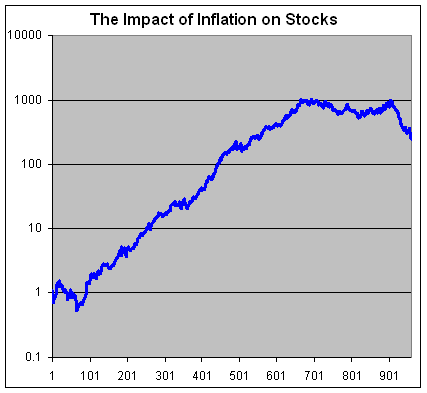
At the far left are the most deflationary months, and the far right are the most inflationary. The blue line shows the after-inflation cumulative return of the market.
As you can see, deflation has a negative impact on equity prices. The market falls until about the 70th data point which corresponds with an annualized deflation rate of 5.5%. The vast majority of those months were in the 1930s.
Stocks rise very steadily until it hits a brick wall around data point 660. That corresponds with an inflation rate of 5.1%. -
CPI Surge
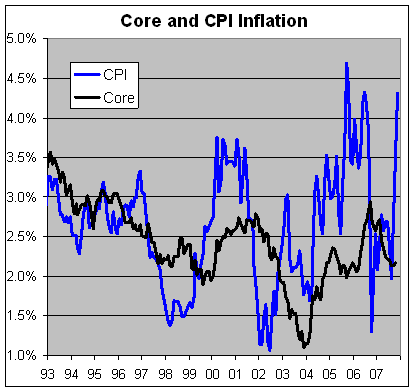
Posted by Eddy Elfenbein on December 14th, 2007 at 9:25 amThe government just reported that consumer inflation surged 0.8% last month. That’s the fastest rate in more than two years. The year-over-year rate is now 4.31%, which is slightly more than where the Fed is. Still, I’m an inflation skeptic. The government’s numbers most certainly understate the rate of inflation, but I’m only concerned if inflation seems to be getting out of hand.
The core rate was just 0.3% last month. Yes, yes, I know the core rate comes in for a lot of criticism, but I think it’s important to watch. For nearly twelve straight years, the year-over-year core rate has never been greater than 3% or less than 1%. Also, long-term interest rates are still quite low.
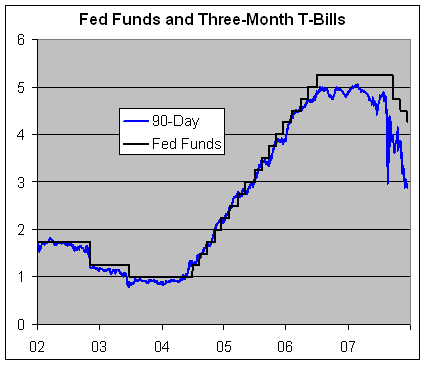
In fact, more Fed rate cuts could be on the way. The rate on short-term Treasury bills are still far below the Fed Funds rate. Yesterday, the T-bill rate closed at 2.78%, the lowest since the August panic. The Fed is about 140 basis points above the market.
-
Bill Miller on Risk
Posted by Eddy Elfenbein on December 13th, 2007 at 3:03 pmVia B-Ritz:
You also know that rising stock prices mean lower future rates of return and falling stock prices mean higher rates of return. So I was much happier in the summer of ’02 when you buy everything on sale than I was in the Spring of 2000 when a lot of things were super-expensive.
My view is that the evidence is overwhelming that most people are too risk averse. And that therefore they should be taking a lot more risk than they feel like is right.
The problem is that real risk and perceived risk are two different things. And that’s where people get into trouble, because they perceive risk to be high when prices are low, and they perceive risk to be low when prices are high. That’s the psychological problem that most people have. -
Buy List Update
Posted by Eddy Elfenbein on December 13th, 2007 at 12:34 pmGood news from Jos. A Bank Clothiers (JOSB). The company just reported earnings of 38 cents a share, which is a big jump from the 30 cents it made in the same quarter a year ago. The Street was looking for earnings of 33 cents a share. Sales rose 10% to $131.3 million.
This stock has had a bizarre year. For the first half of the year, it charged out of the gate and gave us a quick 57% profit. It then took it all back and we’re now in the red. But I still like JOSB and the numbers look good.
Late yesterday, Danaher (DHR) reaffirmed its Q4 outlook for EPS of $1.09 to $1.14. Sometimes investors ignore these “reaffirm” stories. I don’t. It’s one thing to say earnings will be good, but it’s nice to see a company follow-up on their forecast, even if it’s just reaffirming. DHR expects 2008 EPS to range between $4.30 to $4.40.
-
Archives
- July 2026
- June 2026
- May 2026
- April 2026
- March 2026
- February 2026
- January 2026
- December 2025
- November 2025
- October 2025
- September 2025
- August 2025
- July 2025
- June 2025
- May 2025
- April 2025
- March 2025
- February 2025
- January 2025
- December 2024
- November 2024
- October 2024
- September 2024
- August 2024
- July 2024
- June 2024
- May 2024
- April 2024
- March 2024
- February 2024
- January 2024
- December 2023
- November 2023
- October 2023
- September 2023
- August 2023
- July 2023
- June 2023
- May 2023
- April 2023
- March 2023
- February 2023
- January 2023
- December 2022
- November 2022
- October 2022
- September 2022
- August 2022
- July 2022
- June 2022
- May 2022
- April 2022
- March 2022
- February 2022
- January 2022
- December 2021
- November 2021
- October 2021
- September 2021
- August 2021
- July 2021
- June 2021
- May 2021
- April 2021
- March 2021
- February 2021
- January 2021
- December 2020
- November 2020
- October 2020
- September 2020
- August 2020
- July 2020
- June 2020
- May 2020
- April 2020
- March 2020
- February 2020
- January 2020
- December 2019
- November 2019
- October 2019
- September 2019
- August 2019
- July 2019
- June 2019
- May 2019
- April 2019
- March 2019
- February 2019
- January 2019
- December 2018
- November 2018
- October 2018
- September 2018
- August 2018
- July 2018
- June 2018
- May 2018
- April 2018
- March 2018
- February 2018
- January 2018
- December 2017
- November 2017
- October 2017
- September 2017
- August 2017
- July 2017
- June 2017
- May 2017
- April 2017
- March 2017
- February 2017
- January 2017
- December 2016
- November 2016
- October 2016
- September 2016
- August 2016
- July 2016
- June 2016
- May 2016
- April 2016
- March 2016
- February 2016
- January 2016
- December 2015
- November 2015
- October 2015
- September 2015
- August 2015
- July 2015
- June 2015
- May 2015
- April 2015
- March 2015
- February 2015
- January 2015
- December 2014
- November 2014
- October 2014
- September 2014
- August 2014
- July 2014
- June 2014
- May 2014
- April 2014
- March 2014
- February 2014
- January 2014
- December 2013
- November 2013
- October 2013
- September 2013
- August 2013
- July 2013
- June 2013
- May 2013
- April 2013
- March 2013
- February 2013
- January 2013
- December 2012
- November 2012
- October 2012
- September 2012
- August 2012
- July 2012
- June 2012
- May 2012
- April 2012
- March 2012
- February 2012
- January 2012
- December 2011
- November 2011
- October 2011
- September 2011
- August 2011
- July 2011
- June 2011
- May 2011
- April 2011
- March 2011
- February 2011
- January 2011
- December 2010
- November 2010
- October 2010
- September 2010
- August 2010
- July 2010
- June 2010
- May 2010
- April 2010
- March 2010
- February 2010
- January 2010
- December 2009
- November 2009
- October 2009
- September 2009
- August 2009
- July 2009
- June 2009
- May 2009
- April 2009
- March 2009
- February 2009
- January 2009
- December 2008
- November 2008
- October 2008
- September 2008
- August 2008
- July 2008
- June 2008
- May 2008
- April 2008
- March 2008
- February 2008
- January 2008
- December 2007
- November 2007
- October 2007
- September 2007
- August 2007
- July 2007
- June 2007
- May 2007
- April 2007
- March 2007
- February 2007
- January 2007
- December 2006
- November 2006
- October 2006
- September 2006
- August 2006
- July 2006
- June 2006
- May 2006
- April 2006
- March 2006
- February 2006
- January 2006
- December 2005
- November 2005
- October 2005
- September 2005
- August 2005
- July 2005
 Eddy Elfenbein is a Washington, DC-based speaker, portfolio manager and editor of the blog Crossing Wall Street. His