-
Dividends Continue to Rise
Posted by Eddy Elfenbein on December 28th, 2007 at 8:27 pmI often hear market bears describe the current market as “a bubble.” What I find interesting is that if this is a bubble, it’s got to be one of the few bubbles where stock prices have generally lagged growth in both earnings and dividends.
S&P just reported that dividends for the S&P 500 grew by 11.5% over last year. They’re also projecting a 9.3% growth for next year. This means that in the last four years, dividends have grown by 60%.
The overall dividend rate is still very low—less than 2%. But don’t overestimate how quickly these payments can add up. Over the last five-and-a-half years, dividends have contributed about 10% to the overall return of the S&P 500. That’s around 1,300 Dow points.
S&P also added five new stocks to its list of Dividend Aristocrats. These are companies that have increased their dividend every year for the last 25 years. The stocks are Avery Dennison, Exxon Mobil, Integrys Energy, Pitney Bowes and our very own AFLAC (AFL).
Here’s a complete list of Dividend Aristocrats. There’s also an ETF for the Dividend Aristocrats, symbol SDY. -
Projected Earnings Growth
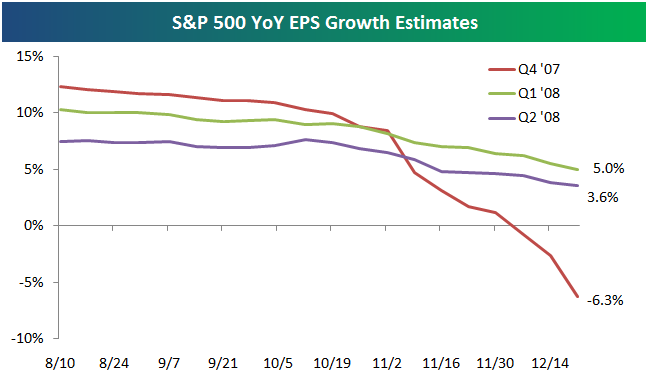
Posted by Eddy Elfenbein on December 27th, 2007 at 3:46 pmThe lads at Bespoke Investment Group have tracked projected earnings growth for the S&P 500. Or I should say, lack of growth. For Q4, analysts now expect a decline of 6.3%. In August, analysts were expecting 12.3% growth.
Q1 has been pared back to 5% growth and Q2 is now at 3.6%.
-
NICK Under $7 a Share
Posted by Eddy Elfenbein on December 27th, 2007 at 1:43 pmI hope to have more about this sometime soon, but gosh darn it—Nicholas Financial (NICK) is cheap. The stock is priced as if it’s going out of business. NICK is currently priced well below book value which is $7.30 a share. Last quarter, NICK made 25 cents a share, and it made 27 cents in the quarter before that.
We’ll find out more when the company reports its third-quarter earnings next month. I think it’s very reasonable to assume that NICK will make $1 a share for this fiscal year. That means the P/E ratio is under 7. -
10-Year-Old Cramer
Posted by Eddy Elfenbein on December 26th, 2007 at 9:06 pmWatch out, Jim. He’s got your game.
-
Apocalypse When?
Posted by Eddy Elfenbein on December 26th, 2007 at 8:42 pmAs long-time readers of this site know, one of my pet peeves is the lack of balance in accountability between overly bearish and overly bullish predictions.
Simply put: You can say that the sky is about to fall until your blue in the face, and be completely wrong, and few people will hold you accountable. As long as you’re vague about time and stress the “about to” part.
On the other hand, if you’re bullish and wrong, you’ll be mocked until the cows come home. Or the bears, whichever comes first.
Nouriel Roubini is probably the most prominent bear on Wall Street. I like his analysis even if I don’t always agree with it. Of course, I don’t read people to have my views confirmed. I want them challenged.
I do want to point out that Roubini’s predictions haven’t exactly been spot on. In June 2006, he wrote:So, this Q2 GDP report is as bad as it could be. I thus stick with my prediction that, by Q4, the growth rate will be close to zero and by early 2007 the U.S. will be in a recession. Panglossian optimists have been proven wrong again. They’d better start adjusting their wishful-thinking forecasts of H2 growth (still close to a 3% consensus) to a reality of an economy rapidly slipping into an nasty recession.
A wee bit off, no? To be fair, his views are more complicated than this bit suggests. I’m not trying to pick on him. Instead, my point is to show that it’s easy to get carried away with your hypothesis, and suffer from confirmation bias.
One of the problems is that even if you’re right, you still can be wrong. The U.S. economy is titanically complex. There are millions of consumers making several economic decisions every day. Still, the real economic growth rate for the past 40 years has been about 3%. To be a bit more refined, it’s about 3.07%. What’s truly surprising it how little it varies.
Here’s a look at GDP growth (blue) compared with a 3.07% trend line (red). I apologize that the table is lame but that’s my point.
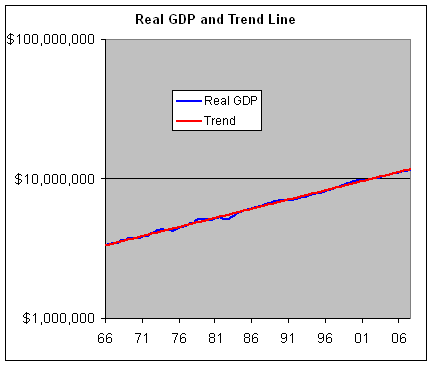
So even when these “crisis” do come along, the overall economy is incredibly resilient. My prediction is that at some point, a recession will come along. It will be short and unpleasant, but after it, a recovery will follow. -
Amazon’s Best Holiday Ever
Posted by Eddy Elfenbein on December 26th, 2007 at 10:39 amAmazon.com just celebrated its best Holiday EVER. Jeff Mathews isn’t impressed. He finds that today’s press release kinda looks familiar:
12/26/2007 “Amazon Wraps Up Its 13th Holiday With Best Season Ever”
12/26/2006 “Amazon.com’s 12th Holiday Season is Best Ever”
12/26/2005 “Amazon.com, Inc. today announced that the 2005 holiday season finished as its best ever…”
12/27/2004 “Amazon.com’s Tenth Holiday Season is Best Ever…”
12/26/2003 “Amazon.com Wraps Up Its Ninth Holiday With Busiest Season Ever.”
12/26/2002 “Amazon.com today announced it has finished its busiest holiday season ever…” -
Merry Everything!
Posted by Eddy Elfenbein on December 25th, 2007 at 12:08 pm
I want to wish everyone a Happy Holiday, and a healthy and profitable New Year.
I also want to thank all my readers for their support. Everyday, I get e-mail from readers all over the world. I try to respond to as much as I can, but unfortunately, I can’t get to it all. But I assure you that every e-mail is read and the correspondence helps me with my posts.
I don’t charge a dime to use Crossing Wall Street and I don’t run any ads. It’s all a labor of love. In fact, not only is this site free, but I give away market-beating advice. Through Monday, the Buy List is up 6.12%, and there were zero transaction costs throughout the year. So if you started with, say, $100 million to invest, then I made you $6.12 million. If you started with $100 billion, then I made you $6.12 billion.
Since I’m so generous, I’ll give you one more thing. This. -
Inefficient Markets
Posted by Eddy Elfenbein on December 23rd, 2007 at 2:16 pm -
Pats-Dolphins
Posted by Eddy Elfenbein on December 23rd, 2007 at 8:23 amThe New England Patriots are set to play the Miami Dolphins, which is a match-up between the best team in the league and the worst. How do you set a point spread for such an extreme event?
Vegas has decided on 21-1/2 points. Just like the stock market, this is the collective judgment of many, many um…investors. The New York Times notes that the Pats have failed to cover in four of their last six games.The possibility of the Patriots’ becoming the N.F.L.’s second unbeaten champion has captured the nation’s fascination. At the same time, they seem to have rewritten the rule book when it comes to sports gambling. Not only are the Patriots close to setting several N.F.L. records, including most points and touchdowns, but their march to perfection has also set bank-breaking numbers that have astounded the sports-gambling culture.
“We try to come up with a line that at least gives the perception that either team has an equal chance to cover, and for his backer to win,” said Jeff Sherman, assistant race and sports book manager at the Las Vegas Hilton. “We just want to split the action — it sounds like it’s pretty simple. But this year with the Patriots, things are way out of whack.”Out of whack? So the Pats are a market dislocation.
-
Abbey Road Webcam
Posted by Eddy Elfenbein on December 22nd, 2007 at 11:01 pmSee what’s happening live at the spot where the Beatles walked across the street.
Strangely, I kept watching for something to happen but it never did. Although, two double-decker buses passed by.
-
Archives
- October 2026
- September 2026
- August 2026
- July 2026
- June 2026
- May 2026
- April 2026
- March 2026
- February 2026
- January 2026
- December 2025
- November 2025
- October 2025
- September 2025
- August 2025
- July 2025
- June 2025
- May 2025
- April 2025
- March 2025
- February 2025
- January 2025
- December 2024
- November 2024
- October 2024
- September 2024
- August 2024
- July 2024
- June 2024
- May 2024
- April 2024
- March 2024
- February 2024
- January 2024
- December 2023
- November 2023
- October 2023
- September 2023
- August 2023
- July 2023
- June 2023
- May 2023
- April 2023
- March 2023
- February 2023
- January 2023
- December 2022
- November 2022
- October 2022
- September 2022
- August 2022
- July 2022
- June 2022
- May 2022
- April 2022
- March 2022
- February 2022
- January 2022
- December 2021
- November 2021
- October 2021
- September 2021
- August 2021
- July 2021
- June 2021
- May 2021
- April 2021
- March 2021
- February 2021
- January 2021
- December 2020
- November 2020
- October 2020
- September 2020
- August 2020
- July 2020
- June 2020
- May 2020
- April 2020
- March 2020
- February 2020
- January 2020
- December 2019
- November 2019
- October 2019
- September 2019
- August 2019
- July 2019
- June 2019
- May 2019
- April 2019
- March 2019
- February 2019
- January 2019
- December 2018
- November 2018
- October 2018
- September 2018
- August 2018
- July 2018
- June 2018
- May 2018
- April 2018
- March 2018
- February 2018
- January 2018
- December 2017
- November 2017
- October 2017
- September 2017
- August 2017
- July 2017
- June 2017
- May 2017
- April 2017
- March 2017
- February 2017
- January 2017
- December 2016
- November 2016
- October 2016
- September 2016
- August 2016
- July 2016
- June 2016
- May 2016
- April 2016
- March 2016
- February 2016
- January 2016
- December 2015
- November 2015
- October 2015
- September 2015
- August 2015
- July 2015
- June 2015
- May 2015
- April 2015
- March 2015
- February 2015
- January 2015
- December 2014
- November 2014
- October 2014
- September 2014
- August 2014
- July 2014
- June 2014
- May 2014
- April 2014
- March 2014
- February 2014
- January 2014
- December 2013
- November 2013
- October 2013
- September 2013
- August 2013
- July 2013
- June 2013
- May 2013
- April 2013
- March 2013
- February 2013
- January 2013
- December 2012
- November 2012
- October 2012
- September 2012
- August 2012
- July 2012
- June 2012
- May 2012
- April 2012
- March 2012
- February 2012
- January 2012
- December 2011
- November 2011
- October 2011
- September 2011
- August 2011
- July 2011
- June 2011
- May 2011
- April 2011
- March 2011
- February 2011
- January 2011
- December 2010
- November 2010
- October 2010
- September 2010
- August 2010
- July 2010
- June 2010
- May 2010
- April 2010
- March 2010
- February 2010
- January 2010
- December 2009
- November 2009
- October 2009
- September 2009
- August 2009
- July 2009
- June 2009
- May 2009
- April 2009
- March 2009
- February 2009
- January 2009
- December 2008
- November 2008
- October 2008
- September 2008
- August 2008
- July 2008
- June 2008
- May 2008
- April 2008
- March 2008
- February 2008
- January 2008
- December 2007
- November 2007
- October 2007
- September 2007
- August 2007
- July 2007
- June 2007
- May 2007
- April 2007
- March 2007
- February 2007
- January 2007
- December 2006
- November 2006
- October 2006
- September 2006
- August 2006
- July 2006
- June 2006
- May 2006
- April 2006
- March 2006
- February 2006
- January 2006
- December 2005
- November 2005
- October 2005
- September 2005
- August 2005
- July 2005
 Eddy Elfenbein is a Washington, DC-based speaker, portfolio manager and editor of the blog Crossing Wall Street. His