-
The Mortgage Lender Implode-O-Meter
Posted by Eddy Elfenbein on February 28th, 2007 at 12:33 pmWhat a great idea for a Web site:
Latest count of major US mortgage lenders that have croaked since late 2006: 27
-
U.S. Dollar Drops Against Counterfeit U.S. Dollar
Posted by Eddy Elfenbein on February 28th, 2007 at 12:22 pmThe Onion is on the scene:
NEW YORK—At the close of trading Monday, the U.S. dollar dipped to a record low of $.60 against the counterfeit U.S. dollar, which also outpaced the dollar against the euro and the yen.
“We don’t even accept regular U.S. dollars anymore,” said Union, NJ 7-Eleven manager Rick Grove, echoing the sentiments of merchants nationwide. “We’ve gotten stung a few times taking in the real ones. I always tell my cashiers, if it feels fake to the touch, and you can’t see both sides when you hold it up to the light, it’s fine.”
Concerned about further devalutation of standard U.S. currency, Federal Reserve Chairman Ben Bernanke has suggested that Congress outlaw counterfeit bills entirely.As funny as this sounds, there is a real life parallel. In 1869, Jay Gould and Jim Fisk tried to corner the gold market. The price of gold, expressed as a premium to dollars, went to 160. On September 24, Black Friday, the government dumped gold on the market, and the premium instantly fell to 130. Here’s a cartoon.
-
Wall Street Through the Looking Glass
Posted by Eddy Elfenbein on February 28th, 2007 at 11:49 amOne more word about yesterday: The sell-off was not caused by a computer glitch.
The sell-off was already happening. The glitch was in the accurate reporting of what was happening. This is Wall Street going through the looking glass. If stocks are going down, and no one reports it, are they really going down?
When the computers finally caught up with the trades (see video), some traders thought it was an obvious misprint. No, everything until that point was incorrect. Only when they learned what they really had been doing did they start to panic. At which point, stocks started to rise. -
What’s Happening to Goldman’s China Goldmine?
Posted by Eddy Elfenbein on February 28th, 2007 at 11:06 amShares of Goldman Sachs (GS) were whacked especially hard yesterday. I noted that it was the eighth-worst performing stock in the entire S&P 500.
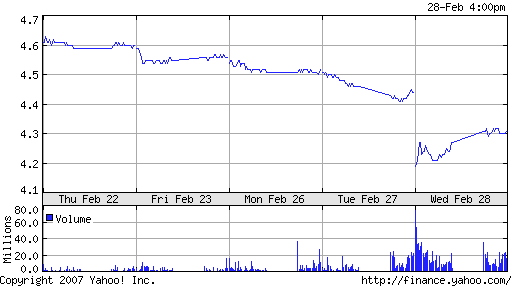
The reason may have to do with the Industrial & Commercial Bank of China, or ICBC (1398.HK). Last year, Goldman put up $2.6 billion for 5% of the bank. Hank Paulson made several trips to China to secure a role in the IPO. In the end, Goldman lost out to Merrill, Credit Suisse and Deutsche Bank.
Despite the snub, when the shares went public last year, Goldman made a huge profit. In fact, it was probably the largest profit for any trade anywhere. In less than nine months, Goldman made $4 billion. The investment was made with Goldman’s GS Capital Partners V fund, which is heavily owned by Goldman’s top execs.
But look at ICBC lately:
-
Today’s GDP Revision
Posted by Eddy Elfenbein on February 28th, 2007 at 10:19 amThe government updated its fourth-quarter GDP report today. Instead of growing by 3.5%, it turns out that the economy only grew by 2.2%. That’s the biggest revision in ten years. Still, if you look at it in the larger context, it’s not that big of a change.
Here, if you squint real hard, you might be able to make it out:
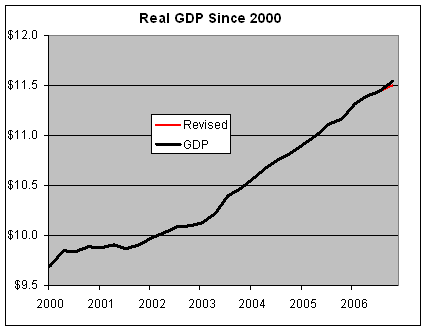
What’s interesting is that this is the third straight quarter of below-trend GDP growth. But it’s not that far below trend. From September 2003 to March 2006, the economy grew at annualized rate of 3.4%. For the last three quarters, it has averaged 2.2% growth. That’s slower growth, but there’s still no evidence of a recession. -
Boo Hoo!
Posted by Eddy Elfenbein on February 28th, 2007 at 7:36 amOh, boo hoo, people! You think this is crash? Please, this ain’t no crash.
We’ve become so used to no volatility, we forgot what a normal market acts like. I’m sorry, but this was nothing compared to the olden days, say 1999. Yesterday may have been the worst day in four years, but going back ten years, it was ranks just twelfth. Twelfth, people!
Back then, we would have laughed at this. Four hundred points? Please, that was a lunch break. There were three days worse than this in August ‘98 alone.
Let’s see how bad the big bad bear is. For the year, the S&P 500 is now down 1.36%. OMG! Throw in dividends, and it’s down 1.05%. Are you heading for the hills now?
So what went wrong? I dunno. When in doubt, I blame the Fed. It’s easy to do, and there’s always a chance someone accidentally told the truth. But this time, we have two Fed chairmen in play, old and new, Benilocks and the Maestro.
The former Fed chair is the more likely suspect. He was in the Far East, and according to the AP, Greenspeak was in top form:Former U.S. Federal Reserve Chairman Alan Greenspan warned Monday that the American economy might slip into recession by year’s end. . . .
“While, yes, it is possible we can get a recession in the latter months of 2007, most forecasters are not making that judgment and indeed are projecting forward into 2008 . . . with some slowdown,” he said.
Greenspan said that while it would be “very precarious” to try to forecast that far into the future, he could not rule out the possibility of a recession late this year.Perhaps there’s a chance that the media could possibly use what some might believe is possibly the most provocative headline: “Greenspan Warns of Likely U.S. Recession.”
(H/T: BOTW)
All observers agreed that the trouble started in China. The market there fell by nearly 9%, which was the worst day there in a decade. OK, so what caused China to wobble?
According to Bloomberg:Stocks fell yesterday after the State Council, China’s highest ruling body, approved a special task force to clamp down on illegal activities in the market. Investors were concerned the Chinese government would impose further measures as the National People’s Congress, China’s legislature, meets next week.
Let me get this right. My portfolio took a hit because of the Chinese National People’s Congress? Talk about globalization. First, the bird flue, now a special task force of the State Council. Now there’s a winning combo, discarded 19th century economic theory and 21st century securities regulation!
I’m sorry, but I can’t accept that some Communist bureaucrat is the reason for the loss of half-a-trillion dollars. What kind of connection does a company like Graco (GGG) have to Shanghai margin requirements? Outside the occasional takeout, I’m guessing it’s pretty slim.
Let’s look at the indexes for some clues. It wasn’t a size issue. The S&P 500 and Small-Cap 600 (^SML) were down nearly identical amounts (3.47% and 3.50%). But the Mid-Cap 400 (^MID) was only down 3.08%.
Nor was it a valuation issue. The Growth Index (^SGX) was down 3.49% and the Value Index (^SVX) was down 3.45%.
Here’s the most telling fact about yesterday: There were 4.24 billion shares traded on the NYSE; 4.19 billion was down volume, just 45 million was up volume. That wasn’t a typo, 45 million. Declining volume led advancing volume by more than 93-to-1. Declining issues led advancers by more than six-to-one.
This was no boat accident. And it wasn’t China either. It was a broad-based sell-off. -
Today’s S&P 500
Posted by Eddy Elfenbein on February 27th, 2007 at 11:18 pmHere’s a spreadsheet detailing the performance of every stock in the S&P 500 today.
Goldman Sachs (GS) fell 6.65%, making it the eighth-worst performing stock in the index today.
Pfizer‘s (PFE) dividend yield is now 4.61%, which is roughly equal to the 30-year Treasury bond (^TYX). Seven years ago, Pfizer yielded 1.4% while the 30-year T-bond yielded 6.2%. -
CNBC from 2:59 to 3:04
Posted by Eddy Elfenbein on February 27th, 2007 at 8:38 pmWatch as the CNBC crew reacts to the Dow’s plunge. Or rather, reacting to the NYSE’s computers catching up to the Dow’s plunge.
-
-416.02
Posted by Eddy Elfenbein on February 27th, 2007 at 6:21 pmI’m currently writing to you from the ledge of the 87th Floor of the Crossing Wall Street Tower.
The good news is that this is a terrific view. The downside, of course, is the market today. The crackup yesterday in China has spread to the U.S. At one point, the Dow was off by 546 points. The Dow bounced off that level and finished 416 points lower.
The S&P 500 fell to 1399.04, a drop of 3.47%, which is the index’s worst day since March 24, 2004.
In about 30 seconds, the Dow lost over 200 points.
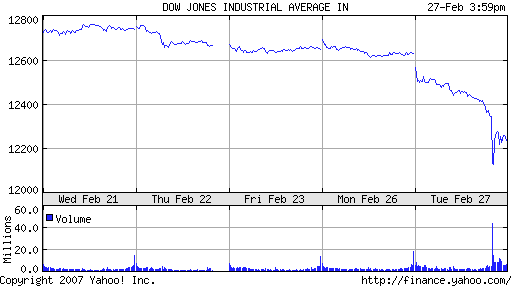
Notice how the big drop in the Dow wasn’t mirrored by the S&P 500.
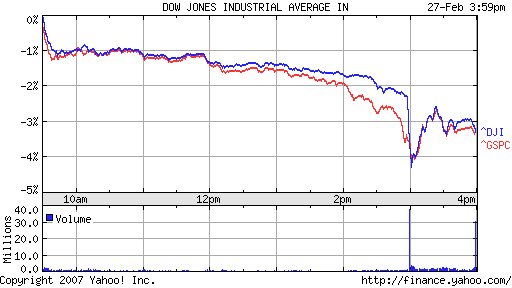
Update: Dow Jones blames it on the computers. Humans apparently are not at fault. (Whew!)
The S&P 500 was down 3.47%, while our Buy List lost 3.19%. For the year, the S&P is down 1.36%, and the Buy List is down 0.28%.
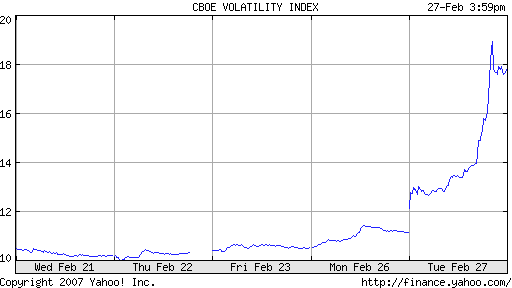
One of the biggest changes today came from the CBOE Volatility Index (^VIX). Look at this jump:
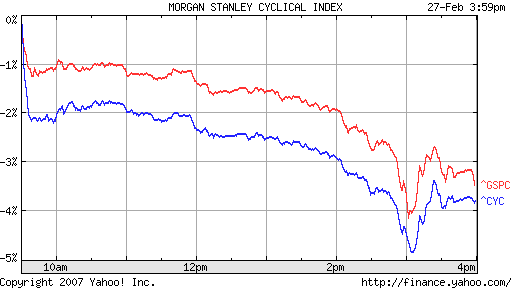
Every Dow industry group fell today. Of the 500 stocks in the S&P 500, 498 closed lower. Only Radio Shack (RSH) and Questar (STR) rallied today. Cyclical stocks were especially hard hit. The Morgan Stanley Cyclical Index (^CYC) fell 3.86%.
My timing was impeccable. Five days ago, I wrote another defense of the bull. But as I look at today’s market, I really haven’t changed my mind. I was happy to see that gold fell and money went towards bonds. The 10-year Treasury (^TNX) is nearly at 4.5%. This tells us that money isn’t leaving the market, but it’s merely going to higher ground. -
The Importance of Rounding
Posted by Eddy Elfenbein on February 27th, 2007 at 11:32 amThis abstract wants to look at the impact that numerical rounding used in economic reports has on the markets. This may yield some interesting results.
I’ve noticed that the initial press articles on some data points are often slightly off-key because, say, inflation didn’t rise by 0.2%–it really rose by 0.015%. Because they’re fairly low numbers, I think the phenomenon is most common with the unemployment and inflation reports.
I should add that there’s probably a grad paper to be written (pay attention finance ABDs!!) about the impact of rounding in EPS reporting. I’ll bet there are many companies that always seems to land on the decimal of “point five” every quarter (i.e., they earn 52.5 cents a share, or 18.5 cents a share).
Maybe the media could look into it. After all, we live in an era when reporters can win the Polk Award for bravely uncovering some fairly minor accounting misstatements.
-
Archives
- July 2026
- June 2026
- May 2026
- April 2026
- March 2026
- February 2026
- January 2026
- December 2025
- November 2025
- October 2025
- September 2025
- August 2025
- July 2025
- June 2025
- May 2025
- April 2025
- March 2025
- February 2025
- January 2025
- December 2024
- November 2024
- October 2024
- September 2024
- August 2024
- July 2024
- June 2024
- May 2024
- April 2024
- March 2024
- February 2024
- January 2024
- December 2023
- November 2023
- October 2023
- September 2023
- August 2023
- July 2023
- June 2023
- May 2023
- April 2023
- March 2023
- February 2023
- January 2023
- December 2022
- November 2022
- October 2022
- September 2022
- August 2022
- July 2022
- June 2022
- May 2022
- April 2022
- March 2022
- February 2022
- January 2022
- December 2021
- November 2021
- October 2021
- September 2021
- August 2021
- July 2021
- June 2021
- May 2021
- April 2021
- March 2021
- February 2021
- January 2021
- December 2020
- November 2020
- October 2020
- September 2020
- August 2020
- July 2020
- June 2020
- May 2020
- April 2020
- March 2020
- February 2020
- January 2020
- December 2019
- November 2019
- October 2019
- September 2019
- August 2019
- July 2019
- June 2019
- May 2019
- April 2019
- March 2019
- February 2019
- January 2019
- December 2018
- November 2018
- October 2018
- September 2018
- August 2018
- July 2018
- June 2018
- May 2018
- April 2018
- March 2018
- February 2018
- January 2018
- December 2017
- November 2017
- October 2017
- September 2017
- August 2017
- July 2017
- June 2017
- May 2017
- April 2017
- March 2017
- February 2017
- January 2017
- December 2016
- November 2016
- October 2016
- September 2016
- August 2016
- July 2016
- June 2016
- May 2016
- April 2016
- March 2016
- February 2016
- January 2016
- December 2015
- November 2015
- October 2015
- September 2015
- August 2015
- July 2015
- June 2015
- May 2015
- April 2015
- March 2015
- February 2015
- January 2015
- December 2014
- November 2014
- October 2014
- September 2014
- August 2014
- July 2014
- June 2014
- May 2014
- April 2014
- March 2014
- February 2014
- January 2014
- December 2013
- November 2013
- October 2013
- September 2013
- August 2013
- July 2013
- June 2013
- May 2013
- April 2013
- March 2013
- February 2013
- January 2013
- December 2012
- November 2012
- October 2012
- September 2012
- August 2012
- July 2012
- June 2012
- May 2012
- April 2012
- March 2012
- February 2012
- January 2012
- December 2011
- November 2011
- October 2011
- September 2011
- August 2011
- July 2011
- June 2011
- May 2011
- April 2011
- March 2011
- February 2011
- January 2011
- December 2010
- November 2010
- October 2010
- September 2010
- August 2010
- July 2010
- June 2010
- May 2010
- April 2010
- March 2010
- February 2010
- January 2010
- December 2009
- November 2009
- October 2009
- September 2009
- August 2009
- July 2009
- June 2009
- May 2009
- April 2009
- March 2009
- February 2009
- January 2009
- December 2008
- November 2008
- October 2008
- September 2008
- August 2008
- July 2008
- June 2008
- May 2008
- April 2008
- March 2008
- February 2008
- January 2008
- December 2007
- November 2007
- October 2007
- September 2007
- August 2007
- July 2007
- June 2007
- May 2007
- April 2007
- March 2007
- February 2007
- January 2007
- December 2006
- November 2006
- October 2006
- September 2006
- August 2006
- July 2006
- June 2006
- May 2006
- April 2006
- March 2006
- February 2006
- January 2006
- December 2005
- November 2005
- October 2005
- September 2005
- August 2005
- July 2005
 Eddy Elfenbein is a Washington, DC-based speaker, portfolio manager and editor of the blog Crossing Wall Street. His