-
Chicken Vs. Pork
Posted by Eddy Elfenbein on February 1st, 2007 at 12:21 pmOver the last 30 years, Tyson Foods (TSN) is up 24,000% while Smithfield Foods (SFD) is up by 33,000%.
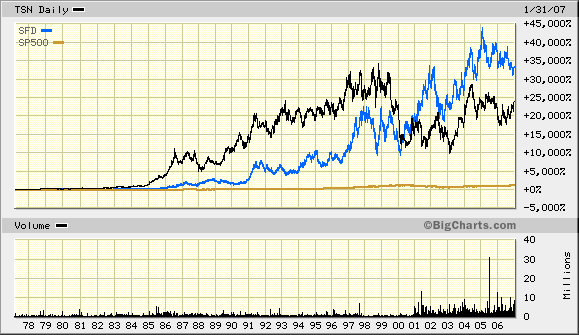
The two stocks have done so well that the S&P 500 (the gold line) looks flat, even though it’s up more than 1,300%. -
Exxon Mobil’s Earnings
Posted by Eddy Elfenbein on February 1st, 2007 at 11:21 amFor 2006, Exxon Mobil (XOM) earned $39.5 billion. That’s an astounding number.
To put that in perspective, the GDP of the United States for last year was $13.25 trillion. About 27% of XOM’s profits, or $10.8 billion, came from the U.S. So that means that one company makes up nearly 0.1% of the national economy. -
American Standard to Split Itself Into Three
Posted by Eddy Elfenbein on February 1st, 2007 at 10:31 amOne of the companies I like to follow is American Standard (ASD). Most people assume that this is a toilet stock. By that, I don’t mean the shares are in the toilet, but that the company literally makes toilets. Actually, both assumptions are incorrect. The company’s main business is Trane air conditioning, and the stock has done very well.
The company has a rather interesting history. American Standard first went public in 1929, which was a good time to be selling shares. In 1968, the company bought WEBCO, which was the Westinghouse Air Brake Company. George Westinghouse’s air brake revolutionized rail travel. When Westinghouse died in 1914, the New York Times wrote that his invention saved more lives than all wars combined.
By 1988, American Standard was threatened with a hostile takeover, so the management decided to take the company private through an LBO. In 1995, American Standard returned to the markets when it IPO’d at $20 a share. The stock reached an all-time high yesterday of $49.47, and that includes a 3-for-1 split. So ASD’s shares are up about 650% in 12 years.
Now for the good news. Today the company announced fourth-quarter earnings of 51 cents a share, and it guided higher for 2007. Now for the really good news—the company will split itself up into three parts. Please take note. Whenever a successful company splits itself up, you can often find outstanding buys. Check out Moody’s stock since it was spun off from Dun & Bradstreet. Or Corporate Executive Board since it was spun off from the Advisory Board Company.
American Standard will sell off its struggling kitchen and bath unit (the toilets), which accounts for about 21% of sales. The WEBCO unit (about 18% of sales), which is now vehicle control, will be spun off to shareholder. ASD shareholders will get one share of WEBCO for every three shares of ASD they own. Lastly, the core air-conditioning business (61% of sales) will change its name to Trane.
The stock is up to $53 this morning. -
SEI Investments’ Earnings
Posted by Eddy Elfenbein on February 1st, 2007 at 9:28 amSEI Investments (SEIC) was our top-performing stock from last year. The company just reported another quarter of solid results. For the last three months of 2006, SEIC earned 62 cents a share. This was three cents more than estimates. For last year’s fourth quarter, the company earned 50 cents a share. For the year, SEIC earned $2.33 a share compared with $1.83 in 2005.
-
Rollins is Out at Dell
Posted by Eddy Elfenbein on January 31st, 2007 at 5:39 pmFrom Bloomberg:
Dell Inc. Chairman and founder Michael Dell replaced Kevin Rollins as chief executive officer and said fourth-quarter results will miss analysts’ estimates. The shares rose 4.3 percent.
My thoughts exactly.
-
The Buy List So Far
Posted by Eddy Elfenbein on January 31st, 2007 at 5:26 pmOne month down, eleven to go. The Buy List had a great first half of January, followed by a blah second half. For the month, the S&P 500 was up 1.41% while our Buy List was up 1.66%.
The big winners were Respironics (12.85%), Bed Bath & Beyond (10.73%) and Amphenol (9.09%). Our losers for January were Sysco (-6.01%), Nicholas Financial (-4.24%) and WR Berkley (-4.11%). -
Fiserv Earns 64 Cents a Share
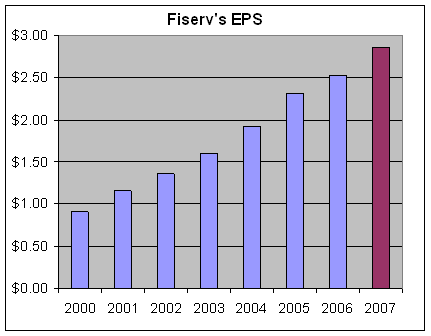
Posted by Eddy Elfenbein on January 31st, 2007 at 5:00 pmFiserv (FISV) just reported fourth-quarter earnings, after charges, of 64 cents a share. This was in line with expectations. Sales were up 19%.
For 2006, Fiserv earned $2.53 a share, up from $2.19 in 2005. The company is also forecasting 2007 earnings growth of 13% to 16%, which works out to earnings of $2.86 to $2.94 per share. That means that Fiserv is going for about 18 times forward earnings.
-
Today’s Fed Statement
Posted by Eddy Elfenbein on January 31st, 2007 at 2:32 pmFor the fifth meeting in a row, the Federal Reserve does nothing:
The Federal Open Market Committee decided today to keep its target for the federal funds rate at 5-1/4 percent.
Recent indicators have suggested somewhat firmer economic growth, and some tentative signs of stabilization have appeared in the housing market. Overall, the economy seems likely to expand at a moderate pace over coming quarters.
Readings on core inflation have improved modestly in recent months, and inflation pressures seem likely to moderate over time. However, the high level of resource utilization has the potential to sustain inflation pressures.
The Committee judges that some inflation risks remain. The extent and timing of any additional firming that may be needed to address these risks will depend on the evolution of the outlook for both inflation and economic growth, as implied by incoming information.
Voting for the FOMC monetary policy action were: Ben S. Bernanke, Chairman; Timothy F. Geithner, Vice Chairman; Susan S. Bies; Thomas M. Hoenig; Donald L. Kohn; Randall S. Kroszner; Cathy E. Minehan; Frederic S. Mishkin; Michael H. Moskow; William Poole; and Kevin M. Warsh.This is a very positive statement.
The “somewhat firmer economic growth” line replaces “has slowed over the course of the year” from December. That’s a big change. Also, the “substantial cooling” of the housing market is gone and has been replaced with “some tentative signs of stabilization.” In the world of Fedspeak, that’s a jump for joy.
Core inflation has now “improved modestly,” where last month it was “elevated.” With Jeffrey Lacker off the committee, the vote was unanimous. -
GDP Grew By 3.5% in Q4
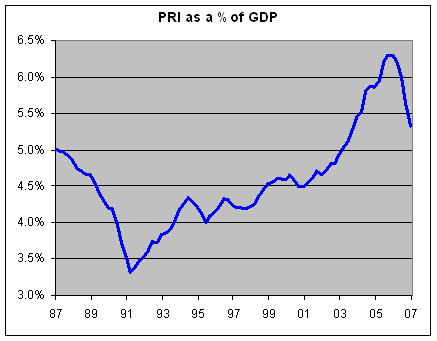
Posted by Eddy Elfenbein on January 31st, 2007 at 9:10 amThe economy continues to plow along. After two quarters of below-trend growth, the economy grew by 3.5% (annualized) in the fourth quarter. This happened even though residential private investment (i.e., home construction) dropped by 19%, the largest decline since 1991.
Here’s GDP growth since 1997:
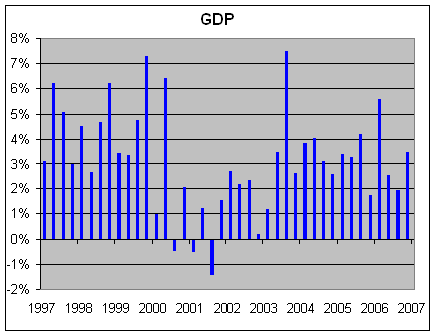
The drop in residential private investment took 1.2% off GDP growth. Here’s a look at home construction’s share of the economy since 1987:
Over the last four years, the economy has grown by 27.3% (not adjusted for inflation). -
AFLAC’s Earnings
Posted by Eddy Elfenbein on January 30th, 2007 at 4:58 pmAFLAC‘s (AFL) stock is getting beaten up in the after-hours market. The supplemental insurance company reported earnings of 66 cents a share (with insurers, the important number is operating earnings). This was a nice improvement over the 59 cents from last year, but it was a penny shy of expectations. The good news is that AFLAC guided higher for 2007. The company now sees EPS of $3.28 to $3.31.
-
Archives
- October 2026
- September 2026
- August 2026
- July 2026
- June 2026
- May 2026
- April 2026
- March 2026
- February 2026
- January 2026
- December 2025
- November 2025
- October 2025
- September 2025
- August 2025
- July 2025
- June 2025
- May 2025
- April 2025
- March 2025
- February 2025
- January 2025
- December 2024
- November 2024
- October 2024
- September 2024
- August 2024
- July 2024
- June 2024
- May 2024
- April 2024
- March 2024
- February 2024
- January 2024
- December 2023
- November 2023
- October 2023
- September 2023
- August 2023
- July 2023
- June 2023
- May 2023
- April 2023
- March 2023
- February 2023
- January 2023
- December 2022
- November 2022
- October 2022
- September 2022
- August 2022
- July 2022
- June 2022
- May 2022
- April 2022
- March 2022
- February 2022
- January 2022
- December 2021
- November 2021
- October 2021
- September 2021
- August 2021
- July 2021
- June 2021
- May 2021
- April 2021
- March 2021
- February 2021
- January 2021
- December 2020
- November 2020
- October 2020
- September 2020
- August 2020
- July 2020
- June 2020
- May 2020
- April 2020
- March 2020
- February 2020
- January 2020
- December 2019
- November 2019
- October 2019
- September 2019
- August 2019
- July 2019
- June 2019
- May 2019
- April 2019
- March 2019
- February 2019
- January 2019
- December 2018
- November 2018
- October 2018
- September 2018
- August 2018
- July 2018
- June 2018
- May 2018
- April 2018
- March 2018
- February 2018
- January 2018
- December 2017
- November 2017
- October 2017
- September 2017
- August 2017
- July 2017
- June 2017
- May 2017
- April 2017
- March 2017
- February 2017
- January 2017
- December 2016
- November 2016
- October 2016
- September 2016
- August 2016
- July 2016
- June 2016
- May 2016
- April 2016
- March 2016
- February 2016
- January 2016
- December 2015
- November 2015
- October 2015
- September 2015
- August 2015
- July 2015
- June 2015
- May 2015
- April 2015
- March 2015
- February 2015
- January 2015
- December 2014
- November 2014
- October 2014
- September 2014
- August 2014
- July 2014
- June 2014
- May 2014
- April 2014
- March 2014
- February 2014
- January 2014
- December 2013
- November 2013
- October 2013
- September 2013
- August 2013
- July 2013
- June 2013
- May 2013
- April 2013
- March 2013
- February 2013
- January 2013
- December 2012
- November 2012
- October 2012
- September 2012
- August 2012
- July 2012
- June 2012
- May 2012
- April 2012
- March 2012
- February 2012
- January 2012
- December 2011
- November 2011
- October 2011
- September 2011
- August 2011
- July 2011
- June 2011
- May 2011
- April 2011
- March 2011
- February 2011
- January 2011
- December 2010
- November 2010
- October 2010
- September 2010
- August 2010
- July 2010
- June 2010
- May 2010
- April 2010
- March 2010
- February 2010
- January 2010
- December 2009
- November 2009
- October 2009
- September 2009
- August 2009
- July 2009
- June 2009
- May 2009
- April 2009
- March 2009
- February 2009
- January 2009
- December 2008
- November 2008
- October 2008
- September 2008
- August 2008
- July 2008
- June 2008
- May 2008
- April 2008
- March 2008
- February 2008
- January 2008
- December 2007
- November 2007
- October 2007
- September 2007
- August 2007
- July 2007
- June 2007
- May 2007
- April 2007
- March 2007
- February 2007
- January 2007
- December 2006
- November 2006
- October 2006
- September 2006
- August 2006
- July 2006
- June 2006
- May 2006
- April 2006
- March 2006
- February 2006
- January 2006
- December 2005
- November 2005
- October 2005
- September 2005
- August 2005
- July 2005
 Eddy Elfenbein is a Washington, DC-based speaker, portfolio manager and editor of the blog Crossing Wall Street. His