-
Heico Earned 62 Cents per Share
Posted by Eddy Elfenbein on December 15th, 2021 at 4:32 pmAfter the closing bell, Heico (HEI) reported fiscal Q4 earnings of 62 cents per share. That’s up from 45 cents per share one year ago. Wall Street had been expecting 58 cents per share.
For the year, Heico made $2.21 per share which was down slightly from the $2.29 per share it made in the year before.
For the quarter, net sales increased 20% to $509.4 million and operating income increased 29% to $115.0 million.
CEO Laurans A. Mendelson said:
As we look ahead to fiscal 2022, we expect the commercial air travel recovery to continue, particularly in certain domestic travel markets, while less so in international markets, even though the Pandemic will likely continue to adversely impact the commercial aerospace industry and HEICO. International markets have not recovered to the extent of domestic markets, and while we are confident of their future recovery and the potential sales increase, the timing is uncertain. We remain cautiously optimistic that the ongoing worldwide COVID-19 vaccine rollouts, including boosters, will continue to positively influence commercial air travel, and benefit the markets we serve. As we’ve all continued to see and learn, it is very difficult to predict the Pandemic’s path and effect, including factors such as new variants and vaccination rates, which can impact our key markets. Therefore, we feel it would not be responsible to provide fiscal 2022 net sales and earnings guidance at this time. But, our ongoing conservative policies, strong balance sheet, and high degree of liquidity enable us to invest in new research and development, execute on our successful acquisition program, and position HEICO for market share gains.”
The stock is up 3% after hours.
-
Today’s Fed Policy Statement
Posted by Eddy Elfenbein on December 15th, 2021 at 2:02 pmThe Fed decided to double taper to $30 billion per month. Here’s today’s Fed policy statement:
The Federal Reserve is committed to using its full range of tools to support the U.S. economy in this challenging time, thereby promoting its maximum employment and price stability goals.
With progress on vaccinations and strong policy support, indicators of economic activity and employment have continued to strengthen. The sectors most adversely affected by the pandemic have improved in recent months but continue to be affected by COVID-19. Job gains have been solid in recent months, and the unemployment rate has declined substantially. Supply and demand imbalances related to the pandemic and the reopening of the economy have continued to contribute to elevated levels of inflation. Overall financial conditions remain accommodative, in part reflecting policy measures to support the economy and the flow of credit to U.S. households and businesses.
The path of the economy continues to depend on the course of the virus. Progress on vaccinations and an easing of supply constraints are expected to support continued gains in economic activity and employment as well as a reduction in inflation. Risks to the economic outlook remain, including from new variants of the virus.
The Committee seeks to achieve maximum employment and inflation at the rate of 2 percent over the longer run. In support of these goals, the Committee decided to keep the target range for the federal funds rate at 0 to 1/4 percent. With inflation having exceeded 2 percent for some time, the Committee expects it will be appropriate to maintain this target range until labor market conditions have reached levels consistent with the Committee’s assessments of maximum employment. In light of inflation developments and the further improvement in the labor market, the Committee decided to reduce the monthly pace of its net asset purchases by $20 billion for Treasury securities and $10 billion for agency mortgage-backed securities. Beginning in January, the Committee will increase its holdings of Treasury securities by at least $40 billion per month and of agency mortgage backed securities by at least $20 billion per month. The Committee judges that similar reductions in the pace of net asset purchases will likely be appropriate each month, but it is prepared to adjust the pace of purchases if warranted by changes in the economic outlook. The Federal Reserve’s ongoing purchases and holdings of securities will continue to foster smooth market functioning and accommodative financial conditions, thereby supporting the flow of credit to households and businesses.
In assessing the appropriate stance of monetary policy, the Committee will continue to monitor the implications of incoming information for the economic outlook. The Committee would be prepared to adjust the stance of monetary policy as appropriate if risks emerge that could impede the attainment of the Committee’s goals. The Committee’s assessments will take into account a wide range of information, including readings on public health, labor market conditions, inflation pressures and inflation expectations, and financial and international developments.
Voting for the monetary policy action were Jerome H. Powell, Chair; John C. Williams, Vice Chair; Thomas I. Barkin; Raphael W. Bostic; Michelle W. Bowman; Lael Brainard; Richard H. Clarida; Mary C. Daly; Charles L. Evans; Randal K. Quarles; and Christopher J. Waller.
Here are the economic projections.
-
Retail Sales Rose 0.3% Last Month
Posted by Eddy Elfenbein on December 15th, 2021 at 1:34 pmThe stock market is down again today, but not by much. Today could be our third straight loss this week. Once again, it’s the high beta stocks that are feeling the heat. Many of the low volatility stocks are doing just fine.
This morning we learned that for November, retail sales rose by 0.3%. That’s lower than the 1.8% increase we had in October. (That’s seasonally adjusted.) In the last year, retail sales are up 18%. Over the same time, consumer prices rose by 6.8%.
This is more of the trend of depressed, angry, disillusioned shoppers who are flooding the malls, gobbling up houses and madly bidding up stocks. I say this jokingly, but there’s some truth to it.
I love this bit from the WSJ:
Jill Grobowsky Bergus, co-owner of three Lockhart Smokehouse barbecue restaurants in the Dallas area, said that they have had to raise prices by 20% to 30% in recent months and have held back from further increases because they worry customers will blanch.
“We’re talking to our meat supplier like we’re day traders,” Ms. Grobowsky Bergus said. Beef prices are up 21% over the past year while pork is up 17%, according to government data. Spending at restaurants was up 1% in November over the previous month.
Shortages of materials and labor have also caused problems. Lockhart Smokehouse has raised pay to keep their employees and has had to contend with suppliers who don’t have enough delivery drivers. Even the 2-ounce plastic cups for barbecue sauce have been in short supply.
Homebuilder confidence remains very high. Today we learned that the index for this rose by one point to 84. Any number above 50 is positive.
The Fed’s policy statement is due out at 2 pm.
-
Morning News: December 15, 2021
Posted by Eddy Elfenbein on December 15th, 2021 at 5:41 amHow Did Turkey’s Economy Go So Wrong?
China’s Economic Activity Slows on Property Slump, Weak Consumption
These Are the Countries With the Clearest Crypto Tax Policies
Crash in Shimao Bonds Stokes Contagion Fear, Bailout Speculation
U.S. to Blacklist DJI and Seven Other China Firms, FT Reports
U.S. Lawmakers Call for Sanctions Against Israel’s NSO, Spyware Firms
The Fed Meets Amid Faster Inflation and Prepares to React
French Billionaire Weighs IPO of Sotheby’s Auction House
Uber Looking to Sell Didi, China Market Has Little Transparency, CEO Says
Sears, Struggling to Sell Goods, Markets a Valuable Asset: Real Estate
Zara Owner and H&M Bounce Back from Pandemic Blues
Who’s Traveling Now—and Where and Why
3M to Combine Its Food-Safety Unit With Neogen
Group Nine, Vox Keep Price of Deal Quiet as Valuations of Digital Media Darlings Plummet
What Elon Musk as ‘Person of the Year’ Says About Us
Be sure to follow me on Twitter.
-
CWS Market Review – December 14, 2021
Posted by Eddy Elfenbein on December 14th, 2021 at 6:53 pm(This is the free version of CWS Market Review. I’m going to unveil our 2022 Buy List on December 24. To see the new list, make sure you’re a premium subscriber. You can get the premium newsletter for $20 per month or $200 for the whole year.)
The Worst Inflation in 40 Years
Last Friday, the government released the inflation report for November and it confirmed that the U.S. is now having its worst bout of inflation in 40 years.
Remember how Fed Chairman Jerome Powell kept telling us that inflation is merely “transitory”? Well, that’s all out the window. Now it looks like the Fed may ramp up its tapering bonds. (My apologies for the confusing syntax. By this I mean the Fed will reduce their bond purchases at a faster pace than before.)
First, let’s look at the numbers. For November, headline inflation increased by 0.78%. That’s actually a slight decrease from October’s rate of 0.94%. For its part, the Federal Reserve puts a lot of the blame on the supply-chain crisis. In other words, the Fed says it’s not the fault of the Fed.
I’m reminded of this quote from Milton Friedman:
Central bankers always try to avoid their last big mistake. So every time there’s the threat of a contraction in the economy, they’ll overstimulate the economy by printing too much money. The result will be a rising roller coaster of inflation, with each high and low being higher than the preceding one.
Personally, I’m not so worried about supply issues. As long as there’s money to be made, someone will come along and fix it. That just takes time. I’m more worried about consumers becoming used to higher prices. Once that mentality settles in, it’s hard to shake loose.
Over the past year, consumer prices have increased by 6.88%. That means that if you have a $1 million portfolio, inflation eats up $68,800 every year. That’s the highest year-over-year rate of inflation since June 1982.
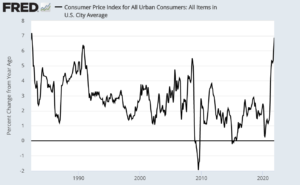
The “core rate” of inflation, which excludes volatile food and energy prices, was a little better behaved. For November, the core rate was up by 0.54%. Over the past year, the core rate is up by 4.96%. That’s the fastest core rate in 30 years.
By the way, the core rate comes in for a lot of criticism. It’s not that we ignore food and energy costs. That’s obviously an important part of every family’s budget, especially lower-income folks. Inflation is an especially cruel tax on the poor and those on fixed income.
The problem is that food and energy can be highly volatile. As a result, the month-to-month prices may not give us an accurate measure of the trend in inflation.
For example, here’s a surprisingly optimistic fact. November’s rise in core inflation was the fifth highest in the past eight months. That could suggest that inflation may already be cresting. I think it’s far too early to say that conclusively, but it’s something to take note of.
There’s still more evidence of high inflation. Today we learned that wholesale prices are up 9.6% over the last year ending in November. That’s the highest on record which sounds impressive, but the data series only goes back 11 years. Still, it was higher than Wall Street’s estimate of 9.2%.
The wholesale numbers are important to watch because higher inflation would hit this sector first before wending its way to consumers. Businesses generally do their best to make prices for the consumer as stable as possible.
Inflation has an unusual impact on businesses and, in turn, on stocks. Not all earnings are the same, and inflation exacts a heavy toll on asset-heavy businesses. Companies with high assets relative to their profits tend to report ersatz earnings.
Inflation has an impact similar to putting a magnet near a compass. Everything gets a little screwy. Historically, stocks have not performed well during periods of high inflation. Investors who lived through the 1970s will certainly recall that. During the entire decade of the 70s, the Dow gained a grand total of 38 points.
While inflation has been tough on stocks, there’s only one thing worse for stocks, and that’s deflation. What the market truly loves is low consistent inflation. In other words, pretty much what we had over the last 30 years, minus 12 months.
Of course, the recent inflation numbers haven’t scared off stock investors. On Friday, the S&P 500 closed at an all-time high. Our 67th record high this year. Last week was the second-best week for the S&P 500 all year.
However, the problem isn’t inflation per se. The threat for stocks is really the threat from bonds. Inflation doesn’t impact the stock market directly. Instead, inflation wrecks the bond market and that throws sand in the gears of the stock market. The higher bond yields are greater competition for stocks.
The last time inflation was this high.

The Federal Reserve is meeting this week, today and tomorrow, and I think there’s a good chance that the Fed will change its taper policy. Previously, the Fed said it will reduce its pace of bond buying by $15 billion each month. They may double that. That means the Fed would be on pace to wrap up its bond purchases by March of next year. We can assume that rate hikes would come shortly after that.
The bond market is already pricing in the rate increase. The futures market now sees three rate hikes coming next year. This is a sudden change from only a few months ago. On June 3, the two-year Treasury was yielding just 0.09%. Now that’s all the way up to 0.66%. That’s still very low, but it’s higher than where it was. Over the same time, the three-year yield has jumped from 0.16% to 0.95%.
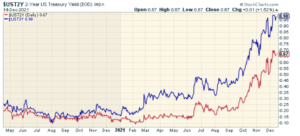
It’s as if the bond market is saying, “rates aren’t rising now, but they soon will be.” The Fed will release its policy statement tomorrow at 2 pm.
The Stock Market Is Still on Defense
I’ve become a broken record on this topic, but it’s too important to set side. The stock market has become much more defensive over the past month. Riskier stocks have been feeling the pain. Meanwhile, the stable stocks are doing just fine. Even though the surface of the stock market appears fairly staid, the undercurrents are quite dramatic.
On our Buy List, stocks like Church & Dwight (CHD) and Hershey (HSY) have been at or near new highs. But former high-fliers like Nvidia (NVDA) and Tesla (TSLA) are down sharply. Tesla is more than 20% off its recent high.
Here’s another look at the S&P 500 High Beta Index (red) compared with the S&P 500 Low Volatility Index (blue). Since November 8, the Low Vol Index is up by 3% while the High Beta stocks are down over 8.3%.
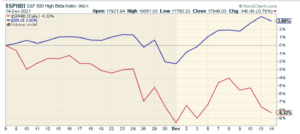
This is a direct result of the Fed’s willingness to tackle inflation. Once the Fed gets tough, rates will go up. That’s why the defensive stocks are prospering. Already this year, we’ve had more than one rotation. Those have petered out. This one may not.
Apple’s Lost 20 Years
Every so often, I tweet this fact: “If you had invested $10,000 in Apple (AAPL) on June 6, 1983, by April 17, 2003, you’d be sitting on $8,400.”
I’ll usually get a few responses telling me that this can’t possibly true. Or I obviously left out stock splits. Nope, the numbers are correct.
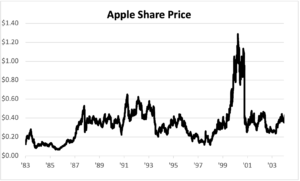
It’s remarkable to consider that Apple, which is on the doorstep of a $3 trillion valuation, didn’t do much for nearly 20 years. I think there’s an important lesson for investors in that.
Even if you’re right about the stock, you can get the timing all wrong. It even took a few years after Steve Jobs had returned to Apple for it to turn around. It’s also a reminder that companies are always changing. Sometimes for the better, but not always.
Oh…by the way, that $10,000 investment is now worth more than $6.2 million.
That’s all for now. I’ll have more for you in the next issue of CWS Market Review.
– Eddy
P.S. Don’t forget to sign up for our premium newsletter.
-
Morning News: December 14, 2021
Posted by Eddy Elfenbein on December 14th, 2021 at 7:03 amShimao Is the Latest Chinese Property Developer to Worry Investors
Its Human Rights Record in Question, China Turns to an Old Friend
How Beijing Influences the Influencers
Investors Brace for Faster Fed Taper, Rate Hikes Next Year
Central Bankers Are the Biggest Risk to Stocks in 2022, Survey Finds
Worried About Inflation? Here’s What That May Reveal About You.
How Covid Turbocharged the American Consumer
Omicron Will Slow Oil Demand Recovery but Not Destroy It, IEA Says
Heating Your Home Is Expensive and Carbon Heavy. Will Heat Pumps Help?
Fires, Landslides, Lack of Snow: The Ski Industry Girds for Battle
Toyota Says It Will Shift More Rapidly to EVs
Tesla to Accept Dogecoin as Payment for Some Products, Musk Says
How to Get Rich Sending Low-Income Workers to College
Goldman and JPMorgan Plan Bumper Bonuses to Get Edge in Deal Boom
Meet The Billionaire Robot Overlord Reinventing Walmart’s Warehouses
Nike Just Bought a Virtual Shoe Company that Makes NFTs and Sneakers ‘For the Metaverse’
Be sure to follow me on Twitter.
-
Stocks Down Some Before the Fed Meeting
Posted by Eddy Elfenbein on December 13th, 2021 at 10:54 amFriday’s inflation report wasn’t enough to scare the market. The S&P 500 closed at an all-time high even though the economy had its worst inflation in four decades.
Last week, the S&P 500 had its second-best weekly gain this year:
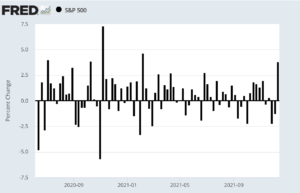
The stock market is down so far this morning although there’s no major economic news. The Federal Reserve meets tomorrow and on Wednesday. The policy statement will be due out on Wednesday afternoon.
There’s an unusually wide divide in today’s market. Both the energy and consumer cyclicals sectors are down over 2% while utilities, staples and REITs are up modestly. That’s another shift towards defensive stocks.
On our Buy List, we have new highs this morning from Abbott Labs (ABT), Hershey (HSY), Church & Dwight (CHD) and Zoetis (ZTS).
The WSJ reports:
Companies in the S&P 500 repurchased $234.5 billion in shares during the third quarter, topping the previous record of $223 billion in the fourth quarter of 2018, according to preliminary data from S&P Dow Jones Indices. The wave of share repurchases has helped propel U.S. stock indexes to dozens of records in 2021. The S&P 500 is up 25% this year, notching 67 record closes.
-
Morning News: December 13, 2021
Posted by Eddy Elfenbein on December 13th, 2021 at 7:02 amWhat Could Possibly Go Wrong? These Are the Biggest Economic Risks for 2022
India’s Latest Religious and Cultural Flashpoint: Eggs
Workers in Europe Are Demanding Higher Pay as Inflation Soars
Libor Limbers Up for ‘Y2K’ Walk Into a $265 Trillion Sunset
China’s SenseTime Postpones its Hong Kong I.P.O. Following U.S. Sanctions
Fed to Pivot on Inflation Fears in the Face of Another Uncertain Year
SEC Lures Top Enforcer Who Says Tougher Punishment Is Coming
Firms’ Shrinking Cash Piles Set to Fuel Sales of High-Grade Debt
Ackman Says SALT Tax Deduction Increase ‘Makes No Sense’
New Double Act Reinforces Ortega Family Grip on Inditex
VP Harris Secures New Investment from Companies Like Pepsico, Cargill for Central America Strategy
How Do You Feel About Inflation? The Answer Will Help Determine Its Longevity
When Companies Fire Their Auditors, Timing Is Clue to Future Trouble
Binance Drops Singapore Cryptocurrency Bourse Application
The Big Question: Could Peloton Sue Over Its ‘And Just Like That’ Appearance?
Her Instagram Handle Was ‘Metaverse.’ Last Month, It Vanished.
Be sure to follow me on Twitter.
-
Abbott Raises Dividend for 50th Year in a Row
Posted by Eddy Elfenbein on December 10th, 2021 at 4:39 pmAbbott (NYSE: ABT) today announced that its board of directors has increased the company’s quarterly common dividend, marking the company’s 50th consecutive year of dividend growth.
Abbott’s quarterly common dividend has been increased to 47 cents per share, a 4.4% increase that follows a 25% increase to the company’s quarterly dividend in 2021. It will be the 392nd consecutive quarterly dividend to be paid by Abbott since 1924. The cash dividend is payable Feb. 15, 2022, to shareholders of record at the close of business on Jan. 14, 2022.
Abbott is a member of the S&P 500 Dividend Aristocrats Index, which tracks companies that have increased dividends annually for at least 25 consecutive years.
“Fifty years of dividend growth reflects the consistently strong performance of our diversified business model,” said Robert B. Ford, president and chief executive officer, Abbott. “It exemplifies our longstanding commitment to delivering sustainable growth that fuels innovation as well as shareholder returns.”
Abbott’s board also has authorized the repurchase of up to $5 billion of the corporation’s common shares. This new authorization is in addition to the unused portion of the previous program authorized by Abbott’s board in October 2019. The purchases may be made from time to time as market conditions warrant and subject to regulatory considerations.
-
Cerner Hikes Dividend by 22.7%
Posted by Eddy Elfenbein on December 10th, 2021 at 9:45 amWe got our third dividend increase this week. Today it’s Cerner‘s (CERN) turn.
The company increased its quarterly payout from 22 to 27 cents per share. The new dividend will be payable on January 11 to shareholders of record as of December 27.
-
Archives
- August 2026
- July 2026
- June 2026
- May 2026
- April 2026
- March 2026
- February 2026
- January 2026
- December 2025
- November 2025
- October 2025
- September 2025
- August 2025
- July 2025
- June 2025
- May 2025
- April 2025
- March 2025
- February 2025
- January 2025
- December 2024
- November 2024
- October 2024
- September 2024
- August 2024
- July 2024
- June 2024
- May 2024
- April 2024
- March 2024
- February 2024
- January 2024
- December 2023
- November 2023
- October 2023
- September 2023
- August 2023
- July 2023
- June 2023
- May 2023
- April 2023
- March 2023
- February 2023
- January 2023
- December 2022
- November 2022
- October 2022
- September 2022
- August 2022
- July 2022
- June 2022
- May 2022
- April 2022
- March 2022
- February 2022
- January 2022
- December 2021
- November 2021
- October 2021
- September 2021
- August 2021
- July 2021
- June 2021
- May 2021
- April 2021
- March 2021
- February 2021
- January 2021
- December 2020
- November 2020
- October 2020
- September 2020
- August 2020
- July 2020
- June 2020
- May 2020
- April 2020
- March 2020
- February 2020
- January 2020
- December 2019
- November 2019
- October 2019
- September 2019
- August 2019
- July 2019
- June 2019
- May 2019
- April 2019
- March 2019
- February 2019
- January 2019
- December 2018
- November 2018
- October 2018
- September 2018
- August 2018
- July 2018
- June 2018
- May 2018
- April 2018
- March 2018
- February 2018
- January 2018
- December 2017
- November 2017
- October 2017
- September 2017
- August 2017
- July 2017
- June 2017
- May 2017
- April 2017
- March 2017
- February 2017
- January 2017
- December 2016
- November 2016
- October 2016
- September 2016
- August 2016
- July 2016
- June 2016
- May 2016
- April 2016
- March 2016
- February 2016
- January 2016
- December 2015
- November 2015
- October 2015
- September 2015
- August 2015
- July 2015
- June 2015
- May 2015
- April 2015
- March 2015
- February 2015
- January 2015
- December 2014
- November 2014
- October 2014
- September 2014
- August 2014
- July 2014
- June 2014
- May 2014
- April 2014
- March 2014
- February 2014
- January 2014
- December 2013
- November 2013
- October 2013
- September 2013
- August 2013
- July 2013
- June 2013
- May 2013
- April 2013
- March 2013
- February 2013
- January 2013
- December 2012
- November 2012
- October 2012
- September 2012
- August 2012
- July 2012
- June 2012
- May 2012
- April 2012
- March 2012
- February 2012
- January 2012
- December 2011
- November 2011
- October 2011
- September 2011
- August 2011
- July 2011
- June 2011
- May 2011
- April 2011
- March 2011
- February 2011
- January 2011
- December 2010
- November 2010
- October 2010
- September 2010
- August 2010
- July 2010
- June 2010
- May 2010
- April 2010
- March 2010
- February 2010
- January 2010
- December 2009
- November 2009
- October 2009
- September 2009
- August 2009
- July 2009
- June 2009
- May 2009
- April 2009
- March 2009
- February 2009
- January 2009
- December 2008
- November 2008
- October 2008
- September 2008
- August 2008
- July 2008
- June 2008
- May 2008
- April 2008
- March 2008
- February 2008
- January 2008
- December 2007
- November 2007
- October 2007
- September 2007
- August 2007
- July 2007
- June 2007
- May 2007
- April 2007
- March 2007
- February 2007
- January 2007
- December 2006
- November 2006
- October 2006
- September 2006
- August 2006
- July 2006
- June 2006
- May 2006
- April 2006
- March 2006
- February 2006
- January 2006
- December 2005
- November 2005
- October 2005
- September 2005
- August 2005
- July 2005
 Eddy Elfenbein is a Washington, DC-based speaker, portfolio manager and editor of the blog Crossing Wall Street. His