-
Morning News: October 20, 2021
Posted by Eddy Elfenbein on October 20th, 2021 at 7:01 amChina’s Real Estate Crisis Could Threaten Growth Into 2022. Beijing’s Undeterred
As Evergrande Teeters, Chinese Media Walks a Fine Line
The Reclusive Dictator Behind a Global Climate Catastrophe
Boris Johnson Claims a Positive in Britain’s Shortages. Economists Disagree.
Hot Vax Summer to Winter of Discontent — Stagflation-Lite Looms
Lower-Income Americans Starting to Opt Out of Holiday Spending
Bitcoin Sits Below All-Time High After U.S. ETF Debut
Stock Fear Gauge Defies Bond Turmoil. Here Are Four Reasons Why
Senators Urge FCC to Address Surveillance Threats to US Telecom Networks
Bundesbank President Jens Weidmann to Step Down
Meta? Horizon? Facebook Renaming Report Sparks Speculation
Britain Fines Facebook $70 Million for Breaching Order in Giphy Deal
Biogen Posts Much Smaller-Than-Expected Sales of New Alzheimer’s Drug
Elon Musk Will Become a Trillionaire With SpaceX, Morgan Stanley Says
Of Shots and Supply-Chain Snarls
The Incredible Disappearing Hotel Breakfast—and Other Amenities Travelers Miss
Be sure to follow me on Twitter.
-
CWS Market Review – October 19, 2021
Posted by Eddy Elfenbein on October 19th, 2021 at 6:40 pm(This is the free version of CWS Market Review. If you like what you see, then please sign up for the premium newsletter for $20 per month or $200 for the whole year. If you sign up today, you can see our two reports, “Your Handy Guide to Stock Orders” and “How Not to Get Screwed on Your Mortgage.”)
-508 Points
Thirty-four years ago today, the stock market crashed. The Dow Jones Industrial Average plunged 508 points to close at 1,783.74.
A loss of 508 points is big today, but in 1987, it was staggering. In percentages terms, the 1987 crash was a loss of 22.6%. That was the biggest one-day percentage loss in the Dow’s history, and it still is today. It was bigger than even 1929.
In fact, given the market’s “circuit breaker” rules, it’s a record that may never be broken. Nowadays, the exchange shuts down for the day if the S&P 500 falls by more than 20%.
The Crash of 1987 is a difficult fact for people like myself who advocate a long-term buy-and-hold philosophy. After all, how could a crash like that happen? How come no one saw it coming? Why did it happen?
The answers aren’t so easy. Like many historical events, the crash appears to be obvious in retrospect, yet it was so surprising when it happened.
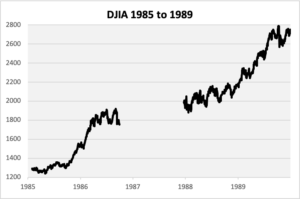
Let’s consider a few facts surrounding the crash of 1987. For one, the stock market had been soaring. The bull market started in 1982 and it was putting up very impressive numbers in 1986 and 1987. The big crash really just gave back the last several months’ worth of returns. The Dow actually closed slightly higher for the year of 1987. Many people forget that.
Here’s a chart I made. Sure, I omitted some important data. But viewed from this perspective, the market doesn’t look so bad.
The Federal Reserve, under the leadership of Alan Greenspan, had started raising interest rates. That’s always a painful tonic for a rising market. Also, Greenspan was new on the job, having started in August.
Markets were already nervous. On Friday, October 16th, the Dow closed down 108 points. That may not sound like a lot to us, but it was an all-time record back then. On that evening’s “Wall $treet Week With Louis Rukeyser,” Rukeyser talked about the problem of mindless program trading.
October 19th was a Monday but over the weekend, London was hit by its worst storm in 300 years. The storm was so bad that the Bank of England declared Friday the 16th a holiday. In an eerie coincidence, London was hit by a massive storm 58 years before in October 1929. As it turns out, Winston Churchill was visiting the NYSE on Black Thursday 1929.
On Saturday October 17, James Baker, who was then Treasury Secretary, threatened the German government to weaken its currency or else he would devalue the U.S. dollar. Baker was reacting to the recently-released trade deficit figures. Baker reiterated his currency threats on the Sunday morning talk shows. That clearly alarmed many investors.
By the way, if you’re into the Fibonacci sequence, then 1987 had a lot to offer you. It was five years after the bull market start, 13 years from the 1974 low, 21 years from the 1966 high and 55 years from the 1932 low.
I’m sure there are others I’m missing. The point is that a lot of strange things seemed to come together on October 19, 1987.
That morning’s Wall Street Journal ran a chart overlaying the recent market with the one in 1929, supposedly showing them following a similar path. I often see these scary charts. The trick is that the two lines follow wildly different scales.
Asian markets opened lower on Monday morning. That was followed by a messy open in the U.S. The early losses, however, weren’t that bad. But after 2 p.m., the losses started to accelerate. In the final hour of trading, it turned into a panic.
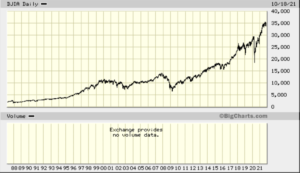
From a long-term perspective, the 1987 crash was a great time to buy.
There’s another lesson to the market crash of 1987. It’s that at root, the market is fundamentally mysterious. There really is no good explanation for the market doing what it does. It just happens. We have lots of fancy math formulas to model what the market might do, but all of that is a guess. The market gods are capricious.
The market is a mob and it will be no more wise or patient than a mob. Sir Isaac Newton famously said, “I can calculate the motion of heavenly bodies, but not the madness of people.” That’s wise counsel to heed the next time you hear someone’s market forecast.
Now, whenever I hear someone say, “this market reminds me a lot of 1987.” I’m inclined to respond, “so you think we’re going to rise 20-fold in 34 years?”
In the Compound with Friends
Last week, I was invited by Josh Brown and Michael Batnick of Ritholtz Wealth Management to be a guest on their first-rate podcast, The Compound & Friends. I’ve been friends with them and an admirer of them for many years. Blair duQuesnay, one of my favorite bloggers/writers, also of Ritholtz, was another guest.
Check it out:
(During the podcast, I mangled my explanation of Miller Industries. Here’s a better explanation.)
The First Bitcoin ETF Hits the Market
Earlier today, the first Bitcoin ETF started trading. The official name is the ProShares Bitcoin Strategy ETF and the ticker symbol is BITO.
There’s been a long battle to get a Bitcoin ETF. The SEC has been adamantly opposed to just about every idea. The fear is that Bitcoin can be easily manipulated. Technically, this ETF trades Bitcoin futures, not Bitcoin itself. That means the ETF won’t exactly track Bitcoin. The fund will have to constantly roll its portfolio into the following month’s contract which will probably eat into returns. In day-to-day terms, that won’t mean much but it could have a big impact over the long haul. The fund’s expense ratio is 0.95%.
There are still lots of indirect ways of investing in crypto. According to the latest numbers I’ve seen, the company Microstrategy (MSTR) owns over 114,042 Bitcoins. That’s over $7 billion (well, in boring fiat).
Our Buy List has been in on the game as well. Yesterday, Bakkt Holdings (BKKT) started trading. Bakkt is a digital asset trading platform. The company was launched three years ago by our very own Intercontinental Exchange (ICE).
The Alpharetta, Georgia-based company, founded in 2018, initially focused on developing Bitcoin futures contracts and a custodial service that can be used by hedge funds and other institutional investors to store their digital assets. The business has since expanded, partnering with travel and leisure companies such as Choice Hotels and Starbucks to allow their customers to convert loyalty points into cash or buy a cup of coffee with their coin via their app.
It helps that that ICE owns the NYSE. The deal involved Bakkt combining with a SPAC called VPC Impact Acquisition Holdings. The new Bitcoin ETF should be a big boost for Bakkt. According to Bakkt, the total market could reach $5 trillion by 2025. Frankly, the initial launch of Bakkt on the market was a disappointment. I think many investors had been expecting a big pop on its first day and it didn’t come.
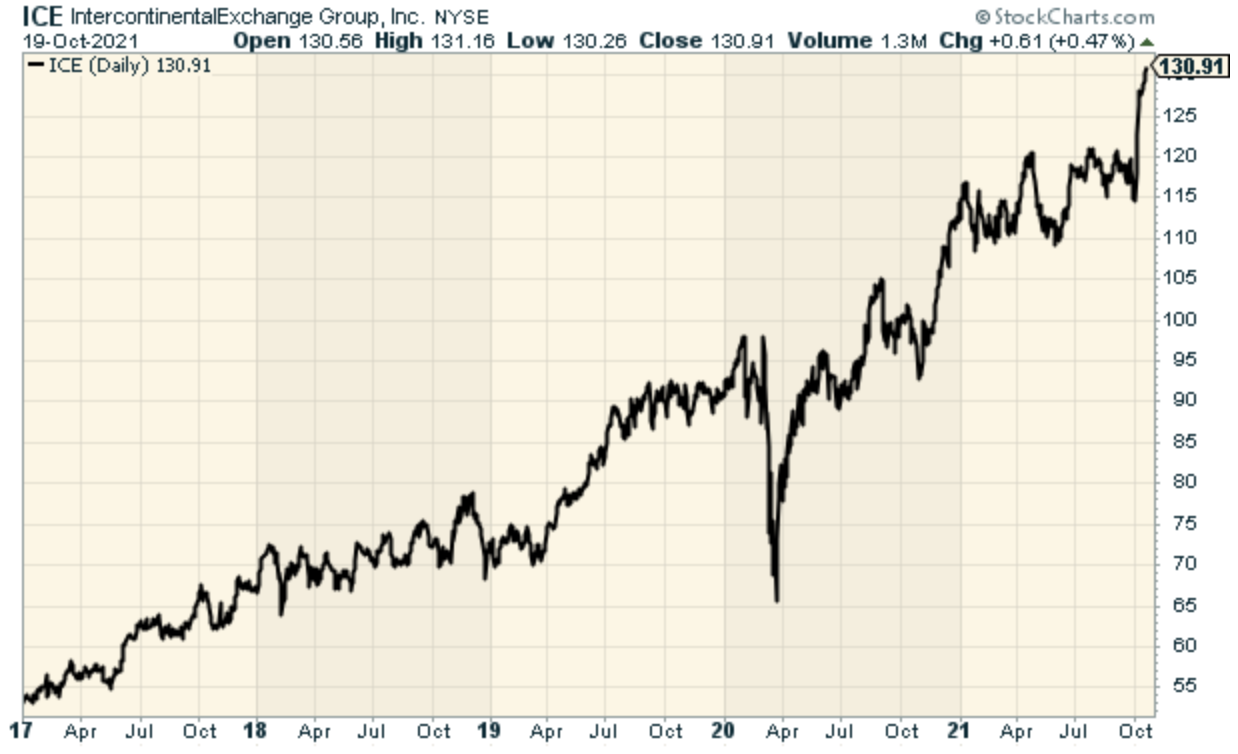
Intercontinental Exchange continues to do very well for us. It’s been on our Buy List for nearly five years and it’s up 145% for us. The company is due to report earnings on October 28. The consensus on Wall Street is for earnings of $1.21 per share.
Stock Focus: Public Storage
Let’s say your boss offers you a big raise and a promotion, but the catch is that the job requires you to move out of the country. You love to see the world, so you jump at the chance.
But there’s one nagging question: what do you do with all your stuff?
Nowadays, there’s an easy answer. You rent a storage unit. There are lots of these facilities all over the country. If you look long enough, you’re bound to come across Public Storage (PSA).
Public Storage is the largest self-storage real estate investment trust (REIT) in the United States. There are currently more than 2,600 Public Storage locations around the world. The company is based in Glendale, CA.
If you’re not familiar with a REIT, it’s basically the landlord of some real estate. If the REIT pays out almost all of its income to shareholders, then it gets preferential tax treatment. As a result, REITs often have good dividend yields. It’s a great way to invest in real estate.

Public Storage was founded in 1972 by B. Wayne Hughes and Kenneth Volk Jr. During a trip to Texas, Hughes saw that local real estate developers had made, in effect, mini storage units, so he decided to bring the idea to Southern California. It was a brilliant idea because he could charge as much as apartments in term of price per square foot. The difference is that the upkeep costs were far less.
The business quickly took off and by 1989, it had grown to 1,000 locations. PSA officially became a REIT in 1995. Today it has a market cap of $56 billion, and PSA is one of the largest REITs around.
More than 90% of PSA’s revenue comes from its self-storage business. The company does a lot more than just provide the space. They also provide a broad range of services for their clients. PSA offers insurance and packing products. The company also had a subsidiary that provides boxes and truck rentals.
It’s an interesting business because the storage lots tend to be located in unforgiving parts of large cities. They’re often located in dense clusters near freeways and intersections. It’s also interesting that PSA has relatively few employees. The lots are automated so customers can access their units at any time.
As any fan of the TV show Storage Wars knows, abandoned units are auctioned off. (Despite what you may have heard, most abandoned or unpaid lots contain useless junk.)
PSA has been a tremendous business over the years.
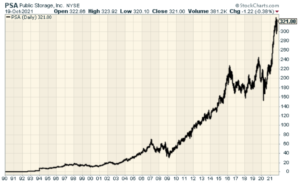
Thirty years ago, you could have picked up one share of PSA for $8. Since then, the stock has increased by 40-fold! And that doesn’t include dividends. If you include dividends, then PSA gained over 180-fold. All from renting storage units!
I really like PSA’s dividend. The company currently pays out a quarterly dividend of $2 per share, or $8 for the year. Think of it this way: If you had bought PSA 15 years ago, you’d now be yielding close to 10% based on your original purchase price.
One of the reasons why I like the stock right now is that the industry is rebounding from an early pandemic decline. I also like that PSA is the dominant player in the industry. The company buys up smaller companies all the time. There hasn’t been much self-storage building recently. That means there’s been a scramble to buy out smaller storage companies. There are lots of small operators and they’re happy to sell to PSA.
Public Storage currently yields 2.5% which is 0.87% more than the 10-year Treasury’s yield. The next earnings report is due out on November 1.
(Don’t forget, if you want to learn more about Intercontinental Exchange and our other Buy List stocks, you can sign up for our premium newsletter. Join us today!)
I’ll have more for you in the next issue of CWS Market Review.
– Eddy
-
The Bitcoin ETF
Posted by Eddy Elfenbein on October 19th, 2021 at 11:01 amThe first Bitcoin ETF, the ProShares Bitcoin Strategy ETF, is now trading under the ticker symbol BITO. The fund tracks Bitcoin futures.

-
Housing Starts Dropped Last Month
Posted by Eddy Elfenbein on October 19th, 2021 at 10:52 amThe S&P 500 is up again today. This could be the fifth up day in a row. The index is now above 4,500, and we’re not far from our all-time high close of 4,536.95 from September 2.
Lots of earnings are coming in today. Philip Morris (PM), Procter & Gamble (PG) and Johnson & Johnson (JNJ) all beat estimates. Netflix (NFLX) is due to report after the close. Wall Street expects $2.56 per share.
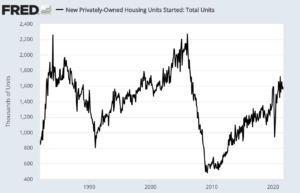
This morning’s report on housing starts shows that housing starts fell to a one-year low. Starts dropped by 1.6% to 1.56 million. That’s the annualized rate. Wall Street had been expecting 1.62 million.
Permits to build fell by 7.7%. That’s the biggest drop since February. The backlog of homes to build is near a 15-year high.
From Barron’s:
Supply chain disruptions and shortages aren’t particularly new for the residential real estate industry. When polled by the National Association of Home Builders in May, industry professionals reported widespread shortages across an assortment of building materials and supplies, including appliances, lumber, and wiring. Several home builders said last month that supply chain issues had cut into sales or deliveries, while Zillow said Monday it would pause home purchases through its Zillow Offers program due in part to a renovations backlog.
-
Morning News: October 19, 2021
Posted by Eddy Elfenbein on October 19th, 2021 at 7:03 amWorld Faces Fiscal Problems Much Worse Than Those From Covid, OECD Warns
China’s Coal Rally Slows as Authorities Act to Tame Price
How Villagers in China’s Silicon Valley Built a $30 Billion Fortune
HSBC, Citigroup Rush In to Catch China Cross-Border Wealth
Bitcoin Pushes Toward Record Before Debut of Futures-Based ETF
Treasury Warns That Digital Currencies Could Weaken U.S. Sanctions
The S.E.C. Weighs In on Meme-Stock Mania
Halliburton Posts Q3 Profit As Higher Oil Prices Fuel Drilling Demand
J&J Raises 2021 Profit View, Keeps Vaccine Sales Outlook Unchanged
Procter & Gamble to Raise Prices on More Staples as Supply Problems Hit
As Starbucks Workers Seek a Union, Company Officials Converge on Stores
App Deal Highlights a Push to Lure Workers Back Into Offices
What’s Your Pleasure? How About a T-shirt?
Disney Stock Downgraded for First Time in 3 Years Amid Streaming Worries
Nuclear Fusion Edges Toward the Mainstream
Be sure to follow me on Twitter.
-
Industrial Production Unexpectedly Drops
Posted by Eddy Elfenbein on October 18th, 2021 at 12:50 pmThe S&P 500 is a little bit higher today although the Dow is barely lower. On our Buy List, Intercontinental Exchange (ICE) is up to a new 52-week high. ICE is a 13% winner for us this year.
This morning’s report in industrial production showed a sharp drop for September. Output dropped by 1.3%. That’s the biggest fall since February. Wall Street had been expecting a gain of 0.2%. Once again, the problem is supply-chain disruptions. The number for August was revised downward to a loss of 0.1% from a gain of 0.4%.
From the Wall Street Journal:
Manufacturing output, the biggest component of industrial production, fell 0.7% in September compared with August. Motor vehicle and parts production decreased 7.2% amid the shortage of semiconductors.
The lingering effects of Hurricane Ida also contributed to the drop in manufacturing, by 0.3 percentage point, the Fed said.
Despite the bad number for September, industrial production has recovered nicely in the last year. Compared with a year ago, industrial production is up 4.6%.
-
Morning News: October 18, 2021
Posted by Eddy Elfenbein on October 18th, 2021 at 7:01 amChina’s Economy Stumbles on Power Crunch, Property Woes
Oil Prices Climb as Covid Recovery, Power Generators Stoke Demand
Central Banks and Governments in Eastern Europe at Odds Amid Inflation
Italy Faces Capital Demand of More than $8 Billion to Offload Monte dei Paschi
Biden’s Plans Raise Questions About What U.S. Can Afford Not to Do
Fed Staff Says Wall Street Is Getting Inflation Call All Wrong
Bitcoin Comes to the Big Board
Big Labor and the Supply Shortage
The 60/40 Portfolio Isn’t Dead, Just More Expensive
Barclays Trading Boss Saw the $6 Billion London Whale Coming
Goldman Sachs Wins Approval to Buy Out Its Partner in China
Zillow Tumbles After It Stops Buying New Homes
Toyota to Invest $3.4 Billion on U.S. Automotive Batteries Through 2030
Google CEO Pichai Opens Up on Its Biggest Moonshot Yet
Instagram Struggles With Fears of Losing Its ‘Pipeline’: Young Users
Roblox, the Gaming Site, Wants to Grow Up Without Sacrificing Child Safety
Be sure to follow me on Twitter.
-
In the Compound & Friends
Posted by Eddy Elfenbein on October 15th, 2021 at 1:13 pmI was invited by Josh Brown and Michael Batnick of Ritholtz Wealth Management to be a guest on their first-rate podcast, The Compound & Friends. I’ve been friends and an admirer of them for many years. Blair duQuesnay, one of my favorite bloggers/writers, also of Ritholtz, was another guest.
(During the podcast, I mangled my explanation of Miller Industries. Here’s a better explanation.)
-
Morning News: October 15, 2021
Posted by Eddy Elfenbein on October 15th, 2021 at 7:01 amUK Says Billions Already Raised for “Green Revolution” Ahead of Investment Summit
Shareholder Democracy Is Getting Bigger Trial Runs
China Breaks Silence on Evergrande, Saying Risks ‘Controllable’
Bitcoin Futures Frenzy Erupts as Day Traders Pile Into ETF Bets
Brent Oil Hits $85 as Energy Crisis Stokes Demand Before Winter
Rising Rents Are Fueling Inflation, Posing Trouble for the Fed
Why Does Everyone Suddenly Care About Supply Chains?
U.S. Banks See Wealth Management Boom on Borrowing, New Assets
China Is Forcing Fashion to Mute Itself Over Dirty Cotton
Chinese Electric Cars Engulf Western Europe’s Top Oil Producer
Microsoft Shuts LinkedIn China, Citing ‘Challenging’ Climate
Plant-Based Food Companies Face Critics: Environmental Advocates
Meet Me in My Office, in Men’s Underwear on 5
Review: In ‘The Lehman Trilogy,’ a Vivid Tale of Profit and Pain
5 Reasons Not to Quit Your Job (Yet)
Be sure to follow me on Twitter.
-
Jobless Claims Fall Below 300,000
Posted by Eddy Elfenbein on October 14th, 2021 at 12:30 pmI’m on the road today but I wanted to give you a quick update on the markets. This morning’s jobless claims came in at 293,000. That’s a new pandemic low. That’s also the first time we’ve broken below 300,000 in 20 months. Wall Street had been expecting 318,000.
The drop in claims comes at an important time for the labor market, which has added jobs over the past two months at a decidedly slower-than-expected pace – 366,000 in August and 194,000 in September, leaving the household employment total still more than 5 million shy of where it was pre-pandemic.
Thursday’s jobless claims report covered the period just before the Labor Department’s survey week for the closely watched nonfarm payrolls report.
Federal Reserve officials have been watching the job market’s progress closely as the central bank weighs when to begin pulling back on the extraordinary help it’s been providing. Minutes released Wednesday from the Fed’s September meeting indicated that the first pullback could start as early as mid-November with a reduction in the amount of bonds it buys each month.
We’re also getting the first earnings reports this week. Usually, the big banks go first. Bank of America (BAC), Wells Fargo (WFC), Citigroup (C) and Morgan Stanley (MS) reported earnings and all beat expectations.
Morgan Stanley earned $1.98 per share which beat by 30 cents per share. Wells Fargo made $1.17 which topped expectations of $1 per share. Bank of America made 85 cents per share versus a 71-cent estimate. Citigroup made $2.15 per share which beat by 50 cents.
-
Archives
- September 2026
- August 2026
- July 2026
- June 2026
- May 2026
- April 2026
- March 2026
- February 2026
- January 2026
- December 2025
- November 2025
- October 2025
- September 2025
- August 2025
- July 2025
- June 2025
- May 2025
- April 2025
- March 2025
- February 2025
- January 2025
- December 2024
- November 2024
- October 2024
- September 2024
- August 2024
- July 2024
- June 2024
- May 2024
- April 2024
- March 2024
- February 2024
- January 2024
- December 2023
- November 2023
- October 2023
- September 2023
- August 2023
- July 2023
- June 2023
- May 2023
- April 2023
- March 2023
- February 2023
- January 2023
- December 2022
- November 2022
- October 2022
- September 2022
- August 2022
- July 2022
- June 2022
- May 2022
- April 2022
- March 2022
- February 2022
- January 2022
- December 2021
- November 2021
- October 2021
- September 2021
- August 2021
- July 2021
- June 2021
- May 2021
- April 2021
- March 2021
- February 2021
- January 2021
- December 2020
- November 2020
- October 2020
- September 2020
- August 2020
- July 2020
- June 2020
- May 2020
- April 2020
- March 2020
- February 2020
- January 2020
- December 2019
- November 2019
- October 2019
- September 2019
- August 2019
- July 2019
- June 2019
- May 2019
- April 2019
- March 2019
- February 2019
- January 2019
- December 2018
- November 2018
- October 2018
- September 2018
- August 2018
- July 2018
- June 2018
- May 2018
- April 2018
- March 2018
- February 2018
- January 2018
- December 2017
- November 2017
- October 2017
- September 2017
- August 2017
- July 2017
- June 2017
- May 2017
- April 2017
- March 2017
- February 2017
- January 2017
- December 2016
- November 2016
- October 2016
- September 2016
- August 2016
- July 2016
- June 2016
- May 2016
- April 2016
- March 2016
- February 2016
- January 2016
- December 2015
- November 2015
- October 2015
- September 2015
- August 2015
- July 2015
- June 2015
- May 2015
- April 2015
- March 2015
- February 2015
- January 2015
- December 2014
- November 2014
- October 2014
- September 2014
- August 2014
- July 2014
- June 2014
- May 2014
- April 2014
- March 2014
- February 2014
- January 2014
- December 2013
- November 2013
- October 2013
- September 2013
- August 2013
- July 2013
- June 2013
- May 2013
- April 2013
- March 2013
- February 2013
- January 2013
- December 2012
- November 2012
- October 2012
- September 2012
- August 2012
- July 2012
- June 2012
- May 2012
- April 2012
- March 2012
- February 2012
- January 2012
- December 2011
- November 2011
- October 2011
- September 2011
- August 2011
- July 2011
- June 2011
- May 2011
- April 2011
- March 2011
- February 2011
- January 2011
- December 2010
- November 2010
- October 2010
- September 2010
- August 2010
- July 2010
- June 2010
- May 2010
- April 2010
- March 2010
- February 2010
- January 2010
- December 2009
- November 2009
- October 2009
- September 2009
- August 2009
- July 2009
- June 2009
- May 2009
- April 2009
- March 2009
- February 2009
- January 2009
- December 2008
- November 2008
- October 2008
- September 2008
- August 2008
- July 2008
- June 2008
- May 2008
- April 2008
- March 2008
- February 2008
- January 2008
- December 2007
- November 2007
- October 2007
- September 2007
- August 2007
- July 2007
- June 2007
- May 2007
- April 2007
- March 2007
- February 2007
- January 2007
- December 2006
- November 2006
- October 2006
- September 2006
- August 2006
- July 2006
- June 2006
- May 2006
- April 2006
- March 2006
- February 2006
- January 2006
- December 2005
- November 2005
- October 2005
- September 2005
- August 2005
- July 2005
 Eddy Elfenbein is a Washington, DC-based speaker, portfolio manager and editor of the blog Crossing Wall Street. His