-
The September Jobs Report Bombs
Posted by Eddy Elfenbein on October 8th, 2021 at 12:42 pm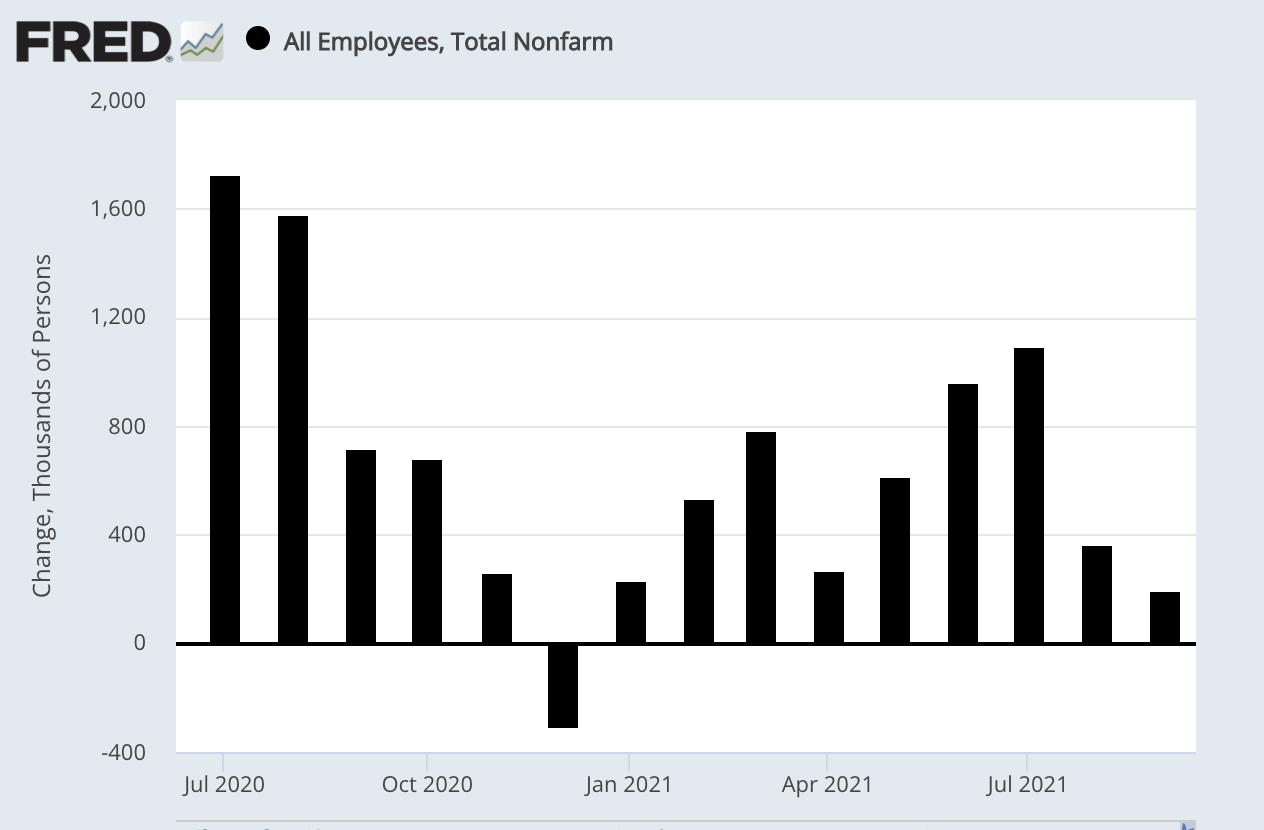
The official September jobs report came out today and it was another bust. The U.S. economy created 194,000 net new jobs last month. That was well short of expectations for 500,000. The unemployment rate fell to 4.8%. Wall Street had been expecting 5.1%.
The unemployment rate is lower now than it was during every single month from 1974 through 1996.
The headline number was hurt by a 123,000 decline in government payrolls, while private payrolls increased by 317,000.
The drop in the jobless rate came as the labor force participation rate edged lower, meaning more people who were sidelined during the coronavirus pandemic have returned to the workforce. A more encompassing number that also includes so-called discouraged workers and those holding part-time jobs for economic reasons declined to 8.5%, also a pandemic-era low.
The good news is that wages are rising. Average hourly earnings rose 0.6% last month. Over the last year, average hourly earnings are up 4.6%.
Of course, inflation is still an issue. That reminds me. The price for oil just topped $80 per barrel. That’s the highest since 2014.
Leisure and hospitality again led job creation, adding 74,000 positions, as the unemployment rate for the sector plunged to 7.7% from 9.1%. Professional and business services contributed 60,000 while retail increased by 56,000.
Job gains were spread across a variety of other sectors: Transportation and warehousing (47,000), information (32,000), social assistance (30,000), manufacturing (26,000), construction (22,000) and wholesale trade (17,000).
Local government education jobs fell by 144,000, which may have been due to seasonal adjustments in the numbers, according to Gus Faucher, chief economist at PNC.The stock market is about flat today.
-
Morning News: October 8, 2021
Posted by Eddy Elfenbein on October 8th, 2021 at 7:00 amAs Europe Faces a Cold Winter, Putin Seizes on the Leverage From Russia’s Gas Output
China’s Tech Antitrust Campaign Snares Meituan, a Food-Delivery Giant
The Postal Service Is Slowing the Mail to Save Money. Critics Say It’s a Death Spiral
Dollar Trades Flat as U.S. Jobs Report Awaited
Only Massive U.S. Jobs Miss Will Derail November Taper Bets
A Year After a Jobs Bust, College Students Find a Boom
Tycoon Behind a Crisis-Era Property Crash Now Sits on a $9 Billion Debt Mountain
New York’s Real Estate Tax Breaks Are Now a Rich-Kid Loophole
NYC’s Waldorf Gets Plush Renovation, Becomes Icon of China’s Overreach
U.S. Airlines Look for Holiday Boost After Delta Variant Interrupts Recovery
A Tiny Gas Meter? The More Mundane the Better for Japan’s Capsule Toys.
Bitcoin Preaches Financial Liberty. A Strongman Is Testing That Promise.
Corteva Faces Slow Start As It Takes Aim at Bayer’s Brazil Soy Reign
Tesla Will Move Its Headquarters to Texas
Google To Cut Off Ad Money For YouTube Videos That Spread Climate Change Denial
Be sure to follow me on Twitter.
-
Stocks Rally on Debt Deal
Posted by Eddy Elfenbein on October 7th, 2021 at 2:42 pmThe stock market is up again today. This could be another 1% move for the S&P 500. There seem to be the outlines for a short-term deal on the debt ceiling.
Washington’s race to reach an agreement on the debt ceiling has been an overhang for the market this week as investors hoped to avoid a government default. Schumer said lawmakers reached a deal on a short-term debt ceiling increase, which he hopes will be passed on Thursday. The deal will extend the debt ceiling through early December.
This morning’s jobless claims report came in at 326,000. Expectations were for 348,000. It was also a drop of 38,000 from last week. The pandemic low is 312,000 from a few weeks ago. I wouldn’t be surprised to see us break it again.
The jobs report is tomorrow. Expectations are for 500,000 and for unemployment to fall to 5.1%.
-
Morning News: October 7, 2021
Posted by Eddy Elfenbein on October 7th, 2021 at 7:05 amYet Another Covid Victim: Capitalism
‘Containergeddon’: Supply crisis drives Walmart and rivals to hire their own ships
The Future Farmers of France Are Tech Savvy, and Want Weekends Off
Fall in China’s $1.3 Trillion Land Sales to Test Local Finances, Economy
America’s Challenges Take Center Stage in Greece
How Other Nations Pay for Child Care. The U.S. Is an Outlier.
Powell’s Path to New Term Gets Trickier on Trading Furor, Warren
Anyone Seen Tether’s Billions?
Shiba Inu Now 12th-Biggest Crypto After 367% Rise in Just a Week
Tesla’s Gigafactory Electrifies California-Germany Culture Clash
Apple’s Plan for Cars: Using iPhone to Control A/C, Seats, Radio
Why Frances Haugen Is Actually Facebook’s Worst Nightmare
Barry Diller’s Dotdash Agrees to Buy Meredith, a Magazine Giant
India’s $99 Billion Man is Opening the Country’s First 7-Eleven
Evergrande Backer Chinese Estates’ Stock Soars on Take-Private Offer
Workers’ Strike at Kellogg’s Brings Its U.S. Cereal Production to a Halt
Be sure to follow me on Twitter.
-
ADP Shows Jobs Gain of 568,000 Last Month
Posted by Eddy Elfenbein on October 6th, 2021 at 3:06 pmThe stock market opened lower today but has recovered nicely, and we may make a small gain today. This, we’re told, is due to promising talks regarding the debt ceiling. Hmm…we’ll see.
This is also jobs week and the big labor report will come out on Friday. Today we got the ADP report, and it showed a gain of 568,000 jobs in September. Wall Street had been expecting 430,000. I should caution you that the ADP report is not always a good indicator of the government’s official report.
Shares of Intercontinental Exchange (ICE) are close to a new high. The stock’s most recent high is from July. ICE got as high as $121.55 today. The 52-week high is $122.42.
The White House said that Covid home test sales are ready to soar. This is good news for Abbott Labs (ABT):
The White House will announce Wednesday that the nation’s supply of at-home Covid-19 tests is on track to triple by early November, driven by recent government investments and the FDA’s emergency authorization of a test from ACON Laboratories.
The Biden administration projects that even more tests should be available by the end of the year. A White House official told POLITICO the administration is purchasing another $1 billion of at-home tests that will contribute to a quadrupling of the market to 200 million tests per month in December.
-
Morning News: October 6, 2021
Posted by Eddy Elfenbein on October 6th, 2021 at 7:03 amFutures Tumble as Soaring Energy Prices Fuel Inflation Worries
New Zealand Raises Rates for First Time in Seven Years, More to Come
A Shock Default in China Has Investors Scanning Repayment Dates
Chinese Golden Week Travel Suggests Sluggish Holiday Spending
Why Wall Street Cheers China, Despite Growing Business Unease
As the Debt Default Looms, the White House Warns of Financial Crisis
Biden Team Seeks to Pare Back Economic Agenda in Strategy Shift
Federal Reserve Chair Jerome Powell Faces Reappointment Amid Tumult
Bank Groups Unite Against Biden’s Pick for Key Regulatory Post
Airlines Warn Erratic Global COVID-19 Rules Could Delay Recovery
Airbus Exec Says Wary Engine Makers Will Meet Demand for New Jets
Zuckerberg Says Claims That Facebook Prioritizes Profit ‘Just Not True’
Home Depot Hires Walmart Delivery Drivers to Drop Off Paint and More to Customers’ Doors
Why Texas Embodies Economic Future of America
Single People Make Less Money Than Those With Partners, Research Finds
The Forbes 400: The Definitive Ranking of The Wealthiest Americans In 2021
Be sure to follow me on Twitter.
-
CWS Market Review – October 5, 2021
Posted by Eddy Elfenbein on October 5th, 2021 at 8:11 pm(This is the free version of CWS Market Review. If you like what you see, then please sign up for the premium newsletter for $20 per month or $200 for the whole year. If you sign up today, you can see our two reports, “Your Handy Guide to Stock Orders” and “How Not to Get Screwed on Your Mortgage.”)
The stock market bounced back today after another difficult Monday. Daily volatility has increased markedly recently. Consider that in all of June, July and August, the S&P 500 had seven days when it moved up or down by more than 1%. Today it happened for the fourth day in a row and for the seventh time in the last 12 sessions.
So what’s got everyone so jumpy? We can round up the usual suspects. For example, this is the historically tough time of year for stocks. September is the worst month and October is the most volatile. We also have another debt ceiling debate. Of course, there are worries about the Fed tapering soon. On top of that, the Q3 earnings will begin in a few weeks. There are also increased tensions between China and Taiwan. China has been repeatedly violating Taiwanese airspace.
If you had a rough day, consider that Mark Zuckerberg lost about $6 billion yesterday. Don’t feel too bad for him. The Zuck made back about $2 billion of that today.
To be honest, volatility has returned to normal. The unusual period isn’t now. Instead, it was the extremely calm market we had this summer. Through September, the S&P 500 hit 54 new highs this year. That trails only 1995.
Dividends Are Back
Another sign of the market returning to normal is the growth of dividends. I’ve been very happy to see this. We just got the Q3 numbers, and the companies in the S&P 500 paid out $15.36 per share in dividends. (I should explain that that’s the index-adjusted number. Roughly, every one point in the S&P 500 is worth about $8.5 billion.)
The good news about that $15.36 per share number is that it’s a 10% increase over last year’s Q3. That comes after three quarters of dividends being cut and two more quarters of very slight increases to dividends. Very close to being flat. The S&P 500 finally eclipsed its previous dividend record of $15.32 per share from the first quarter of 2020.
Here’s a chart showing the growth of dividends per share of the S&P 500:
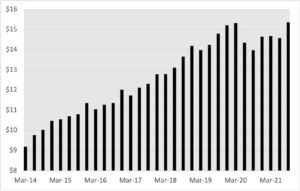
Once the pandemic started, many companies slashed their dividends. They wanted to make sure they had enough cash to ride out the lockdowns. Disney (DIS), for example, stopped paying its semi-annual dividend. We’d better get used to it. The CEO recently said the dividend won’t be coming back anytime soon.
But many companies are paying dividends again. Ross Stores (ROST) is a good example. The deep-discounter stopped paying its 21.5-cent dividend in March 2020. It restored it a year later. The company has gone on to pay more dividends in June and September. This is a good sign of confidence from the company.
This is also a good reason why it can be dangerous to follow a single indicator like dividend yields. In unusual circumstances, the dividend can give you a false reading. This is a subject I talk about a lot. The stock market’s overall dividend yield has plunged due to fewer dividends. This has happened as the market has rallied. That means that if you viewed lower yields as a signal of a pricey market, you would have missed out on some very nice gains. The overreliance on numbers can lead you astray.
Chistine Benz has a smart piece at Morningstar on what she calls the tyranny of what can be quantified. This is so true. Just because we can measure something, we deem it important. That’s not always the case. Oftentimes, it’s things we can’t so easily measure that are the most important. With investing, that can mean things like reputation or management’s effectiveness.
There’s a story that during the Vietnam War, Robert McNamara devised a massive system for measuring the success of the war based on data. McNamara’s team collected mountains of data. One of his aides remarked that it lacked one crucial data point, the feelings of the Vietnamese people.
I like dividends a lot, and it’s important to find companies that pay out solid dividends. One reason is that dividends don’t lie. One of the disturbing things you learn when you delve into corporate accounting is how much leeway companies are allowed when fixing their books. For example, a term like “cash flow” can mean lots of different things. But dividends are a check right from the company, so there’s no funny business going on.
I knew one person who liked to value companies based on a multiple of how much they paid in taxes. That’s based on a similar idea. If the company is admitting to a tax bill of that size, you can be sure they earned it and it’s not the result of funny accounting.
Also with dividends, there’s an implied promise that the company will at least do its best to maintain that dividend payment into the future. Of course, there’s no guarantee, but most companies at least try. Cutting your dividend is certainly not against the law, but it doesn’t look good.
I also like companies with long streaks of increasing their dividends each year. When a company in the S&P 500 has increased its dividend for 25 or more years, it’s known as a Dividend Aristocrat. Again, we have to look out for companies that only do token increases to keep their streaks alive.
Two websites that are invaluable for dividend investors are Dividend Value Builder and Dividend Growth Investor. I like that Dividend Value Builder also keeps takes on stocks not in the S&P 500 that have raised their dividend for 25 or more years.
Here’s a list of the longest dividend raisers:

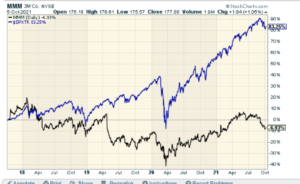
Source: Dividend Value BuilderOne stock on this list that grabs my attention is 3M (MMM). For years, this has been a great company. Blue chips don’t get much bluer than 3M. It’s beaten the market and consistently increased its dividend. Recently, however, the stock has lagged badly.
The company is a diversified industrial giant that has its hands in just about everything. Over the last four years, the S&P 500 Total Return Index has gained 83.25%. By contrast, 3M has lost 6.93%. Wall Street analysts hate the stock. 3M’s earnings peaked in 2018 and its profits fell in 2019 and again last year. So far this year, profits are running well ahead of last year, but it looks like 3M will still fall short of its 2018 peak.
When a well-run outfit sees its stock lag, I take notice. The problem 3M faces is lawsuits regarding the environmental damage resulting from chemicals it used to use. We don’t know what the eventual legal liabilities will be, but it won’t be small. There’s also a lawsuit regarding 3M’s earplugs for the military.
This is a difficult issue for an investor because a a new shareholder of today inherits the problems of the company’s past. I want nothing to do with environmental damage, but I recognize that’s not what 3M is today. At some point, 3M will be a big bargain, but we’re not quite there yet. I’m still keeping an eye on this one.
Older Male Investors Tend to Panic Sell More Often
I have bad news for the older guys out there. It turns out that you’re not so good at keeping cool during a market panic. Researchers at MIT found:
Investors who are male, over the age of 45, married or consider themselves as having “excellent investment experience” are more likely to “freak out” and dump their portfolio during a downturn, according to a paper published last month that analyzed more than 600,000 brokerage accounts.
The researchers say their work can be used to create predictive models, which would help identify individuals at risk of panic selling.
“Financial advisors have long advised their clients to stay calm and weather any passing financial storm in their portfolios,” wrote Daniel Elkind, Kathryn Kaminski, Andrew Lo and colleagues. “Despite this, a percentage of investors tend to freak out and sell off a large portion of their risky assets.”
I can’t say I’m surprised. If it didn’t already have a name, I would call testosterone, “bad investor juice.”
I can’t be too hard on the guys. During a market panic, it’s very hard to do nothing. The urge to pull the plug can be overwhelming. The researchers also found that investors with less than $20,000 in their portfolios were quick to liquidate the whole thing.
The fact is that the pain of losses weighs far more heavily on our psyches than the pleasure of winning does.
James O’Shaughnessy told me of a study that Fidelity did years ago of its clients. The firm wanted to see which investors did the best. Was it older investors or younger ones? Large portfolio investors or smaller ones? Men or women?
It turns out that the best investors among Fidelity’s clientele was an interesting group. It was people who had forgotten they had Fidelity accounts.
To quote the great Jesse Livermore:
“It never was my thinking that made the big money for me. It always was my sitting. Got that? My sitting tight! It is no trick at all to be right on the market. You always find lots of early bulls in bull markets and early bears in bear markets. I’ve known many men who were right at exactly the right time, and began buying or selling stocks when prices were at the very level which should show the greatest profit. And their experience invariably matched mine–that is, they made no real money out of it. Men who can both be right and sit tight are uncommon.”
I’ll have more for you in the next issue of CWS Market Review.
– Eddy
P.S. If you haven’t had a chance, you can subscribe to our premium newsletter. It’s only $20 a month or $200 a year. Please join us!
-
FactSet Reaches New High
Posted by Eddy Elfenbein on October 5th, 2021 at 1:39 pmThe stock market is improving today. Yesterday, the S&P 500 closed at its lowest level in two months. It looks like we’ll have another 1% day but this time to the upside.
Thanks to Facebook (FB) tanking yesterday, Mark Zuckerberg lost more than $6 billion yesterday. He’s made back about $2 billion today.
On our Buy List, shares of FactSet (FDS) just touched a new 52-week high. I was not expecting the stock to respond so strongly to its earnings report from last week.
Intercontinental Exchange (ICE) is having a good day for us. The stock is up about 3%. It’s not far from a new 52-week high.
On the economic front, the ISM Services Index rose to 61.9. That’s quite good. The trade deficit increased to $73 billion.
-
Morning News: October 5, 2021
Posted by Eddy Elfenbein on October 5th, 2021 at 7:04 amThe End of a ‘Gilded Age’: China Is Bringing Business to Heel
New U.S. China Trade Plan Leaves Industry Hungry for Specifics
John Authers: Stagflation Fear Is Having a British Renaissance
Energy Prices Spike as Producers Worry Over Pandemic and Climate
OPEC Opts Against Big Output Boost, Pushing Oil Prices to Seven-Year High
Global Energy Crisis Shows Fragility of Clean-Power Era
Facebook Is Weaker Than We Knew
Here’s What Facebook Says Triggered the Massive Outage on Its Apps
Amazon is Starting Black Friday Deals Early. Like, Now
PepsiCo Raises Annual Revenue Forecast as Soda Demand Jumps
Ouster Will Buy Sense Photonics, Drive for More Automotive Deals
Hollywood Crew Union Votes to Authorize Strike Against Studios
Tesla Ordered to Pay $137 Million Over Racism in Rare Verdict
Law Firm at Center of Pandora Helped Global Rich Hide Billions
The Pope’s Corruption Problems
Be sure to follow me on Twitter.
-
Facebook Leads the Market Lower
Posted by Eddy Elfenbein on October 4th, 2021 at 2:14 pmThe stock market is having another rough day today. The S&P 500 is currently down over 1.5%. Tech stocks are suffering the most. The NASDAQ is currently off by more than 2.3%. Facebook, in particular, has been hit hard. The shares are currently down over 5%.
A Facebook whistle blower was featured on last night’s 60 Minutes.
The identity of the Facebook whistleblower who released tens of thousands of pages of internal research and documents — leading to a firestorm for the social media company in recent weeks — was revealed on “60 Minutes” Sunday night as Frances Haugen.
The 37-year-old former Facebook product manager who worked on civic integrity issues at the company says the documents show that Facebook knows its platforms are used to spread hate, violence and misinformation, and that the company has tried to hide that evidence.
“The thing I saw at Facebook over and over again was there were conflicts of interest between what was good for the public and what was good for Facebook, and Facebook over and over again chose to optimize for its own interests, like making more money,” Haugen told “60 Minutes.”
-
Archives
- September 2026
- August 2026
- July 2026
- June 2026
- May 2026
- April 2026
- March 2026
- February 2026
- January 2026
- December 2025
- November 2025
- October 2025
- September 2025
- August 2025
- July 2025
- June 2025
- May 2025
- April 2025
- March 2025
- February 2025
- January 2025
- December 2024
- November 2024
- October 2024
- September 2024
- August 2024
- July 2024
- June 2024
- May 2024
- April 2024
- March 2024
- February 2024
- January 2024
- December 2023
- November 2023
- October 2023
- September 2023
- August 2023
- July 2023
- June 2023
- May 2023
- April 2023
- March 2023
- February 2023
- January 2023
- December 2022
- November 2022
- October 2022
- September 2022
- August 2022
- July 2022
- June 2022
- May 2022
- April 2022
- March 2022
- February 2022
- January 2022
- December 2021
- November 2021
- October 2021
- September 2021
- August 2021
- July 2021
- June 2021
- May 2021
- April 2021
- March 2021
- February 2021
- January 2021
- December 2020
- November 2020
- October 2020
- September 2020
- August 2020
- July 2020
- June 2020
- May 2020
- April 2020
- March 2020
- February 2020
- January 2020
- December 2019
- November 2019
- October 2019
- September 2019
- August 2019
- July 2019
- June 2019
- May 2019
- April 2019
- March 2019
- February 2019
- January 2019
- December 2018
- November 2018
- October 2018
- September 2018
- August 2018
- July 2018
- June 2018
- May 2018
- April 2018
- March 2018
- February 2018
- January 2018
- December 2017
- November 2017
- October 2017
- September 2017
- August 2017
- July 2017
- June 2017
- May 2017
- April 2017
- March 2017
- February 2017
- January 2017
- December 2016
- November 2016
- October 2016
- September 2016
- August 2016
- July 2016
- June 2016
- May 2016
- April 2016
- March 2016
- February 2016
- January 2016
- December 2015
- November 2015
- October 2015
- September 2015
- August 2015
- July 2015
- June 2015
- May 2015
- April 2015
- March 2015
- February 2015
- January 2015
- December 2014
- November 2014
- October 2014
- September 2014
- August 2014
- July 2014
- June 2014
- May 2014
- April 2014
- March 2014
- February 2014
- January 2014
- December 2013
- November 2013
- October 2013
- September 2013
- August 2013
- July 2013
- June 2013
- May 2013
- April 2013
- March 2013
- February 2013
- January 2013
- December 2012
- November 2012
- October 2012
- September 2012
- August 2012
- July 2012
- June 2012
- May 2012
- April 2012
- March 2012
- February 2012
- January 2012
- December 2011
- November 2011
- October 2011
- September 2011
- August 2011
- July 2011
- June 2011
- May 2011
- April 2011
- March 2011
- February 2011
- January 2011
- December 2010
- November 2010
- October 2010
- September 2010
- August 2010
- July 2010
- June 2010
- May 2010
- April 2010
- March 2010
- February 2010
- January 2010
- December 2009
- November 2009
- October 2009
- September 2009
- August 2009
- July 2009
- June 2009
- May 2009
- April 2009
- March 2009
- February 2009
- January 2009
- December 2008
- November 2008
- October 2008
- September 2008
- August 2008
- July 2008
- June 2008
- May 2008
- April 2008
- March 2008
- February 2008
- January 2008
- December 2007
- November 2007
- October 2007
- September 2007
- August 2007
- July 2007
- June 2007
- May 2007
- April 2007
- March 2007
- February 2007
- January 2007
- December 2006
- November 2006
- October 2006
- September 2006
- August 2006
- July 2006
- June 2006
- May 2006
- April 2006
- March 2006
- February 2006
- January 2006
- December 2005
- November 2005
- October 2005
- September 2005
- August 2005
- July 2005
 Eddy Elfenbein is a Washington, DC-based speaker, portfolio manager and editor of the blog Crossing Wall Street. His