-
CWS Market Review – January 15, 2021
Posted by Eddy Elfenbein on January 15th, 2021 at 7:08 am“There is only one boss. The customer. And he can fire everybody in the company from the chairman on down, simply by spending his money somewhere else.” – Sam Walton
For the fourth time in U.S. history, a president was impeached this week. A Senate trial may not happen for a few more weeks, after President Trump has left office. The financial markets, however, took the news in stride, and stock prices are still close to a new all-time high.
In last week’s issue, I cautioned that the December jobs report might not be a good one. I was right: it wasn’t. That, combined with other evidence, strongly suggests that the economy went into a nasty slide toward the close of 2020. President-elect Biden just unveiled plans for a massive stimulus program.
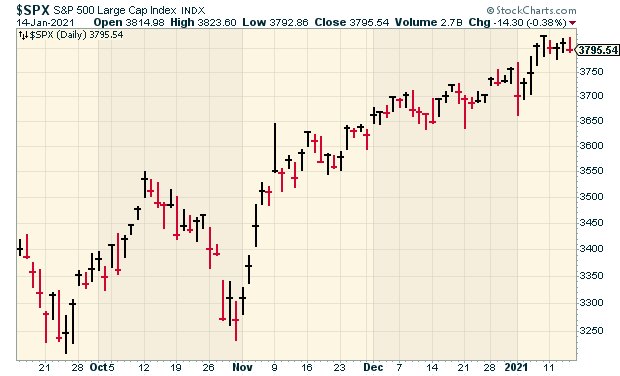
However, the big news coming our way is the fourth-quarter earnings season. From mid-January through early February, hundreds of companies will tell us how business fared during the final three months of 2020. For Wall Street, earnings season is like Judgment Day. Investors will learn who’s been naughty or nice. On our Buy List, 22 of our 25 stocks follow the March/June/September/December reporting period. That means they’ll be reporting soon. As usual, I’ll provide a complete earnings calendar for you as we get closer to earnings season.
In this issue, I have some Buy List updates for you. Some of our stocks are already up nicely this year. Trex, for example, is up close to 10%. That’s nice to see after last year’s big run. Miller Industries, a newbie this year, is already an 8% winner for us. Of course, it’s still early. Later on, I’ll lift some of our Buy Below prices. I’ll also highlight shares of Thermo Fisher Scientific. But first, let’s take a closer look at some recent economic news.
The U.S. Economy Lost 140,000 Jobs Last Month
Earlier this week, multi-gazillionaire and noted bluntsman Elon Musk tweeted rather mysteriously: “Use Signal.” Investors immediately sprang into action. Shares of Signal Advance (SIGL) skyrocketed from 60 cents per share to $3.76 per share. Within a few days, the stock eventually reached $70 per share.
There was one wee problem. Signal Advance had nothing to do with the company Musk was tweeting about. Signal Advance is a tiny biotech stock that used to be known as Biodyne Development Company. Musk wanted people to use Signal, an encrypted-messaging platform that isn’t publicly traded.
Still, the market took the wrong signal, literally, and the wrong Signal soared. With investing, people often talk of the Greater Fool Theory. This means that someone is overpaying but they’re buying in because they think they can unload it an even higher price. Here the theory became reality.
Well after the Signal mix-up was discovered, shares of SIGL were still frantically bouncing around. On Thursday, shares of SIGL closed at $11.50 per share. That was a 36% gain in one day for a stock that has little true value.
My point is that investing isn’t a rational business. Over the long term, sure, it’s pretty good. But in the short term? No way. The market is little more than a poorly-organized mob.
Last Friday, the government released the December jobs report. Wall Street was expecting a loss of 50,000 jobs. Instead, the economy lost 140,000 jobs. The unemployment rate is now 6.7%. The situation is grim. There are currently more than 110 million people who are either out of work or out of the job market entirely.
After digging into the details of the jobs report, we learned that most of the damage fell on the education sector as well as the leisure and hospitality sectors. In a net-net sense, all of the jobs lost last month were held by women. Male employment increased by 16,000.
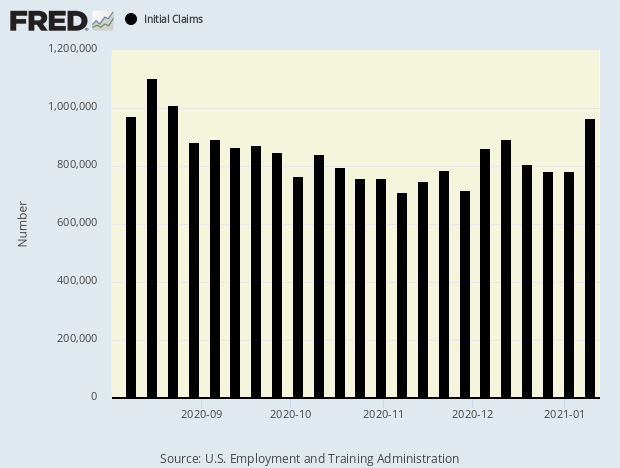
As I said in last week’s issue, I had been expecting bad news. Several other economic reports hinted that the economy was slowing down late in 2020. On Thursday, the initial-claims report rose to 965,000. That was the highest since August. It’s still about four times higher than the pre-pandemic average.
On January 28, the government will release its initial estimate for Q4 GDP growth. Again, I’m not expecting good news. The New York Fed’s Nowcast currently estimates Q4 GDP growth of 2.2%. I think that’s too high. President-elect Biden unveiled his $1.9 trillion stimulus package.
To fill the lingering holes in the economic recovery, the plan also includes more than $1 trillion in direct aid to struggling families through $2,000 stimulus checks, extended unemployment insurance, rental protections and nutrition assistance. The Biden proposal also allocates $440 billion to small businesses, local communities and transit systems on the brink.
Well, that’s the proposal. What Congress approves may look quite different.
One concern is inflation. The government has already spent lots of money, and it’s looking to spend ever more. So far, there hasn’t been much evidence of inflation. This week’s CPI report showed that headline inflation rose by 0.4% last month. That matched expectations.
The culprit for higher prices wasn’t hard to find. For December, gasoline prices rose by 8.4%, and that accounted for 60% of the rise in December’s CPI. When we look at the “core rate” of inflation, which excludes food and energy prices, then inflation rose by just 0.1%. I tend to be a pragmatist on this issue. There are far too many folks predicting that massive inflation is just around the bend. Eh…maybe. I prefer to look at the data. We’re just not seeing a big increase yet, but it may soon come.
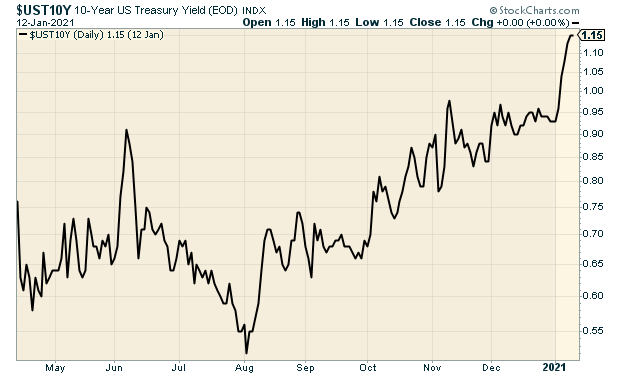
I can’t help noticing that the bond market is reacting, albeit slowly. In August, the 10-year Treasury yield was as low as 0.5%. This week, it got as high as 1.2%. That’s still low, but I’m keeping an eye on it. Inflation may be back with us.
Small Caps Soar
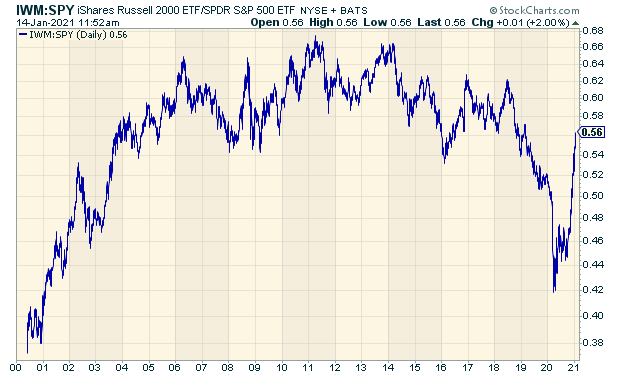
One of the more remarkable events of recent months has been the tremendous rally in small-cap stocks. This comes after nearly a decade of the small-cap Russell 2000 Index’s trailing the overall market, sometimes badly. But not lately. The Russell 2000 ETF (IWM) is up more than 123% from its March low. The relative performance really took off at the end of September. Since then, IWM is up almost 49% while the S&P 500 ETF (SPY) is up “only” 17.5%. That’s a huge gap for that time period.
Here’s a 20-year look at the Russell 2000 ETF divided by the S&P 500 ETF. See how raucous the last year has been.
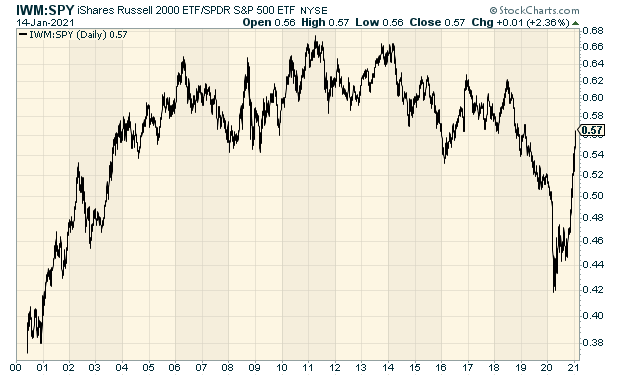
So what’s driving the little guys? I have a slightly heterodox view on this. I don’t think the Russell 2000 is a good indicator of small-cap performance. Instead, it’s an index that leans heavily towards the cyclical sectors, with some unusual features. Most prominently, the R2000 doesn’t have any of the mega-cap tech stocks. That means that whenever the Apples of the world sour, the R2000, by definition, sees a relative gain.
The Russell 2000 leans towards energy and financial stocks. Those are the ones that have been doing well. This is further evidence of the trend we’ve discussed before. Cyclical and value stocks have been leading the charge, and that may continue. This has been mirrored in the bond market by those yields that we discussed before. What we’re seeing is a large shift from defense to offense. Related to this, consumer staples have been relatively weak, even good ones like Hershey (HSY) and Church & Dwight (CHD).
It’s not so much that cyclicals are getting high valuations. It’s that they’re fed up with trailing for so many years. Not that long ago, Apple was worth more than the entire Russell 2000. That’s not the case anymore. I wasn’t surprised by this rotation, but the quickness with which it occurred did get my attention. I expect this rotation to continue on for at least several more weeks.
Profile of Thermo Fisher Scientific
I promised to go into greater depth on our new stocks. This week, it’s Thermo Fisher Scientific’s (TMO) turn. The best way to think of TMO is to know that they make all the stuff that makes labs run. That means all matter of scientific instruments. The company is also involved with diagnostics consumables and life-sciences reagents.
This is a good business to be in, and a very good business to dominate, because customers buy the initial base of equipment. As that expands and upgrades, TMO gets a steady stream of recurring revenue. I didn’t select it as a Covid stock, but Thermo will certainly be an important player in the fight against the pandemic. In fact, the company recently launched two antibody tests. Wherever research money is spent, Thermo will get its beak wet. It’s simply the arms dealer to the pharma industry.
In many respects, TMO has a business model similar to that of razors and razor blades. Once you get the customer to buy the razor, they’re tied in to buying many more blades. Nearly 80% of TMO’s revenue is recurring. Importantly, the company strives to have the best instruments out there. Thermo spends about $1 billion a year on R&D, and about 40% of TMO’s revenue comes from pharma and biotech.
Last year. TMO offered to buy Qiagen (QGEN) for $11.5 billion. That was a lot of money, but QGEN shareholders shot down the deal. Wisely, TMO walked away. That impressed me.
The stock is currently going for 24 times this year’s earnings estimate. That’s not cheap, but given TMO’s historic valuation, it’s not bad. The company’s ability to grow earnings consistently is truly impressive. Check out the long-term chart below.
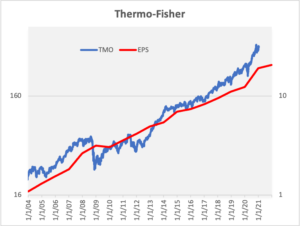
The share price is in blue, and it follows the left scale. The red line is EPS, and it follows the right scale. The two lines are scaled at a ratio of 16-to-1.
The next earnings report is due out on February 1. Wall Street is expecting earnings of $6.47 per share. Thermo Fisher Scientific is a buy up to $490 per share. I may adjust that soon, but I want to see earnings first.
Buy List Updates
Our Buy List is up on the year. Thanks to the recent rally, a few of our stocks have jumped above their Buy Below prices. Right now is the quiet before the storm. There’s not much news about our stocks, but that will change soon. This week, I’m raising our Buy Below on Ansys (ANSS) to $390 per share.
I’m also raising AFLAC’s (AFL) to $50 per share. The duck stock is due to report earnings on February 3. The current estimate on Wall Street is operating earnings of $1.05 per share. Since October 30, AFLAC has rallied 38%.
I’m also raising our Buy Below on Intercontinental Exchange (ICE) to $123 per share. This week, ICE said it’s going to sell its Bakkt unit. The division will enter the public markets via a SPAC. That’s a special purpose acquisition company. It’s basically a shell company that’s listed on the exchange. It can buy up a company like Bakkt in order to avoid all the headache of going public.
Bakkt focuses on digital markets. Initially, it made a big splash by having Bitcoin futures. Now it lets people trade all sorts of digital assets. The deal values Bakkt at $2.1 billion.
As I mentioned earlier, Trex (TREX) is up nearly 10% this year after a spectacular 2020. I’m raising our Buy Below on Trex to $98 per share.
Stepan (SCL) got out of the gate very strongly this year. At one point last week, shares of Stepan broke above $131, but they pulled back some this week. I’m lifting our Buy Below on Stepan to $134 per share.
That’s all for now. The stock market will be closed on Monday is honor of Dr. Martin Luther King’s birthday. The civil rights leader would have been 92. On Wednesday, Joe Biden will be inaugurated as our 46th president. On Thursday, we’ll get another jobless-claims report. On Friday, the existing-home sales report is due out. Be sure to keep checking the blog for daily updates. I’ll have more market analysis for you in the next issue of CWS Market Review!
– Eddy
-
Morning News: January 15, 2021
Posted by Eddy Elfenbein on January 15th, 2021 at 7:02 amUnemployment Claims Rise Sharply, Showing New Economic Pain
Biden Unveils Plan to Pump $1.9 Trillion Into Pandemic-Hit Economy
Biden’s $1.9 Trillion Rescue Package Offers Bridge for Hard-Hit Economy
Who Qualifies for a Second Round of Small-Business Relief?
Why Finding Workers Is Getting Harder for U.S. Homebuilders
The Stock Market’s Perplexing Rise Lifted Many Kinds of Funds
U.S. Targets Xiaomi, Cnooc in Trump’s Late Anti-China Push
Tesla Might Finally Have Some Competition. From Ford. & The Leaders in the Race to Build a Better EV Battery
Disneyland as a Vaccination Site? Airports as Test Centers? The Travel Industry Pitches In
Airbnb CEO Says Travel Never Going Back to the Way It Was Before Pandemic
Intel’s ‘Chief Geek,’ Pat Gelsinger, Returns as CEO
Ben Carlson: It’s Time to Prepare For Markets & the Economy to Get Weird
Joshua Brown: Surprise, Surprise – The Stimulus Is Actually Stimulating & Crowdstrike CEO George Kurtz on The Compound Show
Michael Batnick: The Power of Story Telling & Animal Spirits: Investing in Private Real Estate
Be sure to follow me on Twitter.
-
“Saturn was going to cross Mercury”
Posted by Eddy Elfenbein on January 14th, 2021 at 3:08 pmBitcoin seems so flighty, some might argue you may as well consult a crystal ball, read the runes or stare at the stars to divine the direction of the capricious cryptocurrency.
Enter Maren Altman, bitcoin investor and astrologer.
The New Yorker has been following the movements of celestial objects to predict bitcoin price fluctuations since last summer. And while many people might mock her methods, she has built up a 1 million-strong social-media following on TikTok.
Last week, the 22-year-old told her followers to watch for a price correction on Jan. 11.
Why? Saturn was going to cross Mercury.
Lo and behold, bitcoin fell as much as 21% on that day, before recovering most of its losses, slamming the brakes on a meteoric rally that saw it double from early December to a record $42,000 last week.
-
Jobless Claims Rose to 965,000
Posted by Eddy Elfenbein on January 14th, 2021 at 11:54 amThis morning’s jobless claims report was a bad one. The government said that 965,000 Americans filed jobless claims. That’s the most since August and it’s a clear sign that the trend has turned. Wall Street had been expecting 800,000.
This is more confirmation of last week’s lousy jobs report. Two weeks from today, we’ll get our first look at Q4 GDP and I’m afraid it won’t be good.
Still, the jobless number for the week ended Jan. 9 was another sign of economic turmoil brought on by restrictions in activity aimed at combating the pandemic. The total was the highest since the week of Aug. 22, when just over 1 million claims were filed.
Continuing claims also were higher, rising 199,000 to 5.27 million. That figure runs a week behind the weekly claims total and increased for the first time since late November.
There’s unusual market action today. Stocks are up modestly, but small-caps are doing very well. As I write this, the Russell 2000 is up 1.88% while the S&P 500 is up just 0.20%. Since late September, the Russell 2000 ETF (IWM) is up close to 50%.
On our Buy List, we have new highs today from Ansys (ANSS), Cerner (CERN), Heico (HEI), Miller (MLR) and Trex (TREX).
-
Morning News: January 14, 2021
Posted by Eddy Elfenbein on January 14th, 2021 at 7:04 amGermany’s Economy Contracted By 5% in 2020 As Coronavirus Lockdowns Hit Growth
China Ends 2020 With Record Trade Surplus as Pandemic Goods Soar
Biden to Unveil Plan to Pump $1.5 Trillion Into Pandemic-Hit Economy
Cash, Breakfasts and Firings: An All-Out Push to Vaccinate Wary Medical Workers
U.S. Decides Against Investing Ban on Alibaba, Tencent and Baidu
Cathie Wood’s Vision for Space ETF Sends Whole Industry Soaring
Wall Street Fumes Over Last-Minute Rule From Trump Bank Watchdog
Circle K’s Owner Offers $20 Billion for France’s Biggest Retailer
Wells Fargo CEO to Unveil Cost-Cutting Plan
Millions Flock to Telegram and Signal as Fears Grow Over Big Tech
Parler CEO Says Social Media App, Favored by Trump Supporters, May Not Return
Intel, Under Pressure to Rethink Its Business, Ousts Its Chief Executive
Cullen Roche: 2021 World Podcast Tour Begins!
Howard Lindzon: It’s All Ball Bearings…And Hydrogen – The Fletch Investor
Joshua Brown: What Is The Penalty For Being Wrong?
Be sure to follow me on Twitter.
-
December CPI +0.4%
Posted by Eddy Elfenbein on January 13th, 2021 at 11:31 amThe government released the inflation report for December this morning. The headline rate of inflation was 0.4% last month. That was in line with forecasts, though much of the increase was due to gasoline. For December, gasoline prices rose by 8.4% and that accounted for 60% of the rise in December’s CPI.
Last month’s CPI readings were in line with economists’ expectations. The CPI rose 1.4% in 2020. That was the smallest yearly gain since 2015 and was a deceleration from 2.3% in 2019.
The CPI increased at a 1.7% average annual rate over the last 10 years.
The core rate of inflation, which excludes food and energy, rose by just 0.1% last month.
Economists are divided on the outlook for inflation this year. Some believe inflation will breach its target, citing nearly $900 billion additional pandemic relief approved by the government in late December and expectations for more fiscal stimulus from incoming President Joe Biden’s administration and the Democratic-controlled Congress.
Biden will be sworn in next Wednesday. Indeed, U.S. Treasury yields have risen in anticipation of stronger economic growth in the second half of the year. A survey this month showed a measure of prices paid by manufacturers jumped in December to its highest level since May 2018, likely reflecting bottlenecks in the supply chain caused by the virus.
The bond market seems to be more concerned about inflation. This summer, the yield on the 10-year Treasury was just 0.5%. This morning, it got to 1.18%. That’s hardly a big increase but it’s interesting to note.
-
Morning News: January 13, 2021
Posted by Eddy Elfenbein on January 13th, 2021 at 7:01 amChina’s Economy Surges, and So Does Its Currency
Dubai Loan Standoff Is Said to Pit State Company Against Lenders
Global Banks Warn of Market Chaos If Court Abolishes Libor
Potential Priorities for Wall Street’s Next Top Cop
Elon Musk Loves China, and China Loves Him Back—for Now
Air Cargo Construction Is Booming, Thanks to Amazon
PC Giant Lenovo Plans China Listing, Sending Stock Soaring
Visa and Plaid Scrap $5.3 Billion Merger Agreement
Target Boosts Holiday Sales During Covid-19 Pandemic
YouTube Suspends President Trump’s Account
Trump Suspension to Test Twitter CEO’s Truce with Investors
Apple Invests Millions to Back Entrepreneurs of Color, Part of Racial Justice Effort
Google Backs Biden Immigration Efforts, Covers Fees in Threatened ‘Dreamer’ Program
Nick Maggiulli: Just Take the Money
Ben Carlson: Why People Won’t Change Their Mind
Howard Lindzon: Twitter and Trump…Continued
Joshua Brown: Is Chamath the New Warren Buffett?
Michael Batnick: Animal Spirits: The Next Tesla Is Tesla, Rotation & Knee-jerk Dismissiveness
Be sure to follow me on Twitter.
-
The Dow’s Return by Day of the Month
Posted by Eddy Elfenbein on January 12th, 2021 at 2:12 pmIn previous posts, I’ve crunched the numbers on the entire +120-year history of the Dow Jones Industrial Average to find certain calendar effects. For example, the stock market has historically experienced a nice Santa Claus Rally around Christmastime. Looking at 10-year slices, the market has also perked up in the latter half of a decade.
There are lots of these tidbits. I don’t take them too seriously since I’m geared toward the long term. My latest look, however, was startling. I broke down the entire history of the Dow to see its return by day of the month, meaning its calendar day (the first, second, third, etc.).
The results shocked me. Nearly the entire gain of the Dow has come during the first six days of the month. During the rest of the month, the market is up but a very tiny bit.
I took the Dow from its first day in May 1896 through the end of 2019. Here’s what the average month looks like:
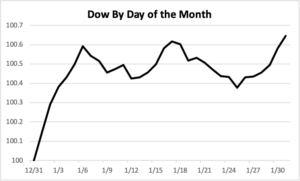
On the first six days of the month, the Dow has gained 54,752%. That’s an average gain of 0.59% per those six days. Over the rest of the month, the Dow has gained just 28%. That’s 28% in over 27,000 trading days. Per month, the return works out to 0.05%.
In plainer terms, in the first six days of each month, the stock market has gained more than 10 times what it does compared with the rest of the month.
Obviously, it’s very expensive to dart in and out of the market so frequently. No serious investor should behave that way, but this does illuminate a broader fact of investing: returns are seldomly equally distributed.
The market has also done well towards the end of each month. Over the 26th through the 31st, the Dow has averaged a gain of 0.27%. (Bearing in mind that only seven months have 31 days, of course.)
That means that from the 7th to the 25th of each month, the Dow has lost an average of 0.21%. The rest of the time, the Dow has gained an average of 0.86% per month.
Here’s the return by each day of the month:

Here’s the date, the return for each day of the month and the number of times that day came up.
 Eddy Elfenbein is a Washington, DC-based speaker, portfolio manager and editor of the blog Crossing Wall Street. His