-
The Tiffany Deal Is Off
Posted by Eddy Elfenbein on September 9th, 2020 at 11:16 amGrowth is having a nice rebound this morning which is to be expected following yesterday’s rout. The question is whether this is the start of a long-term rotation or whether it is yet another head fake. We just don’t know yet.
Growth is beating Value today, but Low Vol is well ahead of High Beta. You don’t see that every day. As I write this, the S&P 500 is up by 1.8%.
One interesting story this morning. LVMH has decided to scrap its $16.2 billion deal to buy out Tiffany. So what went wrong?
Tiffany asked to push the deadline back a few weeks. The French government also asked for a delay because of the threat of American tariffs on French-made goods.
There’s also the angle that the deal was agreed to before the coronavirus hit but it was to be closed during the pandemic. Actually, I’m surprised more deals like this haven’t fallen apart.
It’s an odd take but the deal wound up in the center of a trade dispute between France and the U.S. The Trump administration had actually rolled back its original plans to tax a wide range of French goods including wine and cheese.
The Trump administration threatened these tariffs because, they claimed, that France’s new digital tax unfairly targeted U.S. firms.
They have a point, but the solution may not be the best idea. The French law slaps a 3% tax on revenue that tech companies get from France. The U.S. position is that the law conveniently dings U.S. firms but doesn’t hit areas where French companies are dominant.
That’s clearly true. The French authorities even referred to the tax as the GAFA Tax for Google, Amazon, Facebook and Apple.
The French have said they’re willing to repeal the tax if there’s a broader strategy to tax tech companies across economically-developed countries (OECD, Organization for Economic Cooperation and Development). In fact, Macron even said that if American firms wind up paying more taxes now under the French law than they would under a later agreement, then France would chip in to make up the difference.
For the most part, tech companies and members of Congress support the administration’s policy. The French position is that an American tariff on France is unfair because the U.S. is the one holding up an agreement on taxing tech companies.
The problem is that the U.S. is so dominant in tech that any tax will disproportionally hurt us. Hopefully, the OECD will come up with a plan to tax these companies. I don’t see how anyone is helped by countries going it alone and risking a trade war.
-
Morning News: September 9, 2020
Posted by Eddy Elfenbein on September 9th, 2020 at 7:00 amU.S. Businesses in China Not Heeding Trump’s Call to Return Home
Jerome Powell Channels Alan Greenspan in Putting Stamp on Fed
The Fed Enabled a Record Expansion. Trump Is Taking Credit.
The Largest Mortgage Origination Volume on Record
U.S. Regulator Calls Climate Change A Systemic Risk
Saudi Arabia Just Crushed U.S. Crude Oil Prices Again
Natural Gas Is the Rich World’s New Coal
Pandemic E-Commerce Surge Spurs Race For ‘Tesla-Like’ Electric Delivery Vans
$16 Billion Tiffany Deal Collapses Over Tariffs
Trapped by Pandemic, Ships’ Crews Fight Exhaustion and Despair
‘Mulan,’ Once a Sure Thing, Becomes a Problem for Disney
Nick Maggiulli: What Your Psychology Says About Your Relationship with Money
Michael Batnick: Will Money Printing Cause Inflation?
Joshua Brown: Tesla Snubbed (!) and the Nasdaq Whale Story
Be sure to follow me on Twitter.
-
Whither the P/E?
Posted by Eddy Elfenbein on September 8th, 2020 at 11:54 amWhy is the P/E Ratio so darned high? That’s a question that’s bedeviled analysts for many years, not just now.
As a stock-picker, I generally avoid such arguments. The stock market doesn’t need to “make sense.” The market gods have their reasons for doing whatever it is they do, even if it’s not entirely clear to us mortals. The judgments of the markets are true and righteous altogether.
The market’s sanity has especially been called into question lately because the market has done well even though the economy has not. The disconnect between Wall Street and Main Street has become a popular talking point.
As I’ve noted before, this disconnect should not alarm anyone. The stock market and economy have little reason to be strongly linked in the near term. We’ve experienced many such disconnects. One popular idea is that President Trump and, of course, “his cronies” are propping up the market for the election. I’m curious where this cabal was during February and March.
In any event, Alan Reynolds, a senior fellow at the Cato Institute, is the latest to take on this question. I should add that since Dow 36,000, conservative pundits have not had a particularly stellar track record in discussing market valuations. (By the way, here’s a brilliant critique of Dow 36,000 written by, as it turns out, me.)
Reynolds writes:
The argument for stocks being greatly “overvalued” rests on the fact that the trailing P/E ratio rose significantly from May 1 to September 1. On January 1, the P/E ratio was 24.21 –about the same as two years before (24.87). Even after Covid-19 and lockdowns crushed the economy, the P/E ratio was still 23.74 on April 1. Stock prices and earnings had both collapsed in sync. The P/E ratio was 25.10 on May 1 after the Fed funds rate fell to nil and the $1,200 checks and PPP loans peaked. It then rose to 26.69 on June 1, 27.57 on July 1, 28.31 on August 1 and 30.32 on September 1.
First, Reynolds points out that the inverse of the P/E Ratio, earnings over price, should generally follow bond yields. As bond yields have plunged, valuation should rise. Since the days of Alan Greenspan, this has often been called the Fed Model, though Reynolds believes he may have originally influenced the Maestro. They worked together on Reagan’s transition team.
Here’s a chart from Reynolds’s post:
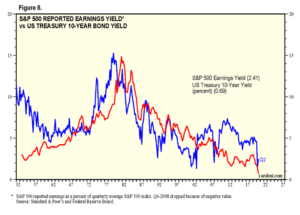
Yes, they certainly do seem to match up. Reynolds also notes that the P/E Ratio falls when inflation rises. Therefore, he claims that Jerome Powell’s Jackson Hole speech, which outlined the Fed’s greater tolerance for inflation, could have been a negative for share prices.
While Reynolds says the lower bond yields justify the higher equity valuations, he says the Federal Reserve deserves zero credit since they were a laggard on lowering short-term rates.
The Federal Reserve can certainly crash the market (e.g., the double-dip recessions of 1980-82), but milder forms of Fed activism rarely explain bond yields or stock prices. The 10-year bond yield has at times risen 3.5 to 4 percentage points above the Fed funds rate, as in 1992, 2001-04 and 2010. Also, the S&P 500 stock index hovered at or below 2000 the last time the Fed kept the funds rate near zero in 2014-15, then rose 46% by July 2019 even as the Fed raised the funds target ten times to 2.5%.
Reynolds then gets to the key point that trailing P/E Ratios are higher but forward ratios may not be. We still don’t know.
I believe Reynolds errs on two key points. One oversight is noting which stocks are rising. There’s a tendency to treat the S&P 500 as if it’s one giant stock. It’s not. The Big Outside of a small group of tech stocks, the stock rally hasn’t been particularly impressive.
Here’s the S&P 500 Tech Index (red) along with the S&P 500 except tech (in blue).
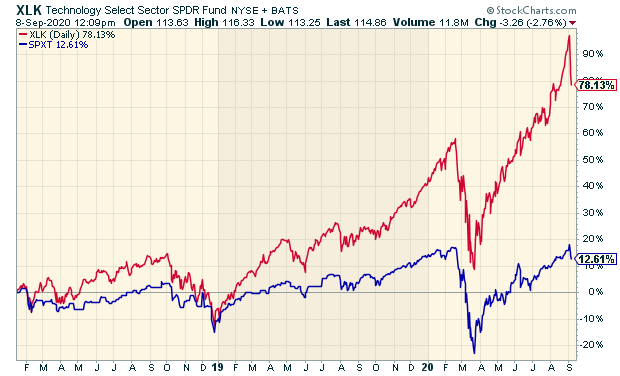
The other point is dividends which are a key component of stock returns. On this point, short-term rates from the Fed have an impact though it’s a limited effect.
-
The Worst Time of the Year
Posted by Eddy Elfenbein on September 8th, 2020 at 9:54 amOver the last 100 years, September has been the worst month for stocks. It’s also been the worst for the last 50 and last 100 years.
I’ve crunched the entire 124-year history of the Dow and here’s what the average year looks like:
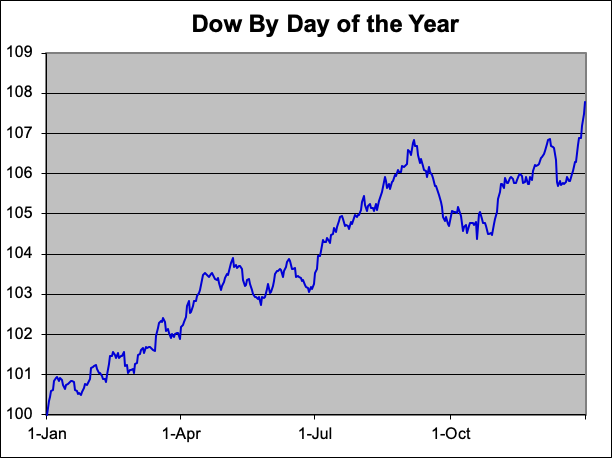
You can see there’s a peak at the end of summer. From September 6 to September 30, the Dow has lost an average of 2.01%. That may not sound like a lot but it’s the average of 124 years of data. More than one-quarter of the Dow’s total gain has been wiped in a little over three weeks.
-
Tech Slumps Again
Posted by Eddy Elfenbein on September 8th, 2020 at 9:36 amTech stocks are down this morning. The fantastic rally in tech seems to be unwinding. There often seems to be a change in market sentiment after Labor Day.
Shares of Tesla were again snubbed by the S&P 500. Despite Tesla’s large size (market cap near $400 billion), the index keepers at S&P haven’t added it to their prestigious index. Also weighing on Tesla, GM took a $2 billion stake in Nikola. They’re going to partner together to make a pickup truck. Nikola is up 25% and GM is up 6%. Tesla is down 15%.
Ahead of Halloween, Hershey (HSY) is partnering with Google to use a person’s search history so they can tailor ads based on whether the person is likely to go out outside or not.
Hershey will tailor digital ads to households using search data provided by Google to overcome fresh challenges that threaten to derail this year’s Halloween.
The Pennsylvania-based candymaker struck a deal with Google last month for access to data showing whether people are more or less likely to go outside based on what they search for. For instance, a person who sought out business hours for nearby stores or vacation ideas suggests the likelihood to go outside.
Honestly, that sounds a little creepy.
-
Morning News: September 8, 2020
Posted by Eddy Elfenbein on September 8th, 2020 at 7:01 amThe Year That Hammered Global Trade Still Poses Five Big Risks
U.S. May Ban Cotton From Xinjiang Region of China Over Rights Concerns
Why Calls to Boycott ‘Mulan’ Over Concerns About China Are Growing
Exxon Downsizes Global Empire As Wall Street Worries About Dividend
U.S. Shale Producers Race For Federal Permits Ahead Of Presidential Election
Dear Wall Street, Your Boss Wants You to Come Back to the Office
The Two Men Buying Your Favorite Retailers
Move Aside Robots, Tesla Bets On Aluminium Casting
Tesla Shares Slump as S&P 500 Inclusion Remains Elusive
GM Venture’s Mini Car Becomes China’s Most Sold EV, Surpassing Tesla’s Model 3
Amazon Bans Sale of Foreign Seeds in the U.S.
Southwest Airlines Loses Another Competitive Advantage
The Next Pandemic Is Already Here
Ben Carlson: Why Even the Best Stocks Have to Crash
Be sure to follow me on Twitter.
-
Morning News: September 7, 2020
Posted by Eddy Elfenbein on September 7th, 2020 at 7:12 amGoldman Says Allure of Brexit Deal Hard to Resist for Johnson
Fed’s Strategy Shift to Bind Big Central Banks From Frankfurt to Tokyo
How A New Type of Money Helped Cause the Great Financial Crisis
The Options-Enhanced Stock Market Money Machine Is Going Global
The Fund Managers, The Sleuths And The Mystery Of The Missing ESG
Samsung Wins $6.6 Billion 5G Verizon Deal While Huawei Struggles
VW Says It May Soon Be Overtaking Tesla
Parents Got More Time Off. Then the Backlash Started.
Joshua Brown: The Biggest Threat to Your Favorite Tech Stock
Michael Batnick: The Stock Split Bonanza
Roger Nusbaum: Dissecting Barron’s Retirement Cover Story
Jeff Miller: Weighing the Week Ahead: The Start of Something Big?
Ben Carlson: The Economics of Parenting & The New Fed Mandate: Full Employment & Asset Bubbles?
Be sure to follow me on Twitter.
-
August Jobs Report
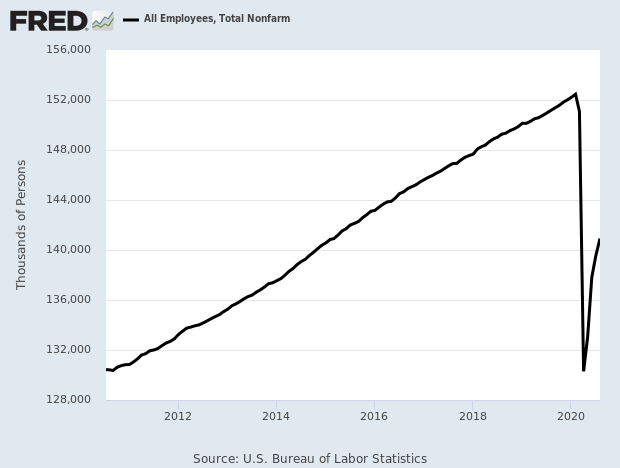
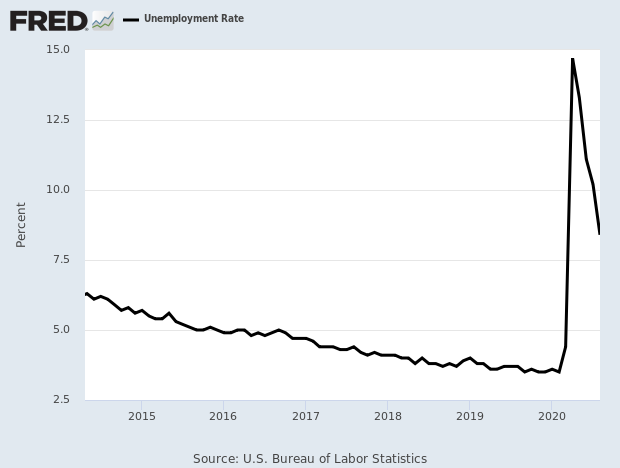
Posted by Eddy Elfenbein on September 4th, 2020 at 8:35 amLast month, the U.S. economy created 1.371 million new jobs. The unemployment rate fell to 8.4%.
In two months, the economy lost 22.16 million jobs. Over the last four months, we’ve gained back 10.61 million jobs.
The labor force participation rate is up to 61.73%, which is still very low. Before the pandemic, it was running around 63%.
The jobs-to-population ratio is at 56.5%. It was over 61% at the start of this year.
Here’s a chart of non-farm payroll:
Here’s the unemployment rate:
-
CWS Market Review – September 4, 2020
Posted by Eddy Elfenbein on September 4th, 2020 at 7:08 am“Become more humble as the market goes your way.” – Bernard Baruch
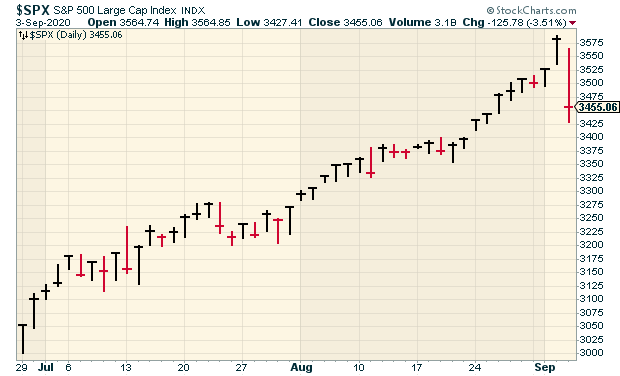
After a spectacular run, the stock market suddenly got a case of the jitters on Thursday. Up until that point, the market had been enjoying an explosive rally.
The numbers are truly impressive. Last month was the best August for the S&P 500 in 36 years. Before Thursday’s swan dive, the index had rallied nine times in the previous 10 days. Going out further, the index closed higher 19 times in 25 days.
It seemed like the market was rising every day, and every day it was being led by the same big-name companies. Heck, Tesla closed higher not for anything they did but simply because they split their stock! (Elon, if you’re reading this, take note of this week’s epigraph.)
I suppose the bulls thought they had scared away the last bear. Not so! On Thursday, the S&P 500 got dinged for a 3.5% loss. That was more than four times worse than any other day in the last six weeks (which probably says more about the last six weeks than it does about Thursday).
Confused? Don’t worry. In this week’s issue, I’ll break down for you what’s happening. I’ll also highlight some recent economic news, which hasn’t been not terrible. I’ll explain what I mean. First, let’s look at Thursday’s Big Chill.
The Rally Finally Gets Some Pushback
One of the old chestnuts on Wall Street is that trends can last longer than you think. It’s natural for a market-watcher to think that some trend has finally exhausted itself, yet it still goes on. Thinking you can accurately spot the turning point is a dangerous game.
I’ve been thinking about this lately since Wall Street has fallen under the spell of a few select stocks. Earlier I mentioned Tesla. On Monday, the stock jumped more than 12% when the company split its stock 5-for-1. To be clear, nothing happened. A stock split has zero bearing on the underlying share price.
But Tesla doesn’t have shareholders, it has fan boys. TSLA is up more than 780% over the last 12 months. Here’s my favorite Tesla fact: the average share of Tesla is owned for ten days.
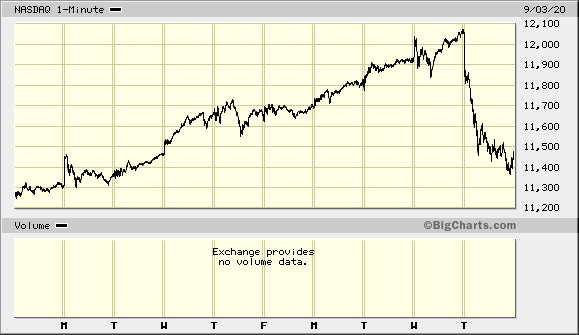
But even Tesla got caught up in the selling. From Tuesday’s high to Thursday’s low, shares of Tesla dropped 20%.
Check out the intra-day chart of the Nasdaq:
Zoom is another superstar stock that had a dramatic week this week. I would have to say that Zoom has probably been the stock that’s most emblematic of 2020. It’s reached the level of Xerox and Kleenex—the brand name is also the generic name.
On Tuesday, Zoom zoomed higher by more than 40%. The company reported earnings that demolished Wall Street’s estimates. For the most recent quarter, Zoom earned 92 cents per share. That more than doubled Wall Street’s consensus of 45 cents per share. This year, the stock is up 460%.
One interesting side note about Zoom. The company’s founder had his visa application rejected by the U.S. government eight times. On Tuesday, he made $6.6 billion.
But like Tesla, Zoom got tangled up in the selling. From Tuesday’s high to Thursday’s close, Zoom lost 22%, a drop similar to Tesla’s.
Apple Is Now Worth More than the Russell 2000
Shares of Apple also got a nice bump this week after they, too, did a stock split. At one point, Apple’s market value surpassed the market value of the Russell 2000. One company is worth more than an index of 2,000 stocks.
And like the others, Apple got a super-atomic wedgie on Thursday. The company lost a staggering $180 billion in market value.
In previous issues I’ve written about how the Big Five (Apple, Amazon, Facebook, Google and Microsoft) have nearly taken over the entire market. The companies are so big, and they’ve done so well, that they distort the rest of the market. These five companies now account for more than 20% of the S&P 500.
So much of the relative performance this year boils down to the question: do you have exposure to the Big Five (or Zoom or Tesla) or not? Our Buy List does not. Despite this, I’ve been impressed by the way we’ve held our own. For example, our Buy List is running ahead of the S&P 500 Equal Weight Index. That’s the regular S&P 500, but with every stock counting the same.
I have to explain that while our Buy List did reach new highs last week and this week, it generally lagged the market. That’s due to the nature of our stocks. Most of the stocks on our Buy List are stable companies and very high-quality. As such, they don’t quite ride the same updraft during a ferocious bull market such as we’ve had. Though to be clear, we’ve gone higher.
Conversely, when the market broke on Thursday, we also fell, but not as much as the overall market. Yesterday, 16 of our 25 stocks fell less than the overall market. Two stocks, Eagle Bancorp (EGBN) and AFLAC (AFL), actually closed higher.
Thursday was a good example of what market folks call a “contra-trend” day. That’s a fancy word meaning all the stuff that’s been doing great is having a rotten day. Meanwhile, all the stuff that’s been lagging is doing well.
Contra-trend rallies are typical within larger rallies, but we can’t say that this spells the end of the superstar stock rally. Clearly, there are nervous investors out there, and the bears have shown that they’re willing to push back.
There are parts of this market that have been almost entirely left behind by this rally. Value stocks, for example, haven’t done much. Here’s a chart of S&P 500 Value (blue) and S&P 500 Growth (black). Growth has outperformed Value, but the gap got dramatically wider this year.
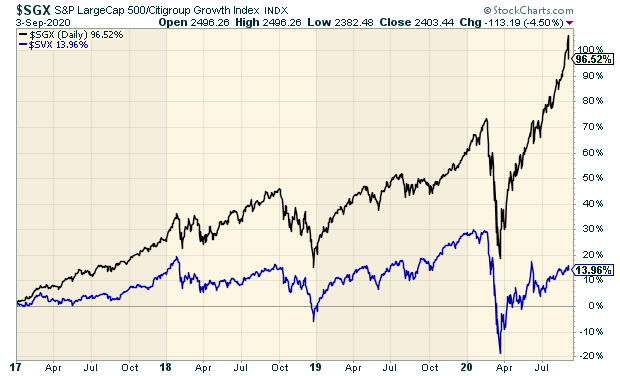
If you look closely, at the end of the chart, Thursday’s drop is visible for Growth, but Value was impacted much more.
Also, the non-tech stocks in the S&P 500 haven’t done particularly well. There’s a decent chance that Thursday could mark the beginning of rotation away from the big Growth winners and toward the Value laggers.
As a very general rule of thumb, the Buy List keeps up with the overall market during bull markets. But during bear markets has been where we’ve set ourselves apart. That happened again earlier this year when the S&P 500 lost more than one-third of its value in just over a month.
The U.S. Economy Is Slowly Getting Better
I also wanted to touch on a few of the recent economic reports. There’s been some brighter economic news, but I have to put that in the context of a very distressing economy for so many. The economy is getting better, but we have a long way to go until we get back to normal.
Last week, the government revised Q2 GDP from an annualized decline of 32.9% to one of “just” 31.7%. In late October, we’ll get our first look at Q3 GDP.
The big August jobs report is due out later this morning. On Thursday, the ADP payroll report said that 428,000 private jobs were created last month. That was well short of Wall Street’s guess of 1.1 million. I should add that the ADP is not a good predictor of what the government’s report will say.
The most recent jobless-claims report came in at 881,000. That’s much better than Wall Street’s estimate of 950,000. This is the lowest initial-claims report since the lockdowns started nearly six months ago.
The Labor Department also changed its methodology which may have overstated the jobless claims earlier this year. Continuing claims fell to 13.254 million.
Factory orders for July rose by 6.4%. Perhaps the best news was the ISM Manufacturing Index. This week’s report came in at 56, which is its best reading in nearly two years. We also learned this week that home prices are rising at the fastest rate in nearly two years. That could be helping business for our friends at Trex (TREX).
That’s all for now. The stock market will be closed on Monday for Labor Day. There’s not much in the way of economic news next week, but there are a few items I want to highlight. On Tuesday, the consumer-credit report comes out. On Wednesday, we’ll get another report on job openings. Thursday we’ll get another jobless-claims report. Then on Friday, the latest CPI report is released. Be sure to keep checking the blog for daily updates. I’ll have more market analysis for you in the next issue of CWS Market Review!
– Eddy
-
Morning News: September 4, 2020
Posted by Eddy Elfenbein on September 4th, 2020 at 7:01 amWall Street Has Its Worst Day in Months
Tech Selloff Seen as Removal of Froth Rather Than a Warning Sign
2016 All Over Again? Investors Ready For Big Market Moves As U.S. Election Nears
Unemployment Claims Show Layoffs Continue to Batter Economy
Unemployment Claims Improve But It’s a Manipulation Mirage
What the Fed’s New Long-Run Inflation Outlook Means for Your Portfolio
Central Bankers Aren’t Using Their Climate Superpowers Yet
Taking Power – Chinese Firm to Run Laos Electric Grid Amid Default Warnings
Justice Dept. Plans to File Antitrust Charges Against Google in Coming Weeks
The Fraud and Drug Binges That Helped Create a Billion-Dollar Shoe Company
‘Mulan’ Tests Subscribers’ Desire to Pay Up for Big-Budget Film
Nick Maggiulli: Why Do Poor People Stay Poor?
Cullen Roche: The COVID Price Compression in Technology
Howard Lindzon: Daddy…What’s a Bubble?
Ben Carlson: How Much Money Is Enough?
Be sure to follow me on Twitter.
-
Archives
- August 2026
- July 2026
- June 2026
- May 2026
- April 2026
- March 2026
- February 2026
- January 2026
- December 2025
- November 2025
- October 2025
- September 2025
- August 2025
- July 2025
- June 2025
- May 2025
- April 2025
- March 2025
- February 2025
- January 2025
- December 2024
- November 2024
- October 2024
- September 2024
- August 2024
- July 2024
- June 2024
- May 2024
- April 2024
- March 2024
- February 2024
- January 2024
- December 2023
- November 2023
- October 2023
- September 2023
- August 2023
- July 2023
- June 2023
- May 2023
- April 2023
- March 2023
- February 2023
- January 2023
- December 2022
- November 2022
- October 2022
- September 2022
- August 2022
- July 2022
- June 2022
- May 2022
- April 2022
- March 2022
- February 2022
- January 2022
- December 2021
- November 2021
- October 2021
- September 2021
- August 2021
- July 2021
- June 2021
- May 2021
- April 2021
- March 2021
- February 2021
- January 2021
- December 2020
- November 2020
- October 2020
- September 2020
- August 2020
- July 2020
- June 2020
- May 2020
- April 2020
- March 2020
- February 2020
- January 2020
- December 2019
- November 2019
- October 2019
- September 2019
- August 2019
- July 2019
- June 2019
- May 2019
- April 2019
- March 2019
- February 2019
- January 2019
- December 2018
- November 2018
- October 2018
- September 2018
- August 2018
- July 2018
- June 2018
- May 2018
- April 2018
- March 2018
- February 2018
- January 2018
- December 2017
- November 2017
- October 2017
- September 2017
- August 2017
- July 2017
- June 2017
- May 2017
- April 2017
- March 2017
- February 2017
- January 2017
- December 2016
- November 2016
- October 2016
- September 2016
- August 2016
- July 2016
- June 2016
- May 2016
- April 2016
- March 2016
- February 2016
- January 2016
- December 2015
- November 2015
- October 2015
- September 2015
- August 2015
- July 2015
- June 2015
- May 2015
- April 2015
- March 2015
- February 2015
- January 2015
- December 2014
- November 2014
- October 2014
- September 2014
- August 2014
- July 2014
- June 2014
- May 2014
- April 2014
- March 2014
- February 2014
- January 2014
- December 2013
- November 2013
- October 2013
- September 2013
- August 2013
- July 2013
- June 2013
- May 2013
- April 2013
- March 2013
- February 2013
- January 2013
- December 2012
- November 2012
- October 2012
- September 2012
- August 2012
- July 2012
- June 2012
- May 2012
- April 2012
- March 2012
- February 2012
- January 2012
- December 2011
- November 2011
- October 2011
- September 2011
- August 2011
- July 2011
- June 2011
- May 2011
- April 2011
- March 2011
- February 2011
- January 2011
- December 2010
- November 2010
- October 2010
- September 2010
- August 2010
- July 2010
- June 2010
- May 2010
- April 2010
- March 2010
- February 2010
- January 2010
- December 2009
- November 2009
- October 2009
- September 2009
- August 2009
- July 2009
- June 2009
- May 2009
- April 2009
- March 2009
- February 2009
- January 2009
- December 2008
- November 2008
- October 2008
- September 2008
- August 2008
- July 2008
- June 2008
- May 2008
- April 2008
- March 2008
- February 2008
- January 2008
- December 2007
- November 2007
- October 2007
- September 2007
- August 2007
- July 2007
- June 2007
- May 2007
- April 2007
- March 2007
- February 2007
- January 2007
- December 2006
- November 2006
- October 2006
- September 2006
- August 2006
- July 2006
- June 2006
- May 2006
- April 2006
- March 2006
- February 2006
- January 2006
- December 2005
- November 2005
- October 2005
- September 2005
- August 2005
- July 2005
 Eddy Elfenbein is a Washington, DC-based speaker, portfolio manager and editor of the blog Crossing Wall Street. His