-
Morning News: October 15, 2020
Posted by Eddy Elfenbein on October 15th, 2020 at 7:09 amIMF Sees Worldwide Debt Soaring to 100 Percent of GDP Due to COVID-19
ECB Sees Little Reason to Rush Into New Stimulus This Month
Trump Administration to Consider Adding China’s Ant Group to Trade Blacklist
Stepped Up Chinese Scrutiny Increases Investment Risk of ‘Beast’ Ant
Japanese Automakers Are Helping Fuel U.S. Recovery
Bank Earnings Show Diverging Fortunes on Wall Street and Main Street
Value Stocks Could Shine After U.S. Election, No Matter Who Wins
The End Of Oil? Battle Lines Drawn As Industry Grapples With Energy’s Future
Why These Retail Giants Are Booming Amid The Pandemic
A Small Business Argument for Joe Biden & What Small Business Owners Really Need From the Next President
DOJ Shoots Down DirecTV and Dish Merger Again
BTS Management’s Stock Soars on First Day of Trading
Ben Carlson: Animal Spirits: Bearish the Whole Way Up
Michael Batnick: Chart of the Day
Be sure to follow me on Twitter.
-
Earnings Season Begins
Posted by Eddy Elfenbein on October 14th, 2020 at 11:26 amYesterday, the market snapped its four-day winning streak, but stocks are up again today. Energy is particularly strong while the rest of the market is mixed. We got some of the first earnings reports this morning. The banks are usually first. Goldman Sachs crushed expectations ($9.68 vs $5.57) while Wells Fargo and Bank of America both missed expectations.
Richard Clarida, the vice-chair of the Fed, told the Institute of International Finance, “That said, the Covid-19 recession threw the economy into a very deep hole, and it will take some time, perhaps another year, for the level of GDP to fully recover to its previous 2019 peak…It will likely take even longer than that for the unemployment rate to return to a level consistent with our maximum-employment mandate.”
-
Morning News: October 14, 2020
Posted by Eddy Elfenbein on October 14th, 2020 at 7:02 amEurope Can Impose Tariffs on U.S. in Long-Running Aircraft Battle
After Two Lost Decades, U.S.’s Weakest Local Economies May Face Worse From Pandemic
Stocks Are Soaring — But Most Black People Are Missing Out
FDA Faults Quality Control at Lilly Plant Making Trump-Touted COVID Drug
BTS’s Loyal Army of Fans Is the Secret Weapon Behind a $4 Billion I.P.O.
Walmart’s Black Friday Plan Caps Customer Capacity at Just 20%
Amazon’s ‘Christmas Creep’ Poses Stress Test for FedEx, UPS
In China, Apple’s 5G iPhone 12 Sparks Fever-Pitch, But Divided Reaction
Three Things Apple Announced That People Actually Want, and One They Don’t
Meet The Guilt-Ridden Oil Billionaire Trying To Save The Planet
Joshua Brown: Disney Wants The Netflix Treatment, Renting A House, Breaking Up Tech Monopolies
Michael Batnick: And Now Some Bad News & New WAYT!
Ben Carlson: Why Are So Many Unprofitable Companies the Best Performing Stocks This Year?
Nick Maggiulli: The Best Investing Books for Every Kind of Investor
Be sure to follow me on Twitter.
-
The Market Is Down After Second-Highest Close
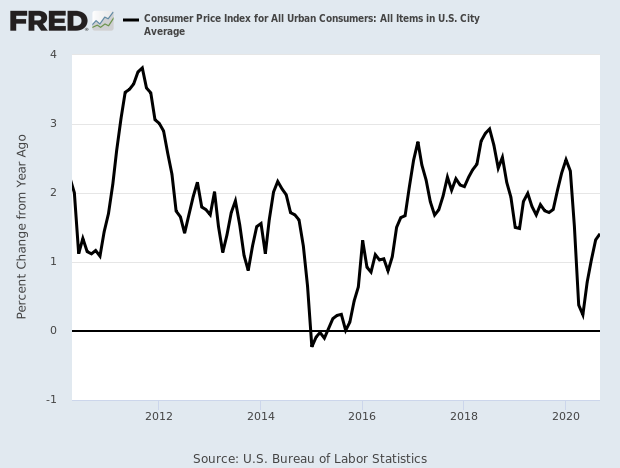
Posted by Eddy Elfenbein on October 13th, 2020 at 3:13 pmYesterday, the stock market closed at its second-highest level ever. Today, the market has pulled back some. This morning’s CPI report showed that both headline and core inflation rose by 0.2% last month.
The Labor Department said on Tuesday its consumer price index increased 0.2% last month after gaining 0.4% in August. The CPI advanced 0.6% in both June and July after falling in the prior three months as business closures to slow the spread of the coronavirus weighed on demand.
In the 12 months through September, the CPI increased 1.4% after rising 1.3% in August. Economists polled by Reuters had forecast the CPI climbing 0.2% in September and rising 1.4% year-on-year.
That’s not bad and it indicates that inflation isn’t heating up despite the Fed’s new permissive attitude. As I write this, the S&P 500 is off by about 0.60%.
Disney got a nice boost today thanks to its reorg announcement. At one point, shares of the Mouse House were up over 5%.
Here’s a chart of headline inflation:
-
Morning News: October 13, 2020
Posted by Eddy Elfenbein on October 13th, 2020 at 7:06 amDalio Says ‘Time Is on China’s Side’ in Power Struggle With U.S.
July Is the New January: More Companies Delay Return to the Office
Walt Disney Restructures Entertainment Businesses to Boost Streaming
Covid-19 Vaccines Are Chance at Salvation, Financial and Beyond, for Drug Makers
First, A Vaccine Approval. Then ‘Chaos and Confusion.’
J&J Halts Covid-19 Vaccine Trial Due to Unexplained Illness
Apple Event Expected to Bring 5G Speed, Smaller iPhone 12
Amazon Pandemic Prime Day Steals Rivals’ Black Friday Spotlight
Amazon Bets on Prime Day in Latin America to Battle Local Rivals
Audi to Build Electric Cars Geared to Chinese Buyers From 2024
Retail Investors Embrace Risk and the ‘Hive Mind’ in Stock Boom
Goldman Sachs Struggling to Reach Financial Targets
Economists Tell Stories, Just Like Novelists — Don’t Let the Nobel for ‘Economic Sciences’ Fool You
Three Rockefellers Say Banks Must Stop Financing Fossil Fuels
Ben Carlson: Don’t Mix Your Politics With Your Portfolio
Howard Lindzon: Momentum Monday – Blue Wave?
Be sure to follow me on Twitter.
-
Disney’s Reorg Announcement
Posted by Eddy Elfenbein on October 12th, 2020 at 4:39 pmAfter the bell, Disney released a statement.
In light of the tremendous success achieved to date in the Company’s direct-to-consumer business and to further accelerate its DTC strategy, The Walt Disney Company (NYSE: DIS) today announced a strategic reorganization of its media and entertainment businesses. Under the new structure, Disney’s world-class creative engines will focus on developing and producing original content for the Company’s streaming services, as well as for legacy platforms, while distribution and commercialization activities will be centralized into a single, global Media and Entertainment Distribution organization. The new Media and Entertainment Distribution group will be responsible for all monetization of content—both distribution and ad sales—and will oversee operations of the Company’s streaming services. It will also have sole P&L accountability for Disney’s media and entertainment businesses.
The creation of content will be managed in three distinct groups—Studios, General Entertainment, and Sports—headed by current leaders Alan F. Horn and Alan Bergman, Peter Rice, and James Pitaro. The Media and Entertainment Distribution group will be headed by Kareem Daniel, formerly President, Consumer Products, Games and Publishing. All five leaders will report directly to Bob Chapek, Chief Executive Officer, The Walt Disney Company. Disney Parks, Experiences and Products will continue to operate under its existing structure, led by Josh D’Amaro, Chairman, Disney Parks, Experiences and Products, who continues to report to Mr. Chapek. Rebecca Campbell will serve as Chairman, International Operations and Direct-to-Consumer. Bob Iger, in his role as Executive Chairman, will continue to direct the Company’s creative endeavors.
“Given the incredible success of Disney+ and our plans to accelerate our direct-to-consumer business, we are strategically positioning our Company to more effectively support our growth strategy and increase shareholder value,” Mr. Chapek said. “Managing content creation distinct from distribution will allow us to be more effective and nimble in making the content consumers want most, delivered in the way they prefer to consume it. Our creative teams will concentrate on what they do best—making world-class, franchise-based content—while our newly centralized global distribution team will focus on delivering and monetizing that content in the most optimal way across all platforms, including Disney+, Hulu, ESPN+ and the coming Star international streaming service.”
Under the new structure, the Company’s three content groups will be responsible and accountable for producing and delivering content for theatrical, linear and streaming, with the primary focus being the Company’s streaming services:
STUDIOS: Messrs. Horn and Bergman will serve as Chairmen, Studios Content, which will focus on creating branded theatrical and episodic content based on the Company’s powerhouse franchises for theatrical exhibition, Disney+ and the Company’s other streaming services. The group will include the content engines of The Walt Disney Studios, including Disney live action and Walt Disney Animation Studios, Pixar Animation Studios, Marvel Studios, Lucasfilm, 20th Century Studios and Searchlight Pictures.
GENERAL ENTERTAINMENT: Mr. Rice will serve as Chairman, General Entertainment Content, which will focus on creating general entertainment episodic and original long-form content for the Company’s streaming platforms and its cable and broadcast networks. The group will include the content engines of 20th Television, ABC Signature and Touchstone Television; ABC News; Disney Channels; Freeform; FX; and National Geographic.
SPORTS: Mr. Pitaro will serve as Chairman, ESPN and Sports Content, which will focus on ESPN’s live sports programming, as well as sports news and original and non-scripted sports-related content, for the cable channels, ESPN+, and ABC.
The Media and Entertainment Distribution group, led by Mr. Daniel, will be responsible for the P&L management and all distribution, operations, sales, advertising, data and technology functions worldwide for all of the Company’s content engines, and it will also manage operations of the Company’s streaming services and domestic television networks. The group will work in close collaboration with the content creation teams on programming and marketing.
-
Should Disney Cut Its Dividend?
Posted by Eddy Elfenbein on October 12th, 2020 at 12:16 pmLast week, Dan Loeb called on Disney (DIS) to suspend its dividend. Loeb is a well-known activist investor. Currently, Disney pays a semi-annual dividend of 88 cents per share, each July and December. The company skipped its dividend this summer.
An annual dividend of $1.76 per share works out to over $3 billion per year. Loeb wants Disney to put that cash into its streaming service.
But through it all, Disney’s streaming business has been a notable success story. After making its debut last November, Disney+ had 60.5 million subscribers worldwide by August—well ahead of analysts’ and Disney’s own forecasts. Its other offerings are Hulu, with 36 million, and ESPN+, with 9 million. Next year, Disney is also planning to add an international streaming service similar to Hulu, to be called Star.
Barron’s points out that this is the opposite of what activist investors usually do. They’re known for pursuing short-term profits at the expense of long-term financial health. This time, Loeb is looking at the long term.
I understand Loeb’s thinking, but I think he’s premature. In my view, it all comes down to Covid-19. If a vaccine comes out tomorrow, then Disney’s troubles go away. Disney is a company almost perfectly made to be impacted by the coronavirus.
Relatedly, I floated the idea on Twitter recently of Disneyland leaving California. Most Twitterers responded by saying this was a very farfetched idea. Probably so. Still, the mess of Covid has allowed people to rethink what their business is about, and unthinkable options are now thinkable.
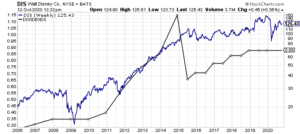
(Note on the chart above. The black line is dividends. Disney switched from an annual to a semi-annual dividend.)
-
The Racial Investing Gap
Posted by Eddy Elfenbein on October 12th, 2020 at 10:31 amAt the Washington Post, Michelle Singletary has an important column on the racial investing gap. For obvious historical reasons, many people of color have little trust in financial institutions. She describes how her own grandmother was unwilling to invest her savings.
Big Mama eventually put aside about $20,000 for her retirement. But she kept it all in a simple savings account. The bank teller couldn’t even persuade her to put the money in a short-term certificate of deposit.
“No, ma’am,” Big Mama told her. “Leave my money right in the savings account.”
Federal Reserve data from the 2019 Survey of Consumer Finances found that Black families are far less likely than White families to have retirement investment accounts.
“Among middle-aged families — who have the highest rates of account ownership — 65 percent of White families have at least one retirement account, compared to 44 percent of Black families,” the Fed said.
Those who like to pigeonhole Blacks as financial illiterates argue that the disparity results from the failure of Blacks to comprehend the importance of investing. This viewpoint ignores the history of slavery and its enduring impact on the descendants of enslaved people.
-
Morning News: October 12, 2020
Posted by Eddy Elfenbein on October 12th, 2020 at 7:02 amEU Crafting Big Tech ‘Hit List’ – FT
Tech-Giant Tax Negotiations Stumble, Raising Risk of Trade Clash
Silicon Valley Pay Cuts Ignite Tech-Industry Covid-19 Tensions
Wall Street Layoffs A Matter Of When, Not If, Sources Say
Milgrom, Wilson Win Nobel in Economics for Work on Auctions
Singapore Air’s A380 Restaurant Tickets Sell Out in 30 Minutes
When Your Last $166 Vanishes: ‘Fast Fraud’ Surges on Payment Apps
Harvard Names Srikant Datar as New Dean of Its Business School
British Airways Abruptly Replaces Its Chief Executive
Joshua Brown: Too Much Money, Nowhere To Put It
Howard Lindzon: Catching Up On All Things SPACs and Collectibles
Jeff Carter: YCharts Exits to LLM Partners
Michael Batnick: Animal Spirits: Protecting the Tails & Your Home is Not an Investment
Ben Carlson: Don’t Take Personal Finance Advice From Billionaires & Some Thoughts For Young People in the Financial Services Industry
Be sure to follow me on Twitter.
-
CWS Market Review – October 9, 2020
Posted by Eddy Elfenbein on October 9th, 2020 at 7:08 am“There are two times in a man’s life when he shouldn’t speculate: when he can afford to and when he can’t.” – Mark Twain
The stock market got dinged on Tuesday when President Trump said he wasn’t interested in pursuing fiscal stimulus until after the election. The markets then rebounded on Wednesday and Thursday when the president clarified that he would sign a stand-alone stimulus bill.
Just looking at the calendar, it may be too late to get any bill passed before election day. Yet despite the impasse, the stock market has been in a cheery mood of late. The S&P 500 has closed higher eight times in the last eleven sessions. On Thursday, the index finished the day at a five-week high.
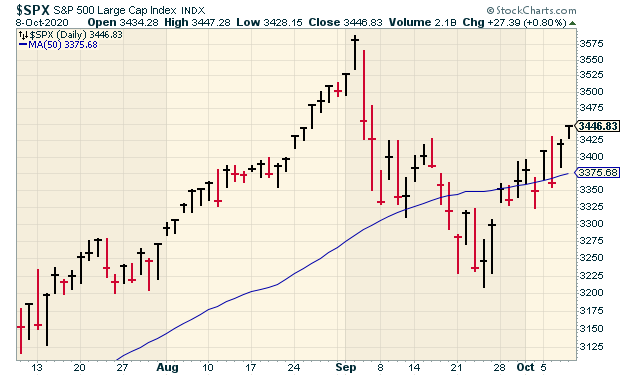
Will it last? Frankly, I’m skeptical. The V-shaped recovery is looking wobbly, and this week’s Fed minutes agreed. We also have the Q3 earnings season coming soon, plus there’s the uncertainty of the upcoming election. In this week’s issue, I’ll try to sort it all out for you.
I’ll also cover the recent earnings report from RPM International, and it was a good one. RPM topped Wall Street’s consensus by 25 cents per share and raised its dividend for the 47th year in a row. Not bad.
Later on, I’ll unveil our calendar for this earnings season so you’ll know exactly what to expect. But first, let’s look at the recent jobs report and what it says about the economy.
The U.S. Economy Has Made Back Half the Jobs It Lost
Last Friday, the government released the jobs numbers for September. The U.S. economy created 661,000 net new jobs last month. That was below Wall Street’s estimates of 800,000. Normally, a gain of more than 600,000 a month is an astounding number. However, in the age of the Covid-19, it’s actually the slowest gain of the last five months.
What’s happening is that the tremendous bounce back from the economic lockdown is starting to wane. Actually, there have been hints of this for some time, but now we have solid data.
The unemployment rate fell to 7.9%. Wall Street’s estimate was for 8.2%. Even though the jobless rate has been nearly cut in half since April, it’s still higher than the peak rate hit during the recession of the early 1990s.
In simple terms, the U.S. economy lost 22 million jobs in two months. In the five months since then, the economy has recovered 11 million jobs. Yes, it’s an impressive recovery, but it’s only about halfway back to the status quo ante.
Here’s a chart of nonfarm payrolls (black) along with the S&P 500 (red). Both lines dipped, but stocks recovered more robustly than did jobs.
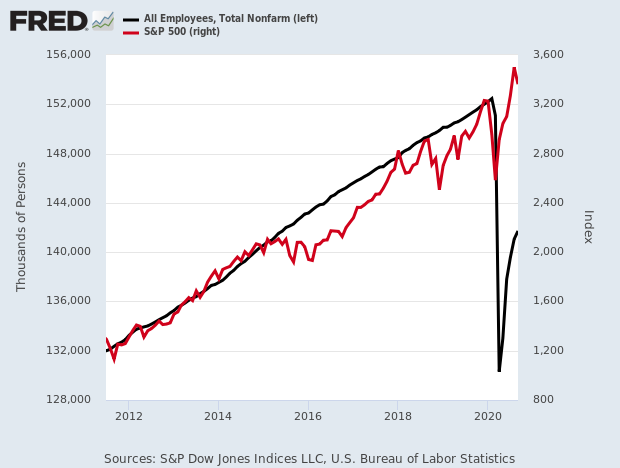
The bottom line is that the US economy is still adding jobs but at a slower rate than it had been before. The private sector added 877,000 net new jobs last month. The labor-force participation rate fell to 61.4% for September. Average hourly earnings rose by 0.1%.
We got more confirmation of the slowing jobs growth with the latest jobless-claims report. On Thursday, it was reported that 840,000 Americans filed for first-time claims. That was a little higher than Wall Street’s estimate of 825,000. Although it’s another six-month low, this was the sixth weekly report in a row that fell in the range of 800,000 to 900,000.
In plain terms, the boost from the re-opening is gone, and it looks like the economy is stabilizing within a new, and lower, range. Of course, there are many more variables to consider, and it adds extra attention to the stimulus debate in Washington. This view was confirmed this week by the release of the minutes to the most recent Federal Reserve meeting.
The minutes said, “Many participants noted that their economic outlook assumed additional fiscal support and that if future fiscal support was significantly smaller or arrived significantly later than they expected, the pace of the recovery could be slower than anticipated.” That’s unusually bold language for a central bank, but I see their point.
Again, I urge investors to be cautious. Make sure you’re well diversified and have plenty of dividend-payers in your portfolio. I expect more good earnings news from our stocks once earnings season heats up, but you never know how the market will react. Now let’s look at our Buy List earnings report from this week.
RPM Beats Earnings and Raises Dividend
On Wednesday, RPM International (RPM) reported very good earnings for its fiscal Q1. This was for the quarter that ended on August 31. RPM is one of those fairly dull companies that I like. RPM consistently churns out solid numbers.
For the quarter, sales rose 9.1% to $1.61 billion, and net income increased by 70% to $180.6 million. RPM made $1.44 per share, which was a 51% jump over last year’s Q1. That result beat Wall Street’s estimate by 25 cents per share.
CEO Frank C. Sullivan said:
During our fiscal 2021 first quarter, select segments of the global economy began to gain momentum as stay-at-home orders were relaxed, which freed pent-up demand from last year’s fourth quarter. This helped drive our record top-line results, which grew 9.1% over the prior-year period. This was in sharp contrast to the Covid-19-related sales decline we reported for the fiscal 2020 fourth quarter. Our two largest segments, the Construction Products Group and the Consumer Group, posted positive growth in the first quarter, while the other two segments declined.
Let’s look at the breakdown by RPM’s four business groups. The Construction Products Group saw Q1 sales rise by 2.2% to $547.7 million. Performance Coatings had a sales decrease of 12.6% to $259.8 million. The Consumer Group was the star. It had a sales increase of 33.8% to $641.2 million. Lastly, Specialty Products Group had a sales decrease of 1.3% to $158.0 million
The strong quarterly results helped RPM’s balance sheet. Cash generated from operations more than doubled to $318.1 million. During the quarter, RPM reduced its total debt by $200 million. That’s good to see.
For fiscal Q2, RPM expects “sales growth in the low- to mid-single digits with strong leverage to the bottom line for more than 20% adjusted EBIT growth.”
RPM didn’t provide full-year earnings guidance, but the company believes Construction Products and Performance Coatings could experience sales declines for the next two quarters and then turn positive in the fourth quarter. Specialty Products is likely to see flat sales, while the Consumer Group should experience strong sales growth this year.
On Thursday, RPM said that it’s raising its quarterly dividend from 36 cents to 38 cents per share. That’s an increase of 5.6%. Moreover, it’s RPM’s 47th annual dividend increase in a row. Only 41 other companies can boast of a streak that long. The dividend will be paid on October 30 to stockholders of record as of October 19. Going by Thursday’s close, RPM now yields 1.7%.
After the earnings report, the stock gapped up some. On Thursday, it briefly went above $90 per share before pulling back. We now have a 13% gain this year with RPM. The stock remains a good buy up to $90 per share.

Q3 Earnings Calendar
Over the next few weeks, 21 of our 25 Buy List stocks will report their earnings. Here’s a list of companies along with the earnings dates.
Also, I don’t have all the earnings dates just yet. As I like to say, some companies are better at shareholder communication than others.
 Eddy Elfenbein is a Washington, DC-based speaker, portfolio manager and editor of the blog Crossing Wall Street. His