-
GDP Plunges
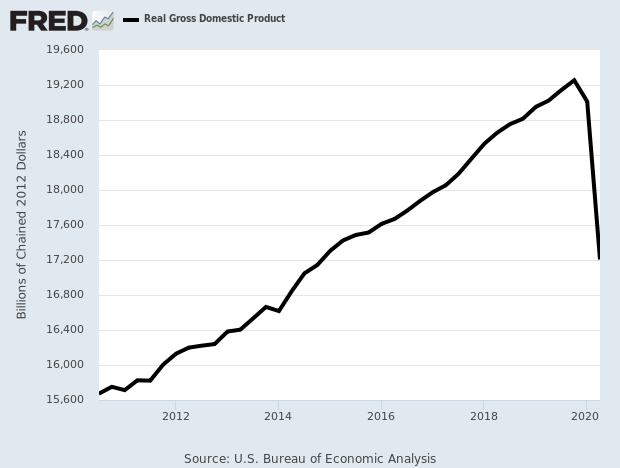
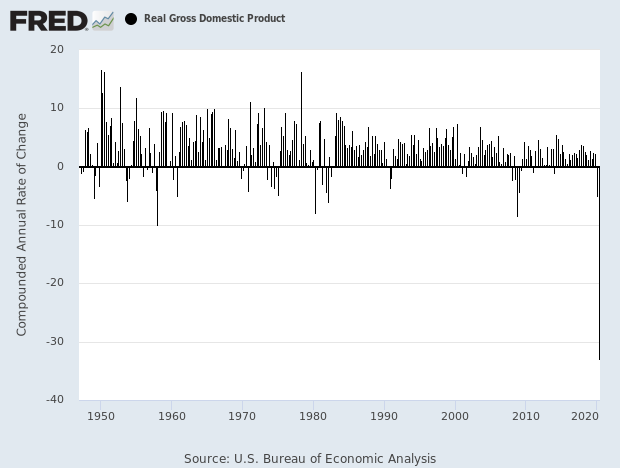
Posted by Eddy Elfenbein on July 30th, 2020 at 9:42 amA very busy morning. First, the Q2 GDP report showed that the U.S. economy contracted by 32.9% last quarter. That’s the steepest drop on record. As bad as it is, it actually beat expectations by a little bit. Q2 GDP is actually lower than what it was for the same quarter five years ago.
Also this morning, initial jobless claims rose to 1.434 million. This was the second-straight weekly increase after 15 declines in a row. It was also the 19th week in a row that jobless claims topped one million.
The S&P 500 is down about 1% in early trading.
-
Morning News: July 30, 2020
Posted by Eddy Elfenbein on July 30th, 2020 at 7:04 amChina Tries Its Favorite Economic Cure: More Construction
German GDP Slumps By Most Since 1970 in the Second Quarter
Winter Virus Surge Down Under Offers Warning of What’s Ahead
A $158 Billion CLO Bet Is Putting the Insurance Industry at Risk
The Gulf Between Republicans and Democrats on Coronavirus Aid, in 9 Charts
How to Fight Against Big Tech’s Power
Kodak Pivots to Drugs After Failing at Photography and Crypto
As Japan Weighs Missile-Defence Options, Raytheon Lobbies for Lockheed’s $300 Million Radar Deal
Shell’s Second-Quarter Profit Slumps 82% on Coronavirus Hit to Oil Prices, Energy Demand
Inside Goldman’s Five-Day Race to Seal a 1MDB Deal With Malaysia
Cullen Roche: The Investor’s Podcast Interview
Michael Batnick: The Permanent Portfolio
Ben Carlson: Animal Spirits: The Golden Age of Fraud
Be sure to follow me on Twitter.
-
Cerner Earns 63 Cents per Share
Posted by Eddy Elfenbein on July 29th, 2020 at 4:23 pmAfter yesterday’s close, Cerner (CERN) reported fiscal Q2 earnings of 63 cents per share. The range Cerner had given is was for earnings of 60 to 64 cents per share. Wall Street had been expecting 61 cents per share.
Overall, I’m pleased with these numbers. Cerner said that bookings were $1.34 billion, which was $100 above the high-end of the company’s guidance. Quarterly revenue fell 7% to $1.43 billion. That was $10 billion below the company’s expected range.
For the quarter, Cerner had operating cash flow of $259 million and free cash flow of $64 million. Total backlog now stands at $13.66 billion.
“Cerner’s solid results during the pandemic reflect the commitment of our associates, the importance of Cerner’s solutions, and the resiliency of our business model,” said Brent Shafer, Chairman and CEO. “Our clients are heroes on the frontlines providing health care, and I am proud of Cerner’s ability to support them. COVID19 has brought Cerner’s vision and mission to life and strengthened our belief that Cerner is well-positioned to play a key role in shaping the future of health care.”
Now for guidance. For Q3, Cerner expects revenue to range between $1.35 billion and $1.40 billion, and they expect full-year revenue between $5.45 billion and $5.55 billion. The latter range is a downgrade from their previous guidance.
For earnings, Cerner expects Q3 to range between 70 and 74 cents per share. For the whole year, they see earnings between $2.80 and $2.88 per share. The previous range was $2.78 to $2.90 per share. Wall Street had been expecting $2.83 per share.
-
Today’s Fed Statement
Posted by Eddy Elfenbein on July 29th, 2020 at 2:17 pmHere’s the statement. Nothing unexpected.
The Federal Reserve is committed to using its full range of tools to support the U.S. economy in this challenging time, thereby promoting its maximum employment and price stability goals.
The coronavirus outbreak is causing tremendous human and economic hardship across the United States and around the world. Following sharp declines, economic activity and employment have picked up somewhat in recent months but remain well below their levels at the beginning of the year. Weaker demand and significantly lower oil prices are holding down consumer price inflation. Overall financial conditions have improved in recent months, in part reflecting policy measures to support the economy and the flow of credit to U.S. households and businesses.
The path of the economy will depend significantly on the course of the virus. The ongoing public health crisis will weigh heavily on economic activity, employment, and inflation in the near term, and poses considerable risks to the economic outlook over the medium term. In light of these developments, the Committee decided to maintain the target range for the federal funds rate at 0 to 1/4 percent. The Committee expects to maintain this target range until it is confident that the economy has weathered recent events and is on track to achieve its maximum employment and price stability goals.
The Committee will continue to monitor the implications of incoming information for the economic outlook, including information related to public health, as well as global developments and muted inflation pressures, and will use its tools and act as appropriate to support the economy. In determining the timing and size of future adjustments to the stance of monetary policy, the Committee will assess realized and expected economic conditions relative to its maximum employment objective and its symmetric 2 percent inflation objective. This assessment will take into account a wide range of information, including measures of labor market conditions, indicators of inflation pressures and inflation expectations, and readings on financial and international developments.
To support the flow of credit to households and businesses, over coming months the Federal Reserve will increase its holdings of Treasury securities and agency residential and commercial mortgage-backed securities at least at the current pace to sustain smooth market functioning, thereby fostering effective transmission of monetary policy to broader financial conditions. In addition, the Open Market Desk will continue to offer large-scale overnight and term repurchase agreement operations. The Committee will closely monitor developments and is prepared to adjust its plans as appropriate.
Voting for the monetary policy action were Jerome H. Powell, Chair; John C. Williams, Vice Chair; Michelle W. Bowman; Lael Brainard; Richard H. Clarida; Patrick Harker; Robert S. Kaplan; Neel Kashkari; Loretta J. Mester; and Randal K. Quarles.
-
Barron’s on Sherwin-Williams
Posted by Eddy Elfenbein on July 29th, 2020 at 1:48 pmBarron’s highlights the strong earnings for Sherwin-Williams (SHW):
Covid-19 wasn’t all good news for the company: Net sales in its Americas group fell 8.4% in the quarter and fell 1.7% for the first half of the year as a whole, as DIY demand wasn’t able to make up for declines in other end markets. Its performance coatings group saw sales slip 16.5% and 9% for the quarter and first half, respectively. However, sales in its consumer brands group climbed 21.8% in the quarter and 9.8% in the first six months of 2020.
For the full year, Sherwin-Williams expects to earn between $21.75 and $23.25 a share, up from its previous range of $19 to $21 a share, and above the $20.33 consensus estimate. (Its forecast excludes $2.54 a share in amortization expenses related to acquisitions.)
Expectations were already high going into the report, given how much consumers are spending on their homes. Sherwin-Williams is up 1.4% to $642.55 in morning trading, bolstered by the strong results. The shares have gained 10% since the start of the year, while the S&P 500 is up less than 1% over the same period.
However the company’s bottom-line results were much better than expected: Not only are people redoing their own homes, but new-home construction has led to an increase in demand from professionals as well. Many companies aren’t providing full-year guidance. Sherwin-Williams’ ability to raise its forecast—and say it plans to resume buying back shares in the second half of the year—was a welcome development.
-
Morning News: July 29, 2020
Posted by Eddy Elfenbein on July 29th, 2020 at 7:02 amU.S. Is About to Unveil the Ugliest GDP Report Ever Recorded
Americans Aren’t Making Babies, and That’s Bad for the Economy
Where Expiring $600 Unemployment Checks Will Hurt Most
Fed Faces Viral Wave, Mounting Risks to Recovery
Oil and Gas Groups See ‘Some Common Ground’ in Biden Energy Plan
A Handbook to Today’s Tech Hearing
Fintechs Face Pressure To Grow Up As Coronavirus Casts A Chill
All Eyes On Pandemic, Economy As Detroit Automakers Post Results
Deutsche Bank Posts Earnings Beat As Restructuring Continues Amid The Pandemic
Howard Lindzon: The DTC-fication Of The US Economy…Web Smith Joins Me On Panic With Friends
Ben Carlson: What If We Get Inflation But Interest Rates Don’t Rise?
Roger Nusbaum: All Weather Life
Nick Maggiulli: You Don’t Need Alpha
Michael Batnick: Does the Financial Media Affect the Stock Market?
Joshua Brown: The Biggest Earnings Day Ever, The 10 Most Indebted Companies on Earth & Bitcoin Got the Gold Memo
Be sure to follow me on Twitter.
-
AFLAC Earns $1.28 per Share
Posted by Eddy Elfenbein on July 28th, 2020 at 5:29 pmAfter the closing bell, Aflac (AFL) reported Q2 earnings of $1.28 per share. Total revenues were $5.4 billion which was down a bit from the $5.5 billion of one year ago.
Net income was $805 million or $1.12 per share. That’s up from $1.09 per share for last year’s Q2. With insurance companies, we always want to look at the adjusted earnings because investment gains and losses can have a big impact on net income. Adjusting for that, brings us to $1.28 per share. Wall Street had been expecting $1.07 per share.
During Q2, the yen/dollar exchange rate average 107.65. That was 2.1% stronger than the average rate from last year’s Q2. That knocked off a penny per share in earnings so adjusted for currency, AFLAC’s earnings rose 12.4% to $1.27 per share.
AFLAC is usually pretty good at giving guidance. This time, however, is much more difficult.
Here’s the CEO:
“We expect full-year sales results in both countries to be significantly affected, but we also see potential for a modest sales recovery in the second half of the year, contingent upon the pace of economic recovery. At the same time, we are seeing a temporary decline in the benefit ratio in the U.S. as consumers defer treatment, which led to favorable results in this quarter. However, economic conditions and claims activity within this environment remain uncertain in both the Japan and the U.S. as both countries address the pandemic.
“As always, we are committed to prudent liquidity and capital management. This includes maintaining strong capital ratios on behalf of our policyholders in both the U.S. and Japan and a tactical approach to capital allocation. In addition, we remain committed to defending and extending our 37-year track record of annual dividend increases and remain in the market repurchasing shares. At the same time, we are focused on integrating the growth investments we have made in our platform. By doing so, we look to emerge from this period in a continued position of strength and leadership.”
-
Sherwin-Williams Beats and Raises Guidance
Posted by Eddy Elfenbein on July 28th, 2020 at 8:54 amThe Federal Reserve begins its two-day meeting today. The policy statement will come out tomorrow afternoon. We have two Buy List earnings reports today. AFLAC (AFL) reports after the closing bell and Sherwin-Williams reported earlier today.
For Q2, Sherwin-Williams (SHW) earned $7.10 per share. That easily beat Wall Street’s estimate of $5.85 per share. Sales fell 5.6% to $4.60 billion.
For Q2, diluted net income increased to $6.48 per share. That’s up from $5.03 per share a year ago. However, there’s also 62 cents for “acquisition-related amortization expense.” That brings us up to $7.10 per share.
CEO John G. Morikis said:
While sales were down by a mid-single digit percentage overall, favorable customer and product mix, lower input costs and strong spending controls enabled us to deliver significantly improved performance compared to last year’s second quarter. Gross margin expanded 330 basis points to 48%, and adjusted earnings per share increased 8.1% to $7.10 per share. Adjusted EBITDA grew 6.2% to $979.0 million, or 21.3% of sales, compared to 18.9% in second quarter last year.
The best news is that Sherwin is increasing its full-year range to $19.21 – $20.71 per share which includes $2.54 per share in acquisition-related amortization expense. That previous range was $16.46 per share to $18.46 per share, including $2.54 per share acquisition-related amortization expense. For Q3, the company sees net sales up or down in the low single digits.
-
Morning News: July 28, 2020
Posted by Eddy Elfenbein on July 28th, 2020 at 7:04 amEnd Game for Oil? OPEC Prepares For an Age of Dwindling Demand
As Gold Smashes Records, Forecasters Ask Whether Peak Is Near
In Summer of Turmoil, Subdued ‘Fear’ Gauges Make Markets Uneasy
Amazon, Apple, Facebook and Google Prepare for Their ‘Big Tobacco Moment’ & Jeff Bezos Cast in a Role He Never Wanted: Amazon’s D.C. Defender
McDonald’s Global Sales Suffer As COVID-19 Lockdowns Limit Operations
Virginia Chick-fil-A Offering Free Food In Exchange For Coins Amid Shortage
Hotels Are Promoting the Nostalgia of the Family Road Trip & Longer, Slower, Farther: Savoring the Prospects of Future Travels
One of America’s Oldest Gun Makers Files for Bankruptcy for 2nd Time
Where to Invest $1 Million Right Now
Boaz Weinstein Piles Up 90% Gain in Hamptons, Bets on More Chaos
Malaysia Ex-PM Najib Razak Sentenced to 12 Years in Jail in 1MDB Unit Case
The Hunt for the Next Blockbuster Manga
Joshua Brown: Sad Old Man Rocks Making New High
Ben Carlson: Patience Is A Virtue No One Has Time For Anymore
Be sure to follow me on Twitter.
-
Durable Goods Jump 7.3%
Posted by Eddy Elfenbein on July 27th, 2020 at 10:05 amIt seems each day on Wall Street, the mood is determined by the Big Five. Today, the major tech companies are leading the market strongly. The rest of the market is largely flat.
The price for gold has surged to an all-time high. This finally snapped gold’s previous high from 11 years ago. Adjusted for inflation, gold is still below its high from 1980.
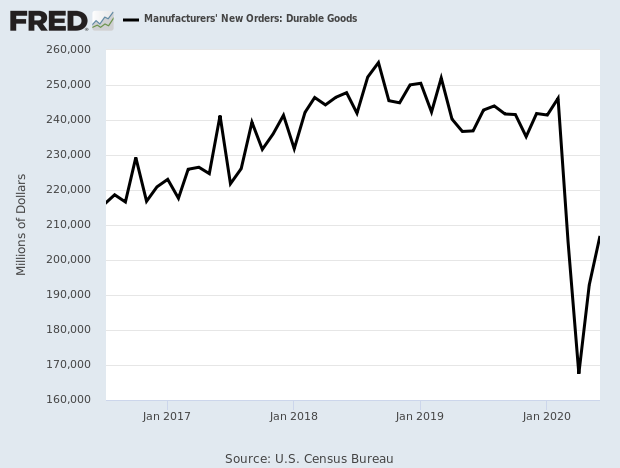
This morning’s durable goods report for June showed an increase of 7.3% for June. That beat expectations by 0.1%. Durable goods were up 15.1% the month before.
Orders for non-defense capital goods excluding aircraft, a closely watched proxy for business spending plans, jumped 3.3% last month, the Commerce Department said on Monday. These so-called core capital goods orders rose 1.6% in May and remained below their pre-pandemic level. Orders last month were boosted by strong demand for machinery, fabricated metals, primary metals and electrical equipment, appliances, and components.
Economists polled by Reuters had forecast core capital goods orders advancing 2.3% in June. Core capital goods orders fell 2.3% on a year-on-year basis in June.
On Thursday, we’ll get the Q2 GDP report. It may be the worst one on record.
-
Archives
- October 2026
- September 2026
- August 2026
- July 2026
- June 2026
- May 2026
- April 2026
- March 2026
- February 2026
- January 2026
- December 2025
- November 2025
- October 2025
- September 2025
- August 2025
- July 2025
- June 2025
- May 2025
- April 2025
- March 2025
- February 2025
- January 2025
- December 2024
- November 2024
- October 2024
- September 2024
- August 2024
- July 2024
- June 2024
- May 2024
- April 2024
- March 2024
- February 2024
- January 2024
- December 2023
- November 2023
- October 2023
- September 2023
- August 2023
- July 2023
- June 2023
- May 2023
- April 2023
- March 2023
- February 2023
- January 2023
- December 2022
- November 2022
- October 2022
- September 2022
- August 2022
- July 2022
- June 2022
- May 2022
- April 2022
- March 2022
- February 2022
- January 2022
- December 2021
- November 2021
- October 2021
- September 2021
- August 2021
- July 2021
- June 2021
- May 2021
- April 2021
- March 2021
- February 2021
- January 2021
- December 2020
- November 2020
- October 2020
- September 2020
- August 2020
- July 2020
- June 2020
- May 2020
- April 2020
- March 2020
- February 2020
- January 2020
- December 2019
- November 2019
- October 2019
- September 2019
- August 2019
- July 2019
- June 2019
- May 2019
- April 2019
- March 2019
- February 2019
- January 2019
- December 2018
- November 2018
- October 2018
- September 2018
- August 2018
- July 2018
- June 2018
- May 2018
- April 2018
- March 2018
- February 2018
- January 2018
- December 2017
- November 2017
- October 2017
- September 2017
- August 2017
- July 2017
- June 2017
- May 2017
- April 2017
- March 2017
- February 2017
- January 2017
- December 2016
- November 2016
- October 2016
- September 2016
- August 2016
- July 2016
- June 2016
- May 2016
- April 2016
- March 2016
- February 2016
- January 2016
- December 2015
- November 2015
- October 2015
- September 2015
- August 2015
- July 2015
- June 2015
- May 2015
- April 2015
- March 2015
- February 2015
- January 2015
- December 2014
- November 2014
- October 2014
- September 2014
- August 2014
- July 2014
- June 2014
- May 2014
- April 2014
- March 2014
- February 2014
- January 2014
- December 2013
- November 2013
- October 2013
- September 2013
- August 2013
- July 2013
- June 2013
- May 2013
- April 2013
- March 2013
- February 2013
- January 2013
- December 2012
- November 2012
- October 2012
- September 2012
- August 2012
- July 2012
- June 2012
- May 2012
- April 2012
- March 2012
- February 2012
- January 2012
- December 2011
- November 2011
- October 2011
- September 2011
- August 2011
- July 2011
- June 2011
- May 2011
- April 2011
- March 2011
- February 2011
- January 2011
- December 2010
- November 2010
- October 2010
- September 2010
- August 2010
- July 2010
- June 2010
- May 2010
- April 2010
- March 2010
- February 2010
- January 2010
- December 2009
- November 2009
- October 2009
- September 2009
- August 2009
- July 2009
- June 2009
- May 2009
- April 2009
- March 2009
- February 2009
- January 2009
- December 2008
- November 2008
- October 2008
- September 2008
- August 2008
- July 2008
- June 2008
- May 2008
- April 2008
- March 2008
- February 2008
- January 2008
- December 2007
- November 2007
- October 2007
- September 2007
- August 2007
- July 2007
- June 2007
- May 2007
- April 2007
- March 2007
- February 2007
- January 2007
- December 2006
- November 2006
- October 2006
- September 2006
- August 2006
- July 2006
- June 2006
- May 2006
- April 2006
- March 2006
- February 2006
- January 2006
- December 2005
- November 2005
- October 2005
- September 2005
- August 2005
- July 2005
 Eddy Elfenbein is a Washington, DC-based speaker, portfolio manager and editor of the blog Crossing Wall Street. His