-
That’s Now How It Works
Posted by Eddy Elfenbein on July 31st, 2018 at 10:37 amIn this morning’s Wall Street Journal, Kevin Kingsbury makes the case that Apple could already have a market value of $1 trillion, if not for dividends and share buybacks.
The article begins:
All else being equal, every dollar a company spends on shareholder dividends or stock buybacks cuts a firm’s market cap by a buck.
That’s incorrect. A dividend payment would reduce the market value of a firm. It’s effectively spinning off some of its bank account. But a share buyback should make no difference in a firm’s market value.
Think of it this way. What would happen if you were to undo the share buyback? The firm would just sell shares on the open market for cash. The nature of the firm’s assets change, but the value doesn’t change.
-
Morning News: July 31, 2018
Posted by Eddy Elfenbein on July 31st, 2018 at 7:30 amHow Companies Are Making Customers Pay for Trump’s Trade War
How to Gauge the Fed’s Reaction to Trump’s Tweet
Correction Worse Than February Is Looming, Morgan Stanley Says
Smartphone Slowdown Hits Profits at Samsung Electronics
Sony’s Profit Soars on PlayStation Strength
BP Earnings Boosted by Higher Oil Prices
Nokia, T-Mobile US Agree $3.5 Billion Deal, World’s First Big 5G Award
Credit Suisse Returns on Horizon as Thiam Overhaul Nears End
Harley-Davidson Beats the Street But Is Still Losing in the Marketplace
Uber Shuts Down Its Self-Driving Truck Unit
Vivendi to Explore Selling Up to 50% of Universal Music Group
Michael Batnick: Contrarian Indicators
Ben Carlson: Mean Reversion & The Placebo Effect
Roger Nusbaum: Less Forgiving Backdrop For Individual Stocks
Be sure to follow me on Twitter.
-
CNN: “Why Amazon Can’t Touch Ross and TJMaxx”
Posted by Eddy Elfenbein on July 30th, 2018 at 10:20 pmCNN echoes a point we’ve made a few times before. Ross is not being sunk by Amazon:
Ross (ROST), a clothing and home decor chain, recently opened 30 stores and plans to add 70 more this year. It’s aiming for 2,500 stores eventually, up from about 1,500 today.
(…)
Ross, which doesn’t have a digital shop, relies on a flexible purchasing strategy to offer top brands at bargain prices, enticing shoppers to head to stores to find clothes they can’t buy online.
The average item is only $10, and 98% of the stuff in its store is under $30.
“The place that Ross and TJX occupy is a place that’s tough to do online,” said Simeon Siegel, a retail analyst at Nomura Group. “I believe Ross is winning because it doesn’t have e-commerce, not in spite of it.”
Capitalizing on brand miscues
Ross racked up more than $14 billion in sales last year, second only to TJX in its category. It has recorded 13 consecutive years of growth at stores open at least a year, outpacing Macy’s (M), JCPenney (JCP), and Nordstrom (JWN).
Ross stores offer a mix of name-brand and designer apparel and home fashion for 20% to 60% less than department and specialty stores.
When brands produce too many clothes or department stores cancel orders, Ross and other discounters step in and buy the leftover inventory.
Ross calls them “opportunistic purchases.” It can either quickly ship the product to shelves to meet in-season looks or pack the products away in warehouses to sell later. Both methods help the company constantly rotate through a wide assortment of styles and fashions.
(…)
Discounters like Ross have much shorter lead times — often late in the season when fashion trends have already been well established.
“They can be more nimble reacting to what customers want,” said Moody’s senior retail analyst Christina Boni. The business model “reduces fashion and markdown risks that other apparel retailers face.”
‘Treasure hunt’
Brands and retail stores are expanding online and focusing on improving in-store amenities. By contrast, Ross offers a “treasure-hunt shopping experience that cannot be replicated online,” said Betty Chen, Ross’ director of investor and media relations.
Stores are a single floor, laid out neatly and predictably, to make it easy for shoppers to identify sections and find their sizes.
(…)
The average household income for Ross customers is $63,000 a year, according to an off-price sector report set to be released by retail think tank Coresight Research in early August. Amazon shoppers’ average household income is $85,000.
The off-price sector has shown strength during recessions, when consumers look to trade down for purchases, and also during growth periods.
Despite a healthy economy and a recovery in many Americans’ discretionary income since the 2008 recession, widening inequality has created a base of Ross’ low and middle-income core shoppers, said John Mercer, a senior analyst at Coresight.
(…)
Siegel argued Ross is also protected against Amazon because two-thirds of the business is handled with cash or debit.
Ross has argued that the high costs of online shipping and frequent return rates mean it doesn’t make sense for Amazon to attack heavy-discount apparel sellers.
“The economics just don’t work,” Ross’ president and chief operating officer, Michael O’Sullivan, told Goldman Sachs analysts last year. “If I was Amazon, I don’t think I’d be looking at the off-price space as my big opportunity.”
Amazon may have reached a similar conclusion. Analysts see the company operating in clothing as more of a traditional department store rather than an off-pricer.
“Amazon looks to be shifting its focus away from cut-price, third-party-branded offerings with the launch of many more private labels and stronger relationships with brands,” Coresight’s Mercer said.
-
The Tech Crack-Up
Posted by Eddy Elfenbein on July 30th, 2018 at 2:57 pmThe tech sector has been getting hit hard over the last few days. Here’s a look at the intra-day chart of Facebook (black), Netflix (gold) and Twitter (blue):
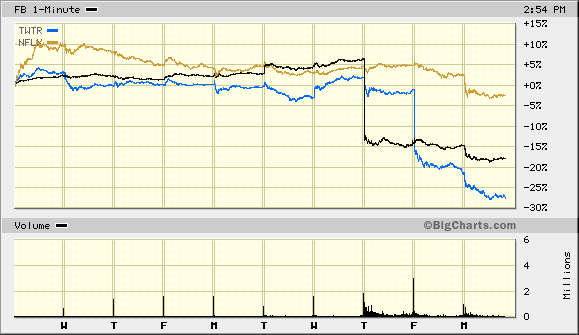
Bloomberg says that the tech correction is close to $300 billion.
What’s interesting is that Facebook is the biggest loser today in the S&P 100. At least it was the last time I looked. After that come some semi-related stocks: MasterCard, Amex, Visa, PayPal, Priceline and Amazon.
-
Clarifying the Record
Posted by Eddy Elfenbein on July 30th, 2018 at 2:25 pmI will never understand what makes a tweet go viral. Last night, I tweeted:
To the guy who stole my antidepressants, I hope you're happy now.
— Eddy Elfenbein (@EddyElfenbein) July 30, 2018
Currently, it’s been liked over 18,000 times. I had no idea it would take off like this. To set the record straight, I got the joke from Reddit. I cleaned up the original and corrected some of the grammar. I found versions of this joke going back even further.
-
New High for AFLAC
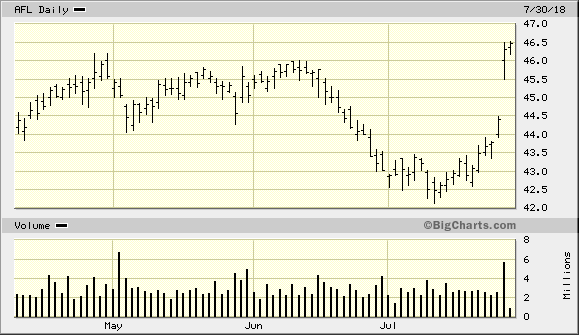
Posted by Eddy Elfenbein on July 30th, 2018 at 11:36 amShares of AFLAC (AFL) had a rough June, but the recent strong earnings report combined with higher guidance has pushed the duck stock to a new all-time high.
-
Alliance Data Announces $500 million Buyback
Posted by Eddy Elfenbein on July 30th, 2018 at 10:03 amThis morning, Alliance Data Systems (ADS) announced a new $500 million share buyback program.
Alliance Data Systems Corporation (NYSE: ADS), a leading global provider of data-driven marketing and loyalty solutions, today announced that its board of directors has approved a new $500 million share repurchase program beginning August 1, 2018 to replace the current program that expires July 31, 2018.
Repurchases will be financed primarily through free cash flow. The Company expects to maintain moderate levels of debt over the course of the repurchase program, providing flexibility to pursue tuck-in acquisitions or portfolio purchases.
“This repurchase agreement demonstrates the Board’s confidence in our business model, our financial performance, and our commitment to delivering value to our stakeholders,” said Charles Horn, chief financial officer of Alliance Data. “We will opportunistically repurchase our stock, while maintaining ample liquidity to have the flexibility to support our growth, as well as the continuation of a quarterly dividend.”
-
Morning News: July 30, 2018
Posted by Eddy Elfenbein on July 30th, 2018 at 6:53 amMark Carney Is Preparing for Brexit and the Next Crisis
Oil Rises After Fourth Weekly Decline as Supply Risks Persist
Debt Is the Easy Way for Aramco
The U.S. Is Still The Global Natural Gas King
Powell to Duck Trump Jabs and Let Economy Justify Fed Rate Pause
BMW is Hiking the Prices of American-Made SUVs in China
Coca-Cola Raises Prices On Trump’s Favorite Drink Over Tariffs
The FAANG-Nary In The Coal Mine
Have a Cryptocurrency Company? Bermuda, Malta or Gibraltar Wants You
SoftBank-Owned ARM Is Said to Agree to Buy Treasure Data
3 Reasons a $1 Million Nest Egg Won’t Cut It in Retirement
Cullen Roche: Three Things I Think I Think – GDP, Housing and Bad Narratives & The Best Investment Writing – Volume 2
Michael Batnick: These Are the Goods
Howard Lindzon: Keep An Eye On Homebuilders and Some Good Reads
Be sure to follow me on Twitter.
-
Q2 GDP = 4.1%
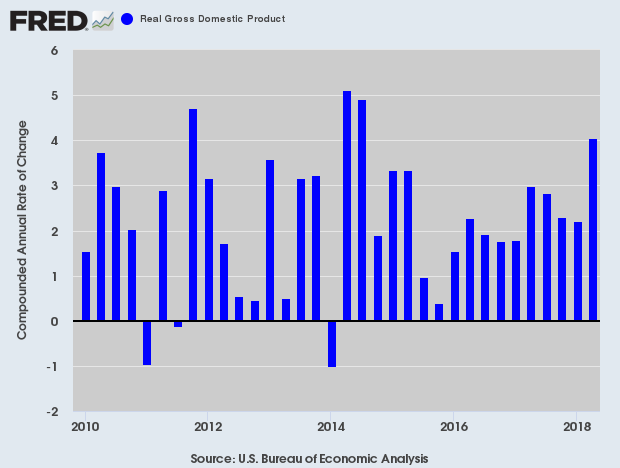
Posted by Eddy Elfenbein on July 27th, 2018 at 12:50 pmThe second-quarter GDP is out. The U.S. economy grew by 4.1% during the second three months of the year.
The U.S. economy grew at the strongest pace in nearly four years during the second quarter, powered by a rebound in consumer spending, strong exports and firm business investment.
Gross domestic product—the value of all goods and services produced across the economy—rose at a seasonally and inflation-adjusted annual rate of 4.1% from April through June, the Commerce Department said Friday. That was a pickup from the first quarter’s revised growth rate of 2.2%.
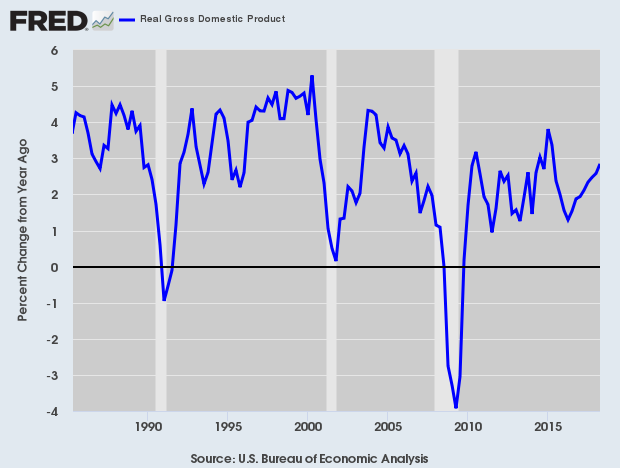
The bounce back in consumer spending “was more powerful than anticipated and speaks to the impact of an increasingly tight labor market and strong job growth on consumer income and households’ confidence,” Brian Coulton, chief economist at Fitch Ratings, said in a note to clients, adding the “numbers really bring the possibility of 3% growth for 2018 as a whole into the frame.” Compared with the second quarter a year ago, output grew 2.8%.
President Donald Trump said Friday that the U.S. economy is growing at a “very sustainable” pace and predicted that it will expand at least 3% for the year.
The president touted his own track record since taking office, saying that the economy is growing at a pace 10 times faster than during the presidencies of George W. Bush or Barack Obama.
While last quarter was good, let’s remember that the U.S. economy grew at a faster rate during the entire time from 1950 through 1978 than it did last quarter.
Here’s a look at recent quarterly growth rates:
Here’s year-over-year change in nominal GDP growth:
-
Moody’s Earned $2.04 per Share
Posted by Eddy Elfenbein on July 27th, 2018 at 9:27 amThis morning, Moody’s (MCO) reported Q2 earnings of $2.04 per share. Wall Street had been looking for $1.89 per share. Here are some details:
2Q18 revenue of $1.2 billion up 17% from 2Q17
2Q18 operating income up 16% from 2Q17; adjusted operating income up 17%1
2Q18 diluted EPS of $1.94 up 20% from 2Q17; adjusted diluted EPS of $2.04, up 32%
Reaffirming FY 2018 diluted EPS and adjusted diluted EPS guidance ranges of $7.20 to $7.40 and $7.65 to $7.85, respectively“Moody’s second quarter revenue increased 17%, reflecting strong performance at Moody’s Analytics, driven by contribution from Bureau van Dijk, as well as record revenue for Moody’s Investors Service, primarily due to robust bank loan and collateralized loan obligation market activity,” said Raymond McDaniel, President and Chief Executive Officer of Moody’s. “Additionally, we are reaffirming our full year 2018 guidance of $7.20 to $7.40 for diluted EPS and $7.65 to $7.85 for adjusted diluted EPS.”
SECOND QUARTER HIGHLIGHTS
Moody’s Corporation reported record revenue of $1.2 billion for the three months ended June 30, 2018, up 17% from the second quarter of 2017, including eight percentage points of growth attributable to Bureau van Dijk.
Operating expenses totaled $641.1 million, up 19% from the prior-year period, including 11 percentage points attributable to Bureau van Dijk operating expenses, amortization of acquired intangible assets, as well as non-recurring acquisition and integration expenses associated with the Bureau van Dijk acquisition (“Acquisition-Related Expenses”).
Operating income was $534.0 million, up 16% from the second quarter of 2017. Adjusted operating income, which excludes depreciation and amortization, as well as Acquisition-Related Expenses, was $584.4 million, up 17% from the prior-year period. Operating margin for the second quarter was 45.4% and the adjusted operating margin was 49.7%.
Diluted EPS of $1.94 was up 20% from the second quarter of 2017. Adjusted diluted EPS of $2.04 was up 32%. Second quarter 2018 adjusted diluted EPS excludes $0.10 per share related to amortization of acquired intangible assets and Acquisition-Related Expenses. Second quarter 2017 adjusted diluted EPS primarily excludes a $0.13 foreign currency hedge gain. Both second quarter 2018 diluted EPS and adjusted diluted EPS include a $0.02 per share tax benefit related to the adoption of accounting standard update ASU 2016-09, “Improvements to Employee Share-Based Payment Accounting,” compared to a $0.05 per share tax benefit in the second quarter of 2017.
Despite the earnings beat, shares of MCO lost 4.9% on Friday.
-
Archives
- July 2026
- June 2026
- May 2026
- April 2026
- March 2026
- February 2026
- January 2026
- December 2025
- November 2025
- October 2025
- September 2025
- August 2025
- July 2025
- June 2025
- May 2025
- April 2025
- March 2025
- February 2025
- January 2025
- December 2024
- November 2024
- October 2024
- September 2024
- August 2024
- July 2024
- June 2024
- May 2024
- April 2024
- March 2024
- February 2024
- January 2024
- December 2023
- November 2023
- October 2023
- September 2023
- August 2023
- July 2023
- June 2023
- May 2023
- April 2023
- March 2023
- February 2023
- January 2023
- December 2022
- November 2022
- October 2022
- September 2022
- August 2022
- July 2022
- June 2022
- May 2022
- April 2022
- March 2022
- February 2022
- January 2022
- December 2021
- November 2021
- October 2021
- September 2021
- August 2021
- July 2021
- June 2021
- May 2021
- April 2021
- March 2021
- February 2021
- January 2021
- December 2020
- November 2020
- October 2020
- September 2020
- August 2020
- July 2020
- June 2020
- May 2020
- April 2020
- March 2020
- February 2020
- January 2020
- December 2019
- November 2019
- October 2019
- September 2019
- August 2019
- July 2019
- June 2019
- May 2019
- April 2019
- March 2019
- February 2019
- January 2019
- December 2018
- November 2018
- October 2018
- September 2018
- August 2018
- July 2018
- June 2018
- May 2018
- April 2018
- March 2018
- February 2018
- January 2018
- December 2017
- November 2017
- October 2017
- September 2017
- August 2017
- July 2017
- June 2017
- May 2017
- April 2017
- March 2017
- February 2017
- January 2017
- December 2016
- November 2016
- October 2016
- September 2016
- August 2016
- July 2016
- June 2016
- May 2016
- April 2016
- March 2016
- February 2016
- January 2016
- December 2015
- November 2015
- October 2015
- September 2015
- August 2015
- July 2015
- June 2015
- May 2015
- April 2015
- March 2015
- February 2015
- January 2015
- December 2014
- November 2014
- October 2014
- September 2014
- August 2014
- July 2014
- June 2014
- May 2014
- April 2014
- March 2014
- February 2014
- January 2014
- December 2013
- November 2013
- October 2013
- September 2013
- August 2013
- July 2013
- June 2013
- May 2013
- April 2013
- March 2013
- February 2013
- January 2013
- December 2012
- November 2012
- October 2012
- September 2012
- August 2012
- July 2012
- June 2012
- May 2012
- April 2012
- March 2012
- February 2012
- January 2012
- December 2011
- November 2011
- October 2011
- September 2011
- August 2011
- July 2011
- June 2011
- May 2011
- April 2011
- March 2011
- February 2011
- January 2011
- December 2010
- November 2010
- October 2010
- September 2010
- August 2010
- July 2010
- June 2010
- May 2010
- April 2010
- March 2010
- February 2010
- January 2010
- December 2009
- November 2009
- October 2009
- September 2009
- August 2009
- July 2009
- June 2009
- May 2009
- April 2009
- March 2009
- February 2009
- January 2009
- December 2008
- November 2008
- October 2008
- September 2008
- August 2008
- July 2008
- June 2008
- May 2008
- April 2008
- March 2008
- February 2008
- January 2008
- December 2007
- November 2007
- October 2007
- September 2007
- August 2007
- July 2007
- June 2007
- May 2007
- April 2007
- March 2007
- February 2007
- January 2007
- December 2006
- November 2006
- October 2006
- September 2006
- August 2006
- July 2006
- June 2006
- May 2006
- April 2006
- March 2006
- February 2006
- January 2006
- December 2005
- November 2005
- October 2005
- September 2005
- August 2005
- July 2005
 Eddy Elfenbein is a Washington, DC-based speaker, portfolio manager and editor of the blog Crossing Wall Street. His