-
Q1 GDP Growth Revised to 2.0%
Posted by Eddy Elfenbein on June 28th, 2018 at 8:53 amThis morning, the government revised the economic growth numbers for the first quarter of this year. According to the new data, the US economy grew, in real terms, at a 2% annualized rate for Q1.
That’s been about the average for the recovery. What’s interesting is that the recovery has been less than the average of the last several decades.
There’s been talk of the economy ramping up to a faster growth rate. So far, the numbers say that hasn’t happened. Of course, this is for Q1 which began six months ago and ended three months ago, so Q2 could be a different story. The Atlanta Fed thinks Q2 came in at 4.5%.
I hope so. That’s a very good number, and it could signal that things are ramping up. We’ll get our first look at the Q2 numbers in late July.
Here’s a look at the year-over-year growth rate in real GDP.
-
Morning News: June 28, 2018
Posted by Eddy Elfenbein on June 28th, 2018 at 7:10 amSurging Oil Prices Are Doing Nothing for Stocks in 2018
Gold Marks Third Straight Decline and Another 6-Month Low
BOE Warns of Growing Risks in Global Debt Markets
Ford Fiestas Aren’t Tools of War, Automakers Say in Trump Retort
Vanguard Group Goes Greener With Two ESG ETFs
Elon Musk Races to Exit Tesla’s ‘Production Hell’
T-Mobile, Sprint Bosses Defend Wireless Merger
The New GE Could Use Some Berkshire Spirit
Why Canopy Growth Corp’s Shares Plunged 12% Today
Google Exec Says Microsoft Beat Search Giant to Buy GitHub
MoviePass Owner Dips Below 25 Cents as AMC Debuts Rival Service
Amazon Plans Start-Up Delivery Services for Its Own Packages
Nick Maggiulli: You See What You Want To See
Cullen Roche: How Blogging Changed Wall Street
Michael Batnick: Animal Spirits: Individual Alpha
Be sure to follow me on Twitter.
-
Ross Stores Hits New High
Posted by Eddy Elfenbein on June 27th, 2018 at 11:55 am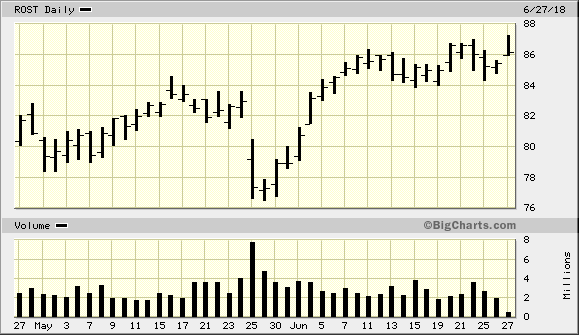
On May 25, shares of Ross Stores (ROST) fell 7% after the deep-discount retailer reported earnings. I thought the earnings were just fine, but traders apparently disagreed.
This is from the CWS Market Review of June 1:
Ross Stores (ROST) reported fiscal Q1 adjusted earnings of $1.11 per share. Earlier, the company had projected earnings of $1.03 to $1.07 per share. They made 82 cents per share for last year’s Q1.
There were a few accounting items to adjust for. Ross said they were helped in Q1 by 17 cents per share due to tax reform plus two cents per share thanks to “the favorable timing of packaway-related expenses that we expect to reverse in subsequent quarters.”
Q1 sales rose 9% to $3.6 billion, and comparable-stores sales were up 3%. Ross had been expecting 1% to 2%. I knew that forecast was too low. The company said it was hurt by poor weather during the quarter. I’m usually pretty skeptical of weather as an excuse. Ross’s operating margin fell to 15.1%. That’s still pretty good.
For fiscal Q2, Ross expects earnings of 95 to 99 cents per share. They see same-store sales growth of 1% to 2%. That’s pretty low. The good news is that Ross raised its full-year guidance. The old range was $3.86 to $4.03 per share, and the new range is $3.92 to $4.05 per share.
Pretty good, but still, shares of Ross dropped in one day from $82.96 to $77.34. Here we are one month later and ROST touched $87.22 this morning.
This is why we focus on high-quality names. They may get knocked around, but quality shines through.
-
Morning News: June 27, 2018
Posted by Eddy Elfenbein on June 27th, 2018 at 6:43 amHedge Fund Managers See Echo of Past Crashes in Markets
China’s ‘Big Mama’ Steps In as Yuan Tumbles Further
Trump’s Trade War Revives Fears China Will Devalue Yuan
The Trade War Finally Got Real
Trump Threatens Harley-Davidson With Taxes ‘Like Never Before’ and Predicts Its Eventual Collapse
The Culture Clash Behind GE’s Quick Exit From Baker Hughes Stake
Facebook Loosens Ban on Cryptocurrency Ads for Approved Vendors
Facebook Abandons its Plans to Build Giant Drones and Lays Off 16 Employees
Uber Regains Temporary License to Operate in London After Promising to Stop Being Terrible
We Have Reached Peak Screen. Now Revolution Is In The Air.
Google Retires DoubleClick, AdWords Brand Names
Roger Nusbaum: What You Need Might Cost More Than Three Basis Points
Ben Carlson: My Evolution on Asset Allocation
Joshua Brown: How to Chop Up Your Portfolio
Be sure to follow me on Twitter.
-
High Beta vs. Low Vol
Posted by Eddy Elfenbein on June 26th, 2018 at 8:04 amHere’s an intra-day look at High Beta vs. Low Vol ETFs over the past two weeks. Low Vol hasn’t moved much while High Beta has been knocked about.
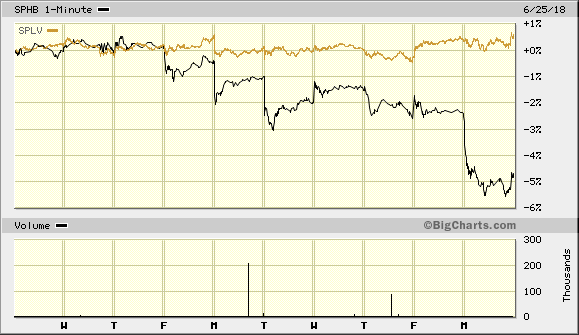
In financial markets, it’s interesting how often a big move like yesterday’s is quietly hinted at in the prior few days. The gap between the two gradually got bigger, until it completely blew apart yesterday.
-
FactSet Earns $2.18 per Share
Posted by Eddy Elfenbein on June 26th, 2018 at 7:10 amThis morning FactSet (FDS) reported fiscal Q3 earnings of $2.18 per share. That beat Wall Street’s estimate by five cents per share. Revenues increased 8.9% to $339.9 million compared.
Thanks to the good earnings, FactSet bumped up its full-year earnings forecast. The old range was $8.35 to $8.55 per share. The new range is $8.37 to $8.62 per share.
The CEO said, “We are making progress integrating and cross selling our acquisitions resulting in important wins this quarter, particularly within Analytics. We continue to innovate with the launch of the Open:FactSet marketplace and enhancing our risk offering. We believe we have a solid pipeline for the fourth quarter and expect to finish fiscal 2018 in our guidance range.”
A key metric for FactSet is Annual Subscription Value or ASV. For Q3, ASV rose 5.3% to $1.36 billion. At the end of the quarter, FactSet had 4,975 clients. That’s an increase of 80 clients. User count rose by 860 to 89,506.
FactSet’s operating margin fell to 31.0% last quarter compared with 31.9% a year ago. The drop reflects restructuring actions and certain one-time administrative expenses.
The CEO said, “We made good progress on our annual and medium term goals this quarter. The restructuring actions we initiated this quarter help us to optimize costs and benefit margins in the future. With our balanced capital allocation framework including our robust share buyback program and an increase in dividends, we continued to return value to shareholders.”
For the first nine months of the year, FDS has earned $6.34 per share. The new outlook implies Q4 earnings of $2.03 to $2.28 per share. Wall Street had been expecting $2.19 per share.
-
Morning News: June 26, 2018
Posted by Eddy Elfenbein on June 26th, 2018 at 7:04 amDow Jones Cuts Losses; Is Donald Trump About To Blink In China Trade War?
The Supreme Court Just Issued a Ruling Affecting the Credit Card Industry — and Silicon Valley, Too
Judge Dismisses Climate Suits Targeting Big Oil Companies
GE’s Exit From the Dow Will Change the Index’s Calculation In An Important Way
GE Is To Spin Off Health Care Division In Bid to Streamline
Harley-Davidson To Shift Some Production Overseas Due To Trade War
With Cryptocurrencies in Freefall, One Big Firm Doubles Down
BMW Warns of U.K. Pullback If There’s No Brexit Deal
Apple’s Tim Cook Weighs In On Social Issues
How to Solve the Plastic Crisis
Kinder Morgan, EagleClaw, Apache to Develop Permian Highway Pipeline
McDonald’s Wants to Win Breakfast by Selling the Best Part of the Muffin
Joshua Brown: Three Uncelebrated Edges
Ben Carlson: The Best Free Investing Tools on the Web
Howard Lindzon: Momentum Monday – I Wish It Was Friday
Be sure to follow me on Twitter.
-
Strong Relative Performance for our Buy List
Posted by Eddy Elfenbein on June 25th, 2018 at 10:53 pmToday was a remarkable day for the stock market. A large group of stocks fell sharply while the rest were barely scratched. Fortunately, our Buy List was tilted toward the latter.
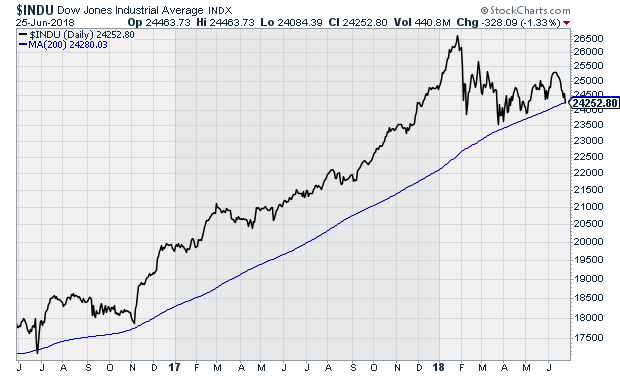
The S&P 500 fell 1.37%. The Dow lost 328 points. In fact, the Dow closed below its 200-day moving average for the first time in 501 trading days.
The S&P 500 briefly dipped below 2,700 but rallied some late in the day. The big divergence can be seen by looking at the value and growth indexes. The S&P 500 Value Index fell -0.89% while the growth part fell -1.78%. That’s exactly double.
The effect is even more pronounced by looking at the High Beta and Low Vol indexes. The S&P 500 High Beta index fell 2.28% today. Low Vol actually gained 0.16%. Nineteen of our 25 stocks outpaced the S&P 500 today.
Our Buy List lost -0.63% today. That was much better than the overall market.
Here’s the sector breakdown, worst to first.
Tech -2.28%
Energy -2.20%
Discrete -2.18%
Materials -1.46%
Industrials -1.24%
Financials-1.03%
Health Care -0.90%
REITs -0.18%
Telecom -0.08%
Staples +0.44%
Utes +1.65% -
Harley Will Move Some Production Overseas
Posted by Eddy Elfenbein on June 25th, 2018 at 12:29 pmThis is what to worry about with a trade war. Harley-Davidson (HOG) said they’ll move some production out of the U.S. due to trade tariffs.
In response to the Trump administration’s tariffs, the EU responded by jacking up the tariffs on U.S. bikes. That dings Harley $2,200 per each bike.
Harley-Davidson’s move is some of the most direct evidence yet that tit-for-tat trade fights between the United States and other countries have consequences for American companies. Harley-Davidson said it stood to lose as much as $100 million a year.
“Increasing international production to alleviate the EU tariff burden is not the company’s preference, but represents the only sustainable option,” Harley-Davidson said in a regulatory filing on Monday.
The EU began imposing tariffs Friday on $3.2 billion worth of American goods, including motorcycles, orange juice, bourbon, peanut butter, motorboats, cigarettes and denim. They are a response to the Trump administration’s tariffs on steel and aluminum imports from Europe.
For motorcycles, the EU raised its 6% tariff to 31%. That will make each bike about $2,200 more expensive to export, Harley said.
Last year, Harley sold 140,000 bikes in the U.S. and about 40,000 in Europe.
-
Major “Defensive” Day
Posted by Eddy Elfenbein on June 25th, 2018 at 11:16 amThe stock market is taking a hit so far this morning. Today is very good example of the market becoming much more defensive. In simpler terms, risky stocks are getting slammed, but conservative ones aren’t down so much. That’s good news for our Buy List in that while we’re down, we’re not down by nearly as much as the market.
In fact, some of our most defensive names are in the green today. Church & Dwight (CHD), Hormel (HRL) and Smucker (SJM) are all currently positive today.
The best place to look to see this effect is by comparing the S&P 500 High Beta index to the S&P 500 Low Vol index. So far, High Beta is down 2.22% today while the Low Vol is up 0.22%.
This means that the market is becoming more defensive and less willing to take on risk.
-
Archives
- September 2026
- August 2026
- July 2026
- June 2026
- May 2026
- April 2026
- March 2026
- February 2026
- January 2026
- December 2025
- November 2025
- October 2025
- September 2025
- August 2025
- July 2025
- June 2025
- May 2025
- April 2025
- March 2025
- February 2025
- January 2025
- December 2024
- November 2024
- October 2024
- September 2024
- August 2024
- July 2024
- June 2024
- May 2024
- April 2024
- March 2024
- February 2024
- January 2024
- December 2023
- November 2023
- October 2023
- September 2023
- August 2023
- July 2023
- June 2023
- May 2023
- April 2023
- March 2023
- February 2023
- January 2023
- December 2022
- November 2022
- October 2022
- September 2022
- August 2022
- July 2022
- June 2022
- May 2022
- April 2022
- March 2022
- February 2022
- January 2022
- December 2021
- November 2021
- October 2021
- September 2021
- August 2021
- July 2021
- June 2021
- May 2021
- April 2021
- March 2021
- February 2021
- January 2021
- December 2020
- November 2020
- October 2020
- September 2020
- August 2020
- July 2020
- June 2020
- May 2020
- April 2020
- March 2020
- February 2020
- January 2020
- December 2019
- November 2019
- October 2019
- September 2019
- August 2019
- July 2019
- June 2019
- May 2019
- April 2019
- March 2019
- February 2019
- January 2019
- December 2018
- November 2018
- October 2018
- September 2018
- August 2018
- July 2018
- June 2018
- May 2018
- April 2018
- March 2018
- February 2018
- January 2018
- December 2017
- November 2017
- October 2017
- September 2017
- August 2017
- July 2017
- June 2017
- May 2017
- April 2017
- March 2017
- February 2017
- January 2017
- December 2016
- November 2016
- October 2016
- September 2016
- August 2016
- July 2016
- June 2016
- May 2016
- April 2016
- March 2016
- February 2016
- January 2016
- December 2015
- November 2015
- October 2015
- September 2015
- August 2015
- July 2015
- June 2015
- May 2015
- April 2015
- March 2015
- February 2015
- January 2015
- December 2014
- November 2014
- October 2014
- September 2014
- August 2014
- July 2014
- June 2014
- May 2014
- April 2014
- March 2014
- February 2014
- January 2014
- December 2013
- November 2013
- October 2013
- September 2013
- August 2013
- July 2013
- June 2013
- May 2013
- April 2013
- March 2013
- February 2013
- January 2013
- December 2012
- November 2012
- October 2012
- September 2012
- August 2012
- July 2012
- June 2012
- May 2012
- April 2012
- March 2012
- February 2012
- January 2012
- December 2011
- November 2011
- October 2011
- September 2011
- August 2011
- July 2011
- June 2011
- May 2011
- April 2011
- March 2011
- February 2011
- January 2011
- December 2010
- November 2010
- October 2010
- September 2010
- August 2010
- July 2010
- June 2010
- May 2010
- April 2010
- March 2010
- February 2010
- January 2010
- December 2009
- November 2009
- October 2009
- September 2009
- August 2009
- July 2009
- June 2009
- May 2009
- April 2009
- March 2009
- February 2009
- January 2009
- December 2008
- November 2008
- October 2008
- September 2008
- August 2008
- July 2008
- June 2008
- May 2008
- April 2008
- March 2008
- February 2008
- January 2008
- December 2007
- November 2007
- October 2007
- September 2007
- August 2007
- July 2007
- June 2007
- May 2007
- April 2007
- March 2007
- February 2007
- January 2007
- December 2006
- November 2006
- October 2006
- September 2006
- August 2006
- July 2006
- June 2006
- May 2006
- April 2006
- March 2006
- February 2006
- January 2006
- December 2005
- November 2005
- October 2005
- September 2005
- August 2005
- July 2005
 Eddy Elfenbein is a Washington, DC-based speaker, portfolio manager and editor of the blog Crossing Wall Street. His